
Advance Electric Vehicle Design Engineering
- Description
- Curriculum
- Reviews
Time is running out. Apply now!
- 00Days
- 00Hours
- 00Minutes
- 00Seconds
Advance Electric Vehicle Design Engineering
Master EV powertrain, battery pack, BMS, charging infrastructure and thermal management design — a self-paced online program built for engineers, working professionals and entrepreneurs entering India's electric mobility industry.
[ Add hero image: EV powertrain / battery pack design workstation ]
Course Overview
India's electric vehicle industry is scaling fast, and the gap between demand for trained EV design talent and available skilled engineers keeps widening. The Advance Electric Vehicle Design Engineering course is built to close that gap — taking you from EV architecture fundamentals through powertrain, battery pack design, BMS, charging infrastructure and thermal management, into a hands-on capstone project.
Unlike generic EV overview courses, this program is structured the way a design engineering role actually works: you size a motor, you configure a battery pack, you model a drivetrain in MATLAB/Simulink, and you simulate thermal behaviour in ANSYS. It's the same design-first approach IISE uses across its solar and EV careers training tracks, where alumni consistently report faster placement because they can show applied project work, not just theory.
Who Should Enroll
This course is designed to serve five audience segments equally — whichever background you're coming from, the curriculum meets you at a practical, applied level.
Engineering / Science Graduates
Build a design-engineering portfolio and break into EV product roles straight out of college.
Working Professionals
Pivot from mechanical, electrical or automotive roles into the fast-growing EV design function.
Power Sector Engineers
Extend your grid and electrical systems expertise into EV powertrain and charging infrastructure.
EV & Solar Entrepreneurs
Get the technical grounding to specify, evaluate and scale your own EV or battery venture.
ITI / Diploma Holders
Gain practical design and simulation skills that open doors to EV design-associate roles.
8-Week Curriculum
16 modules across 8 weeks, self-paced with lifetime access. Roughly 1–2 modules a week — enough to go deep without burning out alongside a full-time job or degree.
EV Architecture Overview & Powertrain Topologies
Motor Design Fundamentals & Torque-Speed Sizing
Battery Pack Design — Cell Selection & Pack Configuration & Layout
Battery Management System (BMS) — SOC/SOH & Cell Balancing & Protection Logic
Charging Infrastructure Standards & Onboard Charger Design Basics
Thermal Management — Battery Cooling & Thermal Management — Motor Cooling
MATLAB/Simulink Drivetrain Modeling & ANSYS Motor & Thermal Simulation
Capstone Project Kickoff & Scoping & Capstone Review & Presentation
Tools & Simulation Labs
You'll work hands-on with the same industry-standard tools used by EV OEM and Tier-1 design teams.
📊 MATLAB / Simulink
Model and simulate drivetrain behaviour, control logic and vehicle-level performance across drive cycles.
🌐 ANSYS (Motor-CAD / Electronics)
Run electromagnetic and thermal simulations for motor design and battery/motor cooling strategy validation.
Capstone Project
In your final two weeks, you'll choose a focus area — powertrain, battery pack, or thermal management — and design one complete EV subsystem from spec to simulation. This is the deliverable you take into interviews and portfolio reviews: a real design brief, real constraints, and a real simulated result.
Deliverables: Design brief · sizing calculations · MATLAB/Simulink or ANSYS simulation output · final review with IISE faculty.
Career Outcomes
Graduates move into EV OEM design teams, Tier-1 component suppliers, battery/BMS companies, and their own ventures. Many IISE alumni also move fluidly between solar and battery industry roles, since the underlying power-electronics and systems-design skills transfer directly.
EV Design Engineer
Powertrain Engineer
BMS Engineer
EV Product Associate
EV Startup Founder
Fee & Schedule
| Detail | Info |
|---|---|
| Format | Self-paced online, lifetime access |
| Duration | 8 weeks · 16 modules (1–2 modules/week recommended pace) |
| Certification | [ PLACEHOLDER — certification body to be confirmed ] |
| Course Fee | [ PLACEHOLDER — fee to be confirmed ] |
| Payment | Secure checkout via Razorpay |
Student Testimonials
“[ Testimonial placeholder — add student quote about outcome/experience #1 ]”
[ Role / Batch ]
“[ Testimonial placeholder — add student quote about outcome/experience #2 ]”
[ Role / Batch ]
“[ Testimonial placeholder — add student quote about outcome/experience #3 ]”
[ Role / Batch ]
Frequently Asked Questions
Related Courses
Related Articles
Ready to Design the Future of Electric Mobility?
Join the Advance Electric Vehicle Design Engineering program and build a portfolio-ready EV subsystem design in 8 weeks — self-paced, lifetime access.
Advance Electric Vehicle Design Engineering
Self-paced · 8 weeks · 16 modules · lifetime access
⭐ 4.8 · 1,200+ Students
Enroll Now →EV Systems Courses
Explore the full range of IISE's electric vehicle design and systems courses.
Explore EV Systems Courses →Why IISE
From the IISE Blog
Policy updates, industry trends and technical deep-dives on the EV sector.
Read EV Industry Articles →Time is running out. Apply now!
- 00Days
- 00Hours
- 00Minutes
- 00Seconds
FEE ONLINE PAYMENT by NEFT. Details are enclosed below.
NEFT favoring
INDIAN INSTITUTE OF SOLAR ENERGY
Current Account No.: 000412100071051
Bank Name: BHARAT BANK
Branch: CHEMBUR – MUMBAI
IFSC: BCBM0000005
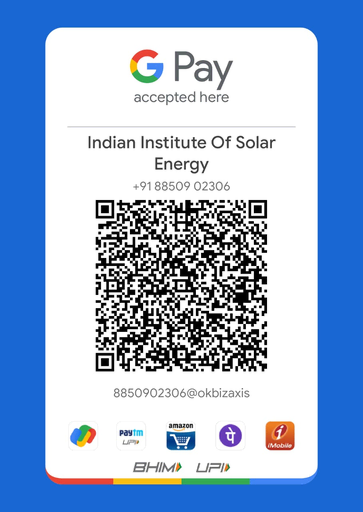
You can pay using Gpay too. Just scan the QR code below.


Popular Courses
-
 PG Diploma in Electric Vehicle Tec...₹160,000By iisemumbai
 -
Solar Practical Workshop₹24,999By iisemumbai
-
Solar Engineer Certificate course ...₹29,999By iisemumbai
-
Fundamentals in Solar PV Systems₹2,999By iisemumbai
-
Fundamentals of Electric Vehicle T...₹14,999By iisemumbai
-
B.Voc in Solar Technology₹41,999By iisemumbai
-
Diploma in Solar Technology | Sola...₹49,999By iisemumbai
-
D.Voc in Solar Technology₹39,999By iisemumbai


Latest Blog posts

Archive
Popular Courses
-
PG Diploma in Electric Vehicle Tec...₹160,000By iisemumbai
-
Solar Practical Workshop₹24,999By iisemumbai
-
Solar Engineer Certificate course ...₹29,999By iisemumbai
-
Fundamentals in Solar PV Systems₹2,999By iisemumbai
-
Fundamentals of Electric Vehicle T...₹14,999By iisemumbai
-
B.Voc in Solar Technology₹41,999By iisemumbai
-
Diploma in Solar Technology | Sola...₹49,999By iisemumbai
-
D.Voc in Solar Technology₹39,999By iisemumbai
Latest Blog posts
Solar Blog
- Energy Audit Report Format: What to Include & How to Write It
- Top Companies Hiring Energy Auditors in India 2026
- Energy Audit Tools & Equipment: Complete Field List for Auditors
- ECBC (Energy Conservation Building Code): Complete Guide for Auditors
- Industrial Energy Audit: Process, Checklist & Report Format India