Solar Training in India: Your First Step to a Career in Solar Energy
Bridge the clean-energy skills gap with industry-certified solar training. Learn PV system engineering, software simulation in PVsyst and HelioScope, hands-on installation, testing, and project management to build a future-proof career or launch your own solar enterprise.
Choose Your Solar Career Goal
Select your background and career ambition to find the exact training roadmap designed for your transition.
Quick Answer & Guide Overview (TL;DR)
Solar training is the formal technical foundation bridging traditional engineering or electrical trades to India's booming renewable energy sector. With India targeting 500 GW of non-fossil capacity by 2030 and national programs like PM Surya Ghar: Muft Bijli Yojana installing solar across 1 crore households, certified solar specialists are essential across design, EPC contracting, installation, and plant operations.
1. What is Solar Training?
Solar training is a structured technical learning pathway designed to equip individuals with the theoretical knowledge, software design proficiency, hands-on installation skills, and safety certifications required to engineer, construct, commission, and maintain solar photovoltaic (PV) systems.
Unlike generic classroom science courses, practical solar training focuses on real-world engineering and field execution. It addresses the entire life cycle of a photovoltaic power plant—from evaluating solar irradiance at a project site and conducting structural shading analyses, to string electrical sizing, protective switchgear selection, earthing grid construction, DISCOM net-metering compliance, and lifetime Operations & Maintenance (O&M).
The solar industry encompasses diverse project scales: residential rooftop systems (1 kW to 10 kW), commercial and industrial (C&I) rooftop and ground plants (100 kW to 2 MW), and utility-scale solar mega-parks (50 MW to multi-gigawatt installations). Each segment requires distinct skill sets spanning civil structure alignment, DC/AC electrical engineering, and remote SCADA monitoring.
The Spectrum of Solar Education
Understanding the distinction between different educational tiers prevents aspiring professionals from enrolling in courses misaligned with their career goals:
| Training Level | Core Focus Area | Typical Duration | Target Roles & Outcomes |
|---|---|---|---|
| Solar Awareness Workshop | Basic clean energy concepts, environmental benefits, subsidy overviews | 1–3 Days | General public, hobbyists, sustainability advocates |
| Hands-On Practical Workshop | Physical module mounting, MC4 crimping, inverter terminations, multimeter testing | 1–2 Weeks | Field technicians, electricians, site supervisors |
| Professional Certificate Course | PV design fundamentals, on-grid vs off-grid sizing, software basics (AutoCAD/PVsyst) | 1–3 Months | Entry-level solar engineers, sales consultants, installers |
| Technician Diploma | Comprehensive wiring, safety compliance, earthing testing, inverter troubleshooting, O&M | 3–6 Months | Certified solar technicians, O&M executives, quality inspectors |
| PG Diploma in Solar Technology | Advanced system modeling, utility EPC management, BESS, financial modeling, grid codes | 6–12 Months | Solar PV design engineers, EPC project managers, technical consultants |
| B.Voc in Solar Technology | Three-year accredited vocational degree combining core electrical engineering with solar specialisation | 3 Years | Long-term engineering careers, PSU eligibility, executive roles |
2. Why Solar Training Matters for Your Career in India
India is currently undergoing one of the most rapid renewable energy transformations in global history. Guided by the national commitment to establish 500 GW of non-fossil fuel capacity by 2030, solar photovoltaic power has emerged as the country’s primary engine of clean electrical generation.
According to operational reports by the Ministry of New and Renewable Energy (MNRE) and the Central Electricity Authority (CEA), India’s installed solar capacity crossed the 85 GW milestone and is rapidly approaching 100 GW. Furthermore, the rollout of the landmark PM Surya Ghar: Muft Bijli Yojana—backed by an outlay of over ₹75,000 crore to install rooftop solar across 1 crore households—has created an unprecedented surge in decentralized solar installations across tier-1, tier-2, and rural Indian districts.
The Clean Energy Skills Gap
While capital investment and module supply have expanded aggressively, EPC developers and installation companies face a persistent shortage of workforce talent possessing certified, job-ready practical skills. Traditional engineering curricula rarely teach DC arc-flash mitigation, single-line diagram (SLD) creation for DISCOM approvals, or simulation software like PVsyst and HelioScope. Structured training directly bridges this gap.
Industry studies by the Skill Council for Green Jobs (SCGJ), International Renewable Energy Agency (IRENA), and the International Energy Agency (IEA) project that achieving India’s clean energy targets will generate hundreds of thousands of specialized employment opportunities. These roles span rooftop EPC execution, utility-scale transmission, preventive plant maintenance, battery energy storage systems (BESS), and green hydrogen synthesis.
3. Who Should Take Solar Training?
Because the solar energy industry combines civil engineering, electrical distribution, software analytics, project finance, and manual field assembly, individuals from diverse technical and professional backgrounds can successfully build rewarding careers.
Electrical Engineers (B.E./B.Tech)
Possess circuit theory fundamentals. Need specialized training in solar string sizing, DC/AC ratio optimization, transformer sizing, grid-tie protections, and PVsyst simulation.
Mechanical Engineers
Ideal for Module Mounting Structure (MMS) design, wind load calculation, tilt angle optimization, tracker mechanics, and thermal dissipation analysis.
Civil Engineers
Specialize in soil testing, pile foundation design, roof load-bearing assessment for rooftop PV, drainage planning, and site leveling for utility solar parks.
Polytechnic Diploma Holders
Excellent transition into site engineering, quality inspection, testing & commissioning, and plant O&M operations across EPC contractors.
ITI Students & Electricians
Transition from general wiring to certified solar PV installation, MC4 connector crimping, combiner box wiring, inverter setup, and earth pit testing.
Working Power & MEP Pros
Engineers working in thermal power, DG sets, or construction MEP seeking to transition to high-growth clean technology and ESG engineering.
Solar Entrepreneurs
Business founders and contractors seeking to launch rooftop solar EPC companies, distribution agencies, or O&M service businesses.
B.Sc. Physics & Electronics
Solid grasp of solid-state physics and semiconductor theory. Training bridges application engineering, technical sales, and energy auditing.
Non-Technical Career Switchers
Professionals from sales, finance, or logistics seeking structured solar domain knowledge to lead clean-energy business development and project coordination.
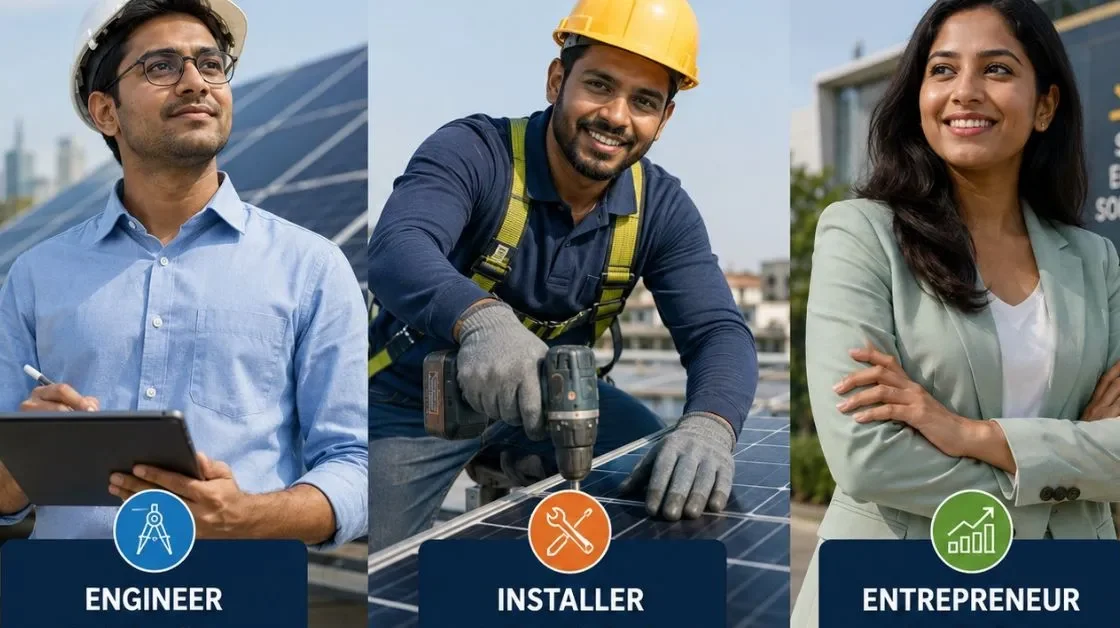
4. Three Proven Pathways Into the Solar Industry
When launching a career in solar energy, your journey typically follows one of three established pathways based on your educational background, practical aptitude, and entrepreneurial goals:
Get a Job in the Solar Industry
Join established EPC companies, developer conglomerates, independent power producers (IPPs), or design consultancies in structured engineering roles.
- Solar PV Design Engineer (AutoCAD & PVsyst)
- Solar Site & Project Engineer
- Testing, Commissioning & QA/QC Engineer
- Plant Operations & Maintenance (O&M) Specialist
- Technical Sales & Proposal Engineer
Become a Solar Installer / Technician
Hands-on technical specialists responsible for physical plant construction, electrical terminations, safety compliance, and troubleshooting on roofs and solar farms.
- Rooftop Solar PV Installation Specialist
- DC String Cabling & Inverter Wiring
- Earthing System & Lightning Protection Setup
- Preventive Maintenance & Thermography
- Grid Synchronization & Metering Support
Start Your Own Solar Business
Leverage the decentralised residential and commercial solar boom to establish an independent rooftop EPC company, component dealership, or O&M agency.
- Turnkey Rooftop EPC Contracting
- DISCOM Net-Metering & Subsidy Liaisoning
- Vendor Sourcing & Tier-1 Supply Chains
- System Costing, ROI & PPA Structuring
- Bundling Battery Storage & EV Chargers
5. Solar Career Roadmap: From Beginner to Senior Professional
A sustainable career in renewable energy is built step by step. Regardless of your entry point, following a structured progression guarantees technical authority and professional mobility:
Stage 1: Core Fundamentals & Solar Physics
Master solar radiation metrics ($GHI, DNI$), photovoltaic cell physics, module efficiencies, bypass diodes, and basic electrical Ohm’s/Kirchhoff’s laws.
Stage 2: Hands-On Laboratory & Field Exposure
Handle physical solar panels, crimp MC4 connectors, assemble anodized aluminum structures, measure $V_{oc}$ and $I_{sc}$, and connect string inverters.
Stage 3: Engineering Simulation & CAD Design
Build 3D layouts, calculate near-shading losses in SketchUp/HelioScope, generate detailed electrical Single Line Diagrams (SLD) in AutoCAD, and model yield in PVsyst.
Stage 4: Entry-Level Field / Design Placement
Join an EPC firm or consultancy as a Junior Design Engineer, Site Engineer, or Solar Technician. Execute live rooftop and commercial installations.
Stage 5: Multi-Discipline Specialisation (BESS & EV)
Add Battery Energy Storage Systems (BESS), microgrid controllers, and EV fast-charging infrastructure to expand into utility-scale hybrid project execution.
Stage 6: Project Management, Consultancy, or Entrepreneurship
Lead multi-megawatt EPC execution as a Project Manager, provide bankable techno-economic feasibility studies, or operate your own solar firm.
6. Solar Courses: Which One Should You Choose?
Selecting the ideal training program depends on your time commitment, academic prerequisites, and career objectives. Below is the decision framework comparing official IISE programs:
| Course Name | Duration | Ideal Candidate | Core Skills Covered | Direct Course Link |
|---|---|---|---|---|
| PG Diploma in Solar Technology | 6–12 Months | B.E./B.Tech graduates, working electrical engineers | PVsyst, HelioScope, AutoCAD, EPC project management, BESS, grid synchronization | Explore PG Diploma → |
| Advance Diploma in Solar Technology | 3–6 Months | Diploma engineers, career transitioners | System sizing, Single Line Diagrams, on-grid/off-grid systems, quality testing | Explore Advance Diploma → |
| Solar Engineer Certificate Course | 1–2 Months | Engineering students, fresh graduates | PV design sizing, inverter matching, electrical loss minimization, AutoCAD layouts | Explore Solar Engineer → |
| Solar Technician Diploma | 2–3 Months | ITI electricians, technicians, 12th pass | Physical module mounting, cabling, inverter termination, earth resistance testing, O&M | Explore Technician Diploma → |
| Solar Practical Workshop | 1–2 Weeks | Field technicians, site supervisors | Intensive hands-on tool work, MC4 crimping, structure alignment, live testing | Explore Workshop → |
| Solar Entrepreneurship Development | 1–2 Months | Aspiring business owners, contractors | EPC business setup, vendor sourcing, DISCOM liaisoning, PM Surya Ghar subsidy, project costing | Explore Entrepreneurship → |
| Solar On-Grid Design & Installation | 3–4 Weeks | Engineers, contractors | Grid-interactive system design, net-metering regulations, anti-islanding protections | Explore On-Grid Course → |
| Solar Off-Grid Design & Installation | 3–4 Weeks | Rural developers, agricultural installers | Battery bank sizing, charge controllers, hybrid inverters, standalone microgrids | Explore Off-Grid Course → |
| Solar PV Installers Certification | 2–4 Weeks | Rooftop installers, field technicians | Rooftop mounting standards, safety protocols, DC stringing, grid tie-in | Explore PV Installers → |
| Microgrid Certification Training | 1 Month | Senior engineers, microgrid designers | Hybrid solar-diesel-storage controllers, decentralized power systems, SCADA | Explore Microgrid Training → |
| B.Voc in Solar Technology | 3 Years | 12th Science / Vocational pass students | Three-year accredited vocational degree spanning comprehensive power engineering | Explore B.Voc Degree → |
7. Solar Training Progression by Educational Background
Your current academic qualification determines the most effective entry point into solar technology:
Solar Training After 10th or 12th
Candidates completing 10th or 12th standard who wish to enter the clean energy workforce should focus on practical vocational training. Beginning with the Fundamentals in Solar PV Systems or the Solar Practical Workshop builds immediate physical competency in module assembly, tools, and electrical safety. For long-term academic degrees, students with 12th Science or Vocational can enroll in the B.Voc in Solar Technology.
Solar Training After ITI (Electrician / Wireman)
ITI electricians already understand AC circuits, conduit bending, and domestic wiring. Solar training equips them with specialized high-voltage DC system knowledge: understanding DC isolators, string fuses, module polarity, earth pit resistance testing, and inverter fault diagnostics. The recommended qualification is the Solar Technician Diploma, enabling graduates to work as certified solar technicians, installation supervisors, and maintenance contractors.
Solar Training After Polytechnic Diploma
Polytechnic diploma holders in Electrical, Mechanical, or Civil engineering possess strong applied technical intuition. By completing the Advance Diploma in Solar Technology, diploma graduates master solar CAD drafting, single-line diagrams, Bill of Quantities (BOQ) preparation, and on-site testing. This bridges the gap into Site Engineer, Quality Assurance (QA/QC), and Assistant Project Manager roles.
Solar Training After B.E. / B.Tech
Engineering graduates from Electrical, Mechanical, Civil, Electronics, or Energy disciplines have the theoretical foundation to pursue high-value engineering roles. They should prioritize advanced design software and project execution methodologies through the PG Diploma in Solar Technology or the Solar Engineer Certificate Course. These programs qualify engineers for Solar PV Design Engineer, EPC Proposal Engineer, Commissioning Engineer, and Project Manager positions.
Solar Training for Working Professionals & Career Changers
Engineers working in fossil thermal power, MEP construction, automotive manufacturing, or general industrial maintenance often seek to transition to the sunrise renewable sector. Modular hybrid courses—combining online theoretical and simulation classes with weekend or short-term physical laboratory intensives—enable working professionals to transition without interrupting their current employment.
8. What Will You Learn in a Professional Solar Training Course?
A high-quality solar curriculum covers eight interconnected engineering and operational domains:
1. Solar Fundamentals & Resource Assessment
- Solar radiation components: Global Horizontal Irradiance (GHI), Direct Normal Irradiance (DNI), and Diffuse Irradiance (DHI).
- Sun path diagrams, zenith angle, azimuth angle, and optimal tilt angle calculation for various Indian latitudes.
- PV cell physics: crystalline silicon (Mono PERC, TOPCon, HJT) vs thin-film technologies, temperature coefficients, and degradation rates.
- Solar resource data extraction using Meteonorm, NASA, and MNRE solar radiation databases.
2. Photovoltaic System Design & Electrical Sizing
- Load profile analysis and energy yield estimation for residential, commercial, and industrial clients.
- String sizing: calculating minimum and maximum modules per string based on inverter MPPT voltage windows and extreme local ambient temperatures.
- DC to AC ratio optimization (overloading ratio) to maximize annual plant capacity utilization factor (CUF).
- Cable sizing: calculating voltage drop (maintaining DC drop below 1.5% and AC drop below 2%) using standard copper and solar XLPO aluminum cables.
- Switchgear selection: DC surge protection devices (SPD Type II), string fuses, DC disconnect switches, and AC miniature/moulded case circuit breakers (MCB/MCCB).
- Earthing system design: chemical pipe earthing pits, dedicated equipment vs lightning earthing, and earth resistance measurement (< 5 Ω).
3. Installation & Physical Assembly
- Module mounting structures (MMS): sheet roof clamps (trapezoidal/standing seam), RCC flat roof ballasted/penetrating consoles, and ground-mount pile foundations.
- Handling photovoltaic modules safely to avoid micro-cracks and hot-spot cell damage.
- DC cable routing, UV-resistant tie-wrapping, conduit protection, and weatherproof MC4 connector crimping.
- Inverter mounting, heat dissipation clearances, and IP65/IP66 weatherproofing standards.
4. Testing & Commissioning Procedures
- Pre-commissioning cold electrical checks: continuity, string polarity verification, and open-circuit voltage ($V_{oc}$) measurements.
- Insulation resistance (Megger) testing of DC cables to ground before energization.
- Operating parameter verification: operating current ($I_{sc}$ / $I_{mp}$), inverter grid synchronization, and active power export checks.
- Commissioning documentation, punch-list resolution, and net-meter test report generation for state DISCOMs.
5. Operations, Maintenance & Troubleshooting
- Preventive maintenance schedules: soiling loss management, robotic and manual module cleaning water quality guidelines.
- Thermographic drone/handheld inspection: identifying localized module hot spots, bypass diode failures, and loose cable terminations.
- Inverter error code diagnosis: grid over-voltage, frequency drift, isolation fault, and ground fault resolution.
- Performance Ratio (PR) calculation and SCADA remote monitoring integration.
6. Workplace Safety & Regulatory Compliance
- Personal Protective Equipment (PPE): 1000V rated insulated hand tools, arc-flash protection, and safety helmets.
- Work-at-height safety: fall arrest harnesses, lifeline anchoring, and fragile asbestos/tin roof walkway safety.
- Lockout / Tagout (LOTO) protocols during inverter and distribution board maintenance.
- Indian electrical regulations: CEA safety standards, IS 16270 / IS 16046 compliance, and State Electricity Regulatory Commission (SERC) net-metering guidelines.
9. Practical Hands-On Training vs Online Solar Training
Prospective students frequently ask whether they can complete solar training entirely online. Because solar power is fundamentally an applied hardware and electrical discipline, a clear distinction exists between skills that can be learned digitally versus those that require physical lab exposure:
| Component | Online Learning Feasibility | Hands-On Field Lab Requirement | Optimal Training Format |
|---|---|---|---|
| Solar Fundamentals & Theory | High — lectures, animations, math sizing | Low — conceptual comprehension | Live Online / On-Demand Video |
| Software Simulation (PVsyst/HelioScope) | High — screen sharing, software exercises | Low — computer workstation based | Guided Online Lab / PC Workshop |
| AutoCAD & Single Line Diagrams | High — digital drafting & templates | Low — CAD software environment | Online Interactive Sessions |
| Module Handling & Structure Clamping | Zero — cannot feel weight or torque | Critical — physical roof mockups & tools | Physical Hands-On Workshop |
| MC4 Crimping & DC Cable Stripping | Low — videos cannot teach tactile feel | Critical — precision crimper operation | Physical Hands-On Workshop |
| Testing with Multimeters & Meggers | Low — virtual dials lack safety awareness | Critical — live circuits, high DC voltage | Physical Testing Lab |
| Inverter Wiring & Earth Pit Testing | Low — safety risk in unverified work | Critical — live grid-tie synchronization | Physical Testing Lab |
The "Learn → Practice → Apply" Framework
The most effective training model is Hybrid Learning: learners master solar mathematics, regulatory codes, and software tools via interactive online modules, then attend intensive physical laboratory sessions to assemble physical rooftop arrays, crimp wiring, test live inverters, and execute real-world commissioning checks.
10. Essential Solar Software Skills That Employers Demand
Proficiency in specialized software is the single greatest differentiator for solar design engineers. Leading EPC developers require mastery of the following engineering tools:
PVsyst
The global gold standard for bankable solar yield simulation. Generates detailed loss diagrams (soiling, thermal, ohmic, IAM, mismatch, inverter clipping) required by financial lenders and utility developers.
AutoCAD Electrical / Solar
Used to draft plant layout drawings, 2D module spacing, cable tray routing, and Single Line Diagrams (SLD) submitted to DISCOMs for statutory net-metering approvals.
HelioScope
Cloud-based tool integrating CAD layout with PVsyst-grade simulation. Ideal for commercial & industrial (C&I) rooftop solar proposals and rapid 3D shading assessment.
SketchUp + Skelion
Constructs architectural 3D building models with parapets, water tanks, and surrounding trees to run solar shadow animations and determine unshaded roof area.
Advanced Engineering Excel
Custom mathematical models for voltage drop calculations, string sizing checks, Bill of Quantities (BOQ) cost rollups, and Levelized Cost of Energy (LCOE) financial models.
Solar SCADA & IoT Platforms
Remote performance monitoring portals (e.g., SolarEdge, Huawei FusionSolar, Sungrow iSolarCloud) tracking daily yield, irradiance sensor inputs, and inverter health.
11. Solar Job Roles, Responsibilities and Career Options
Upon completing structured training, graduates qualify for specialized roles across developers, EPC contractors, component manufacturers, and consultancy firms:
| Job Title | Primary Responsibilities | Key Skills Required | Typical Entry Qualification |
|---|---|---|---|
| Solar PV Design Engineer | System layout, string sizing, PVsyst yield modeling, loss optimization, SLD preparation | PVsyst, AutoCAD, HelioScope, electrical sizing | B.E./B.Tech (Electrical / Mechanical) + PG Diploma |
| Solar Site / Execution Engineer | Supervising on-site structure mounting, cabling, combiner box installation, contractor safety | Site execution, quality checks, drawing interpretation | B.Tech or Diploma (Electrical / Civil) |
| Testing & Commissioning Engineer | Insulation resistance tests, string polarity, inverter synchronization, net-metering liaison | Testing equipment (Megger, clamp meter), DISCOM norms | B.Tech or Diploma in Electrical Engineering |
| Solar O&M Engineer | Plant preventive maintenance, thermography inspections, PR monitoring, inverter fault repairs | SCADA monitoring, fault diagnostics, cleaning cycles | Diploma or B.Tech in Electrical / Electronics |
| Solar Installation Technician | Physical module fixing, structure torque tightening, MC4 crimping, conduit routing | Tool usage, work-at-height safety, DC wiring | ITI Electrician / Wireman / 10th-12th with Diploma |
| Technical Sales / Proposal Engineer | Client site survey, feasibility reports, system sizing, BOQ costing, payback calculations | Client communication, system sizing, Excel modeling | Any Technical Graduate or Diploma |
| Solar EPC Project Manager | End-to-end EPC delivery, vendor management, timeline scheduling, budget control, statutory clearances | Project management (PMP), contract handling, EPC lifecycle | B.Tech with 3–5+ years solar EPC experience |
| QA/QC Engineer | Inspecting incoming modules, torque audits, earth pit resistance checks, factory acceptance tests | IS/IEC standards, testing instrumentation, audit reporting | Diploma or B.Tech in Electrical Engineering |
| Solar Entrepreneur / EPC Contractor | Running an independent solar installation business, client acquisition, team hiring, EPC execution | Business development, vendor networks, subsidy liaison | Entrepreneurship training + technical grounding |
12. Solar Engineer vs. Solar Technician: Key Differences
Understanding whether you are suited for an engineering design profile or a hands-on field technician career helps you pick the right training path from day one:
| Comparison Metric | Solar Engineer | Solar Technician / Installer |
|---|---|---|
| Primary Work Domain | Office / Design Lab & Site Supervision | Field Site / Rooftops / Plant Floors |
| Core Daily Tasks | 3D modeling, PVsyst simulation, electrical sizing, BOQ preparation, DISCOM liaison | Structure assembly, module clamping, MC4 crimping, conduit laying, inverter wiring |
| Primary Tools Used | Workstation, PVsyst, AutoCAD, HelioScope, Excel | Insulated hand tools, torque wrenches, crimpers, multimeters, Megger |
| Baseline Educational Requirement | B.E. / B.Tech or Polytechnic Diploma | ITI (Electrician/Wireman) or 10th/12th Vocational |
| Physical Demand Level | Moderate (site audits, walk-through inspections) | High (rooftop work, tool operation, ladder climbing) |
| Career Progression Path | Senior Design Eng → Lead EPC Eng → Project Manager | Lead Technician → Site Supervisor → O&M Contractor |
| Recommended IISE Program | PG Diploma in Solar Technology | Solar Technician Diploma |
13. Solar Career Salary & Earning Potential in India
Compensation in India’s renewable energy sector is determined by technical specialisation, practical software skills, project scale experience, and location. Candidates with verified software skills (PVsyst, AutoCAD) and hands-on commissioning capability consistently command higher compensation than candidates possessing only general qualifications.
| Job Profile | Entry-Level (0–2 Yrs) | Mid-Level (3–5 Yrs) | Senior / Specialist (6+ Yrs) |
|---|---|---|---|
| Solar PV Design Engineer | ₹3.2L – ₹4.8L / yr | ₹5.5L – ₹8.5L / yr | ₹10.0L – ₹16.0L / yr |
| Solar Site / Execution Engineer | ₹2.8L – ₹4.2L / yr | ₹4.8L – ₹7.2L / yr | ₹8.5L – ₹14.0L / yr |
| Solar O&M Engineer | ₹2.5L – ₹3.8L / yr | ₹4.2L – ₹6.5L / yr | ₹7.5L – ₹12.0L / yr |
| Solar Technician / Installer | ₹1.8L – ₹3.0L / yr | ₹3.2L – ₹4.8L / yr | ₹5.0L – ₹7.0L / yr |
| Technical Sales Engineer | ₹3.0L – ₹5.0L + Comm | ₹6.0L – ₹9.5L + Comm | ₹11.0L – ₹18.0L + Comm |
| Independent Solar EPC Contractor | Project-Based Earnings: ₹40,000 to ₹1,50,000+ margin per 10 kW rooftop installation (Highly variable based on volume) | ||
*Disclaimer: Salary ranges are indicative industry averages derived from published job market surveys and renewable EPC compensation reports. Actual compensation depends on corporate employer scale, metro tier, individual technical proficiency, and field experience.
14. The Multi-Skill Stack: How to Maximize Your Solar Market Value
The solar industry no longer operates in isolation. Employers and clients actively seek multi-disciplinary professionals who combine core photovoltaic design with complementary clean-tech competencies:
The Modern Solar Career Formula
Core Photovoltaic Physics + Electrical Sizing & Earthing + PVsyst & AutoCAD Simulation + Hands-On Testing & Commissioning + Battery Energy Storage (BESS) + EV Charging Integration = Top 10% Industry Earning Tier.
Engineers who master both solar generation and energy storage dispatch can design Round-The-Clock (RTC) green power systems, microgrids for remote infrastructure, and commercial solar EV hubs that attract institutional contracts.
15. Solar + Battery Energy Storage (BESS) Careers
As solar penetration deepens, the intermittency of daytime generation makes Battery Energy Storage Systems (BESS) the single most important growth sector in power engineering. Under national Viability Gap Funding (VGF) initiatives and grid-scale storage tenders by SECI and NTPC, utility and commercial developers are deploying multi-megawatt hour storage facilities across India.
Key technical competencies in high demand include:
- Cell & Pack Chemistries: Lithium Iron Phosphate (LiFePO4 / LFP) thermal stability, cycle life analysis, and C-rate charge/discharge limits.
- Battery Management Systems (BMS): Cell balancing, state of charge (SOC), state of health (SOH) calculation, and CAN/RS485 communication protocols.
- Power Conversion Systems (PCS): Bi-directional inverters, grid-forming vs grid-following controls, and black-start functionality.
- Energy Management Systems (EMS): Time-of-Use (ToU) arbitrage, peak shaving algorithms, and microgrid dispatch control.
Adding a certified battery storage credential accelerates your transition into high-paying energy storage engineering roles. Explore IISE’s specialized curriculum: Battery Systems Courses in India.
16. Solar + Electric Vehicle (EV) Infrastructure Careers
The rapid expansion of electric mobility across 2-wheelers, 3-wheelers, buses, and passenger fleets is driving strong demand for solar-powered EV charging stations. Powering electric vehicles directly from distributed solar generation avoids grid peak demand charges and delivers genuinely zero-emission transportation.
Solar engineers who understand EV infrastructure can execute:
- AC Level-2 (7.4 kW to 22 kW) Type-2 destination chargers integrated with rooftop solar carports.
- DC Fast Charging stations (30 kW to 240 kW CCS2) with battery-buffered solar arrays to avoid costly distribution transformer upgrades.
- Open Charge Point Protocol (OCPP 1.6J / 2.0.1) network integration and billing software setup.
Learn how to design and install solar EV charging hubs with IISE’s specialized program: EV Systems Courses at IISE.
17. How to Choose the Best Solar Training Institute: 15-Point Checklist
Before investing your time and financial resources in any solar course, evaluate the institute against these 15 essential quality benchmarks:
| # | Evaluation Parameter | What You Must Verify |
|---|---|---|
| 1 | Physical Lab Facilities | Does the institute have dedicated solar arrays, real string inverters, and physical mounting structures? |
| 2 | Software Coverage | Do they teach commercial PVsyst, AutoCAD, and HelioScope, or merely free web calculators? |
| 3 | Faculty Industry Experience | Are instructors seasoned practicing solar EPC engineers, or purely theoretical academic lecturers? |
| 4 | Testing Instrumentation | Do students handle real 1000V Meggers, solar irradiance meters, clamp meters, and thermal cameras? |
| 5 | Curriculum Relevance | Does the syllabus cover modern TOPCon/Mono PERC modules, bifacial panels, and PM Surya Ghar norms? |
| 6 | Regulatory Knowledge | Are state net-metering laws, DISCOM approval paperwork, and CEA safety guidelines taught? |
| 7 | Classroom-to-Lab Ratio | Is at least 40% of course time dedicated to practical lab sessions, wiring, and software exercises? |
| 8 | Accreditation & Affiliation | Is the institute recognized, affiliated with UGC-approved frameworks, or aligned with national skill standards? |
| 9 | Project Work | Do students complete a bankable 100 kW+ rooftop design project from initial survey to final BOQ? |
| 10 | Safety Protocol Training | Are work-at-height safety, harness inspection, PPE usage, and LOTO procedures physically demonstrated? |
| 11 | Placement & Career Guidance | Does the institute offer transparent interview preparation, resume reviews, and direct recruiter connections? |
| 12 | Alumni Track Record | Can the institute demonstrate alumni working across established solar EPC developers and IPPs? |
| 13 | Learning Flexibility | Are hybrid options available so working professionals can balance work with lab training? |
| 14 | Post-Training Mentorship | Can alumni consult faculty for technical guidance during their first live commercial installation projects? |
| 15 | Entrepreneurial Guidance | For business aspirants, does the course teach vendor networks, supplier pricing, and financing models? |
18. Why Practical Solar Training Matters in Real-World EPC Work
In the solar EPC industry, theoretical errors can cause severe electrical hazards, arc-flash fires, or underperforming power plants. Hands-on training ensures technicians and engineers master critical field practices:
- Hot Spot & Micro-Crack Prevention: Handling delicate photovoltaic modules without flexing glass or stepping on cells, preserving 25-year warranty performance.
- Torque Calibration: Tightening mid-clamps and end-clamps with calibrated torque wrenches to prevent wind-uplift damage while avoiding frame deformation.
- MC4 Connector Assembly: Ensuring zero water ingress by using dedicated ratchet crimping tools and checking pin click-lock seating.
- Insulation Resistance Verification: Applying 1000V DC testing to detect nicked cable jackets inside metal conduits before connecting inverters.
- Earth Pit Resistance: Preparing chemical earth pits and measuring soil resistance with digital earth testers to guarantee fault current dissipation.
19. Why Train with the Indian Institute of Solar Energy (IISE)?
Established over 15 years ago, the Indian Institute of Solar Energy (IISE) is one of India’s pioneering specialized renewable energy training institutes. With an alumni network of over 3,000+ engineers, technicians, and entrepreneurs, IISE provides practical, industry-aligned training designed to create immediate employment capability.
Dedicated Hands-On Solar Labs
Train on live operational rooftop solar systems, physical module mounting structures, string inverters, and testing equipment under expert supervision.
Commercial Software Licenses
Master industry-standard design tools including PVsyst, HelioScope, SketchUp, and AutoCAD with real project case studies.
Faculty of Industry Practitioners
Learn directly from senior solar EPC project managers, design engineers, and testing professionals with gigawatts of collective field experience.
Active Placement Assistance
Benefit from IISE’s network of over 200+ renewable energy recruiters, resume workshops, mock technical interviews, and employer introductions.
20. Interactive Course Selector: Find Your Ideal Training Program
Answer two quick questions to receive a tailored course recommendation based on your academic background and career ambitions:
Find the Right Solar Course for Your Goal
Select your background and primary ambition below:
Recommended Program
View Course Details →21. Illustrative 12-Month Solar Career Progression Plan
Here is a realistic timeline showing how a focused learner can progress from beginner to a confident solar professional over twelve months:
Months 1–2: Solar Fundamentals & Electrical Circuits
Master PV cell physics, irradiance databases, DC/AC circuit theory, tilt angle optimization, and equipment specifications.
Months 3–4: PV System Sizing & Electrical Design
Learn string sizing, inverter matching, cable sizing (voltage drop), protection selection, earthing layouts, and DISCOM net-metering rules.
Months 5–6: Specialized Software Mastery
Develop proficiency in AutoCAD for Single Line Diagrams and PVsyst / HelioScope for bankable yield simulation and shading reports.
Months 7–8: Hands-On Installation & Testing Labs
Complete physical assembly workshops: module mounting, MC4 crimping, inverter connections, Megger insulation checks, and live commissioning.
Months 9–10: Capstone Project & Advanced Specialisation
Execute an end-to-end commercial rooftop design project (100 kW+) with complete BOQ, costing, and battery storage integration.
Months 11–12: Industry Placement & Professional Execution
Participate in campus interviews, connect with IISE hiring partners, and step into full-time roles as a Design Engineer, Site Engineer, or EPC Contractor.
22. 10 Common Mistakes People Make When Starting a Solar Career
Avoid these critical traps that derail newcomers entering the clean energy sector:
- Choosing purely theoretical online programs: Solar systems are physical electrical installations. Lacking hands-on tool and testing experience leaves candidates unprepared for field interviews.
- Ignoring electrical fundamentals: Neglecting basic Ohm’s law, cable resistance calculations, and AC/DC differences limits an engineer's design accuracy.
- Skipping specialized software: Attempting to enter solar design without mastering PVsyst and AutoCAD limits career mobility to low-level manual roles.
- Overlooking workplace safety: Underestimating high-voltage DC arcs, roof edge hazards, and PPE protocols endangers team safety on live project sites.
- Failing to build a project portfolio: Submitting a generic resume without sample PVsyst simulation reports or AutoCAD single-line diagrams makes it difficult to stand out to recruiters.
- Ignoring local DISCOM net-metering regulations: Failing to understand state electricity board paperwork causes delays in commercial grid approvals.
- Neglecting battery storage and EV charging: Treating solar as standalone generation without learning BESS and EV charger integration limits long-term market value.
- Focusing only on price over curriculum: Choosing the cheapest available course often results in outdated curricula, unverified faculty, and zero placement support.
- Expecting senior managerial salaries immediately: Solar EPC rewards practical execution. Gaining 1–2 years of hands-on site or design experience is essential before advancing to senior project management roles.
- Failing to maintain a professional network: Neglecting industry seminars, clean-energy trade associations, and alumni connections slows career growth.
23. Frequently Asked Questions (FAQ)
Clear, detailed answers to the most common questions asked by prospective solar students, engineers, and career switchers:
Solar training is structured technical education that equips learners with the engineering principles, software tools, installation techniques, and safety protocols needed to deploy solar PV systems. It covers solar resource assessment, electrical string sizing, module mounting, inverter selection, PVsyst/AutoCAD simulation, testing, commissioning, and plant O&M.
Yes. India is targeting 500 GW of non-fossil capacity by 2030 and national rooftop programs like PM Surya Ghar: Muft Bijli Yojana are deploying solar across 1 crore households. This massive capacity addition has created sustained demand for certified design engineers, site supervisors, and qualified technicians across the country.
For engineering graduates (B.E./B.Tech in Electrical, Mechanical, Civil, or Electronics), the PG Diploma in Solar Technology or the Solar Engineer Certificate Course offers the highest placement value because it covers bankable PVsyst simulation, AutoCAD drafting, and utility-scale EPC project execution.
Yes. Non-engineers can take practical vocational courses such as the Solar Technician Diploma to work as certified field technicians, or the Solar Entrepreneurship Development Program to launch independent rooftop solar EPC and dealership businesses.
Course durations vary by training depth. Short-term hands-on workshops take 1 to 2 weeks. Comprehensive certificate programs run between 1 and 3 months, while advanced diplomas and PG Diploma programs span 6 to 12 months with capstone project execution and in-depth software training.
Yes. Solar systems involve high-voltage DC electricity, structural roof mountings, and specialized testing equipment. Employers actively prioritize candidates who have physical experience crimping MC4 connectors, wiring combiner boxes, measuring open-circuit voltages, and operating insulation resistance testers.
Yes. IISE provides hybrid learning programs where theoretical lectures, software classes, and project assignments are delivered via interactive evening or weekend online sessions, accompanied by scheduled physical laboratory intensives for hands-on equipment exposure.
Entry-level solar technicians earn ₹1.8 Lakh to ₹3.0 Lakh annually. Fresh solar design and site engineers earn ₹3.2 Lakh to ₹4.8 Lakh per annum. With 3 to 5 years of EPC project execution and software experience, compensation increases to ₹6 Lakh to ₹10+ Lakh per annum.
The top industry tools are PVsyst for bankable generation simulation, AutoCAD for Single Line Diagrams (SLD) and plant layout drafting, HelioScope for commercial rooftop modeling, and SketchUp for 3D near-shading calculations.
Yes. Many IISE alumni operate successful rooftop solar contracting businesses. Programs like the Solar Entrepreneurship Development Program teach vendor sourcing, DISCOM net-metering procedures, consumer financing, subsidy schemes, and project costing.
The clean energy transition is shifting toward hybrid systems. Grid-scale battery storage (BESS) and electric vehicle charging infrastructure are directly integrated with solar arrays. Multi-disciplinary engineers who master solar, storage, and EV systems command higher salaries and wider project scopes.
Yes. IISE maintains relationships with over 200+ renewable energy recruiters across India. Students receive comprehensive placement support, including technical interview preparation, resume reviews, portfolio building, and direct introductions to hiring companies.
Take the First Step: Get Free Solar Career Guidance
Unsure which course matches your qualifications? Speak directly with a senior IISE career counsellor to review course curricula, batch schedules, fees, and career pathways.
Related Solar Energy Guides & Career Resources
Deepen your technical knowledge and stay up to date on India’s solar policies with these comprehensive guides from the IISE Knowledge Hub:
HelioScope Step-by-Step Solar PV Design Guide
A complete engineering walkthrough for commercial rooftop modeling, electrical stringing, and shading simulations.
Government SchemesPM Surya Ghar & Government Solar Subsidies
Explore current financial incentives, application workflows, and DISCOM net-metering procedures in India.
Battery StorageBattery Technology Engineer Career Guide 2026
Explore high-paying career opportunities across Lithium-ion battery manufacturing, BMS design, and utility BESS.
Electric MobilitySolar-Powered EV Charging Station Design & Cost
Engineering breakdown for designing grid-buffered solar EV charging stations and commercial business models.
Industry ReportSolar Job Market Report India 2026
Detailed analysis of clean energy hiring trends, top recruiting EPC developers, and state-wise compensation data.
Renewable PolicyIndia’s 500 GW Target: Career Opportunities for Engineers
How India’s national clean energy targets are reshaping power sector recruitment and vocational education.
Written & Curated by the IISE Academic & Technical Advisory Board
The Indian Institute of Solar Energy (IISE) is dedicated to advancing practical, technical renewable energy education in India. Content published by IISE is authored by practicing photovoltaic design engineers, reviewed against current Ministry of New and Renewable Energy (MNRE) and Central Electricity Authority (CEA) regulations, and updated periodically to reflect modern technology and employment standards.
Authoritative References & Government Sources
- Ministry of New and Renewable Energy (MNRE), Government of India: Official installed capacity and policy releases (mnre.gov.in).
- Central Electricity Authority (CEA), Ministry of Power: National Generation Capacity and Load Dispatch Reports.
- Skill Council for Green Jobs (SCGJ), National Skill Development Corporation (NSDC): Renewable Energy Human Resource Studies.
- International Renewable Energy Agency (IRENA) & International Energy Agency (IEA): Renewable Energy and Jobs Annual Review.
- PM Surya Ghar: Muft Bijli Yojana Official National Portal (pmsuryaghar.gov.in).
🔋 Battery & Storage Careers
Many of today's best-paid solar roles now require battery storage know-how, as hybrid and off-grid systems become standard. Adding a Battery & Storage qualification alongside your core solar training opens up higher-value job and contracting opportunities.
Explore Battery & Storage Courses →⚡ EV Systems Careers
As India's EV adoption accelerates, solar professionals with EV charging infrastructure skills are increasingly in demand — especially for entrepreneurs looking to combine rooftop solar with EV charging point installation.
Explore EV Systems Courses →Ready to Start Your Solar Career?
Pick the path that fits you best — every path leads to a recognised IISE certification.