
Solar Offgrid Design & Installation
- Description
- Curriculum
- Reviews
Time is running out. Apply now!
- 00Days
- 00Hours
- 00Minutes
- 00Seconds
Solar Off-Grid Design & Installation Course
Master the complete lifecycle of off-grid solar systems — from load estimation and panel sizing to battery bank design and commissioning — through hands-on blended training recognised by MNRE. Whether you are an engineering graduate, a working professional, an entrepreneur, or an ITI holder looking to build a solar career, this course is your launchpad into India's fastest-growing renewable energy sector.
📋 In This Course Guide
What Is the Solar Off-Grid Design & Installation Course?
An off-grid solar system operates completely independently of the electricity grid — storing solar energy in battery banks to power homes, institutions, and commercial facilities even in the most remote locations. As India accelerates its push toward rural electrification and energy independence under the MNRE's ambitious solar mission, the demand for skilled off-grid solar professionals has never been higher. IISE's Solar Off-Grid Design & Installation course is one of the most comprehensive solar courses in India, designed to produce job-ready engineers and entrepreneurs.
This is a 3-month blended solar course — structured theory modules are completed online at your own pace, while hands-on lab sessions at IISE's facility give you real-world exposure to solar panels, battery banks, charge controllers, inverters, and commissioning tools. Every module ties theory directly to practice, ensuring you graduate with both the MNRE-recognised certificate and the confidence to design and install systems in the field.
The solar off-grid design installation course is uniquely suited to India's energy landscape. From sizing a 1 kW solar system for a rural household to designing a 50 kW off-grid facility for an industry, the skills you develop here translate directly to paid projects from day one of graduation.
Who Should Enroll in This Course?
This course is built for five distinct audiences — each with a clear path from enrollment to outcome.
Engineering / Science Graduates
You have the technical foundation but lack solar-specific skills and an industry-recognised certification.
✓ Graduate with an MNRE certificate and the practical skills to land your first solar engineering role.
Working Professionals (Switching to Solar)
You are in electrical, civil, or mechanical fields and want to pivot into the fast-growing solar sector without quitting your job.
✓ Complete blended weekend batches and emerge as a certified solar professional ready for your next career move.
Power Sector Engineers
You work in the power or utility sector and need off-grid solar competency to stay relevant and competitive.
✓ Add MNRE-certified off-grid solar design skills to your existing power engineering expertise.
Solar Entrepreneurs
You want to start a solar EPC or installation business but lack the technical foundation to design systems and win client trust.
✓ Learn to design, price, and deliver off-grid solar projects — everything you need to launch a profitable solar business.
ITI / Diploma Holders
You have technical training but no pathway into the renewable energy industry with a credible government-recognised certification.
✓ Upskill with IISE's blended programme and qualify for solar technician and junior engineer roles across India.
What You Will Learn
The curriculum for this solar off-grid design installation course is structured into 6 progressive modules, combining online theory with in-lab practice. Each module builds directly on the last, taking you from basic concepts to full system commissioning.
Fundamentals of Off-Grid Solar Systems
Understand the difference between on-grid, off-grid, and hybrid solar configurations. This module establishes the building blocks — photovoltaic effect, solar irradiance, panel I-V curves, and the role of each system component. You will study real-world case studies of off-grid installations in rural India and understand how MNRE policy frameworks support off-grid solar deployment.
By the end of this module, you will be able to identify system topologies, interpret solar resource maps, and explain system design trade-offs to clients.
Load Estimation & System Sizing
Accurate load estimation is the foundation of every successful off-grid solar system. In this module you learn to calculate daily energy consumption across residential, commercial, and institutional applications — accounting for appliance wattages, usage hours, and seasonal variation. You then translate the load estimate into a complete system sizing specification covering solar array, battery bank, and inverter.
This module includes hands-on exercises where you size real-world systems — from a 5-light rural home to a 10 kW school campus — using industry-standard worksheets developed by IISE engineers.
Solar Panel Selection & Mounting Design
Not all solar panels are equal — this module teaches you how to evaluate monocrystalline, polycrystalline, and bifacial panels based on efficiency, temperature coefficient, warranty, and cost-per-watt. You will learn to calculate the optimal tilt angle and azimuth for Indian latitudes and design both rooftop and ground-mounted structures using standard mounting hardware.
Module 3 also covers shading analysis using free simulation tools, string configuration (series vs parallel), and the BIS certification requirements that apply to panels sold in India.
Battery Bank Design & Charge Controllers
Energy storage is the heart of any off-grid solar system. This module covers lead-acid, VRLA/AGM, gel, and lithium (LiFePO4) battery technologies — their chemistry, charge/discharge cycles, depth of discharge (DoD), and lifecycle economics. You will learn to design battery banks for different autonomy requirements and select the correct charge controller (PWM vs MPPT) for each application. For deeper expertise in battery bank design and advanced storage technologies, IISE also offers a dedicated Battery Systems course.
Lab sessions in this module include hands-on wiring of 12V, 24V, and 48V battery banks, setting charge parameters on MPPT controllers, and running capacity tests with data loggers.
Inverter Selection, Wiring & Electrical Protection
This module covers the selection of off-grid inverters — pure sine wave vs modified sine wave, standalone vs hybrid, single-phase vs three-phase configurations. You will learn to read inverter datasheets, match inverter capacity to peak load requirements, and design the DC and AC wiring layouts including cable sizing, fusing, MCBs, and earthing as per IS 3764 and CEA guidelines.
Emphasis is placed on surge capacity, transfer switching, and protection against over-voltage, reverse polarity, and short circuits — the most common causes of system failure in the field. Lab sessions cover actual wiring exercises using industry-grade switchgear.
Commissioning, Troubleshooting & O&M
The final module takes you through the complete commissioning checklist — pre-energisation inspections, panel IV curve testing, battery state-of-charge verification, inverter parameter configuration, and system performance validation. You will learn to read monitoring dashboards, interpret data logger outputs, and identify underperformance before it becomes a failure.
The troubleshooting section covers 20 of the most common field faults — from low battery voltage to inverter alarms and ground faults — with step-by-step diagnostic procedures. O&M protocols including cleaning schedules, battery maintenance, and annual performance audits are also covered, preparing you for long-term project responsibility.
Hands-On Lab Training & Industry Tools
IISE's dedicated solar lab is equipped with live off-grid solar installations, battery test benches, and industry-standard instruments used by professional solar engineers across India. Students complete supervised lab sessions that directly correspond to each theory module — you wire systems, measure performance, and troubleshoot faults on real hardware, not simulations.
Our lab training also covers adjacent technologies increasingly demanded by employers — including an introduction to electric vehicle charging systems, bridging students from off-grid solar expertise into the broader electrification ecosystem where solar and EV infrastructure converge.
Monocrystalline & Polycrystalline Solar Panels
250W–540W panels for hands-on IV curve testing and tilt optimisation exercises.
Lead-Acid & LiFePO4 Battery Banks
Live 12V, 24V and 48V banks for capacity testing, wiring, and DoD measurement.
MPPT & PWM Charge Controllers
Victron, Luminous, and EPever units for parameter configuration and comparative performance.
Pure Sine Wave Off-Grid Inverters
1 kW–10 kW inverters for wiring, load testing, and fault simulation exercises.
Digital Clamp Meters & Multimeters
For measuring DC/AC current, voltage, and resistance across all system components.
Data Loggers & Monitoring Dashboards
Real-time energy monitoring for performance ratio calculation and fault detection.
Solar System Simulation Software
PVSyst and HOMER Pro for off-grid system modelling, yield estimation, and financial analysis.
Cable Sizing & Earthing Kits
Industry-grade wiring, MCBs, fuses, and earthing equipment per CEA & BIS standards.
IV Curve Tracer
Professional panel characterisation tool for diagnosing degradation and mismatch losses.
EV AC Charging Station (Demo)
Introduction to EV charging load profiles and solar-to-EV integration concepts.
Off-Grid Solar System Size Estimator
Enter your daily energy load and location details to estimate the solar array size, battery capacity, and approximate system cost.
⚡ Estimated System Specifications
* Estimates based on standard assumptions. Actual sizing should be confirmed with an IISE-trained engineer.
Want to also master Battery Storage system design? Explore our Battery Systems Courses.
Career Outcomes After This Course
India's solar sector is projected to add over 250 GW of capacity by 2030, creating hundreds of thousands of engineering and technical roles — including a fast-growing demand for professionals skilled in Energy Auditing courses and off-grid solar deployment. Graduates of this programme enter the workforce with a government-recognised credential and practical skills that employers across solar EPC, rural electrification, and renewable energy consulting actively seek.
Solar EPC Engineer
Lead end-to-end execution of off-grid solar projects for EPC firms — design, procurement, installation, and commissioning.
₹4–9 LPAOff-Grid System Designer
Design customised off-grid solar solutions for residential, commercial, and institutional clients using simulation tools and field data.
₹4.5–10 LPASolar Project Consultant
Advise clients on solar feasibility, system sizing, MNRE subsidies, and return-on-investment — independently or with a consultancy firm.
₹5–12 LPARenewable Energy Entrepreneur
Launch your own solar installation and EPC business. Graduates with technical credentials win more client trust and government tenders. Explore Solar Business Courses to pair with this programme.
Self-EmployedO&M Engineer (Solar)
Manage preventive and corrective maintenance of installed off-grid solar systems, ensuring peak performance across a project portfolio.
₹3.5–7 LPATechnical Sales Executive (Solar)
Combine technical credibility with sales skills to sell solar systems to commercial and rural clients — a high-growth role in India's solar distribution sector.
₹4–8 LPA + IncentivesFee & Upcoming Batch Schedule
Choose the batch format that fits your schedule. All batches cover the same curriculum and qualify for the same MNRE-recognised certificate.
| Batch Type | Start Date | Format | Duration | Fee | Seats Left | Action |
|---|---|---|---|---|---|---|
| Weekend Batch Sat & Sun, 9 AM–1 PM | 15 Aug 2025 | Blended (Online + Lab) | 3 Months | ₹25,000–40,000 | 8 Seats | Enroll → |
| Weekday Batch Mon–Fri, 10 AM–12 PM | 1 Sep 2025 | Blended (Online + Lab) | 3 Months | ₹25,000–40,000 | 12 Seats | Enroll → |
| Intensive Online + Lab Online daily + 2 lab weekends | 15 Sep 2025 | Blended (Online + Lab) | 3 Months | ₹25,000–40,000 | 15 Seats | Enroll → |
What Our Students Say
Hear from engineers, entrepreneurs, and ITI graduates who transformed their careers through IISE's blended solar training.
"I was working as an electrical engineer at a power distribution company for six years. I knew I wanted to move into renewables but had no solar-specific credentials. IISE's blended format let me attend weekend lab sessions while continuing my job. Within two months of completing the MNRE certification, I got placed at a solar EPC firm at a 35% salary jump. The hands-on battery and inverter lab sessions were worth every rupee."
Arjun Mehta
Solar EPC Engineer, SunPower EPC Pvt. Ltd., Pune
"I had always wanted to start my own solar installation business but was worried clients would not trust someone without technical credentials. After IISE's off-grid course, I could walk into a client site, assess their load, design the system on the spot, and answer every technical question with confidence. Within four months of graduating, I had completed my first three paid off-grid installations and registered my own solar EPC firm. The course ROI was incredible."
Priya Subramaniam
Founder, GreenWatt Solar Solutions, Chennai
"I completed my ITI in electricals and was working as a technician for three years, but most solar companies wanted engineers for their project roles. IISE's course changed that for me. The instructors teach at a level that makes sense to technical diploma holders — practical first, theory to support it. The MNRE certificate gave me the government-recognised qualification I needed. I am now a Junior Solar Engineer at a rural electrification project in Jharkhand, exactly where I wanted to be."
Rohan Pradhan
Junior Solar Engineer, RGGVY Rural Electrification Project, Jharkhand
Frequently Asked Questions
Explore Related Courses at IISE
Build a complete renewable energy skill set by pairing this course with our other programmes across solar, storage, EVs, and energy management.
Battery Systems Courses
Deep-dive into lead-acid, lithium, and advanced battery technologies for solar storage, EV, and industrial applications. The natural companion to this off-grid solar course.
Explore Course →Electric Vehicle Systems Courses
Learn EV technology, charging infrastructure design, and solar-to-EV integration — the fastest-growing career crossover in India's clean energy sector.
Explore Course →Solar Business Courses
Go beyond technical skills — learn solar project finance, tender bidding, client acquisition, and how to build a profitable solar EPC business in India.
Explore Course →Energy Auditing Courses
Become a certified energy auditor — assess buildings, industries, and facilities for energy efficiency and renewable integration opportunities.
Explore Course →Solar Energy Articles & Guides
Read IISE's expert-written solar energy articles — system design guides, policy updates, technology comparisons, and career insights for solar professionals.
Read Articles →Electric Vehicles Blog
Stay current on India's EV revolution — EV policy, charging infrastructure, solar-EV synergies, and career opportunities in the electric vehicle sector.
Read Articles →Solar Off-Grid Design & Installation
⭐ Featured CourseSolar Off-Grid Design & Installation
MNRE-certified 3-month blended course covering complete off-grid solar system design, battery bank sizing, inverter selection, and hands-on commissioning.
⭐ 4.8 · 1,200+ Students Trained
🏛 MNRE / Govt. Recognised Certificate
Enroll Now → Download Course Brochure☀️ Solar Courses Hub
Browse all Solar courses offered by IISE — from off-grid design to on-grid systems and solar software tools.
Explore Solar Courses →🔋 Also Explore: Battery Systems Courses
Master solar energy storage — the critical skill that powers every off-grid solar system you design.
Explore Battery Courses →Why Choose IISE?
🏛 MNRE Recognised Training Partner
Ministry of New & Renewable Energy, Govt. of India
Time is running out. Apply now!
- 00Days
- 00Hours
- 00Minutes
- 00Seconds
FEE ONLINE PAYMENT by NEFT. Details are enclosed below.
NEFT favoring
INDIAN INSTITUTE OF SOLAR ENERGY
Current Account No.: 000412100071051
Bank Name: BHARAT BANK
Branch: CHEMBUR – MUMBAI
IFSC: BCBM0000005
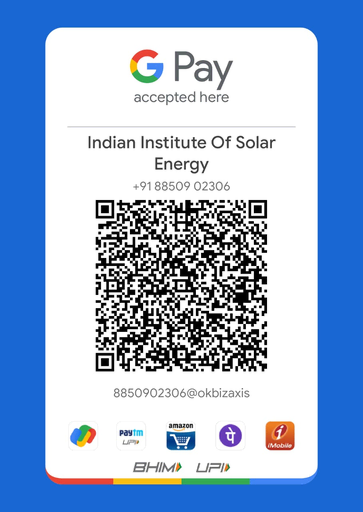
You can pay using Gpay too. Just scan the QR code below.


-
Solar Engineer Certificate course | Solar Engineering Courses ₹29,999
- What is Prerequisite coursesA prerequisite is a specific course that you must complete before you can take another course at the next grade level.

Popular Courses
-
 PG Diploma in Electric Vehicle Tec...₹160,000By iisemumbai
 -
Advance Electric Vehicle Design En...₹49,999By iisemumbai
-
Solar Practical Workshop₹24,999By iisemumbai
-
Solar Engineer Certificate course ...₹29,999By iisemumbai
-
Fundamentals in Solar PV Systems₹2,999By iisemumbai
-
Fundamentals of Electric Vehicle T...₹14,999By iisemumbai
-
B.Voc in Solar Technology₹41,999By iisemumbai
-
Diploma in Solar Technology | Sola...₹49,999By iisemumbai


Latest Blog posts

Archive
Popular Courses
-
PG Diploma in Electric Vehicle Tec...₹160,000By iisemumbai
-
Advance Electric Vehicle Design En...₹49,999By iisemumbai
-
Solar Practical Workshop₹24,999By iisemumbai
-
Solar Engineer Certificate course ...₹29,999By iisemumbai
-
Fundamentals in Solar PV Systems₹2,999By iisemumbai
-
Fundamentals of Electric Vehicle T...₹14,999By iisemumbai
-
B.Voc in Solar Technology₹41,999By iisemumbai
-
Diploma in Solar Technology | Sola...₹49,999By iisemumbai