How Do Solar Subsidies Work in India in 2026?
In India, residential rooftop solar subsidies are governed by the central scheme PM Surya Ghar: Muft Bijli Yojana. Subsidies are disbursed as fixed Central Financial Assistance (CFA) via Direct Benefit Transfer (DBT) into the consumer's bank account following technical inspection and net-meter commissioning by the local DISCOM.
Policy Context: Historical Subsidies vs. Current Direct Benefit Transfer
Historically, the Ministry of New and Renewable Energy (MNRE) administered rooftop solar incentives through percentage-based benchmark subsidies (Phase-I and Phase-II). Under those legacy frameworks, general category states received 30% to 40% capital subsidies, while special category states received up to 70%. In practice, those subsidies were routed through state nodal agencies and empanelled vendors, often leading to prolonged administrative settlement cycles.
In February 2024, the Government of India launched PM Surya Ghar: Muft Bijli Yojana with an outlay of ₹75,021 Crore, fundamentally transitioning India's solar incentive model from percentage benchmarks to a fixed-rupee Central Financial Assistance (CFA) structure delivered directly to the consumer's bank account via Direct Benefit Transfer (DBT).
PM Surya Ghar: Muft Bijli Yojana — The National Residential Rooftop Scheme
PM Surya Ghar: Muft Bijli Yojana is a flagship national initiative designed to provide up to 300 units of free electricity every month to one crore (10 million) Indian households by FY 2026–27. The scheme establishes a transparent, digitally verified workflow connecting consumers, electricity distribution companies (DISCOMs), and empanelled renewable energy contractors.
Central Financial Assistance (CFA) Subsidy Slabs
For general category states (which represent the majority of India), the central subsidy is strictly calibrated to system capacity:
- 1 kW System: ₹30,000 fixed Central Financial Assistance.
- 2 kW System: ₹60,000 fixed Central Financial Assistance (calculated as ₹30,000 per kW).
- 3 kW System: ₹78,000 fixed Central Financial Assistance (calculated as ₹60,000 for the first 2 kW + ₹18,000 for the 3rd kW).
- Systems Above 3 kW (Up to 10 kW Residential): Capped at a maximum ceiling of ₹78,000. While a homeowner may install a 5 kW or 10 kW residential system to meet higher energy consumption, the government financial assistance remains capped at ₹78,000.
Special Category States & UTs Subsidy Slabs
To account for challenging logistics and terrain, higher central assistance is granted to North-Eastern states (including Sikkim), Uttarakhand, Himachal Pradesh, and the Union Territories of Jammu & Kashmir, Ladakh, Andaman & Nicobar Islands, and Lakshadweep:
- 1 kW System: ₹33,000 fixed CFA.
- 2 kW System: ₹66,000 fixed CFA.
- 3 kW System and Above: Capped at ₹85,800 (₹66,000 for first 2 kW + ₹19,800 for 3rd kW).
(₹33,000 in Special States)
(₹66,000 in Special States)
(₹85,800 in Special States)
Remaining funded by user
Mandatory Technical Standards: ALMM & DCR Compliance
To qualify for the central subsidy, residential solar installations must adhere strictly to technical quality standards mandated by MNRE:
- Domestic Content Requirement (DCR): Solar PV modules must be manufactured in India using domestically manufactured solar cells. Installing imported non-DCR panels automatically invalidates the subsidy application.
- Approved List of Models and Manufacturers (ALMM): All installed modules must feature on MNRE's official ALMM list, ensuring certified efficiency and long-term degradation resistance.
- BIS Certified Inverters: Solar grid-tied inverters must satisfy Bureau of Indian Standards requirements (IS 16221 for product safety and IS 16169 for anti-islanding protection).
Concessional Collateral-Free Bank Financing
To eliminate upfront capital barriers, the Government of India established a concessional financing window through major public and private scheduled commercial banks (including State Bank of India, Punjab National Bank, Canara Bank, and Bank of Baroda).
Consumers installing systems up to 3 kW can access collateral-free loans up to ₹2,00,000 at attractive interest rates pegged near repo rate + 0.5% (approximately 7% per annum). When the DBT subsidy is credited, borrowers can choose to prepay their loan principal, drastically reducing monthly EMI burdens.
System Cost, Subsidy & Net Investment Analysis
A frequent consumer misconception is equating the government subsidy with total system cost. The subsidy is a financial contribution that offsets the gross project cost. The table below outlines representative market cost benchmarks across India, eligible subsidies, net out-of-pocket investment, and estimated electricity bill savings.
| System Capacity | Est. Gross Cost | Central CFA (Subsidy) | Net Consumer Cost | Monthly Generation | Monthly Bill Savings (@ ₹8/unit) | Estimated Payback |
|---|---|---|---|---|---|---|
| 1 kW System | ₹55,000 – ₹65,000 | ₹30,000 | ₹25,000 – ₹35,000 | 120 – 130 kWh | ₹960 – ₹1,040 | 2.5 – 3.0 Years |
| 2 kW System | ₹1,10,000 – ₹1,25,000 | ₹60,000 | ₹50,000 – ₹65,000 | 240 – 260 kWh | ₹1,920 – ₹2,080 | 2.3 – 2.8 Years |
| 3 kW System | ₹1,65,000 – ₹1,90,000 | ₹78,000 | ₹87,000 – ₹1,12,000 | 360 – 390 kWh | ₹2,880 – ₹3,120 | 2.5 – 3.2 Years |
| 4 kW System | ₹2,20,000 – ₹2,50,000 | ₹78,000 (Capped) | ₹1,42,000 – ₹1,72,000 | 480 – 520 kWh | ₹3,840 – ₹4,160 | 3.2 – 3.8 Years |
| 5 kW System | ₹2,70,000 – ₹3,10,000 | ₹78,000 (Capped) | ₹1,92,000 – ₹2,32,000 | 600 – 650 kWh | ₹4,800 – ₹5,200 | 3.5 – 4.0 Years |
*Gross equipment costs vary based on module efficiency (TOPCon vs. Mono PERC), elevated mounting structure requirements, inverter brand, cabling length, and local DISCOM meter charges. Central CFA remains fixed per government policy.
Interactive Residential Solar Subsidy & Investment Estimator
Estimate recommended system size, eligible PM Surya Ghar central subsidy, net cost, and annual savings based on your power bill.
*Indicative estimate based on average generation of 120 units/kW/month and average domestic tariff of ₹7.50/unit. Actual generation depends on site irradiation, orientation, and shadow-free roof conditions.
Eligibility Criteria: Who Can Claim Government Solar Subsidy?
To maintain strict compliance and prevent misappropriation of public funds, the Ministry of New and Renewable Energy enforces clear qualifying benchmarks for residential applicants:
- Domestic Electricity Consumers: Individual homeowners with an active residential power connection in their own name.
- Rooftop Rights: Undisputed roof ownership or valid legal consent from co-owners in independent houses and villas.
- Grid Connectivity: Consumers connected to the local state distribution utility (DISCOM) with active consumer numbers.
- Sanctioned Load Match: Proposed solar system size within the DISCOM's sanctioned load limits (or following load enhancement approval).
- Group Housing Societies: Registered RWAs and GHS common facilities (lifts, common lighting, water pumps).
- Commercial & Industrial Establishments: Factories, shops, private hospitals, hotels, and office complexes (ineligible for residential CFA).
- Government & Institutional Buildings: Public administrative offices, schools, and trust properties (separate institutional frameworks apply).
- Tenants Without Independent Meters: Renters without dedicated domestic meters and registered owner NOC.
- Pure Off-Grid Battery Systems: Standalone DC systems operating without DISCOM net metering and grid synchronization.
- Non-DCR / Second-Hand Hardware: Systems using uncertified modules or unlisted vendors outside the National Portal.
Step-by-Step Application Process on the PM Surya Ghar National Portal
All residential solar subsidy claims in India are processed exclusively through the unified National Portal for Rooftop Solar (pmsuryaghar.gov.in). Below is the comprehensive end-to-end workflow:
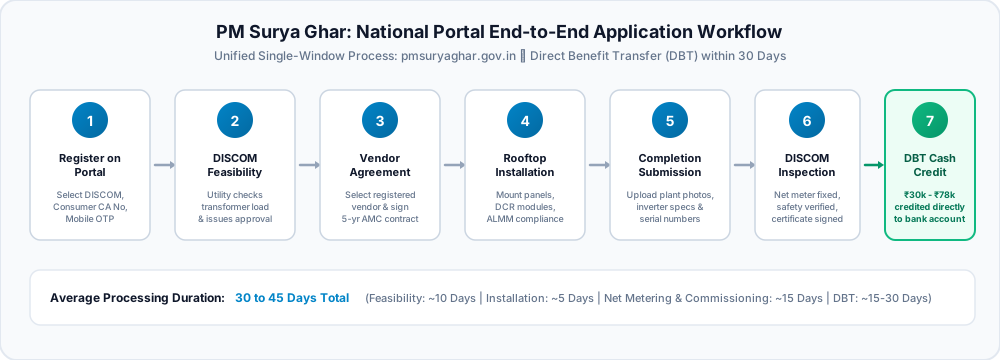
pmsuryaghar.gov.in or download the official mobile app. Select your State, choose your Electricity Distribution Company (DISCOM), and enter your Consumer Account Number (as printed on your monthly electricity bill). Verify your identity using mobile and email OTP authentication.Required Documents Checklist for Solar Subsidy Claims
Ensure you have the following documentation prepared before commencing your National Portal application:
| Application Phase | Required Document | Key Specifications to Verify |
|---|---|---|
| Pre-Application | Latest Electricity Bill | Must show domestic consumer category, active service connection, and exact installation address. |
| Pre-Application | Aadhaar Card of Consumer | Applicant's name must match the name on the electricity bill. |
| Pre-Application | Proof of Roof Ownership | Property tax receipt, sale deed copy, or society NOC in case of shared roofs. |
| Post-Installation | DCR Undertaking Certificate | Manufacturer declaration confirming domestic cells and ALMM module compliance with serial numbers. |
| Post-Installation | Inverter Warranty & Test Report | BIS compliance certificate (IS 16221 / IS 16169) with minimum 5-year OEM warranty. |
| Post-Installation | Vendor Model Agreement | Standard signed agreement confirming 5-year comprehensive maintenance (AMC). |
| Subsidy Disbursement | Cancelled Cheque / Bank Passbook | Clear scanned copy showing Applicant Name, Account Number, and IFSC Code. |
PM-KUSUM: Solar Energy Subsidies and Schemes for Indian Farmers
While PM Surya Ghar targets residential rooftops, PM-KUSUM (Pradhan Mantri Kisan Urja Suraksha evam Utthaan Mahabhiyan) is India's flagship agricultural clean energy program. Formulated by MNRE, PM-KUSUM empowers individual farmers, farmer producer organisations (FPOs), cooperatives, and water user associations to de-dieselise irrigation, generate clean power, and earn steady revenue from surplus solar generation.
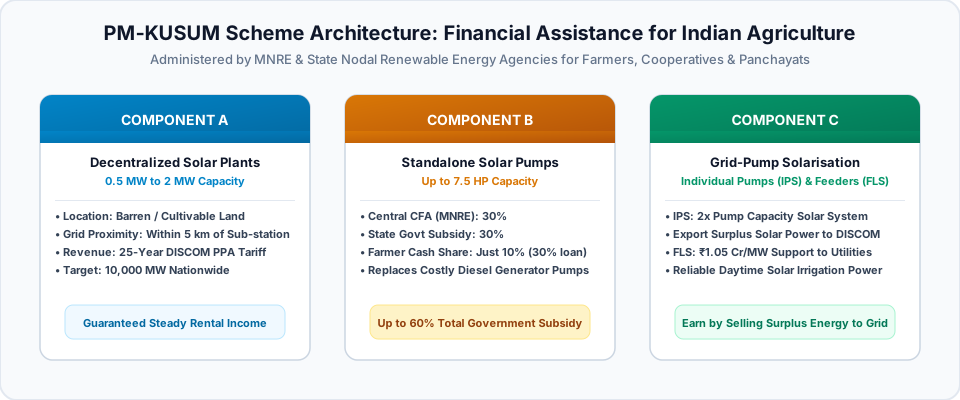
Component A: Decentralized Ground-Mounted Solar Plants (0.5 to 2 MW)
Under Component A, individual farmers, panchayats, and cooperatives can set up grid-connected solar power plants ranging from 0.5 MW to 2 MW on barren, fallow, or cultivable land located within a 5 km radius of local 33/11 kV sub-stations.
The generated power is purchased by the local DISCOM under long-term 25-year Power Purchase Agreements (PPAs) at feed-in tariffs determined by the State Electricity Regulatory Commission (SERC). This creates a dependable, recurring rental income stream for rural landowners.
Component B: Standalone Solar Agriculture Pumps
Component B supports the installation of individual standalone solar water pumps of capacity up to 7.5 HP in off-grid or non-electrified farming areas.
- Central Financial Assistance (MNRE): 30% of benchmark cost (50% in North-Eastern, Himalayan, and Island regions).
- State Government Subsidy: 30% of benchmark cost.
- Farmer Contribution: Only 40% (which can be financed through bank loans up to 30%, leaving just 10% upfront margin money for the farmer).
Component C: Solarisation of Grid-Connected Agricultural Pumps
Component C operates through two distinct execution models:
- Individual Pump Solarisation (IPS): Solar PV arrays of capacity up to twice the pump capacity in kW are installed for grid-connected agricultural pumps. Farmers power their pumps during the day and sell excess solar electricity back to the DISCOM, earning extra income. Central assistance is 30% (50% for special states).
- Feeder Level Solarisation (FLS): Instead of installing solar arrays on individual agricultural pumps, the state utility solarises the entire agricultural power feeder by constructing a centralized MW-scale solar plant at the sub-station. MNRE provides central support of ₹1.05 Crore per MW to DISCOMs or developers.
State-Wise Solar Subsidy & Implementation Framework in India
While the central PM Surya Ghar CFA is uniform across the country via Direct Benefit Transfer, state-level implementation rules, local DISCOM net-metering charges, and optional state top-up subsidies vary. Use the search filter below to view verified details for your state:
| State / UT | Central Scheme | State Top-Up Incentive | Key DISCOMs & Agencies | Net Metering Regulation | Application Portal |
|---|---|---|---|---|---|
| Maharashtra | PM Surya Ghar (Up to ₹78k) | Standard central DBT; no separate residential cash top-up | MSEDCL, Tata Power, Adani Electricity, BEST / MEDA | MERC Net Metering up to 100% sanctioned load | National Portal + MSEDCL Web Portal |
| Gujarat | PM Surya Ghar (Up to ₹78k) | Standard central DBT; high DISCOM processing speed | DGVCL, MGVCL, PGVCL, UGVCL, Torrent Power / GUVNL | GERC Net Metering up to sanctioned load | National Portal (pmsuryaghar.gov.in) |
| Uttar Pradesh | PM Surya Ghar (Up to ₹78k) | State Top-Up: ₹15,000 for 1 kW; ₹30,000 for ≥2 kW (Total up to ₹1.08 Lakh for 3 kW) | UPPCL (DVVNL, MVVNL, PVVNL, PuVVNL) / UPNEDA | UPERC Net Metering regulations | National Portal + UPNEDA State Portal |
| Delhi | PM Surya Ghar (Up to ₹78k) | State Top-Up: ₹2,000/kW (up to ₹10k) + GBI: ₹3/unit (≤3 kW) for 5 yrs | BSES Rajdhani, BSES Yamuna, TPDDL | DERC Net Metering under Delhi Solar Policy 2024 | National Portal (pmsuryaghar.gov.in) |
| Rajasthan | PM Surya Ghar (Up to ₹78k) | Standard central DBT assistance | JVVNL, AVVNL, JdVVNL / RREC | RERC Net Metering up to sanctioned contract load | National Portal (pmsuryaghar.gov.in) |
| Tamil Nadu | PM Surya Ghar (Up to ₹78k) | Central DBT; legacy state subsidies phased out | TANGEDCO / TEDA | TNERC Net Feed-in / Net Metering framework | National Portal (pmsuryaghar.gov.in) |
| Karnataka | PM Surya Ghar (Up to ₹78k) | Standard central DBT assistance | BESCOM, MESCOM, HESCOM, GESCOM, CHESCOM / KREDL | KERC Net Metering / Net Billing provisions | National Portal (pmsuryaghar.gov.in) |
| Kerala | PM Surya Ghar (Up to ₹78k) | Central DBT; Soura initiative integrated | KSEB / ANERT | KSERC Net Metering regulations | National Portal (pmsuryaghar.gov.in) |
| Telangana | PM Surya Ghar (Up to ₹78k) | Standard central DBT assistance | TSSPDCL, TSNPDCL / TGREDCO | TGERC Net Metering up to 100% connected load | National Portal (pmsuryaghar.gov.in) |
| Andhra Pradesh | PM Surya Ghar (Up to ₹78k) | Standard central DBT assistance | APEPDCL, APSPDCL, APCPDCL / NREDCAP | APERC Net Metering & Gross Metering options | National Portal (pmsuryaghar.gov.in) |
| Madhya Pradesh | PM Surya Ghar (Up to ₹78k) | Standard central DBT assistance | MPPKVVCL, MPMKVVCL, MPPoVVCL / MPUVN | MPERC Net Metering regulations | National Portal (pmsuryaghar.gov.in) |
| Haryana | PM Surya Ghar (Up to ₹78k) | Central DBT; state solar water heating/pump incentives | DHBVN, UHBVN / HAREDA | HERC Net Metering up to connected load | National Portal (pmsuryaghar.gov.in) |
| Punjab | PM Surya Ghar (Up to ₹78k) | Standard central DBT assistance | PSPCL / PEDA | PSERC Net Metering regulations | National Portal (pmsuryaghar.gov.in) |
Spotlight: Solar Subsidy in Maharashtra (MSEDCL & MERC Rules)
Maharashtra is one of India's leading states for rooftop solar adoption, driven by progressive regulations from the Maharashtra Electricity Regulatory Commission (MERC) and widespread deployment across Mumbai, Pune, Thane, Nashik, and Nagpur.
In Maharashtra, rooftop applications originate on the National Portal and are synchronized in real-time with MSEDCL's dedicated renewable energy portal. Consumers can install solar capacity up to 100% of their sanctioned electricity load. In major urban centers such as Mumbai, private utilities like Tata Power and Adani Electricity Mumbai Limited (AEML) provide dedicated fast-track desks for net-metering commissioning.
Cooperative housing societies across Maharashtra have achieved rapid payback on solar investments by utilizing the central Group Housing Society subsidy to power common elevators, parking illumination, and water pressure pumps.
Solar Subsidy for Apartment Complexes & Housing Societies (GHS / RWA)
Apartment complexes and cooperative housing societies face substantial monthly common electricity bills from continuous operation of lifts, water booster pumps, corridor lighting, and electric vehicle (EV) charging infrastructure.
Under PM Surya Ghar: Muft Bijli Yojana, registered Resident Welfare Associations (RWAs) and Group Housing Societies (GHS) are eligible for substantial capital assistance:
- CFA Subsidy Rate: ₹18,000 per kW for common facilities.
- Capacity Ceiling: Up to a maximum aggregated capacity limit of 500 kW (inclusive of individual 3 kW rooftop systems in the society). In special category states, the GHS subsidy is ₹19,800 per kW.
- Metering Structure: The solar system connects directly to the common service electricity meter of the society. Energy produced offsets common area bills, lowering monthly maintenance contributions for every resident.
Net Metering & Its Role in Solar Subsidy Economics
Net metering is the technological and regulatory backbone of grid-connected solar power plants. Without an approved bi-directional net meter, rooftop solar systems cannot export excess daytime power or receive commissioning approval for central subsidies.
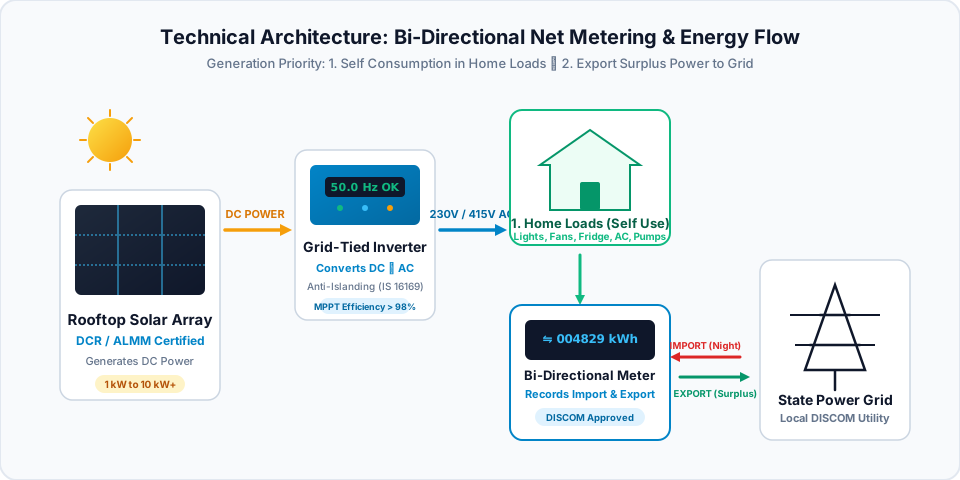
How the Bi-Directional Meter Works
Unlike conventional unidirectional energy meters that run forward whenever electricity flows, a bi-directional net meter features two separate electronic registers:
- Import Register (kWh): Measures electricity drawn from the utility grid at night or during heavy cloud cover when household consumption exceeds solar generation.
- Export Register (kWh): Measures surplus electricity generated by the rooftop solar panels that is fed back into the grid during bright daylight hours after powering active home appliances.
Billing Settlement & Banking Cycles
At each monthly billing cycle, your DISCOM computes:
Net Billed Units = Gross Imported Units − Gross Exported Units
If your solar panels export more units than you consume, you receive a unit credit carried forward to your next monthly bill. At the end of the annual settlement cycle (usually March 31st), any net unadjusted surplus units are settled financially by the DISCOM at the state's Average Power Purchase Cost (APPC) or feed-in tariff rate.
To understand how solar panels, inverters, and distribution boxes work together, explore our technical breakdown of the core components of a rooftop solar power plant.
Government Subsidy vs. Concessional Solar Loans
Many homeowners confuse subsidies with financing. A subsidy is a capital grant from the government that permanently lowers your project cost; a loan is repayable debt that eliminates upfront capital hurdles. The table below illustrates how they compare and complement each other:
| Feature / Dimension | Government Subsidy (CFA) | Concessional Solar Rooftop Loan |
|---|---|---|
| Core Objective | Non-repayable direct capital incentive to reduce net cost. | Debt financing to eliminate upfront out-of-pocket expenditure. |
| Repayment Obligation | Zero Repayment. Direct cash grant to bank account. | Monthly EMI. Repayable over a 3 to 10 year bank tenure. |
| Funding Limit | Up to ₹78,000 (standard states) or ₹85,800 (special states). | Up to ₹2,00,000 collateral-free (up to 3 kW); up to ₹10 Lakh overall. |
| Interest Rate | Not applicable (non-repayable grant). | Concessional (~7% p.a.) via public sector banks under PM Surya Ghar. |
| Eligibility Criteria | Residential electricity connection, DCR/ALMM compliant panels. | CIBIL credit score (typically 700+), income criteria, KYC approval. |
| Can They Coexist? | YES. You can finance 100% of the gross cost via a bank loan, then use the DBT subsidy to prepay loan principal once received. | |
Commercial & Industrial (C&I) Solar: Tax & Depreciation Benefits
A common inquiry is whether commercial establishments, manufacturing units, hospitals, and private colleges can claim central subsidies under PM Surya Ghar.
Commercial and Industrial consumers are NOT eligible for residential CFA subsidies. However, the Government of India provides substantial commercial and tax incentives for enterprise solar installations:
- Accelerated Depreciation (AD): Commercial entities can claim up to 40% Accelerated Depreciation on solar equipment in the first year of installation under Section 32 of the Income Tax Act, significantly lowering corporate tax liability.
- Gross Metering & Net Billing: C&I consumers can leverage state-specific net billing or gross metering mechanisms to offset peak commercial power tariffs (often ₹10 to ₹14 per unit).
- Open Access & Group Captive Solar: High-demand industrial consumers can procure solar power from off-site solar parks under open access arrangements, yielding substantial long-term operational savings.
10 Critical Mistakes That Delay or Disqualify Solar Subsidies
- Purchasing Non-DCR Solar Modules: Procuring cheaper imported solar panels without Domestic Content Requirement certification completely invalidates your central subsidy application.
- Hiring Unregistered / Non-Empanelled Installers: Systems installed by private contractors who are not empanelled with your local DISCOM on the National Portal cannot receive inspection sign-offs.
- Mismatched Consumer & Bank Account Names: The applicant's name on the electricity bill, Aadhaar card, and bank account must match character-for-character to prevent Direct Benefit Transfer failure.
- Installing Hardware Before Feasibility Clearance: Procuring or mounting equipment on the roof before your DISCOM grants technical feasibility approval risks immediate application rejection.
- Modules Not Listed on ALMM: MNRE's Approved List of Models and Manufacturers is strictly verified against module serial numbers during DISCOM site inspection.
- Ignoring Sanctioned Load Limits: Attempting to install a 5 kW plant on a 2 kW sanctioned residential meter without applying for a sanctioned load enhancement will lead to technical disapproval.
- Submitting Illegible Cheque Copies: Uploading blurred or low-resolution scans of bank passbooks or cancelled cheques where the account number or IFSC code is unreadable causes administrative banking freezes.
- Paying 100% Vendor Contract Price Upfront: Releasing complete project fees prior to net-meter commissioning deprives the vendor of incentive to swiftly address DISCOM technical queries.
- Inadequate Roof Shadow Sizing: Failing to conduct professional solar shadow path analysis can result in equipment under-generation, violating minimum generation expectations.
- Failing to Execute the 5-Year Maintenance Agreement: Omitting the standardized Model Agreement on the portal leaves homeowners without legal recourse if equipment malfunctions prematurely.
The Ministry of New and Renewable Energy (MNRE) and State DISCOMs frequently issue advisories warning the public against fraudulent agents and fake online portals. Keep these protective guidelines in mind:
- No "100% Free Solar" Schemes: The Government of India does NOT provide 100% free solar panels. Any contractor advertising completely free residential solar installations is engaging in deceptive marketing.
- Single Official Portal: Subsidies are administered ONLY via pmsuryaghar.gov.in. Never register or upload sensitive identity documents to unofficial domain extensions.
- No Private Payment Gateways: Official application processing fees are never collected via personal UPI IDs, QR codes, or WhatsApp payment links.
- Never Disclose Banking OTPs: Government officials will never call requesting banking OTPs, debit card PINs, or net banking passwords to credit your subsidy.
Report fraudulent solicitations to the National Consumer Helpline (1915) or your local DISCOM vigilance cell.
Frequently Asked Questions (FAQ) on Solar Subsidies in India
What is the solar subsidy in India in 2026?
How much subsidy do I get for a 1 kW, 2 kW, and 3 kW solar system?
Is there any subsidy for residential solar systems above 3 kW?
Can commercial or industrial businesses claim the PM Surya Ghar subsidy?
Are apartment buildings and housing societies eligible for solar subsidy?
What is the official website to apply for the solar subsidy in India?
pmsuryaghar.gov.in. You can also apply using the official PM - Surya Ghar mobile application available on Android and iOS.How does the subsidy money reach my bank account?
How long does it take to receive the subsidy after installation?
What are DCR-compliant solar panels, and why are they mandatory for subsidy?
Is net metering mandatory to receive the PM Surya Ghar subsidy?
Can I install an off-grid solar system with batteries and claim subsidy?
What is the difference between PM Surya Ghar and PM-KUSUM?
Do all Indian states provide additional top-up solar subsidies?
What documents are required to apply for a rooftop solar subsidy?
Can tenants apply for solar subsidies in India?
How much roof area is required for a 1 kW, 2 kW, and 3 kW solar system?
Can I choose any local electrician or contractor to install the panels?
Can I get a bank loan to finance my rooftop solar installation?
What happens to the excess solar electricity I generate?
Is the solar subsidy amount taxable as income in India?
Authoritative Official Resources & Portals
To verify ongoing circulars, vendor empanelment lists, or model agreements, refer strictly to official statutory portals:
- PM Surya Ghar National Portal: pmsuryaghar.gov.in
- Ministry of New & Renewable Energy (MNRE): mnre.gov.in
- PM-KUSUM National Agricultural Portal: pmkusum.mnre.gov.in
- Central Electricity Authority (Technical Standards): cea.nic.in