Solar Engineer Certificate Course – Professional Training in Solar Energy
Build Professional Skills in Solar PV Design, Installation, Commissioning and Maintenance.
Bridging core electrical engineering with live industrial solar photovoltaic deployment. Gain hands-on mastery in solar resource evaluation, load auditing, Single Line Diagram (SLD) preparation, inverter MPPT window matching, DC/AC cable sizing, rooftop structural installation, and plant operations & maintenance across residential, commercial, and hybrid solar systems.
Course Highlights at a Glance
A structured, industry-calibrated curriculum delivering foundational science, practical engineering calculations, and physical field competency.
Balanced hybrid schedule requiring 5 to 7 hours of study per week, ideal for students and professionals.
Comprehensive step-by-step video lectures, engineering design formulas, and real site walkthroughs.
Spans renewable fundamentals, cell physics, BoS sizing, inverters, batteries, earthing, and plant O&M.
24/7 access to digital LMS content combined with scheduled on-campus hands-on practical workshops.
Direct assembly of live PV arrays, string inverters, MC4 crimping, earth resistance testing, and thermography.
Accessible to high-school science leavers, wiremen, engineering degree/diploma holders, and career pivots.
Covers LMS access, practical lab sessions, study guides, and certification. Flexible monthly EMI available.
Issued by Indian Institute of Solar Energy under Centre for Energy Research and Training (CERT).
Which Path Fits Your Career Goals? Two Distinct Pathways
The Solar Engineer Certificate Course serves two ambitious groups of learners. Whether your objective is to excel in established solar engineering corporations or build the technical foundation needed to launch an independent installation business, this course delivers exact competencies.
Build Your Career as a Solar Engineer
Engineered for engineering degree/diploma holders, electrical supervisors, and ITI wiremen seeking technical design, site execution, and O&M positions in established solar EPC firms.
- Solar PV design, Single-Line Diagrams (SLD), and string sizing
- Inverter matching and maximum MPPT voltage window optimization
- Balance of System (BoS) engineering, cable sizing, and protection
- Chemical earthing, lightning arresters, and IS 3043 safety compliance
- Pre-commissioning electrical testing, Megger audits, and IV curve tracing
- Plant Operations & Maintenance (O&M) and thermography diagnostics
Build Your Own Solar Business
Built for aspiring solar entrepreneurs, electrical contractors, and traders who need rigorous technical literacy to audit sites, evaluate OEM vendors, quote accurately, and oversee compliant installations.
- Rooftop solar site surveying, structural assessment, and shadow mapping
- Accurate load calculation from electricity bills to prevent undersizing
- Preparation of detailed Bill of Materials (BOM) and technical quotations
- Evaluating Tier-1 solar panels, string inverters, and BoS component quality
- DISCOM net metering procedures, bi-directional meter liaison, and safety
- Understanding rooftop solar subsidies (including PM Surya Ghar scheme)
What is a Solar Engineer Certificate Course?
A Solar Engineer Certificate Course is a specialized 6-month technical training program designed to teach the end-to-end engineering of solar photovoltaic (PV) power systems. It equips learners with practical competencies in solar resource assessment, load sizing, single-line diagram (SLD) creation, balance of system (BoS) selection, physical installation, and operations & maintenance (O&M) across residential, commercial, and utility-scale installations.
Throughout this program, students bridge the gap between academic theory and practical field execution. You will study solar radiation physics, photovoltaic cell characteristics, monocrystalline and bifacial panel specifications, string inverter MPPT window matching, and battery energy storage dynamics. Crucially, the course instills safety compliance based on Indian Electricity Rules (IER) and Central Electricity Authority (CEA) guidelines, ensuring graduates are equipped to oversee code-compliant solar projects.
Direct synchronization with utility grid. Learn string inverter selection, bidirectional net metering, anti-islanding safety protocols, and DISCOM interconnection standards.
Independent power generation for areas without reliable grid access. Sizing solar charge controllers (PWM vs MPPT), battery storage banks (LFP vs Lead-Acid), and inductive surge protection.
Modern hybrid inverters that manage solar PV generation, battery energy storage, and grid export simultaneously with seamless microsecond critical load transfer switching.
Who Should Join This Course?
Tailored for engineering graduates seeking green-energy specialization, electrical technicians advancing their skills, and entrepreneurs building solar businesses.
1. B.E. / B.Tech Graduates
Electrical, Mechanical, Civil, and Electronics graduates aiming to translate university engineering theory into job-ready solar design and site execution credentials.
2. Diploma Engineers
Polytechnic diploma holders looking to secure competitive technical roles in solar project engineering, site coordination, and rooftop installation supervision.
3. Electrical Professionals
Practicing electrical supervisors and commercial contractors upgrading their capabilities to quote, engineer, and commission code-compliant solar PV arrays.
4. ITI Electricians & Wiremen
Skilled certified wiremen transitioning from standard domestic electrical work into higher-paying rooftop solar installation, DC wiring, and maintenance.
5. Solar Technicians
Existing solar field technicians seeking formal engineering foundations in string sizing, inverter matching, and instrumentation to advance to engineer grades.
6. Fresh Graduates
B.Sc, BCA, or technical graduates seeking a fast, structured entry pathway into India's expanding renewable energy and decarbonization sectors.
7. Working Professionals
Engineers and managers currently in conventional thermal, oil & gas, or manufacturing industries desiring a structured transition into clean energy.
8. Solar Entrepreneurs
Founders, traders, and contractors establishing a solar EPC dealership who need technical competence to survey roofs, quote accurately, and inspect jobs.
9. Career Changers
Disciplined individuals with strong analytical aptitude who meet the 10+2 baseline and want to build a future in the clean energy revolution.
Course Eligibility Criteria
Clear, transparent guidelines distinguishing minimum entry requirements from preferred academic backgrounds.
Must have completed 10+2 with science or mathematics fundamentals, or hold equivalent technical secondary certificates. Candidates must possess basic numerical aptitude.
Electrical, Electronics, Mechanical, Civil, E&TC degrees or diplomas. Licensed wiremen, electricians, and solar technicians with field experience are highly preferred for design roles.
Technical Skills You Will Develop: 6 Engineering Pillars
The curriculum is constructed around 6 practical engineering domains reflecting the daily responsibilities of practicing solar project engineers and EPC managers.
Solar Resource & Site Assessment
- Measure Global Horizontal (GHI) and Direct Normal Irradiance (DNI)
- Plot sun path diagrams, azimuth angles, and solar hour angles
- Calculate optimal tilt angles and seasonal tilt variations
- Conduct manual shade assessments and 3D solar pathfinder evaluations
Load Assessment & System Sizing
- Audit client electricity bills, sanctioned demand, and tariff slabs
- Calculate daily/seasonal energy consumption and load curves
- Derive local Peak Sun Hours (PSH) and factor in derating losses
- Determine precise DC array peak capacity (kWp) and annual energy yield
PV Modules & Inverter Matching
- Evaluate Monocrystalline, TOPCon, and Bifacial panel datasheets
- Apply temperature coefficients to calculate extreme winter Voc and summer Vmp
- Calculate minimum and maximum modules per string for inverter MPPT window
- Select string vs central vs microinverters and calculate DC:AC ratio (1.15 to 1.35)
Balance of System (BoS) Engineering
- Size UV-resistant DC solar cables (XLPO) to restrict voltage drop below 2%
- Size AC armored cables, busbars, and distribution breakers for <1% loss
- Specify DC Junction Boxes (DCDB), combiner boxes, and ACDB panels
- Select DC isolator switches, gPV cylindrical fuses, and Type II SPDs
Electrical Safety & Protection Codes
- Design chemical earthing systems achieving resistance under 5 Ohms (IS 3043)
- Engineer dedicated lightning protection zones according to IEC 62305
- Implement separate earthing for DC body, inverter body, and lightning arrester
- Master Lockout/Tagout (LOTO), fall protection, and electrical safety codes
Installation, Commissioning & O&M
- Execute torque-calibrated mounting on RCC roofs and industrial metal sheets
- Perform MC4 ratchet crimping to eliminate high-resistance arc faults
- Pre-commissioning testing: Polarity, Voc, Isc, Megger insulation resistance
- Operations & Maintenance: Infrared thermography hotspot checks & I-V tracing
Complete Course Curriculum: 10 Modules (92 Lectures)
All 92 technical lectures organized into 10 structured modules. Click any module below to expand and view the detailed lecture topics, mathematical sizing formulas, and practical learning outcomes.
Core Focus: Fundamental energy classifications, global decarbonization drivers, India’s renewable energy targets, and the National Solar Mission framework.
- Lecture 1.1: What is Energy? Primary vs Secondary Energy Classifications
- Lecture 1.2: Conventional vs Renewable Energy Sources & Global Transition Drivers
- Lecture 1.3: Storage of Electricity and the Correlation between GDP and Energy Production
- Lecture 1.4: Why Solar Energy? Environmental, Financial, and Strategic Advantages
- Lecture 1.5: Applications of Solar Photovoltaic and Solar Thermal Technologies
- Lecture 1.6: Solar Energy Programme in India: Historical Milestones and Current Installed Capacity
- Lecture 1.7: National Solar Targets: MNRE Policies, Renewable Purchase Obligations (RPO)
- Lecture 1.8: Rooftop Solar Schemes: PM Surya Ghar Muft Bijli Yojana & State DISCOM Frameworks
Practical Outcome: Comprehensive understanding of Indian solar policy landscapes, subsidy structures, and commercial project drivers.
Core Focus: Electrical physics, circuit laws, AC vs DC power dynamics, and single-phase vs three-phase power calculations applied to solar PV systems.
- Lecture 2.1: What is Electricity? Voltage, Current, and Resistance (The Water Analogy)
- Lecture 2.2: Electrical Terminologies: Watt, Kilowatt, Kilowatt-Hour, Power Factor, and Frequency
- Lecture 2.3: Ohm’s Law and Joule’s Law: Mathematical Relationships and Circuit Calculations
- Lecture 2.4: Direct Current (DC) vs Alternating Current (AC): Waveforms, RMS Values, and Losses
- Lecture 2.5: Series Electrical Circuits: Voltage Addition and Current Invariance in Solar Strings
- Lecture 2.6: Parallel Electrical Circuits: Current Addition and Voltage Invariance in Combiner Boxes
- Lecture 2.7: Complex Series-Parallel Combinations in Photovoltaic Array Layouts
- Lecture 2.8: Single-Phase vs Three-Phase Electrical Systems: Line vs Phase Voltages
- Lecture 2.9: Electricity Consumption Calculations and Unit Consumption Auditing
Practical Outcome: Ability to mathematically calculate series and parallel voltage/current parameters and audit facility electrical loads.
Core Focus: Solar geometry, extraterrestrial vs terrestrial irradiance, sun path calculations, and solar resource measurement instrumentation.
- Lecture 3.1: The Sun as an Energy Source: Solar Constant, Extraterrestrial Radiation
- Lecture 3.2: Terrestrial Solar Radiation: Direct Normal (DNI), Diffuse Horizontal (DHI), and Global (GHI)
- Lecture 3.3: Solar Geometry: Zenith Angle, Solar Altitude, Azimuth Angle, and Solar Declination
- Lecture 3.4: Hour Angle and Solar Time vs Local Standard Time (Equation of Time)
- Lecture 3.5: Sun Path Diagrams and Determining Solar Trajectory Across Seasons
- Lecture 3.6: Peak Sun Hours (PSH): Concept, Conversion from Irradiance, and Regional Indian PSH Values
- Lecture 3.7: Solar Orientation and Optimal Tilt Angle Selection (Fixed, Seasonal, and Tracking)
- Lecture 3.8: Solar Radiation Measurement Instruments: Pyranometers, Pyrheliometers, and Albedometers
Practical Outcome: Precision calculation of site-specific Peak Sun Hours and derivation of optimal panel tilt and azimuth.
Core Focus: Semiconductor physics, the photovoltaic effect, P-N junction operation under illumination, and I-V / P-V curve characteristics.
- Lecture 4.1: Semiconductor Fundamentals: Intrinsic vs Extrinsic Silicon, N-Type vs P-Type Doping
- Lecture 4.2: The Photovoltaic Effect: Photon Energy, Bandgap Absorption, and Electron-Hole Pair Generation
- Lecture 4.3: Anatomy of a Solar Cell: Depletion Region, Built-in Potential, and Front/Rear Metal Contacts
- Lecture 4.4: Standard Test Conditions (STC) vs Nominal Module Operating Temperature (NMOT)
- Lecture 4.5: Current-Voltage (I-V) Characteristics: Open-Circuit Voltage (Voc) & Short-Circuit Current (Isc)
- Lecture 4.6: Power-Voltage (P-V) Curves and the Maximum Power Point (MPP: Vmp and Imp)
- Lecture 4.7: Fill Factor (FF) Calculation and Cell Conversion Efficiency Metrics
- Lecture 4.8: Effects of Solar Irradiance on Short-Circuit Current and Curve Shifting
- Lecture 4.9: Effects of Operating Temperature on Open-Circuit Voltage and Cell Degradation
Practical Outcome: Mastery of solar cell I-V and P-V curve interpretation and mathematical temperature-voltage adjustments.
Core Focus: Module manufacturing architectures, Monocrystalline vs Polycrystalline vs TOPCon vs Bifacial, temperature coefficients, bypass diodes, and string assembly.
- Lecture 5.1: Solar PV Module Construction: EVA Encapsulant, Tedlar Backsheet, Glass, and Anodized Aluminum Frame
- Lecture 5.2: Cell Technologies: Polycrystalline vs Monocrystalline PERC (Passivated Emitter and Rear Cell)
- Lecture 5.3: Advanced Cell Architectures: Tunnel Oxide Passivated Contact (TOPCon) and Heterojunction (HJT)
- Lecture 5.4: Bifacial Module Technology: Bifaciality Factor, Ground Albedo Reflections, and Yield Boost
- Lecture 5.5: Module Nameplate Parameters: Reading and Interpreting Manufacturer Technical Datasheets
- Lecture 5.6: Temperature Coefficients: Applying α (Isc), β (Voc), and γ (Pmax) to Real-World Site Extremes
- Lecture 5.7: Shading Impact on Modules, Hotspot Formation, and Localized Thermal Degradation
- Lecture 5.8: Bypass Diodes: Operational Principles, Sub-String Partitioning, and Diode Protection
- Lecture 5.9: Series Stringing Rules: Maximum System Voltage Compliance (1000V / 1500V DC)
- Lecture 5.10: Module Degradation Mechanisms: Light-Induced Degradation (LID) and Potential-Induced Degradation (PID)
Practical Outcome: Ability to evaluate commercial module datasheets, calculate extreme winter Voc, and prevent thermal hotspots.
Core Focus: Pulse Width Modulation (PWM) vs Maximum Power Point Tracking (MPPT) charge controllers, sizing rules, voltage matching, and multi-stage charging algorithms.
- Lecture 6.1: Function and Necessity of Charge Controllers in Battery-Backed Solar PV Systems
- Lecture 6.2: Pulse Width Modulation (PWM) Controllers: Operating Principles, Limitations, and Efficiencies
- Lecture 6.3: Maximum Power Point Tracking (MPPT) Technology: DC-to-DC Buck Conversion & Efficiency
- Lecture 6.4: MPPT Tracking Algorithms: Perturb & Observe (P&O) and Incremental Conductance
- Lecture 6.5: Key Technical Specifications: Max Voc Input, Nominal Battery Voltage, and Continuous Current Rating
- Lecture 6.6: Voltage Matching: Array Operating Voltage (Vmp) vs Battery Nominal Charging Window
- Lecture 6.7: Sizing Calculations for Off-Grid Residential and Commercial Solar Charge Controllers
- Lecture 6.8: Multi-Stage Battery Charging Cycles: Bulk, Absorption, Float, and Equalization Stages
Practical Outcome: Accurate sizing and selection of MPPT charge controllers for off-grid and hybrid backup installations.
Core Focus: Inverter operational principles, string vs central vs microinverters, MPPT voltage window matching, grid synchronization, and anti-islanding safety.
- Lecture 7.1: Fundamental Operation of Inverters: Converting DC Power into Clean Sinusoidal AC Power
- Lecture 7.2: Inverter Topologies: String Inverters, Central Utility Inverters, and Microinverters
- Lecture 7.3: Hybrid Inverters: Multi-Port DC Storage Architecture and Bi-Directional Power Flow
- Lecture 7.4: Inverter Technical Datasheet Analysis: Nominal Power, Max Apparent Power, and Efficiency Curves
- Lecture 7.5: MPPT Window Matching: Minimum Vmp at Max Ambient Temp vs Maximum Voc at Min Ambient Temp
- Lecture 7.6: Inverter DC Overloading Ratio (DC:AC Ratio): Sizing Between 1.15 and 1.35 for Optimal LCOE
- Lecture 7.7: Maximum Continuous Short-Circuit Current (Isc max) per MPPT Channel and String Sizing
- Lecture 7.8: Grid Synchronization Protocols: Voltage Matching, Frequency Locking, and Power Factor Regulation
- Lecture 7.9: Total Harmonic Distortion (THD) Limits and Grid Compliance Standards (IEEE 1547 / IEC 62116)
- Lecture 7.10: Anti-Islanding Protection: Active and Passive Detection Methods to Safeguard Utility Linemen
Practical Outcome: Precision string sizing to inverter MPPT voltage windows and specification of code-compliant grid synchronization.
Core Focus: Battery electrochemical fundamentals, Lead-Acid vs Lithium-Ion LFP, Depth of Discharge (DoD), State of Charge (SoC), C-ratings, BMS, and storage bank sizing.
- Lecture 8.1: Electrochemical Energy Storage Fundamentals: Anode, Cathode, Electrolyte, and Cell Potential
- Lecture 8.2: Lead-Acid Battery Chemistry: Flooded, VRLA, AGM, and Tubular Deep-Cycle Batteries
- Lecture 8.3: Lithium-Ion Battery Technology: Lithium Iron Phosphate (LiFePO4 / LFP) vs NMC Chemistry
- Lecture 8.4: Comparative Analysis: Energy Density, Round-Trip Efficiency, Operating Temp, and Footprint
- Lecture 8.5: Critical Battery Parameters: Nominal Voltage, Ampere-Hour (Ah) Capacity, and Kilowatt-Hour (kWh)
- Lecture 8.6: Depth of Discharge (DoD) vs Cycle Life: Understanding Battery Longevity Degradation Curves
- Lecture 8.7: State of Charge (SoC), State of Health (SoH), and Battery C-Ratings (Discharge and Charge Rates)
- Lecture 8.8: Battery Management Systems (BMS): Cell Balancing, Over-Voltage, Thermal Runaway Protection
- Lecture 8.9: Battery Bank Sizing Calculations for Off-Grid Autonomy (Days of Autonomy & Temperature Derating)
- Lecture 8.10: Modern Commercial Energy Storage Systems (BESS): Peak Shaving and Solar Self-Consumption
Practical Outcome: Accurate mathematical sizing of tubular and LFP battery banks for specified critical loads and autonomy periods.
Core Focus: On-site structural surveying, RCC roof and metal sheet structural evaluation, azimuth/tilt verification, shadow mapping, and utility bill auditing.
- Lecture 9.1: Comprehensive Rooftop Site Survey Methodology: Access, Water Drainage, and Parapet Heights
- Lecture 9.2: Structural Integrity Assessment: RCC Slabs, Pre-Engineered Building (PEB) Metal Sheets, and Tile Roofs
- Lecture 9.3: Structural Dead Load vs Live Wind Load Calculations (Wind Zones in India per IS 875 Part 3)
- Lecture 9.4: True South Alignment: Magnetic Declination Adjustment and Compass/Pyranometer Verification
- Lecture 9.5: Physical and Digital Shading Analysis: Solar Pathfinders, Horizon Obstacles, and Inter-Row Spacing
- Lecture 9.6: How to Audit an Electricity Utility Bill: Sanctioned Demand, Contract Demand, and Power Factor Penalties
- Lecture 9.7: Constructing 24-Hour Load Curves: Identifying Daytime Baseload vs Peak Evening Demand
- Lecture 9.8: Translating Survey Data into System Capacity (kWp) Estimation and Client Proposal Documents
Practical Outcome: Professional execution of site surveys, inter-row shadow calculations, and load curve generation from utility bills.
Core Focus: End-to-end PV system design, Balance of System (BoS), DC/AC cable sizing, chemical earthing (IS 3043), lightning arresters, commissioning protocols, preventive O&M, and net metering.
- Lecture 10.1: Complete Solar PV System Design Workflow: Integrating Panels, Inverters, BoS, and Protection
- Lecture 10.2: Balance of System (BoS) Component Selection: DCDB, ACDB, Isolators, Disconnects, and Busbars
- Lecture 10.3: DC Cable Sizing: Calculating Voltage Drop (<2%) and Selecting Cross-Linked Polyolefin (XLPO) Solar Cables
- Lecture 10.4: AC Armored Cable Sizing: Copper vs Aluminum Conductors, Ampacity Derating, and Voltage Drop (<1%)
- Lecture 10.5: Chemical Earthing Design (IS 3043): Pipe-in-Pipe Electrodes, Earth Enhancing Compound, and <5 Ohm Target
- Lecture 10.6: Dedicated Lightning Protection: Early Streamer Emission (ESE) vs Conventional Rods (IEC 62305)
- Lecture 10.7: Mechanical Installation Checklist: Rail Mounting, Mid Clamps, End Clamps, and Torque Specifications
- Lecture 10.8: Pre-Commissioning Electrical Testing: Open-Circuit Voltage (Voc), Polarity, Short-Circuit Current (Isc)
- Lecture 10.9: Insulation Resistance (Megger) Testing and Earth Continuity Verification across Solar Array
- Lecture 10.10: Inverter Parameter Setup, Grid Interconnection, and Safe Step-by-Step Power Energization
- Lecture 10.11: Preventive Operations & Maintenance (O&M): Scheduled Cleaning, IR Thermography, and I-V Tracing
- Lecture 10.12: DISCOM Net Metering Protocols: Bi-Directional Meter Testing, CEA Safety Approvals, and Grid Synchronization
Practical Outcome: End-to-end design, cable sizing, earthing layout, commissioning checklists, and net-metering execution for turnkey solar projects.
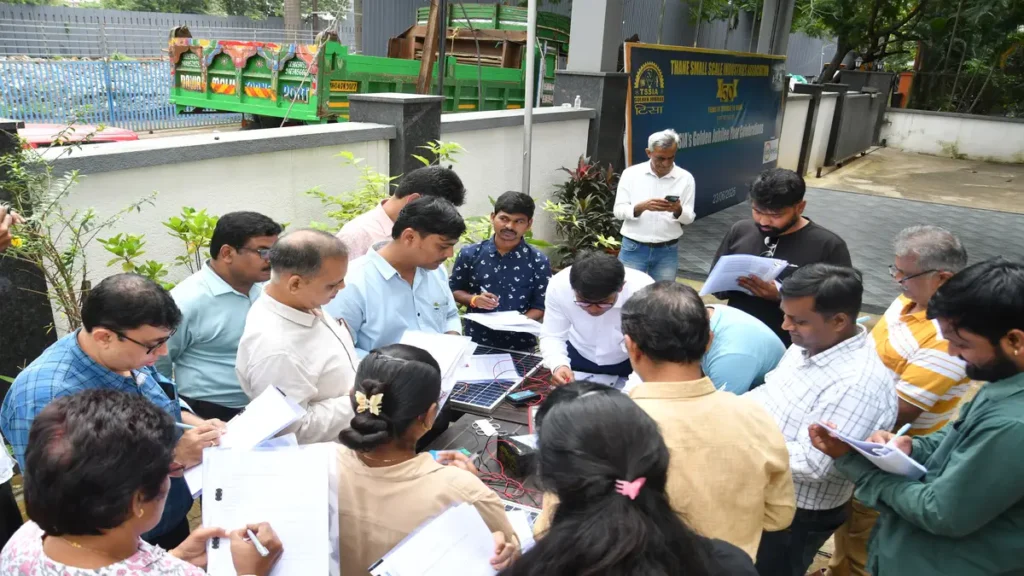
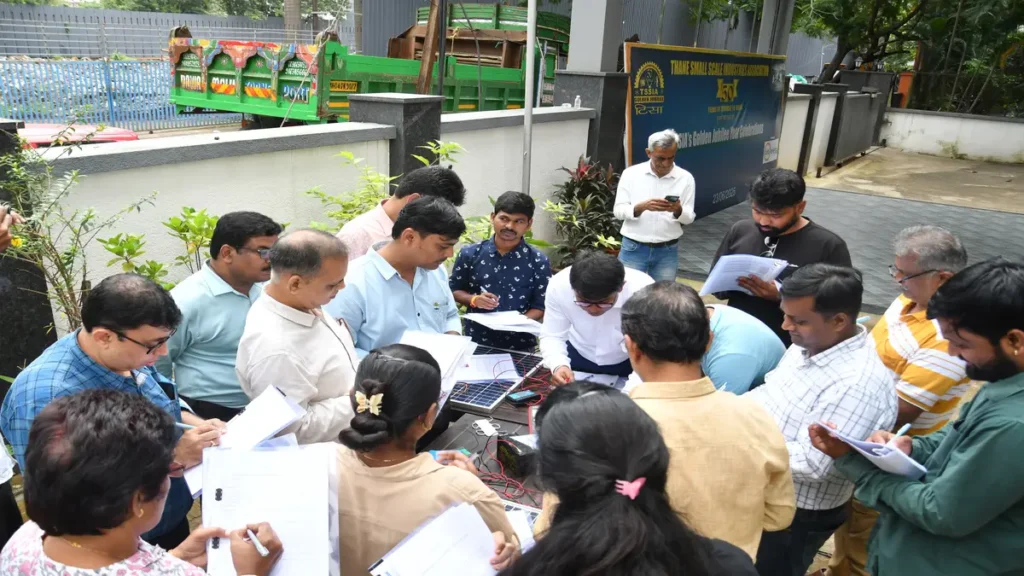
Practical Solar PV Training on Live Installations
Solar engineering is an applied physical discipline. Pure theory cannot replace the muscle memory of torquing clamps, crimping MC4 connectors, and measuring live string voltages.
Mechanical Mounting & Torque
Assemble aluminum rails, mid clamps, and end clamps on RCC and metal sheet mockups using calibrated torque wrenches to prevent micro-cracks in solar silicon cells.
MC4 Ratchet Crimping
Perform hands-on stripping, crimping, and assembly of multi-contact MC4 connectors on 4mm² and 6mm² solar cables to eliminate high-resistance DC arc fault hazards.
Inverter Wiring & Parameter Setup
Terminate DC inputs into string inverters, wire AC outputs into distribution boards, configure grid protection parameters, and verify synchronization.
Megger & Earth Testing
Operate digital earth resistance testers to verify earth pits (<5 Ohms per IS 3043) and utilize 1000V DC insulation Meggers to confirm cable insulation integrity.
Infrared Thermography & O&M
Use thermal imaging cameras to inspect operating PV arrays, identify localized cell hotspots caused by cracked wafers or bypass diode failures, and log O&M reports.
I-V Curve Tracing
Measure string Voc, Isc, Vmp, Imp under real sunlight conditions and plot live I-V curves against manufacturer STC specifications to quantify module degradation.
Learning Methodology: Blended Theory & Field Mastery
A proven 4-stage educational framework engineered to fit working engineers, full-time students, and entrepreneurs.
Interactive Digital LMS
Study high-definition video lectures, downloadable engineering calculation sheets, and technical reading modules at your own schedule 24/7.
Live Technical Masterclasses
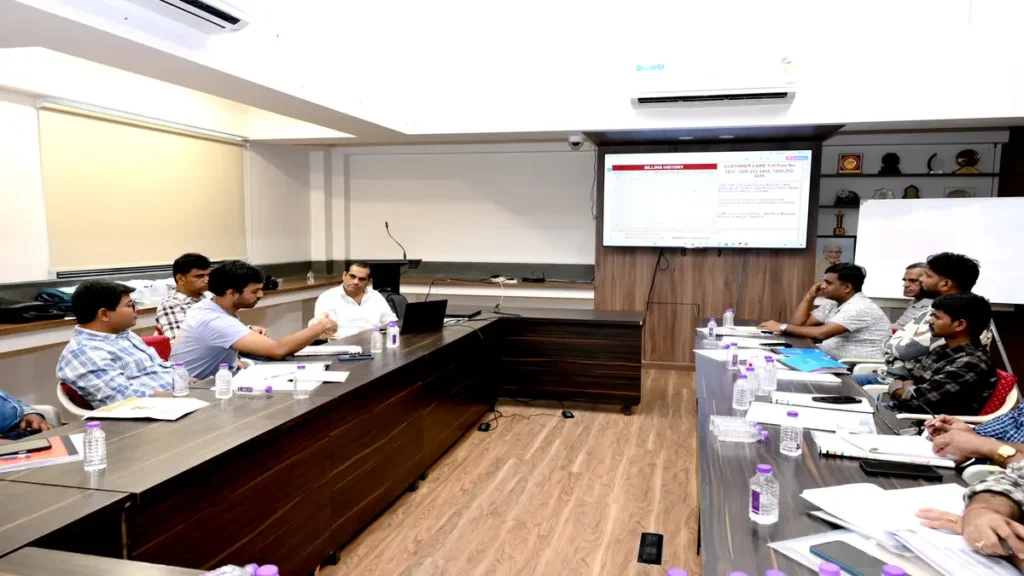
Participate in scheduled live weekend sessions with practicing solar EPC project managers. Review Single-Line Diagrams and clarify complex sizing calculations.
Hands-On Field Labs
Attend mandatory practical workshops at IISE's training facility. Work directly with commercial solar hardware, testing instruments, and live grid-tied arrays.
Capstone Engineering Project
Design an end-to-end 50 kW commercial rooftop solar PV project—complete with SLD, BoS component schedules, cable schedules, and earthing layout—evaluated before certificate issuance.
Career Opportunities: 12 High-Demand Industry Roles
Graduates qualify for technical, operational, and commercial engineering responsibilities across solar EPC companies, module manufacturers, and renewable developers.
1. Solar PV Design Engineer
Prepare single-line diagrams, string layouts, cable schedules, and BoS specifications for rooftop and commercial solar installations.
2. Solar Project Engineer
Supervise turnkey solar projects from civil foundation to electrical energization, coordinating contractors and timelines.
3. Solar Site Execution Engineer
Lead on-site structural assembly, module clamping, DC trenching, conduit laying, and adherence to electrical safety standards.
4. Solar Installation Engineer
Oversee specialized residential and C&I rooftop installations, managing certified electrical wiremen and ensuring zero leakage.
5. Solar Commissioning Engineer
Conduct pre-commissioning testing: string Voc/Isc, earth resistance, Megger insulation audits, and DISCOM synchronization.
6. Solar O&M Engineer
Manage ongoing plant performance, monitor SCADA portals, plan cleaning cycles, execute thermography, and troubleshoot inverter faults.
7. Technical Support Engineer (OEM)
Provide tier-2 engineering support for inverter and module manufacturers, diagnosing field warranty claims and firmware issues.
8. Solar Sales & Application Engineer
Bridge technical engineering with commercial proposals, conducting preliminary roof assessments and client financial payback models.
9. Solar Project Planning Coordinator
Track procurement schedules, vendor BOM milestones, regulatory CEIG inspections, and DISCOM net-metering approvals.
10. Solar Technical Consultant & Auditor
Execute third-party quality audits, verify energy yield calculations, and inspect installation compliance for financial lenders.
11. Solar Photovoltaic Technical Trainer
Train incoming wiremen, technician cohorts, and junior supervisors across polytechnics and corporate training academies.
12. Independent Solar EPC Entrepreneur
Establish an independent rooftop solar EPC company, dealership, or installation consultancy backed by certified technical mastery.
Solar Engineer Salary Benchmarks & Career Growth in India
Realistic industry benchmarks compiled from active recruitment data across Indian renewable energy hubs.
Roles: Junior Design Engineer, Site Supervisor, Field Quality Inspector. Focuses on drafting SLDs, BoS verification, and testing string voltages under supervision.
Roles: Solar Project Engineer, Commissioning Lead, Rooftop EPC Manager. Manages complete rooftop installations, CEIG statutory liaison, and multi-inverter setups.
Roles: Principal Solar Design Lead, Head of O&M, EPC General Manager. Directs utility-scale MW portfolios, high-voltage substation integrations, and commercial bidding.
Start Your Own Solar EPC Business: The Technical Foundation
You cannot profitably sell, quote, or manage what you do not technically understand. This certificate course delivers the engineering rigor required to establish a reputable solar installation firm.
Precision Site Surveying
Assess rooftop load-bearing capacity, verify water drainage slopes, and identify micro-shading from chimneys and parapets before committing to quotations.
Detailed BOM & Quoting
Construct complete Bills of Materials (BOM) including Tier-1 panels, inverters, DC/AC breakers, earthing rods, and conduits to accurately calculate gross profit margins.
OEM Vendor Evaluation
Distinguish genuine Tier-1 modules from re-labeled seconds. Scrutinize inverter warranties, efficiency curves, and local after-sales service centers.
DISCOM & Net Metering
Navigate state utility feasibility approvals, bi-directional net-metering sanctions, and Central PM Surya Ghar subsidy disbursement procedures.
Quality Installation Oversight
Supervise contracted wiremen, enforce torque specs on mid/end clamps, verify chemical earthing resistance, and ensure zero customer complaints.
Annual Maintenance Contracts
Structure lucrative recurring revenue through post-installation preventive maintenance, module washing, and annual thermography audit contracts.
Looking for Dedicated Entrepreneurship & Business Licensing Training?
Explore our specialized program covering company registration, GST compliance, channel partnerships, tender bidding, and project financing.
Explore Solar Entrepreneurship Development Program →Why Choose the Indian Institute of Solar Energy (IISE)?
Operating under the Centre for Energy Research and Training (CERT), IISE provides industry-oriented vocational education backed by over 15 years of clean energy focus.
15+ Years Dedicated Focus
Founded in 2011, renewable energy education is our singular institutional mission, not an outsourced sideline.
Unit of CERT & CERMS
Operates under the Centre for Energy Research and Training (CERT) and CERMS India Foundation, ensuring research-backed technical rigor.
Live Operational PV Labs
Students train physically on live operational rooftop and ground installations with commercial-grade testing instruments.
Practicing Solar EPC Faculty
Instruction is delivered by active renewable consultants and project managers with verified field execution backgrounds.


What Our Graduates & Industry Partners Say
Authentic reviews from engineering graduates, clean-tech entrepreneurs, and recruitment partners who have completed IISE training.
“I would like to express in writing my appreciation at the professionalism and ease in which this course is conducted. To tackle such a complex topic in such an easy manner says volumes. I think everyone who attends this course feels a lot more confident that they can take any lucrative & well paid position in the solar industry!”
“I highly recommend this course to engineering graduates who are interested to work in this industry. The time spent with IISE will help them in the longer run while competing with other aspirants in the solar field!”
“I was working in a completely different field before IISE. Within 3 months of completing my course, I had two job offers from solar EPC companies in Mumbai. The practical training was the key.”
“The practical grounding gave me the confidence to start my own solar installation firm. IISE's faculty provided guidance even after I graduated, helping me land my first 100kW project.”
“Solar companies are always reluctant to recruit fresh engineers as they have to spend months training them. IISE does this work for us with an industry standard syllabus and practical exposure to the various aspects of latest products used in solar installation.”
“It’s a very interactive course. The course covers all the necessary skills and tips to enable you to start working in the industry. We treat highly of IISE graduates and will be recruiting them for our prestigious projects.”
Course Fees & Flexible Payment Plans
All-inclusive pricing with zero hidden charges. Flexible monthly installment (EMI) options available for domestic candidates.
- Full 6-month access to interactive digital LMS portal
- Complete 92 technical video lectures & calculation guides
- Downloadable engineering design templates & SLDs
- Mandatory hands-on practical lab sessions on live PV hardware
- Direct mentorship & Q&A support with solar EPC faculty
- Official verified IISE Solar Engineer Certificate
- Placement assistance & resume engineering support
- Complete online digital learning portal access
- Remote interactive design mentoring & project feedback
- International credit card payment support
- Globally verifiable digital certificate credential
- Tailored guidance on international solar standards (IEC/NEC)
Official Certification & Industry Recognition
Validate your solar PV design, installation, and commissioning capabilities with a verifiable professional certificate.
Issued directly by the Indian Institute of Solar Energy (IISE), operating under the Centre for Energy Research and Training (CERT).
Each certificate features a unique QR code and registration number, allowing prospective employers and clients to independently verify your graduation status.
How to Enroll: 4 Simple Steps to Start
A streamlined onboarding process ensuring you receive academic guidance, verify batch dates, and begin your solar engineering education smoothly.
Submit Inquiry
Fill out the quick online application form with your educational background and contact details.
Academic Counselling
Speak directly with an IISE counsellor to review your prerequisites, career goals, and batch schedule.
Registration & Fee
Confirm your admission with full one-time fee payment or activate your 0% interest monthly EMI plan.
LMS Access & Labs
Receive login credentials, access your study manuals, and receive calendar dates for hands-on labs.
Course Comparison: Select the Ideal IISE Program
Compare our professional certificate with full technical diploma and post-graduate pathways to align with your academic credentials and career timeline.
| Feature / Parameter | Solar Engineer Certificate (Current) | Diploma in Solar Technology | PG Diploma in Solar Technology |
|---|---|---|---|
| Program Level | Professional Certificate | Technical Diploma | Postgraduate Diploma |
| Duration | 6 Months | 1 Year | 1 Year (Post-Grad) |
| Minimum Eligibility | 10+2 / ITI / Diploma / Engineers | 10+2 / ITI / Diploma | B.E. / B.Tech / M.Sc |
| Practical Labs | Live Rooftop PV & Electrical Rig | Extensive Hardware & Field Labs | Advanced Utility MW & Research Lab |
| Tuition Fee | ₹29,999 (EMI Avail.) | ₹49,999 | ₹1,24,999 |
| Action / Link | You Are Here | View Diploma → | View PG Diploma → |
Related Renewable Energy Programs at IISE
Expand your expertise across advanced diplomas, entrepreneurship, and clean energy storage disciplines.

PG Diploma in Solar Technology
Comprehensive postgraduate qualification for engineers aiming for MW-scale design and leadership.
View Course Details →
Diploma in Solar Technology
Thorough practical and theoretical foundation for diploma holders and site execution supervisors.
View Course Details →
Solar Entrepreneurship Certificate
Dedicated curriculum covering solar EPC startup setup, tender bidding, vendor sourcing, and licensing.
View Course Details →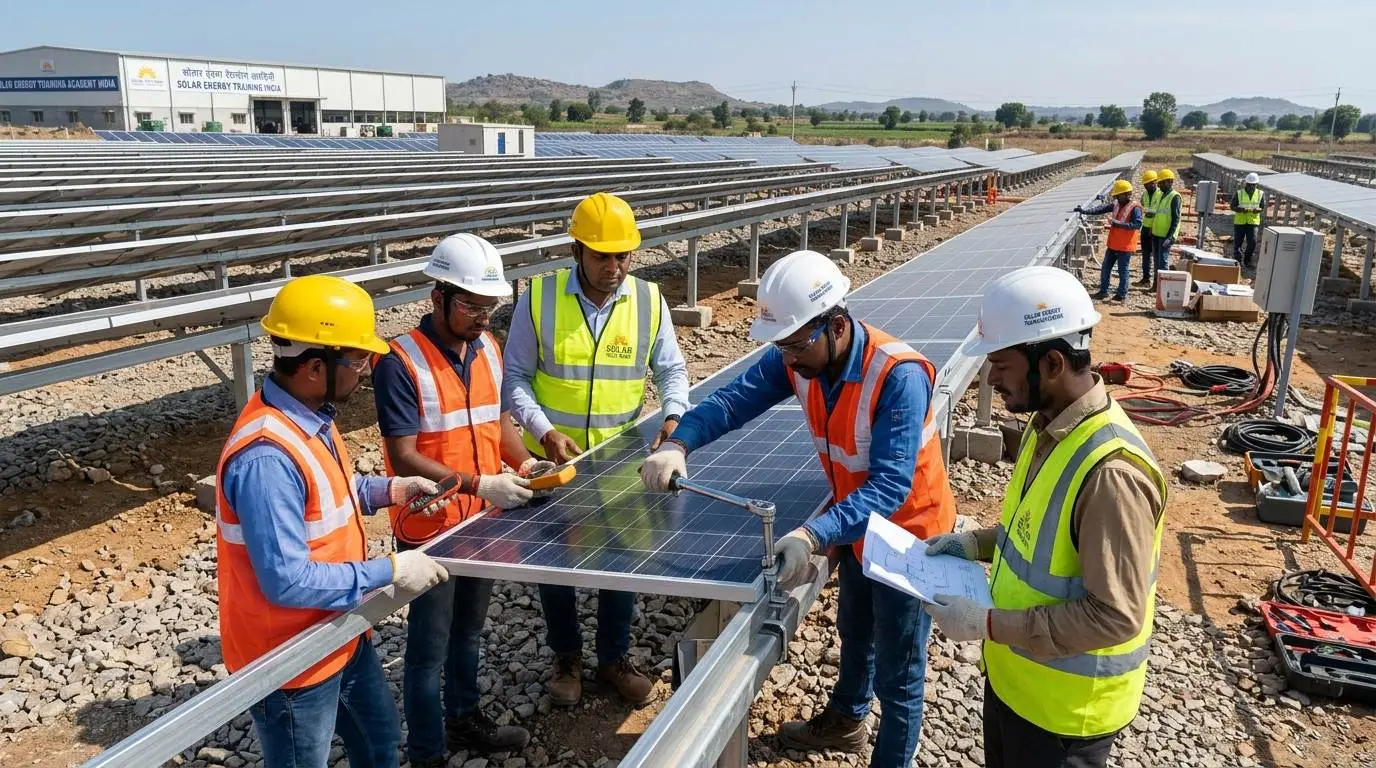
Battery & Storage Systems
Master lithium-ion battery management (BMS), microgrids, and utility-scale energy storage systems.
View Course Details →Frequently Asked Questions (20 Core Inquiries)
Detailed answers covering admission prerequisites, practical lab schedules, software training, payment options, and professional outcomes.
A Solar Engineer Certificate Course is a specialized 6-month technical training program designed to teach the end-to-end engineering of solar photovoltaic (PV) power systems. It equips learners with practical competencies in solar resource assessment, load sizing, single-line diagram (SLD) creation, balance of system (BoS) selection, physical installation, and operations & maintenance (O&M) across residential, commercial, and utility-scale installations.
Engineering graduates (B.E./B.Tech) and diploma holders in Electrical, Mechanical, Civil, and Electronics branches, licensed electricians, ITI wiremen, solar field technicians, and clean-energy entrepreneurs can join the course. The minimum educational qualification is 10+2 with a science or mathematics background.
The minimum educational eligibility is 10+2 (Higher Secondary) with science or mathematics fundamentals. Holding an engineering degree or polytechnic diploma is preferred for advanced design roles, but not mandatory for admission.
Yes. Non-engineering candidates who have completed 10+2 with basic mathematical aptitude can join. The course includes Module 02 (Basics of Electricity) to provide a solid foundation in electrical physics, circuit laws, and power calculations before advancing to solar design.
The course duration is 6 months. It is delivered in a flexible hybrid format requiring approximately 5 to 7 hours of study per week, making it accessible for working professionals and full-time college students.
The course is delivered in a hybrid format. Theoretical concepts, video lectures, and design calculations are accessible 24/7 through IISE’s online learning management system (LMS), supported by mandatory hands-on practical lab sessions conducted on live solar equipment at IISE’s training facility.
Yes. Practical hands-on training is a mandatory component of IISE certification, conducted on live, operational rooftop and ground-mounted solar installations using commercial-grade testing instruments including digital earth testers, Meggers, and thermal cameras.
Yes. The curriculum covers complete electrical and mechanical design for residential, commercial, and industrial rooftop and ground-mounted systems, including Single-Line Diagrams (SLD), DC/AC cable schedules, and component sizing.
Yes. The course teaches physical mechanical and electrical assembly skills required to construct solar arrays safely, including structural rail alignment, torque-calibrated clamping, UV-resistant conduit routing, and MC4 ratchet crimping.
Yes. You will learn how to match inverter hardware topologies (string inverters, microinverters, central inverters, and hybrid inverters) to array voltage-current characteristics, optimize MPPT operating windows, and configure grid synchronization safety.
Yes. You will master the exact mathematical calculations to derive array peak power (kWp) from client utility bills, estimate annual energy yield (kWh), determine DC-to-AC overloading ratios, and calculate string lengths factoring in seasonal temperature extremes.
Yes. A dedicated module covers battery energy storage systems (BESS), including electrochemical comparisons between tubular lead-acid and lithium iron phosphate (LiFePO4 / LFP) chemistries, Depth of Discharge (DoD), State of Charge (SoC), and autonomy bank sizing.
The total course fee for domestic Indian candidates is ₹29,999 (inclusive of all online portal access, study manuals, practical lab sessions, and certification). The fee for international candidates is USD 450.
Yes. Flexible 0% interest monthly installment (EMI) options are available for domestic candidates through our partner payment gateways. You can discuss payment schedules with our admissions team.
Upon successful course completion and submission of your capstone design project, you will receive the official Solar Engineer Certificate from the Indian Institute of Solar Energy (IISE), an operating unit under the Centre for Energy Research and Training (CERT), complete with an online verifiable QR code credential ID.
Graduates qualify for diverse roles including Solar PV Design Engineer, Solar Project Engineer, Site Execution Supervisor, Solar Commissioning Engineer, Solar O&M Engineer, and Technical Sales Specialist, or can launch an independent solar installation business.
Yes. IISE provides structured career support including resume engineering for clean-tech roles, mock technical interviews, and direct referrals to its corporate hiring network comprising solar EPC firms, inverter OEMs, and renewable energy developers across India.
Yes. The course provides the technical literacy needed to audit customer rooftops, calculate system capacities, evaluate OEM components, prepare bankable technical quotations, and supervise code-compliant installations. IISE also offers a dedicated Solar Entrepreneurship Program for business registration and licensing guidance.
Yes. The hybrid model is specifically designed for working professionals. Self-paced digital lectures can be viewed anytime during weekdays, while interactive faculty discussions and practical labs are scheduled on weekends.
You can apply by filling out the online enquiry form below on this page or contacting our academic counselling desk via phone at +91 88509 02306 or WhatsApp. An advisor will verify your eligibility and guide you through batch enrollment.
Start Your Journey Towards Becoming a Solar Engineer
Develop practical solar PV knowledge, strengthen your technical capabilities, and explore high-growth opportunities in India's booming renewable energy sector. Next cohort enrolling now with limited batch capacity.
Get in Touch: Apply or Request a Callback
Submit your details below. An IISE academic advisor will contact you within 24 hours to review your prerequisites and answer your questions.
Admissions Helpdesk
Time is running out. Apply now!
- 00Days
- 00Hours
- 00Minutes
- 00Seconds
Solar Engineer Certificate Course
Get an industry-certified Solar Engineer from Indian Institute of Solar Energy (IISE) in 6 months — or build the technical foundation to launch your own solar business. 92 lectures. 100% practical training. Real placement support.
Which Path Fits Your Career Goals?
The Solar Engineer Certificate Course from Indian Institute of Solar Energy (IISE) serves two distinct groups of ambitious professionals. Whether your objective is to secure a high-growth engineering role in an established EPC firm or to build the technical foundation needed to launch your own solar installation company, this curriculum delivers the exact competencies you need.
Path 1 : I Want to Build a Career as a Solar Engineer
Designed for diploma and degree engineers looking to step into design, project management, and site commissioning roles.
- ✓ UGC-recognised certification
- ✓ Dedicated placement assistance
- ✓ Hands-on training at live solar plants
- ✓ Master PV system design, single-line diagrams, and load sizing
- ✓ Verifiable hands-on training on live operational solar power plants
- ✓ Resume preparation, mock interviews, and access to 200+ hiring partners
Path 2 : I Want to Start a Solar EPC / Installation Business
Built for entrepreneurs, contractors, and traders who need the technical competence to audit sites, evaluate vendors, and quote accurately.
- ✓ Technical foundation for EPC & installation work
- ✓ Vendor & component evaluation skills
- ✓ Access to our Dealer & Channel Partner network
- ✓ Technical foundation for EPC contracting, rooftop quoting, and site auditing
- ✓ Vendor, inverter, and tier-1 solar panel quality evaluation skills
- ✓ Master net metering documentation, DISCOM procedures, and subsidy policies
Course Overview
This training establishes the fundamental concepts required for safe, code-compliant design and installation of photovoltaic (PV) systems — covering grid and off-grid systems, site assessment, component specification, installation, and maintenance.
Who This Course Is For
- ✓ Individuals with a background in engineering, construction, or electrical trades
- ✓ Anyone passionate about clean energy and sustainability
- ✓ Career changers seeking to enter the solar energy field
- ✓ Professionals looking to expand their skillset in renewable energy
Looking for something broader or more advanced? Browse all Solar Courses →
Career Outcomes
Graduates of this program go on to roles across India's fast-growing solar EPC, manufacturing, and project development sectors.
Explore more career paths on our Career & Education hub →
Building a Solar Business? Start Here.
You can't sell or install what you don't understand. This certificate gives you the technical literacy to evaluate vendors, scope installations accurately, and speak credibly with clients and EPC partners — the foundation every solar entrepreneur needs before scaling a business.
- ✓ Accurate site assessment & system sizing
- ✓ Vendor & component evaluation
- ✓ Code-compliant design oversight
- ✓ Confident, technically-grounded client conversations
Want a dedicated business curriculum instead? See our Solar Entrepreneurship Development Program →
Battery & Storage Courses
Pair this certificate with hands-on battery & storage training for complete system expertise.
Explore Battery Courses →EV Systems Courses
Expanding into EVs? Explore our Electric Vehicle systems training programs.
Explore EV Courses →IISE at a Glance
What is a Solar Engineer Certificate Course?
Throughout this comprehensive program, students bridge the gap between academic theory and practical field execution. You will study solar radiation physics, photovoltaic cell characteristics, monocrystalline and bifacial panel specifications, string inverter MPPT window matching, and battery energy storage dynamics. Crucially, the course instills safety compliance based on Indian Electricity Rules (IER) and Central Electricity Authority (CEA) guidelines, ensuring you graduate fully equipped to oversee code-compliant solar projects.
Who Should Join a Solar Engineer Certificate Course?
This program is tailored for technical professionals seeking to specialize in clean energy as well as ambitious newcomers aiming to participate in India’s multi-gigawatt renewable energy expansion.
B.E., B.Tech, and Diploma holders in Electrical, Mechanical, Civil, and E&TC who want to add industry-ready solar design and site execution credentials to their core degree.
Practicing wiremen, electrical contractors, and site supervisors looking to advance from basic wiring into higher-paying rooftop solar surveying, design, and commissioning roles.
Contractors, business owners, and graduates from non-technical disciplines looking to launch a solar EPC firm, dealership, or consultancy backed by real technical mastery.
Solar Engineering Skills You'll Learn
The curriculum is built around 6 practical engineering domains reflecting the daily technical responsibilities of practicing solar project engineers and EPC managers.
Solar Resource & Site Assessment
Measure irradiance (GHI), plot sun path diagrams, calculate optimal tilt angles, and conduct manual and digital shading evaluations.
Load Auditing & System Sizing
Analyze client utility bills, construct load curves, and calculate required peak capacity (kWp) factoring in seasonal derating and losses.
PV Module & Inverter Matching
Calculate series/parallel strings to ensure maximum winter Voc and minimum summer Vmp stay strictly within the inverter MPPT window.
Balance of System (BoS) Engineering
Size DC cables (XLPO) for <2% voltage drop, specify AC armored cables, select DC/AC isolators, fuses, and Type II Surge Protection Devices.
Earthing, Grounding & Safety Codes
Design chemical earthing (<5 Ohms), dedicated lightning protection zones (IS 3043 / IEC 62305), and personal safety protocols.
Plant Commissioning & O&M Diagnostics
Execute pre-commissioning testing (continuity, insulation resistance, Voc/Isc), infrared thermographic audits, and fault troubleshooting.
Curriculum — 10 Modules
All 92 lectures, organised module by module. Click any module to preview its lessons.
- What is Energy? Different Sources of Energy
- Storage of Electricity · GDP vs Energy Production
- What is Renewable Energy? Why Solar Energy?
- Applications of Solar Energy
- Solar Energy Programme in India · Current Status of Solar in India
- Energy classifications and global transition drivers
- Storage of electricity and GDP correlation;
- Solar energy potential in India;
- National renewable policy,
- MNRE targets, and
- Rooftop solar subsidy frameworks (PM Surya Ghar scheme).
- What is Electricity? The Water Tank Analogy
- Electrical Terminologies · Unit Consumption Calculator
- DC and AC Power
- Series and Parallel Electrical Circuits
- Voltage, current, resistance
- Power, and Ohm’s Law;
- DC vs AC power principles;
- Series and parallel circuit laws applied to photovoltaic arrays
- Power factor
- Single-phase vs three-phase systems,
- Electrical energy consumption auditing.
- What is Solar Radiation? Solar Irradiance
- Intro to Solar Orientation
- How to Determine the Sun Path
- Solar constant
- Extraterrestrial vs terrestrial irradiance;
- Direct, diffuse, and reflected radiation;
- Solar altitude, azimuth, and hour angle;
- Peak Sun Hours (PSH) derivation;
- Pyranometers, albedometers, and
- Solar pathfinder shade mapping.
- What is a Solar Cell? Types of Photovoltaic (PV) Cells
- How Solar Cells Work
- Peak Power Point (Maximum Power)
- Semiconductor physics and the photoelectric effect;
- P-N junction operation under illumination;
- Standard test conditions (STC) vs nominal module operating temperature (NMOT);
- I-V and P-V curve characteristics;
- Maximum power point (MPP).
- Solar PV Modules & Arrays · Ratings of PV Modules
- PV Module Parameters · Hot Spot in a Module
- Monocrystalline, polycrystalline;
- TOPCon, and bifacial module technologies;
- Temperature coefficients of Voc, Isc, and Pmax;
- Bypass diodes and hotspot mitigation;
- Series and parallel stringing rules;
- Module degradation mechanisms.
- Basics & Types of Charge Controller
- Maximum Power Point Tracking (MPPT) & Why It Matters
- Specifications of an MPPT Charge Controller
- Operating principles of PWM vs MPPT charge controllers;
- MPPT tracking efficiency and algorithms;
- Voltage window matching for off-grid battery systems;
- Sizing charge controllers for residential and;
- Industrial DC backup systems;
- Basics & Types of Inverters
- Inverter Topology Comparison
- Types of Grid-Tied Inverters · String vs Central Inverters
- DC to AC power inversion;
- String inverters, Central inverters, Microinverters;
- Bi-directional hybrid inverters;
- MPPT voltage window optimization;
- Anti-islanding protection;
- Total Harmonic Distortion (THD);
- Grid synchronization protocols;
- How Does a Battery Work?
- Components of a Battery Cell
- Types of Batteries · Storage Capacity
- Depth of Discharge · State of Charge (SoC) · Cycle Life
- How to Select a Battery for PV Systems
- Lithium-ion (LFP) vs tubular lead-acid chemistry;
- Depth of Discharge (DoD);
- State of Charge (SoC);
- Cycle life dynamics;
- C-rating and thermal runaway management;
- Sizing battery banks for critical residential and commercial backup autonomy;
- Solar Site Assessment & Measurements
- How to Audit an Electricity Bill
- Rooftop structural integrity checks;
- (RCC, industrial metal sheet, tile);
- Tilt angle and azimuth alignment;
- Physical and digital shade analysis;
- Auditing client electricity utility bills;
- Identifying sanctioned demand;
- Designing optimal system sizes.;
- Component Selection & Balance of System
- Safety in Installation of Solar PV Systems
- PV / Battery / Controller / Inverter System Design
- Photovoltaic System Sizing
- Installation Checklist & Plant Installation
- Plant Operation, Maintenance & Troubleshooting
- Net Metering Reforms & Procedures
- Component selection and Balance of System (BoS);
- DC/AC cable sizing;
- Chemical earthing and lightning arresters (IS 3043);
- Installation checklist and mechanical mounting;
- Pre-commissioning testing;
- Preventive O&M;
- Thermography, and troubleshooting;
- Net metering DISCOM procedures;
Solar PV Design Training: Grid-Tied, Off-Grid & Hybrid Systems
You will master the preparation of professional Single-Line Diagrams (SLD) depicting string arrangements, DC junction boxes, inverter inputs, AC distribution boards, and bidirectional utility metering. You will learn to size DC cables to keep voltage drop strictly below 2% and AC cables below 1%, protecting systems against parasitic transmission losses and dangerous cable overheating.
Grid-Tied Systems
Anti-islanding protection, DISCOM net-metering schemes, and high-efficiency string inverter integration without battery storage.
Off-Grid Standalone
Days of autonomy sizing, MPPT charge controllers, battery bank discharge limits, and heavy inductive surge load handling.
Hybrid Storage Systems
Bi-directional hybrid inverters, critical load panels, seamless microsecond transfer switching, and solar self-consumption optimization.
Solar Installation Training: Safe, Code-Compliant Erection
- • Mechanical Rail Alignment: Securing anodized aluminum and HDGI structures rated for 150+ km/h wind gusts without puncturing roof waterproofing.
- • Precision Torque Clamping: Utilizing calibrated torque wrenches on module mid/end clamps to prevent micro-cracks in solar silicon cells.
- • MC4 Ratchet Crimping: Eliminating high-resistance contact points that cause DC arc faults and thermal meltings.
- • Safety Protocols: Personal protective equipment (PPE), lifeline anchoring, Lockout/Tagout (LOTO), and adherence to CEA electrical safety regulations.
Solar PV System Sizing: Precision Load Audits & Calculations
During the program, you will practice real-world sizing calculations using five systematic steps: (1) Hourly load profiling from electricity bills, (2) Deriving local Peak Sun Hours (PSH), (3) Factoring in temperature, dirt, and transmission derating factors, (4) Calculating the optimal DC-to-AC overloading ratio (1.15 to 1.35), and (5) Deriving minimum and maximum modules per string using seasonal temperature extremes.
Solar Inverter Selection: String vs Central vs Microinverters
| Parameter | String Inverters | Microinverters | Central Inverters | Hybrid Inverters |
|---|---|---|---|---|
| Typical Capacity | 3 kW – 350 kW | 300 W – 2 kW | 500 kW – 5 MW+ | 3 kW – 50 kW |
| Best Application | Commercial & Residential | Shaded / Complex Roofs | Utility Ground MW Plants | Rooftops Needing Backup |
| MPPT Trackers | 2 to 12 Independent MPPTs | Individual Panel MPPT | Single Shared MPPT | Dual MPPT + Battery Bus |
| Efficiency | 98.0% – 98.8% | 96.5% – 97.5% | 98.5% – 99.0% | 97.0% – 98.2% |
Solar O&M Training: Plant Operation, Troubleshooting & Maintenance
A solar plant without systematic O&M can experience generation losses exceeding 20% due to soiling, shading hotspots, and insulation breakdowns. Students in this program learn to use thermal imaging cameras to catch failing bypass diodes, perform open-circuit voltage (Voc) and short-circuit current (Isc) audits, and establish cost-effective cleaning schedules.
Practical Solar Training: Real-World Experience on Live PV Installations
Practice with pyranometers, clinometers, and sun path charts to map rooftop shade and azimuth orientation.
Assembly of aluminum mounting rails, mid-clamps, and end-clamps using calibrated torque wrenches.
Stripping 4mm²/6mm² solar cables, ratchet crimping MC4 terminals, testing contact resistance, and assembling DCDB boxes.
Wiring ACDB switchgear, configuring grid voltage and frequency parameters, and monitoring MPPT generation.
Solar Software Training & Computer-Aided Simulation
Rather than memorizing generic button sequences, learners master the underlying mathematical algorithms: irradiance transposition models, temperature derating curves, and inter-row shading geometry. This foundational engineering math enables students to adapt seamlessly to any commercial solar design software in the renewable energy industry.
Solar Engineer Certification & Credential Value
Every certificate is issued with a unique digital identification credential that prospective employers, EPC contracting clients, and hiring managers can instantly verify. It certifies that the holder has executed real electrical testing on physical photovoltaic hardware and possesses the theoretical and field competencies needed for commercial solar deployment.
Career Opportunities After a Solar Engineer Course
India’s renewable sector is adding tens of gigawatts annually, creating an acute demand for specialized solar engineers. Unlike generalists, certified solar engineers possess domain-specific skills that accelerate recruitment into high-paying EPC and design positions.
Solar Engineer Salary in India: Realistic Industry Benchmarks
| Experience Tier | Annual Salary Range (INR) | Typical Job Roles | Core Competency Focus |
|---|---|---|---|
| Entry-Level (0–2 Yrs) | ₹2.8L – ₹4.5L / yr | Junior Design Engineer, Site Trainee | String sizing, on-site cable supervision, testing support |
| Mid-Level (3–5 Yrs) | ₹5.0L – ₹8.5L / yr | Senior Solar Design Engineer, EPC Lead | Independent SLDs, HT switchyards, DISCOM approvals |
| Senior Lead (6+ Yrs) | ₹9.0L – ₹15.0L+ / yr | Head of EPC, Utility Project Director | Multi-MW plant design, vendor procurement, team leadership |
| Solar EPC Business | 12% – 22% Net Margins | Solar Contractor / EPC Founder | Turnkey project delivery, vendor sourcing, customer sales |
*Data reflects current Indian renewable energy market averages from industry recruitment surveys and alumni placement records. Compensation depends on individual technical skills, geographic location, employer size, and project execution scale.
Solar Engineer Course Duration & Study Schedule
The 6 months are split into progressive phases: Months 1–2 build deep electrical and solar resource foundations; Months 3–4 focus on component engineering, string sizing, and BoS; Month 5 delivers intensive live plant practical lab training; and Month 6 integrates operations, maintenance, net metering, and a comprehensive capstone design project.
Solar Engineer Course Fee & Flexible Payment Plans
- ✓ All 92 technical lectures across 10 modules
- ✓ Full hands-on practical lab sessions on live PV plant
- ✓ Study manuals, calculation spreadsheets & design guides
- ✓ Official verified Solar Engineer Certificate from IISE
- ✓ Placement assistance & resume engineering support
- ✓ Complete online digital learning portal access
- ✓ Remote interactive design mentoring & project feedback
- ✓ International credit card payment support
- ✓ Globally verifiable digital certificate credential
- ✓ Tailored guidance on international solar standards (IEC/NEC)
Solar Engineer Course Eligibility Criteria
Electrical, Mechanical, Civil, Electronics & Telecommunication graduates looking for domain specialization.
Science graduates and certified wiremen looking to advance into higher-tier solar site supervision.
Motivated career changers and entrepreneurs with high-school science/math interested in solar EPC.
Online vs Practical Solar Training: Why Blended Learning Matters
| Training Feature | Purely Online Solar Certificates | IISE Hybrid Practical Certificate |
|---|---|---|
| Physical Hardware Interaction | Zero (Screen & slides only) | Live Panels, Inverters & Cables |
| Electrical Instrument Testing | Theoretical equations only | Live Multimeters, Meggers & Clamp Meters |
| DC MC4 Crimping Practice | None | Physical Ratchet Tool Crimping |
| Inverter Grid Commissioning | Demonstration video only | Hands-On Parameter Setup & Synchronization |
| Employer Hiring Credibility | Low (Viewed as theoretical only) | High (Verified Site Competencies) |
Why Choose the Indian Institute of Solar Energy (IISE)?
Solar education is our singular institutional mission, not a generic add-on subject.
Students train on functioning, commercial rooftop and ground installations.
Instructors are active renewable consultants and project managers, not classroom-only academics.
Direct alumni referrals and placement partnerships with 200+ solar employers across India.
Earn a government-recognised qualification respected by every solar employer in India.
Hands-on training at a live solar power plant — graduate job-ready on day one.
Direct links to 200+ solar companies, EPC contractors, and government renewable energy projects..
Instructors are working professionals from India's leading solar companies, not classroom-only academics.
Connect with EPC contractors, manufacturers, investors &policymakers for partnerships and business growth.
What Our Graduates Say
“I was working in a completely different field before IISE. Within 3 months of completing my diploma, I had two job offers from solar EPC companies in Mumbai.”
“The practical grounding gave me the confidence to start my own solar installation firm. IISE's faculty guided me even after graduation.”
“The hands-on labs and industry-expert faculty at IISE made complex concepts easy to understand.”
How to Enroll: 4 Simple Steps to Start
Provide your contact details and educational background via the quick online form.
Speak with an advisor to discuss prerequisites, batch dates, and career objectives.
Confirm your seat with one-time payment or 0% interest monthly EMI plan.
Receive LMS portal login credentials and scheduled live practical workshop dates.
Power Up Your Solar Career
Harness the sun's energy and build a rewarding career — or business — in India's booming solar industry. Batch [INSERT NEXT BATCH DATE]. Limited seats.
Frequently Asked Questions
Find answers to common questions about the Solar Engineer Certificate Course, eligibility, hands-on practical training, fees, and career pathways.
A Solar Engineer Certificate Course is a specialized 6-month training program covering photovoltaic systems: solar radiation assessment, electrical PV design, system sizing, balance of system (BoS) selection, physical installation, and operations & maintenance (O&M).
Engineering graduates and diploma holders (Electrical, Mechanical, Civil, E&TC), science graduates, ITI electricians, working solar technicians, and clean-energy entrepreneurs can join the course. The minimum educational qualification is 10+2 with a science/maths background.
The minimum requirement is 10+2. However, holding a Diploma or B.E./B.Tech in an engineering discipline is preferred for design and project management roles. Working professionals with electrical field experience are also eligible.
The course takes 6 months to complete. It is delivered in a flexible hybrid format requiring approximately 5 to 7 hours of study per week, making it accessible for working professionals and full-time college students.
Students master solar radiation measurement, cell physics, monocrystalline/bifacial module parameters, string inverter selection, battery storage sizing, Single Line Diagram (SLD) drafting, DC/AC cable sizing, earthing protection, live plant installation, and fault troubleshooting.
Yes. The course provides detailed design training for residential, commercial, and industrial rooftop and ground-mounted systems, covering both grid-tied (on-grid), off-grid, and hybrid energy storage systems.
Yes. In addition to online interactive lectures, the course includes intensive practical training on live solar power plants covering module mounting, MC4 cable crimping, inverter connections, earthing resistance testing, and safety protocols.
Yes. You will learn the exact mathematical formulas to calculate array peak power (kWp), estimate energy yield (kWh), determine DC:AC inverter overloading ratios, and calculate maximum string lengths based on seasonal temperature coefficients.
Yes. The curriculum covers inverter topology selection (string vs central vs microinverters vs hybrid), matching module string voltages to inverter MPPT operating windows, evaluating maximum short-circuit current ratings, and checking grid compliance standards.
Yes. A dedicated module covers Operations and Maintenance (O&M), including scheduled module cleaning schedules, infrared thermography for hotspot detection, I-V curve tracing, insulation resistance (Megger) testing, and inverter error code troubleshooting.
Yes. The theoretical modules, mathematical design calculations, and lecture series are delivered through IISE’s online learning portal, supported by scheduled on-campus hands-on practical lab workshops.
Yes. Practical hands-on training is a mandatory component of IISE certification, conducted on live, operational rooftop and ground-mounted solar installations using commercial-grade testing instruments.
You will receive the official Solar Engineer Certificate from the Indian Institute of Solar Energy (IISE), complete with a unique online credential verification number recognized by solar EPC employers across India.
Graduates qualify for roles such as Solar PV Design Engineer, Solar Site Engineer, Rooftop Project Coordinator, Solar O&M Engineer, Technical Sales Specialist, and Quality Inspector, or can launch an independent solar installation business.
Entry-level solar engineers typically earn between ₹2.8 Lakhs to ₹4.5 Lakhs per annum. With 3 to 5 years of EPC and design experience, compensation advances to ₹5.0 Lakhs to ₹8.5 Lakhs, while senior engineering leads earn ₹9.0 Lakhs to ₹15+ Lakhs annually.
The total course fee for domestic Indian candidates is ₹29,999 (inclusive of all online portal access, study manuals, and practical lab sessions). Flexible no-cost EMI options are available. The international student fee is USD 450.
Yes. The course begins with foundational electrical and solar principles before advancing to complex engineering calculations, making it suitable for motivated beginners with a basic science or electrical background.
Yes. Over 30% of IISE students take this course to establish their own solar EPC or installation firms. The curriculum teaches you how to accurately evaluate roofs, size systems, select high-quality components, handle net-metering approvals, and quote projects profitably.
B.E./B.Tech or Diploma holders in Electrical, Mechanical, Civil, or E&TC are preferred, but graduates from other fields are also accepted. The minimum qualification is 10+2.
The program runs in hybrid mode, combining online lectures with practical, hands-on training at a live solar power plant.
Course fees can be paid in easy monthly instalments with a no-cost EMI option, so you can start your training without financial barriers.
Yes. IISE’s dedicated placement cell provides resume support, interview coaching, and direct referrals to its network of 200+ hiring partners.
Solar Engineer Certificate Course
Master solar photovoltaic (PV) system design, electrical installation, energy yield sizing, and plant maintenance in a structured 6-month hybrid program. Combine rigorous engineering theory with hands-on practical training on live solar installations at India’s premier renewable energy institute.
Time is running out. Apply now!
- 00Days
- 00Hours
- 00Minutes
- 00Seconds
Power Up Your Career in India's Solar Revolution
Join the next cohort of certified solar engineers. Master PV design, system sizing, live plant installation, and maintenance with the Indian Institute of Solar Energy.
Explore Related Renewable Energy Programs at IISE
Ready to Build Practical Skills in Solar Engineering?
Speak with an IISE academic advisor today. Get clarity on batch schedules, practical training sessions, and flexible no-cost EMI payment plans.
Stay Connected with IISE on WhatsApp
Get the latest updates on solar courses, practical workshops, admissions, scholarships, career opportunities, industry insights and upcoming events directly on WhatsApp.
Free to join • Unsubscribe anytime • Opens directly in WhatsApp
Indian Institute of Solar Energy
Official Organization Channel • Renewable Energy
What Subscribers Receive
- Solar Course Admissions & Batch Dates
- Practical Workshop Alerts & Hands-on Sessions
- Career Opportunities & Solar Placement Drives
- Scholarships & Gov. Certification Guidelines
Training Events & Certificate Programs
Diplomas, certificate courses and workshops in solar and EV technology — industry-ready, hands-on training with limited seats per batch.