Top Short Term Renewable Energy Courses in India : A Complete Guide
India's clean energy transition is expanding rapidly, creating unprecedented demand for qualified technical personnel across solar photovoltaic (PV) installation, rooftop design, plant operation & maintenance (O&M), battery storage (BESS), and electric vehicle (EV) charging infrastructure. Whether you are a student exploring green careers after 10th or 12th, an ITI/polytechnic diploma holder seeking practical field skills, an engineer looking to specialize in PVsyst simulation, or an entrepreneur planning a solar EPC business, choosing the right short-term renewable energy course is crucial for gaining job-ready competence.
Objective Course Selection Notice: Short-term courses range from intensive 3-day to 4-week practical certificates up to structured 6-month and 1-year diplomas. This comprehensive guide objectively compares training curricula, eligibility prerequisites, hands-on lab requirements, fee considerations, and realistic career outcomes across India's renewable energy education landscape.
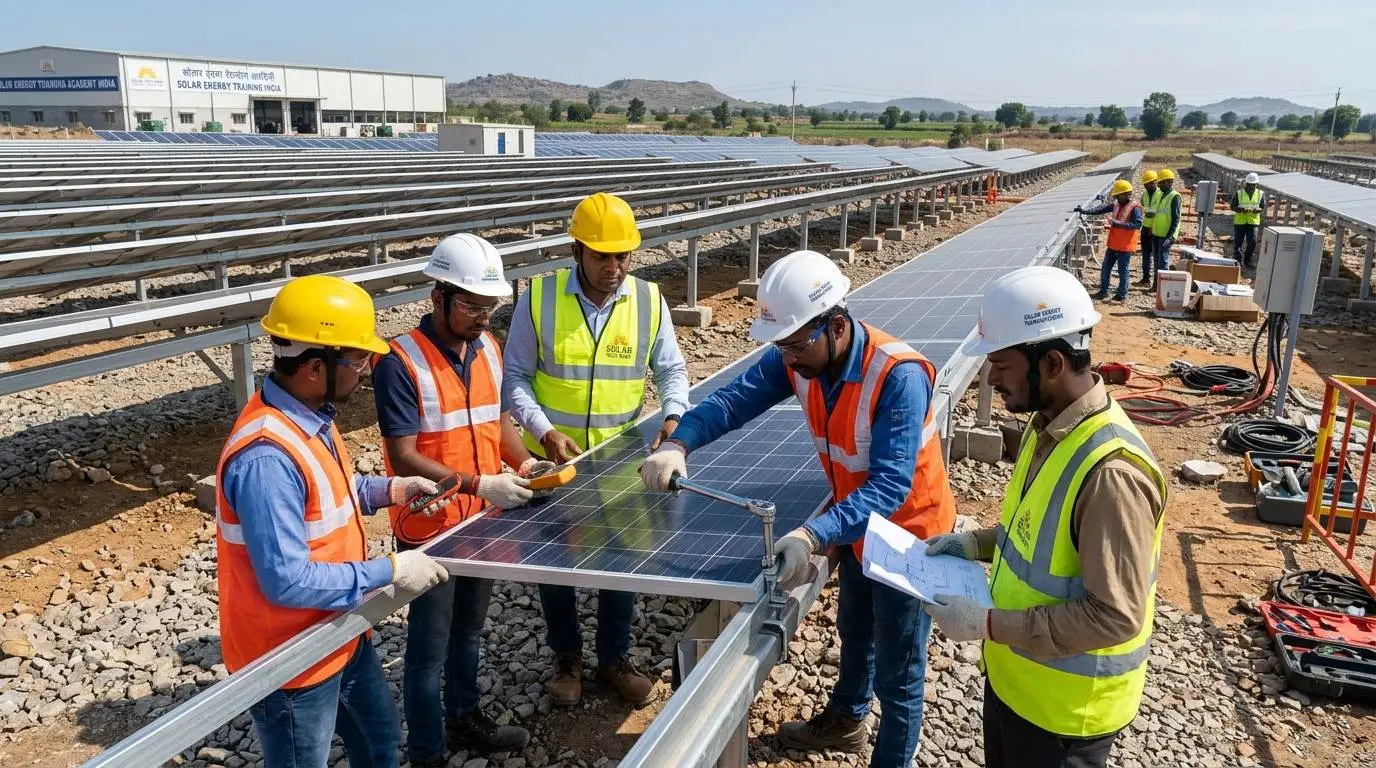
Which Short Term Renewable Energy Courses in India is Right for You?
There is no single "one-size-fits-all" course. The ideal renewable energy training program depends on five critical parameters: (1) your current academic background (10th/12th, ITI, Diploma, or B.E./B.Tech), (2) target technical skill set (hands-on installation, system design, plant O&M, or project EPC), (3) available study duration (intensive 3–7 day practical workshop vs. 1–3 month certificate vs. 1-year UGC-affiliated diploma), (4) delivery format (pure online theory vs. hybrid self-paced study with mandatory practical contact sessions), and (5) your immediate career or entrepreneurial objective.
Below is a rapid breakdown of the primary pathways across Indian clean energy training institutes:
Solar PV Installer & Technician Training
Focuses on physical module mounting, structure assembly, string cable routing, inverter terminations, electrical earthing, and safety protocols for rooftop and ground-mount arrays.
Solar PV Design & Simulation Engineering
Covers solar irradiance mathematics, string sizing, inverter matching, single line diagrams (SLD), 3D shading analysis in HelioScope, and yield estimation in PVsyst.
Solar Plant Operation & Maintenance (O&M)
Teaches preventive servicing, thermographic hotspot detection, I-V curve tracing, soiling loss mitigation, SCADA performance ratio (PR) monitoring, and electrical fault rectification.
Solar EPC & Business Development
Focuses on commercial site feasibility, Bill of Quantities (BoQ) costing, DISCOM net-metering regulations, PM Surya Ghar subsidy processing, and customer quotation proposals.
Table of Contents: Complete Renewable Energy Course Guide
Direct Navigation- 1. Why Study Renewable Energy in India? (Market Drivers & Policies)
- 2. Top 13 Short-Term Renewable Energy Course Categories
- 3. Master Course Comparison Table (Skills, Mode & Duration)
- 4. Which Course Should You Choose? (7 Learner Profiles)
- 5. Eligibility and Admission Prerequisites
- 6. Practical Technical Skills You Can Acquire
- 7. Realistic Career Opportunities & Entry-Level Job Roles
- 8. Online Learning vs. Hands-On Field Training
- 9. Course Fees & Duration Guide in India
- 10. How to Evaluate a Renewable Energy Training Institute (Checklist)
- 11. Why Consider the Indian Institute of Solar Energy (IISE)?
- 12. Explore Verified IISE Training Programmes
- 13. Course-Selection Decision Matrix
- 14. Frequently Asked Questions (FAQs)
Why Study Renewable Energy in India? Industry Drivers & Skilling Demand
India's renewable energy sector is experiencing a historic structural expansion driven by ambitious national decarbonization targets, favorable policy frameworks, and surging private sector capital investment. The Ministry of New and Renewable Energy (MNRE) and the Government of India have committed to establishing 500 GW of non-fossil electric capacity by 2030, aiming to meet 50% of the country's cumulative power requirements from renewable sources.
PM Surya Ghar: Muft Bijli Yojana
The central government's flagship scheme targeting 10 million (1 crore) residential rooftop installations has transformed the decentralized solar market. Implementing this mandate requires thousands of grassroots solar technicians, rooftop structure installers, site survey specialists, and net-metering documentation professionals across tier-1, tier-2, and rural Indian districts.
Electric Vehicle & BESS Integration
The rapid adoption of electric two-wheelers, three-wheelers, and commercial fleets has accelerated demand for battery energy storage systems (BESS), solar-powered EV charging stations, and battery management system (BMS) diagnostics. Professionals cross-trained in both solar PV and EV power systems hold a significant competitive advantage.
Skill Council for Green Jobs (SCGJ)
Industry skilling bodies such as the Skill Council for Green Jobs (SCGJ) and the National Institute of Solar Energy (NISE) emphasize the urgent necessity of standardized technical competencies. Formal short-term training bridges the wide gap between general academic qualifications and real-world EPC installation standards.
Industry Reality: Practical Competence vs. Educational Credentials
A common misconception among candidates is that holding a degree in electrical or mechanical engineering automatically qualifies one for solar EPC or plant operation. Solar energy involves specialized DC voltage hazards up to 1,500V, stringent earthing arrangements, PV-specific inverter grid codes (CEA Technical Standards for Connectivity), and specialized software simulation tools (HelioScope, PVsyst) that are rarely covered in traditional college curricula. Short-term vocational courses provide this targeted, practical domain specialization.
Top 13 Short-Term Renewable Energy Course Categories in India
Renewable energy education is highly diversified. To help you select the exact training required for your background and objectives, we have categorized the leading short-term programs available across India. Note that while IISE offers specialized programs in several of these domains, other categories represent general industry vocational options. Individual short certificates are distinct from 1-year government-recognized or UGC-affiliated diplomas.
Solar PV Fundamentals & Certificate Courses
Overview: Provides an essential theoretical and conceptual foundation of photovoltaic energy conversion, solar irradiance metrics (GHI, DNI, DHI), semiconductor cell physics, solar spectrum principles, and introductory electrical parameters (Voc, Isc, Vmp, Imp).
Target Audience: Beginners, school leavers (10th/12th), non-technical degree holders, and professionals from other industries considering a green energy switch.
Core Practical Skills: Solar geometry, calculating sun angles, understanding peak sun hours (PSH), reading solar module spec sheets, standard test conditions (STC vs. NOCT), and introductory system components.
Practical Component: Measuring solar irradiance using pyranometers/lux meters; basic bench multimeter testing of mini PV modules; identifying shading impacts on open-circuit voltage.
Indicative Duration: 1 week to 1 month (Indicative industry duration)
Entry Prerequisites: Open to all; basic Class 10 or 12 mathematics and science recommended.
Potential Roles & Applications: Junior technical assistant, customer support associate for solar suppliers, solar retail sales executive.
Solar Panel Installation & Solar PV Installer Training
Overview: Rigorous vocational training focused on physical civil mounting, mechanical structure alignment, module bolting, DC cable routing, string connections, crimping MC4 connectors, and solar earthing pit installations.
Target Audience: ITI electricians, wiremen, polytechnic diploma holders, construction contractors, and site supervisors.
Core Practical Skills: Rooftop structural anchoring (ballasted, penetration, tin shed clamps), torque wrench usage, DC wire sizing, MC4 connector assembly, SPD installation, and earthing electrode bonding.
Practical Component: Hands-on mounting structure assembly on mock roofs; tool handling (crimpers, torque wrenches, insulation strippers); earth resistance testing using earth testers.
Indicative Duration: 3 days to 4 weeks (Contact workshop or certified vocational course)
Entry Prerequisites: Class 10/12, ITI (Electrician/Wireman), or practical trade experience.
Potential Roles & Applications: Certified Solar PV Installer, Rooftop Solar Fitter, Site Assembly Technician, Lead Rooftop Installer under PM Surya Ghar projects.
Solar Technician Training & Troubleshooting
Overview: Comprehensive electrical and maintenance training aimed at preparing candidates for end-to-end field diagnostics, AC/DC distribution box assembly, inverter setup, and electrical troubleshooting in distributed and utility solar arrays.
Target Audience: ITI electrical graduates, practicing electricians, electrical maintenance supervisors, and service technicians.
Core Practical Skills: Wiring DCDB/ACDB boxes, selecting MCCBs/MCBs/fuses, testing open-circuit voltage (Voc) and short-circuit current (Isc) across strings, insulation resistance testing (meggering), and inverter error code diagnosis.
Practical Component: Wiring an inverter setup from scratch; identifying loose terminations; using clamp multimeters to measure string imbalance; testing surge protection devices (SPDs).
Indicative Duration: 2 weeks to 3 months (Short certificate) or 1 Year (Technician Diploma)
Entry Prerequisites: 10th/12th with ITI Electrical, Diploma, or verified field electrician background.
Potential Roles & Applications: Solar Service Technician, Field Maintenance Engineer, Commissioning Assistant, Rooftop Service Specialist.
Solar PV System Design & Engineering (AutoCAD, PVsyst, HelioScope)
Overview: Advanced design curriculum teaching mathematical string sizing, inverter matching ratios, single line diagram (SLD) drafting in AutoCAD, 3D rooftop shading simulation in HelioScope, and yield estimation & loss trees in PVsyst.
Target Audience: Electrical, Mechanical, and Civil Engineers (B.E./B.Tech/Diploma), Solar Draftsmen, Project Engineers, and Energy Consultants.
Core Practical Skills: Solar yield modeling, tilt angle & azimuth optimization, temperature coefficient derating, row pitch calculations to avoid inter-row shading, string voltage matching against MPPT windows, and BoQ generation.
Practical Component: Hands-on projects designing a 10 kW residential rooftop and a 500 kW commercial plant; running PVsyst simulation reports; generating SLD drawings.
Indicative Duration: 1 month to 3 months (Specialized Certificate or PG Diploma Module)
Entry Prerequisites: Diploma or Degree in Engineering, Architecture, or relevant technical background with computer literacy.
Potential Roles & Applications: Junior Solar Design Engineer, PV Design Specialist, Solar CAD Draftsman, Pre-Sales Proposal Engineer, Technical Estimator.
Solar Operation & Maintenance (O&M) and Plant Servicing
Overview: Focuses on maximizing energy harvest and asset uptime over a 25-year operational plant life cycle through scheduled preventive maintenance, module cleaning logistics, and advanced condition monitoring.
Target Audience: Field engineers, industrial facility managers, plant supervisors, and electrical maintenance staff.
Core Practical Skills: Performance Ratio (PR) calculation, soiling loss tracking, thermographic hotspot scanning using infrared (IR) cameras, I-V curve tracing, inverter preventive servicing, and vegetation control.
Practical Component: Operating thermal imaging cameras to identify defective solar cells; running I-V curve tracer tests; interpreting SCADA inverter alarms.
Indicative Duration: 3 days to 2 weeks (Indicative crash course/specialization)
Entry Prerequisites: Basic electrical knowledge or ITI/Diploma in Electrical/Electronics.
Potential Roles & Applications: Solar O&M Engineer, Plant Asset Executive, Field Maintenance Supervisor, Solar Service Lead.
Rooftop Solar Design & Installation (PM Surya Ghar Compliance)
Overview: Targeted specifically at residential, housing society, and commercial rooftop projects under current Indian state net-metering regulations and the PM Surya Ghar Muft Bijli Yojana national portal standards.
Target Audience: Electricians, civil/electrical contractors, local entrepreneurs, housing society consultants, and rooftop installers.
Core Practical Skills: Rooftop shadow analysis using Solar Pathfinder / smartphone tools, structural load assessment for RCC roofs vs metal sheds, net-metering application documentation, and DISCOM inspection preparedness.
Practical Component: Performing an actual rooftop site survey; calculating roof usable area; preparing a net-metering single-line diagram and subsidy proposal.
Indicative Duration: 1 week to 1 month
Entry Prerequisites: 10th/12th or ITI/Diploma/Degree with an interest in rooftop solar.
Potential Roles & Applications: Rooftop Solar Consultant, Site Survey Lead, Residential Solar Coordinator, DISCOM Liaison Officer.
Off-Grid & Hybrid Solar Systems (Battery Storage Integration)
Overview: Teaches the design, component matching, and installation of standalone off-grid and battery-backed hybrid solar PV systems for remote areas, telecom towers, agricultural pump sets, and backup power.
Target Audience: Rural energy technicians, telecom infrastructure managers, agricultural pump installers, and solar battery dealers.
Core Practical Skills: Battery bank sizing (Lithium Iron Phosphate vs Tubular Lead Acid), Days of Autonomy calculations, charge controller matching (PWM vs MPPT), hybrid inverter configuration, and DC load management.
Practical Component: Wiring a hybrid inverter with a battery bank; testing charge controller cut-off voltages; measuring battery state-of-charge (SoC) and internal resistance.
Indicative Duration: 3 days to 2 weeks
Entry Prerequisites: Basic knowledge of electrical DC/AC circuits.
Potential Roles & Applications: Off-Grid Solar Specialist, Rural Electrification Technician, Solar Pump Installer, Hybrid System Service Engineer.
Solar Project Execution, Testing & Commissioning
Overview: Covers end-to-end site project management from material dispatch to final grid synchronization. Includes pre-commissioning tests according to IEC 62446 standards, statutory electrical inspectorate compliance, and commercial handover.
Target Audience: Site engineers, project coordinators, civil/electrical contractors, and EPC project managers.
Core Practical Skills: IEC 62446 Category 1 & 2 testing, polarity checks, insulation resistance (DC & AC), earth continuity, transformer testing, grid synchronizing checks, and safety clearance checklists.
Practical Component: Executing pre-commissioning test reports; verifying inverter anti-islanding protection; handling DISCOM grid synchronization protocols.
Indicative Duration: 2 weeks to 1 month
Entry Prerequisites: Diploma or Degree in Electrical/Civil/Mechanical Engineering or prior site experience.
Potential Roles & Applications: Commissioning Engineer, Solar Site QA/QC Inspector, Project Site Supervisor, Assistant EPC Manager.
Solar Business & Entrepreneurship Training
Overview: Equips prospective entrepreneurs, channel partners, and contractors with the commercial, financial, and regulatory toolkit necessary to launch and scale a successful solar EPC or dealership venture in India.
Target Audience: Business owners, electrical contractors, prospective solar channel partners, startup founders, and technical professionals transitioning to business.
Core Practical Skills: Comprehensive project costing, margin calculation, vendor procurement negotiation, DISCOM empanelment procedures, PM Surya Ghar vendor registration, sales pitching, and contract risk management.
Practical Component: Formulating a real-world client quotation proposal; preparing an EPC customer agreement draft; building financial payback models (LCOE, IRR, ROI).
Indicative Duration: 1 week to 1 month
Entry Prerequisites: Open to entrepreneurs, graduates, and contractors with basic business or technical acumen.
Potential Roles & Applications: Solar EPC Business Owner, Solar Channel Partner, Rooftop Solar Dealer, Commercial Clean Energy Consultant.
Renewable Energy Fundamentals (Multi-Source Clean Tech)
Overview: Broad multi-disciplinary overview introducing solar PV, wind turbine aerodynamics, bioenergy, small hydro, grid integration challenges, and national carbon reduction policies.
Target Audience: Students, ESG corporate executives, environmental science graduates, and public policy researchers.
Core Practical Skills: Comparative levelized cost of electricity (LCOE), understanding national energy balances, carbon credit accounting basics, and renewable energy certificate (REC) trading.
Practical Component: Case study reviews of hybrid solar-wind parks; carbon offset calculations for commercial facilities.
Indicative Duration: 2 to 4 weeks (Industry-wide general course)
Entry Prerequisites: General educational background; no specific engineering prerequisites.
Potential Roles & Applications: Sustainability Analyst, ESG Research Associate, Clean Tech Content Writer, Project Research Coordinator.
Electric Vehicle (EV) Technology Fundamentals & Powertrain
Overview: Specialized vocational training covering EV architecture, electric motor topologies (BLDC, PMSM), motor controllers, regenerative braking systems, and EV charging station infrastructure (AC Type 2 & DC Fast Charging).
Target Audience: Automobile technicians, mechanical & electrical engineers, ITI graduates, and service center technicians.
Core Practical Skills: EV powertrain wiring, controller tuning, testing throttle and hall sensors, understanding high-voltage interlock loops (HVIL), and installing EV supply equipment (EVSE).
Practical Component: Bench testing a BLDC hub motor with electronic controller; diagnosing throttle faults; EV charger wiring and earthing setup.
Indicative Duration: 2 weeks to 3 months (or 1 Year Diploma)
Entry Prerequisites: Basic electrical, automobile, or engineering background.
Potential Roles & Applications: EV Service Technician, EV Retrofit Assistant, Charging Station Installation Executive, Powertrain Assembly Technician.
Battery Energy Storage Systems (BESS) Fundamentals
Overview: Detailed study of electrochemistry (LFP, NMC, Sodium-ion), cell balancing, battery management systems (BMS), thermal management, and stationary battery storage design for solar-plus-storage applications.
Target Audience: Electrical engineers, battery assembly technicians, UPS/inverter specialists, and solar design professionals.
Core Practical Skills: Cell testing and grading, spot welding nickel strips, BMS wiring and communication protocols (CAN bus, RS485), thermal runaway risk mitigation, and C-rate cycle sizing.
Practical Component: Building a custom LiFePO4 battery pack; programming a smart BMS with bluetooth/UART; running charge/discharge testing on battery capacity testers.
Indicative Duration: 2 weeks to 2 months
Entry Prerequisites: Understanding of DC electricity, electronics, or relevant trade background.
Potential Roles & Applications: Battery Assembly Technician, BMS Diagnostic Specialist, Energy Storage Project Assistant, Quality Control Tester.
Renewable Energy Project Management & EPC Contracts
Overview: Focuses on commercial contracting, FIDIC conditions, EPC tendering, risk mitigation, project scheduling (Gantt/PERT in MS Project), supply chain logistics, and quality assurance during large-scale solar rollouts.
Target Audience: Senior engineers, project managers, supply chain professionals, and corporate solar executives.
Core Practical Skills: Preparing solar EPC tender bids, analyzing technical specifications, drafting warranty terms, contractor management, and project milestone monitoring.
Practical Component: Evaluating actual government/commercial RFP documents; formulating risk mitigation matrices for solar installations.
Indicative Duration: 1 to 3 months (Executive certification / Industry specialization)
Entry Prerequisites: Degree in Engineering or Project Management with professional work experience.
Potential Roles & Applications: Solar Project Coordinator, Assistant EPC Project Manager, Clean Energy Procurement Specialist.
Master Comparison Table: Short-Term Renewable Energy Courses in India
Compare training specializations across typical target profiles, indicative study durations, delivery formats, practical lab requirements, and potential career applications. Use horizontal scrolling on mobile devices to inspect all columns.
| Course / Specialization | Target Learner Profile | Core Practical Competencies | Indicative Duration | Delivery Mode | Hands-on Training | Career Pathway |
|---|---|---|---|---|---|---|
| Solar PV Fundamentals Certificate | 10th/12th, Non-tech Graduates, Beginners | Solar geometry, PSH, Voc/Isc measurement, basic module parameters | 1 to 4 Weeks | Online / Classroom | Basic bench testing | Junior technical assistant, retail solar sales |
| Solar PV Installer Course | ITI Wiremen, Electricians, Site Fitters | Rooftop structure assembly, module clamping, MC4 crimping, earthing | 3 to 14 Days | Hands-on Workshop | Mandatory Field Practice | Certified Rooftop Installer, PM Surya Ghar Contractor |
| Solar Technician Diploma | ITI Electrical, 12th Vocational, Electricians | DCDB/ACDB wiring, inverter setup, string troubleshooting, megger testing | 6 Months to 1 Year | Hybrid / Regular | Intensive Lab + Field | Solar Service Technician, Maintenance Supervisor |
| Solar PV System Design (AutoCAD/PVsyst) | B.E./B.Tech/Diploma Engineers, Architects | String sizing, inverter matching, 3D shading, HelioScope & PVsyst yield reports | 4 Weeks to 3 Months | Online / Software Lab | Computer Design Simulation | Solar Design Engineer, Pre-Sales Proposal Specialist |
| Solar Plant O&M Servicing | Field Engineers, Facility Supervisors | Thermal imaging (IR), I-V curve tracing, soiling loss tracking, PR calculation | 3 to 10 Days | On-site / Workshop | Instrument Diagnostic Lab | Solar O&M Engineer, Plant Asset Executive |
| Solar Off-Grid & Battery Design | Rural Contractors, UPS/Inverter Dealers | Battery bank sizing, MPPT charge controller matching, autonomous system wiring | 3 to 14 Days | Workshop / Hybrid | Battery & Inverter Bench Lab | Off-Grid Specialist, Solar Pump Technician |
| Solar Business & Entrepreneurship | Entrepreneurs, EPC Contractors, Dealers | BoQ costing, vendor procurement, net-metering liaison, customer proposals, LCOE | 1 to 4 Weeks | Classroom / Online | Project proposal case studies | Solar EPC Founder, Channel Partner, Distributor |
| Electric Vehicle (EV) Technology | Automobile Techs, Electrical Engineers | EV powertrain, BLDC motor control, throttle testing, EVSE charger setup | 2 Weeks to 1 Year | Hybrid / Regular | EV Bench & Charger Lab | EV Service Technician, Charging Station Installer |
| PG Diploma in Solar Technology | Engineering Graduates (B.E./B.Tech) | Complete engineering, AutoCAD, PVsyst, project execution, testing, substation design | 1 Year (UGC Affiliated) | Distance / Hybrid | Practical Contact Workshop | Senior Solar Project Engineer, EPC Project Manager |
Which Course Should You Choose? Guidance for 7 Learner Profiles
Selecting the appropriate renewable energy course depends heavily on your prior educational foundation and immediate professional ambitions. A training program that accelerates an engineering graduate’s career may be overwhelming or mathematically unsuitable for a high school leaver, while an installer certificate may lack the depth needed by a prospective EPC founder. Find your profile below for tailored recommendations:
1. Class 10 and Class 12 School Leavers
Entry LevelRecommended Direction: Solar PV Installer Certificate or foundational vocational training. Avoid high-level simulation software courses (like PVsyst or AutoCAD design) until you possess foundational electrical circuits knowledge. Focus on physical rooftop mounting, tool handling, DC wiring safety, and practical installation practices.
2. ITI Graduates & Polytechnic Diploma Holders
Technical TradeRecommended Direction: Solar Technician Diploma or comprehensive Solar Technology Diploma. Leverage your existing electrical theory to master AC/DC distribution boxes, inverter terminations, fault isolation, earth pit resistance testing, and preventive maintenance. This bridges the gap to supervisor or lead technician roles.
3. Engineering Graduates (B.E. / B.Tech - Electrical, Mechanical, Civil)
Engineering TrackRecommended Direction: Solar PV Design Engineering or Postgraduate Diploma in Solar Technology. Target advanced string sizing mathematics, single-line diagram generation, PVsyst yield simulation, HelioScope 3D modeling, and HT substation interconnection. This positions you for design office and project engineering roles.
4. Working Professionals Seeking a Clean Energy Career Switch
Career PivotRecommended Direction: Flexible distance / hybrid certificate or PG Diploma with short practical contact sessions. Allows professionals from conventional power, telecom, automotive, or IT domains to upskill without quitting their current employment. Focus on solar project management, energy auditing, or system design.
5. Electricians & Existing Uncertified Solar Installers
Skill UpgradeRecommended Direction: Advanced Installer Certification & Solar O&M Servicing. Many experienced electricians know AC wiring but lack understanding of DC string voltages, lightning arrestor radius calculations, earth fault loops, and DISCOM net-metering synchronization standards. Formal certification certifies your expertise.
6. Entrepreneurs, Electrical Contractors & Prospective Solar EPCs
Business FoundersRecommended Direction: Solar Entrepreneurship & Commercial EPC Development. Focuses on site feasibility assessment, BoQ preparation, financial modeling (IRR, payback period), vendor selection, PM Surya Ghar vendor onboarding, and customer contract management.
7. Candidates Interested in Clean Mobility & Energy Storage (EV & BESS)
EV & BatteryRecommended Direction: EV Technology Diploma or Battery Systems Specialization. Tailored for automotive technicians and electrical engineers wanting to specialize in EV powertrains, motor controllers, EV charger installation, and Lithium-ion battery pack assembly with BMS.
Eligibility and Admission Requirements: What You Need to Know
Admission criteria vary significantly depending on the level of technical certification. Reputable training institutions distinguish clearly between foundational vocational courses, intermediate technician programs, and advanced postgraduate engineering diplomas:
A. Vocational & Installer Certificates
- Minimum Qualification: 10th or 12th pass (any stream) or ITI certificate.
- Prior Experience: No mandatory experience required; basic familiarity with electrical safety and tool handling is advantageous.
- Physical Aptitude: Comfort working at heights, carrying rooftop panels, and working in outdoor conditions.
B. Technician & Technical Diplomas
- Minimum Qualification: ITI (Electrician, Wireman, Fitter, Electronics) or 10+2 with Science/Vocational subjects.
- Technical Aptitude: Understanding of AC/DC electricity, basic circuit diagrams, and multimeter operations.
- Program Specifics: IISE's 1-Year Solar Technician Diploma accepts 10th/12th/ITI candidates seeking formal technical qualification.
C. Postgraduate Diplomas & Design Engineering
- Minimum Qualification: B.E. / B.Tech / B.Sc / Polytechnic Diploma in Electrical, Mechanical, Civil, Electronics, or Energy Engineering.
- Technical Aptitude: Computer literacy for CAD drafting, software simulation tools, and mathematical load calculations.
- Program Specifics: IISE PG Diploma courses require a recognized degree or technical diploma for university affiliation eligibility.
Practical Skills Acquired Across Renewable Energy Courses
Industry employers value verifiable technical competencies over theoretical rote learning. The following matrix details the practical skills taught across quality short-term programs:
Using compasses, clinometers, and 3D modeling tools to evaluate seasonal roof shading and usable square meterage.
Calculating string lengths based on lowest ambient temperature Voc and maximum inverter MPPT DC input voltage limits.
Assembling hot-dip galvanized and aluminum mounting structures with correct torque values and wind load resistance.
Crimping UV-resistant solar DC cables with IP67/IP68 MC4 connectors to prevent high-resistance joints and electrical fires.
Installing dedicated AC, DC, and lightning arrestor earth pits; testing earth pit resistance to maintain below 5 ohms.
Configuring on-grid string inverters, setting Indian grid codes, anti-islanding parameters, and RS485/Wi-Fi logging.
Modeling system performance, generating energy yield reports (kWh/kWp), loss diagrams, and financial cashflow sheets.
Conducting insulation resistance (megger), polarity, open-circuit voltage, and short-circuit current tests prior to power-on.
Operating infrared thermal cameras to spot hot spots, bypass diode failures, microcracks, and localized junction heating.
Matching Lithium Iron Phosphate (LiFePO4) cell capacities, wiring smart BMS protection, and configuring charge controllers.
Calculating detailed itemized costs for modules, inverters, structures, cables, earthing, BOS, and installation labor.
Navigating state DISCOM net-metering portal submissions, transformer capacity clearances, and CEIG statutory inspection filings.
Career Opportunities After Short-Term Training: Realistic Roles & Progression
Short-term renewable energy programs open verifiable entry-level pathways across solar EPC contractors, module manufacturers, O&M service companies, rooftop installation agencies, and green startups. Career success, however, depends on demonstrable hands-on competence, prior qualifications, problem-solving skills, and local market demand rather than paper certificates alone.
Solar Installation Technician
Executes rooftop and ground-mounted civil assembly, panel clamping, string connections, and earthing under senior site supervisors.
Solar Plant O&M Technician
Maintains active solar arrays, carries out periodic panel cleaning, string testing, inverter maintenance, and fault rectifications.
Junior Solar Design Engineer
Prepares AutoCAD layout drawings, Single Line Diagrams (SLD), and simulation yield analysis reports in HelioScope or PVsyst for client proposals.
Solar Site Supervisor
Manages rooftop construction schedules, inventory dispatch, tool safety, quality checks, and client coordination at residential and commercial sites.
Technical Sales & Pre-Sales Executive
Assesses prospective customer electricity bills, calculates solar capacity requirements, prepares technical proposals, and explains financial savings.
Solar EPC Entrepreneur
Establishes a localized rooftop solar turnkey business, executing site surveys, procurement, installation, and DISCOM net-metering subsidy liaison.
Online Courses vs. Hands-On Field Training: Making the Right Choice
With the proliferation of e-learning platforms, prospective learners often wonder whether an online solar course is sufficient or if physical hands-on training is mandatory. The answer depends strictly on which aspect of clean energy you intend to master:
When Online Training is Highly Effective
- Theoretical Concepts: Solar geometry, PV physics, irradiance calculations, and policy frameworks.
- Design Software Simulation: Learning AutoCAD drafting, HelioScope layout design, and PVsyst yield estimation.
- Financial & EPC Modeling: BoQ calculation, payback period analysis, LCOE, and contract negotiation.
- Working Professional Flexibility: Self-paced or weekend live lectures without travel overhead.
When In-Person Hands-on Training is Mandatory
- Electrical Safety & DC Hazards: Solar DC strings carry lethal voltages (600V–1,500V DC) that do not cross zero; improper handling creates catastrophic arc flashes.
- Tool Handling & Mechanical Assembly: Correct torque application, crimping MC4 connectors, and anchoring rail clamps cannot be learned via video.
- Instrument Testing: Hands-on operation of insulation testers (meggers), earth pit testers, thermal IR cameras, and clamp meters.
- Inverter Wiring: Making physical terminations inside ACDB, DCDB, and string inverter junction boxes.
Course Fees and Duration: Factors Influencing Cost and Benchmarks
Course fees across Indian renewable energy institutes vary depending on program depth, hands-on laboratory access, licensed engineering software (PVsyst, AutoCAD, HelioScope), physical site visits, and formal university affiliation. Understanding these parameters ensures you invest in high-value education.
3-Day to 2-Week Intensive
Focused hands-on workshops covering installation, DC cabling, or solar plant O&M.
1 to 3 Month Certificates
Comprehensive PV design engineering, AutoCAD drafting, and simulation modeling.
1-Year Technical & PG Diplomas
UGC-affiliated diplomas offering deep technical curricula and formal university credentials.
Advisory on Current Program Fees: Course fees cited above represent industry ranges across vocational institutions in India. IISE maintains transparent, official fee schedules for all certificate, technician, and university-affiliated diploma programs (e.g. Diploma in EV Technology is listed on official portal at ₹79,999). Candidates should always verify current batch schedules, fee inclusions, and installment options directly with the IISE admissions office.
How to Evaluate a Renewable Energy Training Institute: 12-Point Checklist
Before enrolling and paying admission fees at any solar or renewable energy training center in India, cross-reference the institution against this objective 12-point quality checklist:
Does the syllabus cover modern bifacial modules, higher-wattage TOPCon/HJT panels, and Central Electricity Authority (CEA) grid connectivity regulations?
Are instructors active solar engineers and project managers with site execution experience, or purely academic textbook lecturers?
Does the institute possess working on-grid/off-grid inverters, genuine testing meters, and mock rooftop mounting structures for hands-on practice?
Are Personal Protective Equipment (PPE), lockout/tagout (LOTO), and DC arc-flash prevention protocols actively taught and practiced?
Do design engineering courses provide training on industry-standard design tools like PVsyst, AutoCAD, and HelioScope?
Does certification require practical bench testing, SLD drafting, and troubleshooting evaluations rather than automatic attendance-based passes?
Is the awarding body clearly stated? If enrolled in a diploma, is it backed by a recognized university (UGC-affiliated) or statutory council?
Are technical instructors accessible for project guidance, design review, and post-lecture query resolution?
Does the institute offer transparent career networking and resume support without fabricated "100% Guaranteed High-Salary" slogans?
Are all charges (exam fees, lab materials, certificate issuance) communicated transparently upfront with no surprise hidden fees?
Can you connect with genuine alumni or review verifiable video testimonials from working professionals and entrepreneurs?
Does the institute provide pathways into complementary high-growth domains such as Battery Storage (BESS) and Electric Vehicle Technology?
Why Consider the Indian Institute of Solar Energy (IISE)?
The Indian Institute of Solar Energy (IISE) is dedicated to delivering industry-aligned technical training across solar energy engineering, rooftop PV installation, battery storage systems, and electric vehicle technology. Headquartered in Mumbai, IISE has built an educational model centered on ground-level technical competence:
Engineering-Grade Curriculum
Courses are developed by experienced solar EPC engineers to reflect current field challenges, including string inverter sizing, net-metering portal compliance, and PVsyst loss trees.
Hands-on Contact Workshops
Students gain direct physical experience with rooftop structures, DC cabling, inverters, earthing pits, and instrumentation during scheduled practical training contact sessions.
Recognized Diplomas
For candidates seeking formal academic qualifications, IISE provides 1-Year UGC-affiliated Technical Diplomas and Postgraduate Diplomas in Solar and EV Technology.
Solar + EV Cross Integration
Uniquely positioned to offer specialized training across both solar PV power generation and electric mobility / battery storage, equipping students for integrated clean tech roles.
Explore Verified IISE Renewable Energy Programmes
The Indian Institute of Solar Energy offers a structured ladder of courses tailored to diverse educational qualifications and professional goals. Explore our verified programs below:
Solar Engineer Certificate Course
Intensive engineering curriculum covering PV plant design, mathematical string calculations, single-line diagrams, and solar simulation software modeling.
Diploma in Solar Technology
Comprehensive 1-year technical program covering solar resource evaluation, rooftop design, off-grid storage, installation techniques, and maintenance.
PG Diploma in Solar Technology
Postgraduate-level engineering credential focused on megawatt-scale solar parks, high-voltage substations, PVsyst yield optimization, and commercial EPC.
Solar Technician Diploma
Hands-on vocational diploma preparing technicians for DC/AC electrical wiring, inverter fault diagnostics, string megger testing, and rooftop solar servicing.
Solar PV Installers Practical Course
Focused vocational skilling on rooftop structural mounting, module clamping, MC4 connector crimping, DC cable routing, and solar earthing safety.
Solar Operation & Maintenance (O&M) Training
Specialized asset management training focusing on infrared thermography, I-V curve tracing, soiling loss tracking, and scheduled plant servicing.
Solar Off-Grid Design & Installation
Teaches standalone battery storage sizing, Lithium-ion/Lead-acid battery bank integration, MPPT charge controllers, and hybrid inverter setups.
Solar Entrepreneurship Development Program
Business-focused program for prospective solar EPC founders, contractors, and channel partners covering project costing, BoQ, PM Surya Ghar, and DISCOM liaison.
Diploma in Electric Vehicle (EV) Technology
Detailed clean mobility diploma covering EV powertrains, BLDC motors, electronic speed controllers, BMS architecture, and EV charging station installation.
PG Diploma in Electric Vehicle Technology
Advanced postgraduate diploma for engineers covering high-voltage battery architecture, motor controller tuning, regenerative systems, and EVSE network design.
Course-Selection Decision Guide: 4-Step Pathway
Follow this simple 4-step decision flowchart to map your current profile directly to the most appropriate renewable energy program:
Are you 10th/12th/ITI (opt for Installer or Technician Diploma) or do you hold an Engineering Diploma / Degree (opt for Design Engineering or PG Diploma)?
Do you want to work on physical rooftops & tools (Installation/O&M), work on a computer designing PV arrays (Design/Simulation), or launch a contracting business (Entrepreneurship)?
Can you commit to full-time study, an intensive 3–7 day hands-on workshop, or do you require a flexible 1-year distance/hybrid diploma while working?
Ensure your chosen course provides certified practical competency or recognized university affiliation matching your long-term career needs.
Frequently Asked Questions: Renewable Energy & Solar Courses in India
Direct, objective answers to the most common questions asked by Indian students, technicians, engineers, and working professionals:
What are the best short-term renewable-energy courses in India?
The best course depends on your background and objective: for engineering graduates, the Solar Engineer Certificate or PG Diploma in Solar Technology focusing on PVsyst and HelioScope is ideal; for ITI wiremen and technicians, the Solar PV Installers or Solar Technician Diploma provides essential hands-on wiring skills; and for prospective contractors, the Solar Entrepreneurship Development Program offers commercial EPC guidance.
Which short-term solar courses are suitable for beginners?
Beginners without prior electrical engineering experience should start with a Solar PV Fundamentals Certificate or a hands-on Solar PV Installer Course. These focus on introductory solar concepts, rooftop structure assembly, tool handling, DC wiring safety, and basic multimeter testing before progressing to advanced simulation design.
Can I study solar energy after Class 10 or Class 12?
Yes. Class 10 and 12 graduates can enroll in foundational vocational programs such as the Solar PV Installers course or the 1-Year Solar Technician Diploma. These courses emphasize physical rooftop installation, wiring assembly, and plant servicing, which do not require an advanced calculus or engineering degree.
Are renewable-energy certificate courses useful for getting a job?
Yes, provided they include verified practical training or recognized software simulation skills. In the solar industry, employers prioritize technicians who can safely wire DC distribution boxes and engineers who can run accurate PVsyst yield reports over candidates with generic degrees lacking specialized solar knowledge.
How long does a short-term solar course take in India?
Short-term programs vary widely: intensive hands-on installer or O&M workshops typically run between 3 to 14 days; software design and engineering certificates take 1 to 3 months; and comprehensive technical or postgraduate diplomas run for 1 full year with scheduled practical contact sessions.
Can I learn solar installation purely online?
No. While theoretical concepts, solar geometry, and PVsyst software design can be effectively learned online, physical installation—such as DC cable crimping, torque wrench calibration, earth pit resistance testing, and high-voltage DC safety—strictly requires in-person, supervised hands-on workshop experience.
Which solar course is most suitable for working professionals?
Working professionals typically benefit most from distance or hybrid programs, such as the PG Diploma in Solar Technology or weekend Solar Design Engineer modules. These formats allow self-paced online lecture completion followed by a short intensive practical contact workshop.
What is the difference between a solar certificate and a diploma?
A certificate is a focused, short-duration credential (typically 1 week to 3 months) targeting a specific skill set like installation, design, or O&M. A diploma is a structured, longer-duration qualification (typically 1 year) with a broader curriculum, formal university affiliation (e.g. UGC-affiliated), and statutory academic recognition.
What practical skills are taught in solar installation training?
Solar installation training covers rooftop civil structural anchoring, module bolting, DC string wiring, MC4 connector crimping, DCDB/ACDB installation, lightning arrestor and earthing electrode bonding, polarity verification, and insulation resistance megger testing.
Can short-term training help me start a solar EPC business?
Yes. Specialized entrepreneurship programs (like IISE’s Solar Entrepreneurship Development Program) teach site feasibility assessment, BoQ preparation, vendor procurement, margin estimation, DISCOM net-metering liaison, and PM Surya Ghar vendor registration processes essential for launching a solar venture.
Are practical sessions really necessary for solar technicians?
Absolutely. Solar arrays operate at high DC voltages (up to 1,000V–1,500V DC) where electric arcs do not extinguish naturally as AC arcs do. Hands-on training under expert supervision is critical to learn proper PPE usage, lockout/tagout (LOTO) protocols, and safe disconnect practices.
What should I check before paying course fees to any institute?
Always inspect the 12 key factors: curriculum modernity (coverage of TOPCon panels and CEA grid codes), faculty EPC site experience, physical lab equipment, licensed software usage (not pirated tools), clear fee inclusions with no hidden charges, verifiable student reviews, and official university affiliation credentials if enrolling in a diploma.
Are Electric Vehicle (EV) and battery courses part of renewable energy?
Yes. Electric mobility and renewable energy are converging through solar-powered EV charging infrastructure, smart grid net-metering, and Battery Energy Storage Systems (BESS). Professionals trained in both solar generation and battery/EV technology enjoy expanded career versatility.
How do I choose an appropriate IISE training programme?
Review the Course-Selection Decision Guide above or contact IISE’s admissions counseling team via WhatsApp (+91 98192 25503) or email (info@iise.ac). Share your educational background, current location, and career ambitions to receive tailored, non-promotional course recommendations.
Choose the Right Renewable Energy Course for Your Career
Tell us about your educational background, technical interests, and career goals. The Indian Institute of Solar Energy (IISE) academic advisory team can help you identify suitable training options and explain batch schedules, practical contact sessions, and admission prerequisites.
Related Clean Energy Guides and Educational Resources
Solar Energy Courses in India →
Comprehensive overview of solar technical certifications, diplomas, and degree programs.
Electric Vehicle Courses in India →
Explore EV powertrain engineering, battery diagnostics, and charging infrastructure diplomas.
Battery Systems Training Hub →
Specialized courses in Lithium-ion chemistry, BMS calibration, and stationary storage.
Career & Education Guides Hub →
In-depth articles covering solar career pathways, common industry mistakes, and technical tutorials.
Authoritative References & Policy Citations
- Ministry of New and Renewable Energy (MNRE), Govt. of India: National Solar Mission, PM Surya Ghar Muft Bijli Yojana guidelines, and 500 GW renewable energy capacity roadmap.
- National Institute of Solar Energy (NISE): Suryamitra Skill Development Programme framework and solar qualification packs.
- Skill Council for Green Jobs (SCGJ): National Occupational Standards (NOS) for Solar PV Installer (Suryamitra) and Solar O&M Technician.
- Central Electricity Authority (CEA): Technical Standards for Connectivity of Distributed Generation Resources Regulations.
- Bureau of Energy Efficiency (BEE): National energy conservation and electrical efficiency benchmarks.
- International Renewable Energy Agency (IRENA): Renewable Energy and Jobs Annual Review report series.