Two-Wheeler EV Market in India: Career and Business Opportunities
India's vehicular electrification revolution is overwhelmingly powered by two wheels. Out of every 100 electric vehicles registered nationwide, more than 56 are electric scooters or motorcycles. With national retail registrations having crossed 9.44 lakh units in FY 2023-24 and exceeding 1.15 million units in FY 2024-25, India has solidified its position as the world's second-largest electric two-wheeler market. This profound structural transformation is dismantling century-old internal combustion paradigms and building an entirely new engineering, service, and dealership ecosystem.
Driven by the favorable economics of urban commuting, falling lithium-ion cell prices, the Central Government's landmark PM E-DRIVE (PM Electric Drive Revolution in Innovative Vehicle Enhancement) initiative, and aggressive commercial fleet electrification across quick-commerce delivery giants, the two-wheeler EV sector is no longer an experimental clean-tech niche. It is a mainstream automotive powerhouse generating thousands of specialized technical roles and viable entrepreneurial opportunities.
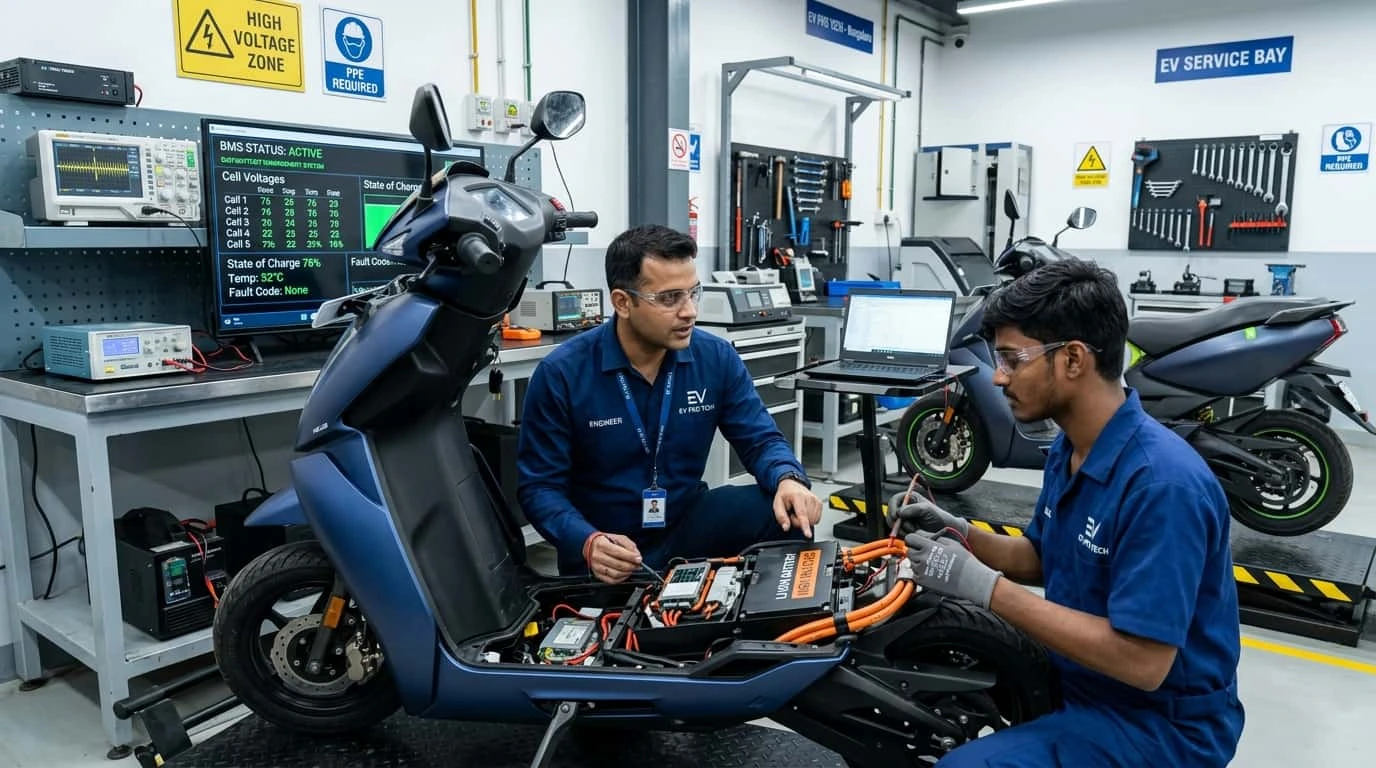
two-wheeler EV market in India - Article Summary & Key Takeaways
Navigating the electric two-wheeler transition requires balancing macroeconomic market data with practical technical execution. Before exploring the individual technical chapters, review the core pillars shaping India's electric two-wheeler landscape:
Two-wheelers represent over 56% of total EV sales in India. Retail registrations surpassed 1.15 million units in FY25, on track to achieve 25%–30% total two-wheeler market penetration by 2030 supported by the ₹10,900-crore PM E-DRIVE framework.
Automotive recruitment has fundamentally pivoted from mechanical engine tuning to CAN-bus diagnostic telemetry, BMS firmware calibration, motor hall-sensor troubleshooting, and battery pack safety homologation under AIS-156 Phase 2.
High-potential business avenues include multi-brand independent EV service bays, battery health diagnostic clinics, commercial fleet annual maintenance contracts (AMCs), and specialized spare-parts distribution, requiring significantly less capital than legacy ICE dealerships.
At ~₹0.30/km for electricity versus ~₹2.35/km for petrol, a daily commuter traveling 30 km recovers the initial EV capital premium within 18 to 22 months, saving upwards of ₹50,000 across a 3-year operating lifecycle.
Battery pack repair, high-voltage testing (>60V DC), and retrofitting require formal compliance with CMVR Rule 126, AIS-156 Amendment 3, and Battery Waste Management Rules (BWMR) 2022 EPR mandates. Uncertified tinkering carries extreme fire and liability risks.
- 1. Breadcrumb & Article Hero
- 2. Executive Summary & Takeaways
- 3. India's Two-Wheeler EV Market
- 4. Why the Segment Matters & Drivers
- 5. 12 High-Demand Career Pathways
- 6. Technical Skills & Engineering Matrix
- 7. 10 Scalable Business Opportunities
- 8. Investment & Feasibility Matrix
- 9. How to Start an EV Service Centre
- 10. How to Evaluate an EV Dealership
- 11. EV Technology Explained: Components
- 12. EV vs Petrol Two-Wheelers (TCO)
- 13. Challenges, Risks & Mitigation
- 14. Government Policies & Compliance
- 15. IISE Certified Learning Pathways
- 16. Four-Step Professional Roadmap
- 17. Practical Pre-Entry Checklist
- 18. Frequently Asked Questions (12 FAQs)
- 19. Related Technical Guides
- 20. Final Conversion & Advisory
- 21. Author, Sources & Structured Schema
India's Two-Wheeler EV Market: Data, Categories & Growth Dynamics
To understand why India's clean mobility transition is centered on two-wheelers, one must examine the country's vehicular demographics. India is home to over 250 million registered vehicles, of which more than 75% are two-wheelers. While four-wheeler passenger cars remain a capital-intensive luxury for the broad middle class, the two-wheeler is the definitive economic workhorse of Indian households and commerce. Consequently, when battery parity made electric propulsion economically compelling, the two-wheeler market responded with explosive velocity.
Electric Scooters vs. Electric Motorcycles: Market Dynamics
Currently, electric scooters account for over 90% of all electric two-wheeler sales in India. This dominance is not accidental; it is driven by fundamental engineering and packaging advantages:
- Flat Floorboard & Under-Seat Packaging: Scooters feature a step-through frame architecture that provides natural enclosures for modular, rectangular lithium-ion battery packs beneath the footboard or under the seat, maintaining a low center of gravity without compromising ergonomics.
- Urban Commuting Match: The typical Indian scooter user covers 20 to 35 km per day in stop-and-go city traffic. The single-speed direct drive of electric powertrains eliminates manual clutch and gear fatigue, offering effortless city maneuverability.
- Swappable Battery Form Factors: Several commercial scooter models utilize dual removable 1.5 kWh packs, enabling users in multi-story apartments to charge batteries indoors without dedicated basement parking infrastructure.
- Motorcycles Emerging: Electric motorcycles (represented by pioneers like Revolt Motors, Matter, Tork Motors, and Ultraviolette) are growing in the commuter 125cc-equivalent and performance segments. As chassis design matures to package larger 4 to 6 kWh battery packs within traditional spine frames, motorcycle adoption is projected to accelerate rapidly between 2026 and 2030.
ICE vs. EV Architectural Comparison
The structural contrast between an internal combustion engine (ICE) scooter and an electric scooter explains both the rapid consumer adoption and the dramatic disruption in after-sales service:
- Moving Parts Reduction: A standard 110cc petrol scooter engine contains approximately 2,000 moving and wear-prone components, including pistons, valves, camshafts, crankshafts, oil pumps, carburetors or fuel injectors, starter motors, centrifugal clutches, and continuously variable transmissions (CVT). An electric two-wheeler powertrain contains fewer than 20 moving parts, principally the motor rotor, bearings, and single-stage reduction gear.
- Thermal & Mechanical Friction: ICE scooters waste 75% to 82% of fuel energy as heat and friction, achieving tank-to-wheel efficiency of barely 18%–22%. Electric scooters achieve grid-to-wheel efficiencies exceeding 85%–88%.
- Maintenance Frequency: While petrol two-wheelers require oil changes, spark plug replacements, valve clearances, and filter renewals every 3,000 to 4,000 km, electric two-wheelers require only periodic brake pad inspection, tire rotation, suspension lubrication, and software diagnostic scans.
Commercial Fleets vs. Personal Commuters
The Indian market exhibits a sharp bifurcation between personal commuters and commercial delivery fleets. Quick-commerce, food delivery, and e-commerce logistics (Zomato, Swiggy, Blinkit, Zepto, Amazon, Flipkart, Porter) have become aggressive institutional buyers of electric two-wheelers. A gig delivery partner riding 80 to 120 km daily burns ₹200 to ₹300 worth of petrol every day (₹6,000–₹9,000/month). Switching to an electric scooter cuts daily energy expenditure to under ₹40, generating immediate monthly disposable income gains of ₹5,000 to ₹7,000. This has fueled specialized B2B leasing, fleet management contracts, and dedicated battery swapping infrastructure.
Official Market Data: Registrations, Wholesale Dispatches & Penetration
The table below compiles verified market figures from the Ministry of Road Transport and Highways (MoRTH) VAHAN National Register, the Society of Indian Automobile Manufacturers (SIAM), and the Federation of Automobile Dealers Associations (FADA). Note that wholesale figures represent OEM dispatches to dealerships, while VAHAN data reflects actual end-consumer retail registrations.
| Metric / Indicator | FY 2022-23 | FY 2023-24 | FY 2024-25 | 2030 National Target | Primary Reporting Source |
|---|---|---|---|---|---|
| Annual E2W Retail Registrations | 7,28,054 units | 9,44,126 units | 11,52,410 units | 45,00,000–55,00,000 units | MoRTH VAHAN Portal (Retail Data) |
| E2W Share of Total EV Sales (All Classes) | 61.2% | 56.4% | 56.8% | >60.0% | FADA / VAHAN Analytics |
| E2W Share of Total 2W Market (Penetration) | 4.5% | 5.4% | 6.2% | 25.0%–30.0% | SIAM Wholesale vs VAHAN Retail |
| Top 5 Manufacturers by Market Share | Ola Electric, TVS, Ather, Ampere, Hero Electric | Ola Electric, TVS Motor, Bajaj Auto, Ather Energy, Greaves | Ola Electric, TVS Motor, Bajaj Auto, Ather Energy, Hero Vida | Consolidated Multi-OEM Competitive Landscape | VAHAN Registrations by OEM Entity |
| Average Battery Pack Cost (India Pack Level) | $145 / kWh (₹12,000/kWh) | $115 / kWh (₹9,600/kWh) | $95 / kWh (₹8,000/kWh) | < $70 / kWh (< ₹5,900/kWh) | BNEF & NITI Aayog ACC Tracking |
| Public Charging Connectors (National) | ~4,200 points | ~12,146 points | ~22,500+ points | >1,50,000 public points | Bureau of Energy Efficiency (BEE) |
*Data note: VAHAN figures exclude Andhra Pradesh, Madhya Pradesh, and Telangana prior to complete portal integration. Retail registration data reflects end-customer deliveries recorded by state RTOs.
Why the Segment Matters: Core Market Drivers & Structural Barriers
The rapid ascent of the two-wheeler EV sector is propelled by a confluence of economic incentives, technology breakthroughs, and policy mandates. However, sustained long-term expansion hinges on overcoming distinct infrastructural and technical hurdles.
1. Primary Catalysts Driving E2W Adoption
With petrol hovering between ₹100 and ₹108 per liter across Indian states, a conventional 110cc scooter operating at an actual city efficiency of 45 km/l costs ₹2.25 to ₹2.40 per kilometer in fuel alone. An electric scooter consuming approximately 3.2 kWh to travel 100 km (at a domestic tariff of ₹7.50 to ₹8.50 per unit of electricity) costs ₹0.24 to ₹0.28 per kilometer. Over an average 30,000 km operating window, fuel expenditures drop from ₹70,000 to under ₹8,500.
The domestic market has matured from early unreliable lead-acid and generic NMC imports to automotive-grade Lithium Iron Phosphate (LiFePO4 / LFP) and thermal-conditioned Nickel Manganese Cobalt (NMC 811) cylindrical cells (21700 format). LFP chemistries offer outstanding thermal stability up to 270°C before onset of decomposition, and 2,000 to 3,000 full charge-discharge cycles, enabling battery lifespans of 6 to 8 years under Indian ambient heat.
The Ministry of Heavy Industries' Production Linked Incentive (PLI) Scheme for Automotive and Auto Components (₹25,938 crore) and Advanced Chemistry Cell (ACC) Battery Storage (₹18,100 crore) has compelled domestic value addition (DVA). Major OEMs and tier-1 component suppliers are now manufacturing BLDC hub motors, mid-drive PMSM motors, MCU controllers, wiring harnesses, and battery packs domestically in hubs like Pune, Hosur, Bengaluru, and Sanand.
State government policies (such as the Delhi Motor Vehicle Aggregator and Delivery Service Provider Scheme 2023) mandate progressive transitions where 100% of new two-wheelers onboarded by commercial aggregators must be electric by 2030. Similar clean air frameworks in Maharashtra, Karnataka, and Tamil Nadu are driving bulk commercial fleet procurement.
2. Critical Market Barriers & Headwinds
Despite remarkable growth, prospective technicians, engineers, and entrepreneurs must understand the real-world friction points that continue to challenge the sector:
- Upfront Purchase Price Delta: Despite declining battery prices, an entry-level high-speed electric scooter (e.g., Ather Rizta, TVS iQube, Bajaj Chetak, Ola S1X) ranges between ₹90,000 and ₹1,30,000 ex-showroom after subsidy, compared to ₹75,000 to ₹85,000 for an entry-level petrol Activa or Jupiter. For price-sensitive rural and semi-urban buyers, upfront capital remains a hurdle.
- Charging Access in Multi-Story Apartments: Over 45% of urban two-wheeler owners in tier-1 cities reside in rented accommodations or cooperative housing societies lacking designated parking bays with 15A electrical metering. Running extension cables or obtaining society NOCs for dedicated EVSE chargers remains an administrative challenge.
- Battery Replacement Cost Anxiety: A 3 kWh traction battery pack costs between ₹32,000 and ₹45,000 to replace out of warranty—equivalent to 35%–40% of the vehicle's initial value. Although battery warranties have expanded to 5 or 8 years, customer fears regarding residual vehicle resale value persist.
- Severe Shortage of Certified Service Infrastructure: India boasts over 3,00,000 independent local automotive roadside workshops ("roadside mechanics"). Fewer than 1% possess the electronic diagnostic tools, high-voltage safety gear, or technical knowledge required to troubleshoot CAN-bus errors, hall sensor failures, or BMS faults. This creates long service queues at authorized OEM service centers and leaves out-of-warranty customers stranded.
Career Opportunities in India's Two-Wheeler EV Sector
The transition to electric mobility has permanently altered the automotive talent profile. The traditional mechanic whose skill set focused on carburetors, spark plugs, valve tappets, and exhaust gas is giving way to cross-disciplinary technicians proficient in high-voltage DC circuits, microcontrollers, CAN-bus communication protocols, and battery chemistry. Below is a comprehensive analysis of the 12 primary career pathways currently driving employment across India's electric two-wheeler industry:
1. EV Service and Repair Technician
Primary Responsibilities: Perform routine periodic servicing, mechanical and electrical fault repairs, brake-by-wire adjustments, suspension tuning, wiring harness replacements, and basic battery pack inspection for electric scooters and motorcycles.
Essential Technical Skills: Multimeter diagnostics, low-voltage (12V) vs. high-voltage (48V–72V) isolation, terminal crimping, soldering, throttle PWM signal verification, brake-cut sensor testing, and Class 0 PPE safety compliance.
Diagnostic Equipment & Tools: True-RMS digital multimeter, DC clamp meter, insulation resistance tester (Megger), hydraulic two-wheeler ramps, torque wrenches, and insulated hand tools.
Recommended Education: ITI in Motor Mechanic Vehicle (MMV), Electrician, or Automobile; Diploma in Mechanical/Electrical Engineering.
Hiring Employers: Authorized OEM service centers (TVS, Bajaj, Ather, Ola), multi-brand EV workshops, fleet maintenance depots.
Indicative Salary Range: ₹2.40 Lakh to ₹3.80 Lakh / year (Entry: ₹18k–₹25k/mo; Experienced: ₹28k–₹35k/mo). Source: TeamLease Automotive Employment Benchmark.
2. Electric Two-Wheeler Diagnostic Specialist
Primary Responsibilities: Interrogate onboard vehicle control units (VCU), read and decipher Diagnostic Trouble Codes (DTCs), diagnose intermittent CAN-bus communication faults, trace phantom electrical drains, and validate over-the-air (OTA) updates.
Essential Technical Skills: CAN-bus protocol sniffing (CAN-High / CAN-Low 2.5V differential signaling), UDS (Unified Diagnostic Services) messaging, oscilloscope waveform analysis, sensor calibration, firmware flashing.
Diagnostic Equipment & Tools: 2-channel digital storage oscilloscope (PicoScope), OEM proprietary scan tools, CANalyzer / Kvaser interfaces, logic analyzers.
Recommended Education: Diploma or B.Tech / B.E. in Electrical & Electronics Engineering (EEE) or Electronics & Communication (ECE).
Hiring Employers: OEM regional diagnostic hubs, premium EV dealership networks, commercial fleet central engineering hubs.
Indicative Salary Range: ₹3.60 Lakh to ₹5.50 Lakh / year (Experienced diagnostic leads: ₹40k–₹50k/mo). Source: AmbitionBox EV Engineering Data.
3. Battery Pack & BMS Specialist Technician
Primary Responsibilities: Assemble, test, balance, and repair traction battery packs; diagnose BMS shunt failures and cell-voltage drift; conduct charge/discharge capacity mapping; and ensure pack compliance with AIS-156 Phase 2 thermal standards.
Essential Technical Skills: Li-ion cell sorting by internal resistance (IR) and open-circuit voltage (OCV), spot-welding nickel strips, BMS wire harness routing, passive/active balancing, thermal pad application, potting, IP67 enclosure sealing.
Diagnostic Equipment & Tools: Battery cycler / capacity tester, internal resistance tester (Hioki 3561), precision pneumatic spot welder, thermal imaging camera (FLIR), cell balancer.
Recommended Education: Diploma or B.Tech in Electrical / Electronics / Chemical Engineering; Certified Battery Technicians.
Hiring Employers: Battery pack assemblers, battery swapping companies (Sun Mobility, Battery Smart), EV OEM battery R&D plants.
Indicative Salary Range: ₹3.50 Lakh to ₹6.00 Lakh / year. Source: CleanTech Talent Index India.
4. Electric Motor & Motor Controller Technician
Primary Responsibilities: Diagnose and repair brushless DC (BLDC) hub motors, permanent magnet synchronous motors (PMSM), and electronic motor controllers; troubleshoot MOSFET bridge failures; tune Field Oriented Control (FOC) parameters.
Essential Technical Skills: 120° vs. 60° hall-effect sensor alignment, phase winding resistance measurement (milliohm level), back-EMF waveform checks, regenerative braking torque tuning, heat-sink thermal management.
Diagnostic Equipment & Tools: Milliohm meter, hall sensor tester, dynamometer test bench, controller programming software, insulation tester.
Recommended Education: Diploma in Electrical Engineering, Mechatronics, or Power Electronics.
Hiring Employers: Motor manufacturing tier-1 suppliers (Bosch, Lucas-TVS, Sona Comstar), EV controller companies, remanufacturing centers.
Indicative Salary Range: ₹3.00 Lakh to ₹5.20 Lakh / year.
5. EV Design & Manufacturing Engineer
Primary Responsibilities: Engineer chassis geometry, battery pack structural enclosures, thermal management ducts, suspension damping, and drivetrain integration; perform finite element analysis (FEA) and computational fluid dynamics (CFD).
Essential Technical Skills: 3D CAD modeling (SolidWorks, CATIA, Siemens NX), structural crash simulation (ANSYS, Altair HyperMesh), DFMEA/PFMEA, Design for Manufacturing (DFM), sheet-metal and aluminum die-casting design.
Diagnostic Equipment & Software: CAD/CAE software suites, MATLAB/Simulink powertrain sizing models, 3D rapid prototyping printers.
Recommended Education: B.Tech / B.E. / M.Tech in Mechanical, Automobile, or Aerospace Engineering.
Hiring Employers: EV OEMs (Ather Energy, TVS, Ola, Hero, Ultraviolette), automotive engineering R&D design consultancies.
Indicative Salary Range: ₹5.50 Lakh to ₹10.50 Lakh / year (Senior R&D: ₹12L–₹18L). Source: Glassdoor & AmbitionBox Automotive R&D Index.
6. Embedded Systems & EV Software Engineer
Primary Responsibilities: Architect and program embedded firmware for Vehicle Control Units (VCU), Battery Management Systems, motor control inverters, and digital TFT clusters; write device drivers and implement RTOS.
Essential Technical Skills: Embedded C/C++, MISRA C standards, ARM Cortex-M microcontrollers (STM32, TI C2000), FreeRTOS, CAN/CAN-FD, SPI, I2C, UART communication, Kalman filter algorithms for SOC/SOH calculation.
Tools & Environments: Keil MDK, STM32CubeIDE, JTAG debuggers, Vector CANoe, MATLAB/Simulink Model-Based Design (MBD).
Recommended Education: B.Tech / M.Tech in Electronics & Communication, Electrical, Computer Science, or Instrumentation.
Hiring Employers: EV OEMs, Tier-1 electronics suppliers, IoT and telematics engineering companies.
Indicative Salary Range: ₹6.00 Lakh to ₹12.00 Lakh / year (Senior firmware leads: ₹14L–₹22L).
7. EV Testing, QA & Validation Professional
Primary Responsibilities: Plan and execute end-to-end vehicle and component validation protocols in accordance with CMVR requirements and AIS-156 Amendment 3; coordinate regulatory testing at national certification agencies.
Essential Technical Skills: Environmental chamber testing (thermal shock, humidity, dust IP6X, water immersion IPX7), vibration and mechanical drop testing, electrical overcharge/over-discharge safety validation, EMC/EMI radiated emissions testing.
Equipment & Facilities: Environmental chambers, shaker tables, chassis dynamometers, high-voltage battery cyclers, data acquisition (DAQ) loggers.
Recommended Education: B.Tech in Mechanical / Electrical / Automotive Engineering.
Hiring Employers: Automotive homologation agencies (ARAI, ICAT, GARC), independent NABL testing labs, EV OEM validation teams.
Indicative Salary Range: ₹4.50 Lakh to ₹8.50 Lakh / year.
8. EV Charging Infrastructure Technician / Engineer
Primary Responsibilities: Site survey, installation, commissioning, maintenance, and grid integration of EV charging stations (AC slow chargers and DC fast charging dispensers); configure OCPP protocols and billing backends.
Essential Technical Skills: Electrical distribution board sizing, earthing and lightning protection (IS 3043), MCB/RCCB selection, 3-phase load balancing, OCPP 1.6J/2.0.1 protocol configuration, payment gateway integration, solar PV hybrid coupling.
Tools & Instruments: Earth resistance tester, phase rotation meter, EVSE protocol simulator, insulation multimeter, network cable certifiers.
Recommended Education: ITI / Diploma in Electrical Engineering, Licensed Electrical Contractor / Wireman.
Hiring Employers: EV charging network operators (Tata Power, Statiq, Jio-bp, ChargeZone), DISCOMs, clean-tech EPC contractors.
Indicative Salary Range: ₹3.00 Lakh to ₹5.00 Lakh / year.
9. Fleet Operations & Technical Support Specialist
Primary Responsibilities: Oversee commercial e-scooter fleet uptime, battery state-of-health (SOH) tracking, charging roster scheduling, preventive maintenance schedules, and rapid mobile breakdown response for delivery logistics.
Essential Technical Skills: Telematics dashboard monitoring, predictive failure detection, spare parts inventory management, driver telemetry evaluation (harsh braking, over-throttling), battery swapping station logistics.
Tools & Software: Fleet management telematics platforms, ERP inventory tools, mobile field service applications.
Recommended Education: Diploma or Degree in Mechanical / Automobile Engineering, Logistics, or Operations Management.
Hiring Employers: EV fleet leasing operators (Zypp Electric, Yulu, MoEVing), delivery logistics companies, corporate e-mobility fleets.
Indicative Salary Range: ₹3.60 Lakh to ₹6.50 Lakh / year.
10. EV Technical Trainer / Vocational Instructor
Primary Responsibilities: Deliver classroom lectures and hands-on workshop training on electric two-wheeler systems, battery safety, diagnostic tools, and motor controller programming to engineering students, ITI technicians, and dealership service staff.
Essential Technical Skills: Curriculum pedagogy, practical demonstration of high-voltage safety isolation, hands-on disassembly and assembly of EV powertrains, lab equipment calibration, instructional clarity.
Tools & Equipment: Cut-section electric scooter training rigs, BMS simulator boards, pedagogical diagnostic modules, multimedia presentation tools.
Recommended Education: B.Tech / M.Tech in Electrical / Automobile Engineering with prior industry or teaching experience; IISE certified trainers.
Hiring Employers: Technical training institutes (such as IISE), polytechnic colleges, government ITIs, OEM corporate training academies.
Indicative Salary Range: ₹4.20 Lakh to ₹7.50 Lakh / year.
11. EV Sales, Dealership & After-Sales Manager
Primary Responsibilities: Drive retail showroom sales, manage OEM relationship and inventory pipelines, structure vehicle financing and insurance tie-ups, lead customer consultative selling on TCO economics, and coordinate service bay operations.
Essential Technical Skills: Deep understanding of EV specs (usable kWh, real vs. IDC range, motor peak vs. continuous power), subsidy claim processing (PM E-DRIVE e-vouchers), CRM systems, after-sales customer satisfaction (CSI) tracking.
Software: Dealer Management Systems (DMS), CRM platforms, VAHAN portal dealer login.
Recommended Education: Graduate / MBA with automotive sales experience and formal EV technical product training.
Hiring Employers: EV dealerships, multi-brand e-mobility retail chains, OEM regional retail sales operations.
Indicative Salary Range: ₹4.00 Lakh to ₹8.00 Lakh / year + performance incentives.
12. EV Service-Centre Entrepreneur / Workshop Founder
Primary Responsibilities: Found and operate an independent or franchised multi-brand EV repair and maintenance center; manage capital expenditure, procure diagnostic equipment, build commercial fleet tie-ups, and ensure regulatory compliance.
Essential Competencies: Workshop workflow design, technician leadership, diagnostic tool evaluation, vendor sourcing for batteries and controllers, statutory licensing (Shop Act, Pollution Consent, Fire NOC), local digital marketing.
Key Assets: Physical workshop (1,000–2,500 sq.ft.), 3-phase power connection, multi-brand diagnostic scan tools, battery testing benches, trained technicians.
Recommended Education: Engineering diploma/degree or automotive trade background combined with formal EV technical certification and business management acumen.
Business Profit Potential: Variable business equity; typical mature multi-brand centers generate healthy net operating margins on labor and diagnostic fees.
*Disclaimer: Salary ranges are indicative benchmarks derived from published automotive recruitment reports (TeamLease Employment Outlook, AmbitionBox) and clean-tech staffing surveys. Actual compensation varies significantly based on candidate competency, geographic city tier, employer scale, and individual performance. IISE does not provide employment guarantees.
Technical Skills Required: The Electric Two-Wheeler Competency Matrix
Success in electric vehicle engineering and diagnostics requires a structured progression from fundamental electrical principles to advanced vehicle network architecture. The matrix below categorizes competencies across three distinct career tiers:
| Subsystem / Domain | Tier 1: Beginner / Foundational | Tier 2: Technician & Diagnostic Specialist | Tier 3: Advanced Engineering & R&D |
|---|---|---|---|
| Electrical Principles & Circuitry | Ohm's Law, DC vs. AC voltage, series/parallel battery configurations, wire gauge sizing, fuse selection, multimeter usage. | Insulation resistance testing (Megger), relay logic, contactor switching, DC-DC converter diagnostics, parasitic draw tracing. | Power electronics circuit design, MOSFET/IGBT gate drivers, busbar inductive loss minimization, EMI/EMC shielding. |
| Lithium-Ion Chemistries & Cells | Cell formats (cylindrical 18650/21700, prismatic), nominal vs. cutoff voltages, C-ratings, State of Charge (SOC) basics. | LiFePO4 vs. NMC degradation curves, internal resistance (IR) measurement, cell grouping/sorting, spot welding nickel strips. | Electrochemical degradation modeling, cycle-life simulation, thermal runaway propagation barrier design (aerogel, phase-change materials). |
| Battery Management Systems (BMS) | BMS functional architecture, overcharge / over-discharge cutoffs, NTC thermistor temperature sensing, shunt resistor basics. | Passive balancing diagnostics, slave board communication testing, BMS wiring harness fault tracing, BMS board replacement. | Master-slave architecture firmware, active balancing algorithms, Extended Kalman Filter (EKF) SOC/SOH estimation, CAN-bus integration. |
| Electric Motors (BLDC & PMSM) | Motor types (hub vs. mid-drive), stator windings, permanent magnet rotor, back-EMF, rotational direction reversal. | Hall-effect sensor testing (5V logic switching), phase-to-phase winding resistance measurement, phase insulation check, bearing replacement. | Electromagnetic motor design (ANSYS Maxwell / Motor-CAD), field-weakening algorithms, torque-speed curve optimization, thermal dissipation. |
| Motor Controllers & Inverters | Controller function, throttle Hall sensor PWM signal (0.8V to 4.2V), brake-cut microswitch interlock, reverse gear logic. | MOSFET bridge continuity testing, controller diagnostic software parameter tuning, regenerative braking calibration. | Field Oriented Control (FOC) vector algorithms, Space Vector PWM (SVPWM), sensorless control, regenerative kinetic energy recapture. |
| Vehicle Diagnostics & Telemetry | Reading digital dashboard fault indicators, visual inspection of connectors, mechanical alignment of belt/chain drives. | OBD-II and OEM diagnostic scanner operation, reading and clearing Diagnostic Trouble Codes (DTCs), CAN bus packet sniffing. | Telematics IoT integration (GSM/4G GPS modules), cloud fleet analytics, predictive maintenance algorithms, remote firmware updates. |
| Charging & Safety Infrastructure | 15A domestic socket charging, plug pinout verification, earthing/grounding checks, external charger power supply testing. | Onboard charger (OBC) diagnostics, CC-CV charge profile verification, Pilot signal (CP/PP) communication troubleshooting. | IS 17017 compliance, CCS Type 2 / Bharat AC-001 DC fast-charging protocol engineering, smart load balancing algorithms. |
Technicians and engineers must never perform battery pack disassembly, cell-level testing, or high-voltage harness modifications without:
- Completing formal, accredited high-voltage safety and isolation training;
- Utilizing Class 0 (1,000V rated) insulated rubber gloves tested per ASTM D120 / IEC 60903, alongside arc-rated safety face shields;
- Applying certified Lockout-Tagout (LOTO) protocols and using 1,000V VDE-insulated hand tools;
- Maintaining dedicated Class D metal-fire or aerosol fire extinguishing equipment, sand buckets, and thermal containment battery bins in the workshop.
Electric Two-Wheeler Business Opportunities: 10 Scalable Models
For entrepreneurs, investors, and workshop owners, India's electric two-wheeler surge offers unprecedented commercial entry points. Unlike conventional automotive businesses that demand massive real estate and millions in inventory, the modular nature of EV systems creates several lean, high-margin business models. Below are 10 distinct business models currently operating successfully in the Indian market:
1. Electric Scooter Dealership (Single-Brand OEM Franchise)
Operational Scope: Exclusive territory-based authorized 3S facility (Sales, Service, Spare Parts) partnering with an established OEM (such as TVS, Bajaj, Ather, Ola, or Hero Vida).
Target Customers: Retail personal commuters, college students, urban working professionals, and small local business delivery riders.
Infrastructure Requirements: 1,500 to 3,500 sq.ft. showroom in a prime commercial retail cluster, plus 1,000 sq.ft. dedicated service bay with 3 hydraulic ramps, washing bay, and customer lounge.
Revenue Streams: Vehicle retail margins (typically 4% to 7% per unit), finance and insurance subvention commissions, accessories sales, periodic service labor, and warranty claim reimbursements.
Key Risks: OEM production delays, subsidy policy shifts, high inventory holding costs, local territory competition.
Statutory Approvals: Shop & Establishment Act, GST Registration, Municipal Trade License, Fire Department NOC, Dealer Point Registration on VAHAN.
2. Multi-Brand EV Retail Showroom & Distribution Hub
Operational Scope: Retail showroom retailing two to four non-competing EV brands across different price segments (low-speed non-RTO scooters, high-speed commuter scooters, and commercial cargo scooters).
Target Customers: Budget-conscious retail buyers, small merchants, senior citizens seeking low-speed transport, and local delivery riders.
Infrastructure Requirements: 1,000 to 2,000 sq.ft. showroom space with display capacity for 8 to 15 vehicles, demonstration area, and integrated quick-service counter.
Revenue Streams: Direct retail markups, multi-brand financing packages, extended warranty sales, aftermarket accessories (helmets, top boxes, seat covers).
Key Risks: Inconsistent spare parts supply from smaller OEMs, brand cannibalization, changing state subsidy eligibility across varied manufacturers.
Statutory Approvals: GST, Shop & Establishment, individual OEM distribution agreements, local municipal permissions.
3. Independent Multi-Brand EV Service & Diagnostic Centre
Operational Scope: Independent, specialized workshop providing general servicing, CAN-bus electronic diagnostics, brake/suspension repair, motor tuning, and battery health checks across all electric scooter brands.
Target Customers: Out-of-warranty EV owners, commercial gig-workers frustrated by OEM service wait times, second-hand EV buyers, and local delivery fleets.
Infrastructure Requirements: 800 to 1,500 sq.ft. industrial/commercial workshop, 10–15 kW three-phase power, 2 hydraulic ramps, diagnostic testing bench, insulated toolsets.
Revenue Streams: Diagnostic scan fees (₹300–₹600), periodic maintenance service packages (₹400–₹900 labor), mechanical repair labor, spare parts retail markup (15%–30%), annual maintenance contracts (AMCs).
Key Risks: Technician turnover, difficulty acquiring proprietary OEM diagnostic software, keeping pace with diverse wiring protocols.
Statutory Approvals: Shop & Establishment, GST, State Pollution Control Board Green Category Consent, Fire Safety NOC.
4. Battery Diagnostics, Reconditioning & Authorized Service Lab
Operational Scope: High-precision laboratory providing automated charge/discharge capacity testing, internal resistance sorting, BMS board testing, cell balancing, and safe recycling triage for lithium-ion battery packs.
Target Customers: EV dealerships, independent workshops, commercial delivery fleet operators, second-hand EV valuation agencies, and solar battery storage recyclers.
Infrastructure Requirements: 600 to 1,200 sq.ft. climate-controlled workshop with flame-resistant partitions, 20 kW electrical load, fume extraction, thermal containment bins, automated battery cyclers.
Revenue Streams: Battery State-of-Health (SOH) diagnostic certification (₹800–₹1,500/pack), active cell balancing service (₹1,500–₹3,000), BMS replacement labor, authorized warranty pack servicing for tier-2 battery OEMs.
Key Risks: Thermal runaway fire risks during improper handling, strict hazardous waste regulatory inspections, rapid BMS encryption by OEMs.
Statutory Approvals: Hazardous Waste Authorization per Battery Waste Management Rules (BWMR) 2022, Fire Department NOC, SPCB Consent to Operate.
5. EV Spare Parts, Consumables & Accessories Wholesale/Retail
Operational Scope: Specialized retail shop and wholesale supply business stocking fast-moving electric two-wheeler components: throttle grips, DC-DC converters, hall sensor boards, brake pads, tire tubes, LED headlights, chargers, and high-voltage wiring harnesses.
Target Customers: Local mechanics, independent EV service centers, fleet maintenance teams, and DIY retail EV riders.
Infrastructure Requirements: 300 to 800 sq.ft. commercial shop with inventory racking, counter point-of-sale, and basic component testing station (testing throttles and DC-DC converters).
Revenue Streams: Wholesale margins (12%–20%) to workshops; retail margins (25%–40%) on direct counter sales; specialized accessories (mobile mounts with USB chargers, waterproof seat covers, crash guards).
Key Risks: Dead inventory due to rapid model changes, counterfeit or uncertified Chinese imports lacking BIS/AIS standards, credit recovery cycles from small workshops.
Statutory Approvals: GST Registration, Shop & Establishment Act, vendor supply agreements.
6. Charging Infrastructure Installation, Maintenance & EPC
Operational Scope: Turnkey engineering and electrical contracting service specializing in installing AC EVSE chargers, 15A metered sockets, and DC fast chargers in residential housing societies, shopping complexes, tech parks, and commercial delivery hubs.
Target Customers: Resident Welfare Associations (RWAs), corporate campuses, commercial property managers, e-commerce delivery hubs, and individual home owners.
Infrastructure Requirements: Office setup with electrical tooling, earth testing equipment, fleet van for field technicians, software for OCPP testing.
Revenue Streams: Turnkey installation and electrical contracting fees (₹8,000–₹25,000 per charger point), hardware reseller margins, recurring annual maintenance contracts (AMCs).
Key Risks: DISCOM sanction delays, slow society approvals, payment delays from RWAs.
Statutory Approvals: Licensed Electrical Contractor Certificate, GST, Central Electricity Authority (CEA) Safety Compliance.
7. Commercial Fleet Maintenance & AMC Contracting
Operational Scope: B2B service contract model providing dedicated preventive maintenance, scheduled overnight checkups, and on-call roadside breakdown recovery for commercial delivery fleet operators (50 to 500+ scooters).
Target Customers: Last-mile delivery aggregators, 3PL logistics companies (Delhivery, Shadowfax, Xpressbees), grocery delivery hubs, bike-taxi operators.
Infrastructure Requirements: Mobile service van equipped with generator, compressed air, spare battery packs, common parts inventory, and diagnostic scanners; central parts store.
Revenue Streams: Monthly per-vehicle AMC retainer fees (typically ₹450 to ₹750 per vehicle per month), accident repair labor, high-margin consumable replacements (brake pads, tires).
Key Risks: High vehicle abuse rates by gig riders, strict uptime SLA penalty clauses in commercial contracts, working-capital delays on 45–60 day credit terms.
Statutory Approvals: GST, Shop & Establishment, formal B2B Master Service Agreements (MSAs).
8. Battery Swapping Station Franchise (B2B Fleet Focus)
Operational Scope: Operating an automated or semi-automated battery swap kiosk partnering with established swapping networks (e.g., Battery Smart, Sun Mobility, Honda Power Pack).
Target Customers: Commercial delivery riders, e-rickshaws, bike-taxi drivers operating on subscription-based battery swapping plans.
Infrastructure Requirements: 100 to 250 sq.ft. roadside commercial space, high-capacity commercial power connection (15 kW to 30 kW three-phase), CCTV security, sheltered swap bay.
Revenue Streams: Per-swap commission (typically ₹8 to ₹15 per swap), subscription onboarding referral fees, co-located snack/refreshment kiosk revenues.
Key Risks: Localized power outages affecting station uptime, commercial electricity tariff hikes, OEM battery interoperability limitations.
Statutory Approvals: DISCOM Commercial Power Sanction, Franchise Agreement, Municipal Trade License, Fire Clearance.
9. EV Technical Training, Skill Development & Certification Center
Operational Scope: Vocational technical training academy delivering hands-on, certified courses on electric scooter repair, BMS testing, controller tuning, and high-voltage safety in tier-2/3 cities.
Target Customers: ITI students, automotive mechanics seeking EV upskilling, fresh diploma holders, and local entrepreneurs planning to open workshops.
Infrastructure Requirements: 1,200 to 2,000 sq.ft. space with classroom audio-visual setup and a dedicated hands-on practical workshop equipped with training rigs, oscilloscope, multimeters, and cut-section scooters.
Revenue Streams: Student tuition fees for short-term and diploma courses, corporate upskilling programs for dealership staff, placement referral tie-ups with EV workshops.
Key Risks: Maintaining curriculum relevance with rapid OEM technology updates, sourcing qualified instructors with practical EV workshop experience.
Statutory Approvals: Educational Society / LLP Registration, GST, Affiliation / Academic Accreditation (partnering with established institutions like IISE).
10. EV Fleet Electrification Consulting & Energy Advisory
Operational Scope: Specialized advisory consultancy helping logistics businesses, corporate campuses, and delivery companies plan, finance, procure, and manage the transition from ICE fleets to electric two-wheelers.
Target Customers: 3PL logistics firms, corporate facility managers, quick-commerce regional directors, municipal corporations.
Infrastructure Requirements: Professional office space, high-end computational hardware, energy modeling and TCO simulation software tools.
Revenue Streams: Retainer consulting fees, turnkey feasibility study reports, procurement commission advisory, solar-plus-EV charging design consulting.
Key Risks: Long corporate sales cycles (3 to 9 months), client internal delays in capital expenditure allocation.
Statutory Approvals: Professional Services GST, Corporate Entity Incorporation (LLP / Pvt Ltd).
Business Investment & Feasibility Planning Matrix
To assist prospective entrepreneurs in selecting the appropriate venture, the table below provides a comparative analysis of the 10 business models across capital requirements, premises, staffing, operational expenses, and commercial feasibility.
Medium Capital: Typically ₹10 Lakhs to ₹30 Lakhs (dedicated commercial space, three-phase power, specialized diagnostic benches).
High Capital: Typically ₹35 Lakhs to ₹1 Crore+ (prime retail showroom, heavy OEM inventory deposits, large working-capital cycles).
| Business Model | Capital Tier | Space & Premises | Core Equipment & Tooling | Staffing Requirements | Primary Revenue Sources | Key Operational Expenses (OPEX) | Local Validation Required |
|---|---|---|---|---|---|---|---|
| 1. Single-Brand Dealership | High | 2,500–4,500 sq.ft. (Showroom + Service) | OEM diagnostic scanner, 3 hydraulic ramps, branded fixtures, tools | Manager, 3 sales consultants, 3 technicians, accountant | Vehicle retail margins, insurance/finance commissions, service labor | Prime commercial rent, OEM vehicle inventory holding, staff payroll | Local 2W sales density, competing dealer presence, RTO registration volume |
| 2. Multi-Brand Showroom | Med–High | 1,200–2,500 sq.ft. (Commercial High Street) | Display fixtures, battery testers, basic service bay tooling | Showroom manager, 2 sales advisors, 1 multi-brand technician | Retail markups across brands, financing commissions, accessories | High-street rent, multi-OEM stock purchase, showroom electricity | Local customer preference for low-speed vs high-speed models |
| 3. Independent EV Service Centre | Medium | 800–1,500 sq.ft. (Semi-Commercial / Industrial) | Multi-brand scanner, oscilloscope, battery tester, 2 hydraulic ramps | Lead diagnostic specialist, 2 technicians, helper / apprentice | Diagnostic scan fees, periodic servicing labor, parts markups, AMCs | Industrial rent, technician payroll, diagnostic software subscriptions | Local out-of-warranty EV density, delivery fleet density within 5 km |
| 4. Battery Diagnostic & Service Lab | Medium | 600–1,200 sq.ft. (Climate Controlled) | Automated battery cyclers, IR testers, spot welders, thermal camera | Senior battery engineer, 1 pack assembly technician, safety handler | Capacity testing fees, cell balancing labor, BMS repair, OEM contracts | High 3-phase electricity consumption, specialized insurance, tool maintenance | Density of commercial delivery riders, battery swapping hubs nearby |
| 5. EV Spare Parts Wholesale / Retail | Low–Med | 300–800 sq.ft. (Commercial Market Hub) | Storage racks, component testing rig, inventory management software | Counter sales executive, inventory stock handler | Retail margins (25%–40%), wholesale bulk supply margins (12%–18%) | Inventory working capital, shop rent, distributor logistics costs | Number of active EV workshops within 15 km, parts delivery speed |
| 6. Charging Station EPC & Installation | Medium | Office space (400 sq.ft.) + Service Van | Earth tester, phase meter, EVSE simulators, crimping hydraulic tools | Project electrical engineer, 2 licensed wiremen technicians | Turnkey installation fees, hardware margin, recurring AMC contracts | Vehicle operating fuel, tool calibration, staff travel & allowances | Growth rate of residential apartments (RWAs) adopting EVs locally |
| 7. Commercial Fleet Maintenance AMC | Low–Med | Service Van + Small Depot (500 sq.ft.) | Mobile generator, air compressor, portable scan tools, spares kit | 2 roving mobile technicians, fleet coordinator | Monthly per-scooter retainer (₹450–₹750/mo), accident repair billing | Mobile van fuel, technician emergency night shift pay, fast spares buffer | Presence of dark stores (Blinkit, Zepto, Swiggy Instamart) in territory |
| 8. Battery Swapping Station Kiosk | Med–High | 100–250 sq.ft. (Roadside / Petrol Pump) | Swapping automated rack (provided by franchisor), safety kiosk | 1 station attendant per shift (often 2 shifts), security monitoring | Per-swap commission (₹8–₹15/swap), subscriber onboarding bonuses | Commercial 3-phase electricity bill, space lease, franchisor deposit | Daily commercial rider transit volume along target arterial road |
| 9. EV Vocational Training Center | Medium | 1,200–2,000 sq.ft. (Institutional Cluster) | Cut-section EV scooters, BMS simulator boards, lab oscilloscopes | 2 certified technical instructors, 1 student counselor / admin | Student tuition fees, corporate upskilling programs, certification fees | Premises rent, faculty remuneration, marketing and student acquisition | Local engineering college density, ITI technician population seeking upskilling |
| 10. EV Fleet Advisory & Consulting | Low | Professional office or Remote Co-working | High-performance laptops, simulation modeling software, telemetry access | Senior EV systems consultant, business analyst | Project consulting retainers, feasibility study fees, procurement advisory | Professional software licenses, corporate client travel, marketing | Corporate and 3PL headquarters exploring green logistics transition |
8-Point Pre-Investment Feasibility Checklist
Before committing financial capital to any electric two-wheeler venture, entrepreneurs should systematically validate the following operational criteria:
- [ ] Local Two-Wheeler EV Population: Have you inspected the local RTO VAHAN registration density within a 5 km radius to confirm adequate active vehicles?
- [ ] Power Grid Infrastructure: Does the target premises have a dedicated, sanctioned 3-phase electrical load (10 kW to 25 kW) with proper chemical earthing (less than 2 Ohms resistance)?
- [ ] Competitor Saturation: Are existing OEM service centers overburdened with long wait times, creating an immediate opportunity for an independent multi-brand bay?
- [ ] Spare Parts Supply Chain: Do you have direct, reliable distributor relationships for critical components (controllers, DC-DC converters, hall sensors, brake pads) with guaranteed lead times under 48 hours?
- [ ] Certified Technical Talent: Have your prospective technicians completed accredited hands-on EV diagnostic training (e.g., IISE programs) and understand high-voltage safety isolation?
- [ ] Working Capital Buffer: Do you have at least 6 months of operating expenses (rent, electricity, salaries, software subscriptions) reserved in liquid capital, independent of initial revenue projections?
- [ ] Hazardous Waste & Safety Compliance: Have you formulated a compliant battery storage and scrap disposal plan adhering to the Battery Waste Management Rules 2022?
- [ ] B2B Fleet Anchor Clients: Have you initiated discussions with local delivery hubs (Zomato, Swiggy, Zepto, Amazon delivery partners) to secure recurring fleet maintenance volume?
How to Start an EV Service Centre: 10-Step Sequential Roadmap
Establishing a successful multi-brand electric two-wheeler service center is fundamentally different from opening a traditional grease-and-oil mechanic shop. It is an electronic and electrical engineering service facility. Follow this verified 10-step sequential roadmap to launch operations systematically:
Audit the target micro-market by mapping the density of registered electric two-wheelers within a 5 to 7 km radius. Identify the major brands in circulation (e.g., Ola, TVS, Ather, Bajaj, Greaves) and calculate the ratio of delivery gig-riders versus personal commuters.
Determine your workshop's service scope: Tier 1 (periodic maintenance, brake pads, tires, suspension, basic electricals); Tier 2 (electronic diagnostics, CAN-bus troubleshooting, controller parameter tuning); or Tier 3 (deep battery pack capacity testing and BMS repair).
Secure 800 to 1,500 sq.ft. of ground-floor industrial or semi-commercial premises with easy ramp ingress. Ensure sanction of a 15 kW to 25 kW three-phase commercial power connection, dedicated chemical earthing pits (<2 Ohms), adequate ventilation, and a sealed battery quarantine bay.
Procure core diagnostic assets: multi-brand OBD/CAN diagnostic scanners, 2-channel digital storage oscilloscopes, True-RMS digital clamp meters, insulation resistance testers (Megger), hydraulic motorcycle ramps, tire changers, and 1,000V VDE-insulated hand toolkits.
Enroll your core technical team in comprehensive, accredited EV technical training (such as the IISE Diploma in EV Technology). Certify staff in high-voltage Class B isolation protocols, thermal runaway containment, and structured diagnostic decision trees.
Establish direct commercial supply tie-ups with verified domestic distributors for high-frequency failure components: throttle assemblies, brake pads, DC-DC step-down converters, hall sensors, main contactors, fuses, LED headlights, and aftermarket smart chargers.
Recruit a lead diagnostic technician with electrical or mechatronics training, supported by 2 mechanical technicians. Implement standardized digital job cards, multi-point vehicle inspection checklists, and battery isolation standard operating procedures (SOPs).
Complete municipal trade license, Shop & Establishment Act registration, GST registration, State Pollution Control Board Green Category Consent to Operate, and secure local Fire Department NOC with designated Class D fire suppression stations.
Structure clear, transparent menu pricing: Basic Periodic Service (₹499), Electronic Diagnostic Scan (₹399), Brake Overhaul (₹299), Battery SOH Health Certification (₹799). Define clear 30-day labor warranties and transparent spare-parts billing.
Optimize local digital visibility through Google Business Profile ("EV Service Near Me"). Simultaneously, pitch commercial Annual Maintenance Contracts (AMCs) to local quick-commerce delivery dark stores (Zomato, Swiggy, Zepto, Blinkit) to establish guaranteed baseline monthly cash flow.
Independent Workshop vs. OEM-Authorized Service Centre
Entrepreneurs frequently debate whether to apply for an authorized OEM franchise or launch an independent multi-brand workshop. The table below delineates the operational trade-offs:
| Evaluation Parameter | OEM-Authorized Service Centre | Independent Multi-Brand EV Centre |
|---|---|---|
| Customer Acquisition | Automatic influx of in-warranty vehicles direct from OEM sales. | Requires active local marketing, Google SEO, and B2B fleet tie-ups. |
| Diagnostic Tool Access | Full access to proprietary OEM cloud software, wiring schematics, and OTA tools. | Relies on universal aftermarket scan tools, oscilloscope waveform analysis, and reverse-engineering. |
| Pricing & Labor Flexibility | Strictly capped labor rates and mandatory standardized pricing enforced by OEM. | 100% pricing autonomy to package high-margin customized diagnostic and fleet repair bundles. |
| Capital & Facility Constraints | Mandatory high capital for branded signage, uniform furniture, and OEM software license fees. | Lean capital expenditure focused strictly on functional diagnostic tools, safety, and inventory. |
| Brand Dependency Risk | Extremely vulnerable if the specific OEM faces recall crises or vehicle sales slowdowns. | Resilient multi-brand revenue stream; services every vehicle brand running on the street. |
How to Evaluate an Electric Scooter Dealership Opportunity
Between 2021 and 2025, several hundred prospective automobile dealers in India suffered major financial losses by partnering with fly-by-night EV startups that lacked genuine automotive engineering, collapsed during subsidy investigations, or failed homologation tests. Prospective dealership investors must conduct rigorous technical and financial due diligence before signing franchise agreements or depositing non-refundable booking fees.
10-Point Dealership Due Diligence Checklist
- 1. Homologation Pedigree & Type Approval Verification: Never accept an OEM's marketing claims at face value. Insist on viewing the official CMVR Type Approval Certificate issued by ARAI (Pune), ICAT (Manesar), or GARC (Chennai). Verify that the certificate explicitly covers the specific commercial model variants being sold and includes AIS-156 Amendment 3 Phase 2 battery certification.
- 2. PM E-DRIVE Scheme Qualification: Verify whether the manufacturer's vehicles are officially listed on the Ministry of Heavy Industries PM E-DRIVE portal. If an OEM is not approved for central subsidy disbursement, its vehicles will suffer a ₹10,000 price disadvantage against competitors.
- 3. Financial Stability & Manufacturing Capital: Audit the OEM's manufacturing footprint. Does the company possess genuine manufacturing and assembly plants (with SMT lines, automated battery pack assembly, and dyno end-of-line testing), or is it merely re-badging knocked-down imported kits?
- 4. Warranty Settlement Track Record: Speak directly to existing dealers in neighboring districts. How rapidly does the OEM settle warranty labor and battery replacement claims? An OEM with 60-to-90-day warranty settlement delays will drain your workshop's working capital.
- 5. Territory Exclusivity & Geo-Protection: Ensure the dealership agreement defines clear geographic territory exclusivity (e.g., minimum 5 to 10 km radius or exclusive pin codes) to prevent the OEM from opening rival sub-dealerships down the street.
- 6. Spare Parts Fill Rate & Lead Times: What percentage of spare parts requests are fulfilled within 48 hours? If an electric scooter sits in your service bay for 3 weeks waiting for a throttle sensor or controller, the customer's frustration is directed at you, destroying your dealership's local reputation.
- 7. Realistic Margin Architecture: Dissect the revenue model. Hardware margins on electric scooters are typically 4% to 7% (₹4,000 to ₹7,000 per scooter). High-performing dealerships generate their real net operating profits from after-sales service labor, insurance renewals, finance subvention commissions, and accessories.
- 8. Mandatory Stockholding Pressure: Scrutinize the dealership agreement for forced vehicle dumping clauses. Some struggling OEMs compel dealers to purchase 50 to 100 unsold units each month regardless of local retail demand, trapping dealer capital in depreciating inventory.
- 9. Software, Telematics & App Reliability: In smart electric scooters, customer satisfaction depends heavily on the mobile app and cloud servers. If the OEM's server experiences frequent outages or buggy OTA firmware updates, your service desk will be inundated with software complaints.
- 10. Clear Exit & Inventory Buyback Terms: Ensure the legal contract contains transparent termination clauses requiring the OEM to buy back unsold vehicle inventory and intact spare parts at depreciated book value if the franchise is dissolved.
EV Technology Explained: Powertrain Architecture & Energy Flow
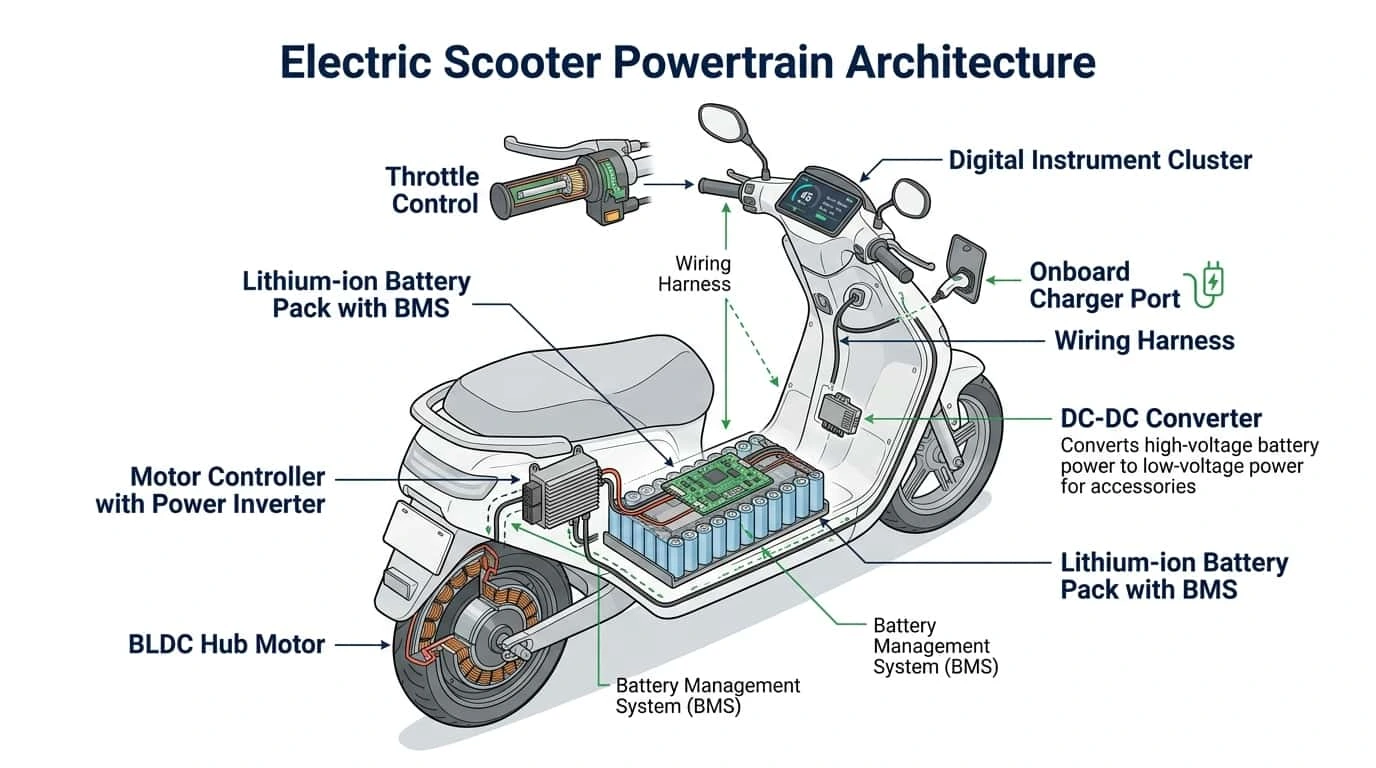
To diagnose, service, or engineer an electric two-wheeler, one must look beyond the plastics and comprehend the interconnected high-voltage and low-voltage electrical subsystems. Unlike an internal combustion motorcycle where fuel and mechanical energy flow linearly from tank to tailpipe, an electric scooter is a bidirectional, software-controlled electromechanical system.
1. The 9 Core Powertrain Subsystems
The chemical energy reservoir. Typically operates at 48V, 60V, or 72V nominal DC bus voltage with capacities ranging from 2.0 kWh to 4.0 kWh. Composed of cylindrical cells (e.g., 21700 or 18650 in 14S to 20S series configurations) or high-capacity prismatic cells using Lithium Iron Phosphate (LiFePO4) or Nickel Manganese Cobalt (NMC).
The electronic brain of the battery. Constantly samples individual cell voltages (millivolt accuracy), pack current via shunt resistors, and multi-point temperatures via NTC thermistors. Performs cell balancing, estimates State of Charge (SOC) and State of Health (SOH), and opens safety contactors during overcurrent or thermal anomalies.
Converts electrical energy into mechanical rotational torque. Most commuter electric scooters utilize outer-rotor BLDC hub motors mounted directly in the rear wheel (eliminating belts/chains), while performance models utilize chassis-mounted Interior Permanent Magnet Synchronous Motors (IPMSM) coupled via carbon-fiber belt drives.
The power modulation hub. Houses a 6-MOSFET or IGBT H-bridge that inverts DC electricity from the battery into 3-phase AC power. Uses Field Oriented Control (FOC) vector algorithms to modulate phase currents based on throttle position, wheel speed, and hall-effect magnetic sensor feedback.
The auxiliary power gateway. Converts high traction bus voltage (48V–72V DC) down to a regulated 12V DC auxiliary bus (typically 10A to 15A rating) to power low-voltage accessories: LED headlights, horn, turn indicators, brake lights, and digital instrument cluster.
Interfaces external power with the vehicle. Electric two-wheelers utilize either an off-board portable SMPS charger or an integrated onboard charger (OBC). Executes a strict Constant Current / Constant Voltage (CC-CV) charging profile under real-time command from the BMS over CAN bus.
High-gauge, flame-retardant (orange-sheathed) cabling connecting the battery, controller, and motor. Includes high-current semiconductor fuses, pre-charge resistors (preventing inrush capacitor arcing), manual service disconnects (MSD), and IP67 waterproof quick-connectors.
During deceleration or coasting, the motor controller reconfigures the traction motor to act as an alternator. Kinetic vehicle energy is converted back into electrical energy, generating counter-electromotive braking force while channeling recapture current through the inverter back into the battery pack.
The master vehicle coordinator. Gathers throttle position, brake inputs, side-stand interlocks, and tilt sensors; commands riding modes (Eco, Normal, Sport, Reverse Assist); and houses 4G LTE / GPS modules for remote anti-theft, geofencing, and cloud diagnostics.
2. Dynamic Energy Flow Across Operating Phases
- Acceleration Phase: Rider twists the hall throttle (signal 0.8V to 4.2V). VCU verifies side-stand is retracted and safety contactors are closed, commanding the motor controller to deliver peak current. The controller's gate drivers switch the MOSFET bridge at frequencies between 10 kHz and 20 kHz, driving multi-phase sinusoidal currents into the motor stator, generating instant maximum torque from 0 RPM.
- Steady-State Cruising Phase: Motor controller modulates pulse-width modulation (PWM) duty cycle to match road load and aerodynamic drag, consuming steady continuous power (typically 800W to 1,500W at 45 km/h). BMS continuously monitors cell temperature rise and ensures cell-to-cell delta remains below 20 millivolts.
- Deceleration & Regenerative Phase: Rider releases throttle or lightly pulls the brake lever (activating the brake-cut microswitch). The controller initiates regenerative braking: motor generates 3-phase AC voltage higher than the battery bus, the body diodes in the MOSFETs rectify this to DC, and a controlled charging pulse enters the battery, recovering 5% to 12% of total range in urban traffic.
- Charging Phase: AC charger is plugged in. Communication protocol initializes: BMS verifies pack temperature is within permissible charge limits (0°C to 45°C), closes the charge MOSFETs, and commands constant current (CC stage). Once cell voltages reach 3.65V (for LFP) or 4.20V (for NMC), it transitions into constant voltage (CV stage) and activates passive bleed resistors to equalize cell voltages.
EV vs. Petrol Two-Wheelers: Total Cost of Ownership (TCO) Analysis
A critical competency for both career professionals and dealership entrepreneurs is explaining the economic mathematics of electric mobility to customers. While an electric scooter carries an initial purchase premium over a 110cc petrol scooter, its total cost of ownership over a typical 3-year operating period is dramatically lower.
| Comparison Parameter | Electric Scooter (3.0 kWh LFP / NMC) | Petrol Scooter (110cc 4-Stroke ICE) | Engineering & Economic Rationale |
|---|---|---|---|
| Purchase Price (On-Road Approx.) | ₹1,15,000 – ₹1,35,000 (after PM E-DRIVE) | ₹88,000 – ₹98,000 | EV carries upfront capital premium of ₹25,000 to ₹35,000 primarily due to battery pack cost. |
| Fuel / Energy Cost per km | ₹0.28 to ₹0.35 / km (3.2 kWh / 100 km @ ₹8.0/unit) | ₹2.25 to ₹2.45 / km (45 km/l @ ₹104/litre petrol) | EV is ~85% cheaper per kilometer. High thermal efficiency of electric motor vs heat waste in ICE. |
| Annual Fuel/Energy Expense (30 km/day) | ₹3,285 / year (10,950 km) | ₹25,185 / year (10,950 km) | Direct operational saving of ₹21,900 per year in running energy costs alone. |
| Periodic Routine Servicing (Annual) | ₹1,500 – ₹2,200 / year (Brake pads, tire wear, software scan) | ₹4,500 – ₹6,500 / year (Engine oil, oil filter, air filter, spark plug, CVT belt) | EV eliminates consumable lubricants, engine oil flushes, and mechanical transmission friction components. |
| Real-World Single-Charge/Tank Range | 85 km – 115 km (True IDC Range) | 220 km – 250 km (5.0 Liter Petrol Tank) | Petrol offers longer single-refuel autonomy; EV requires regular home charging but suffices for 95% of daily urban commutes. |
| Refueling / Recharging Time | 3.5 – 5.0 hours (Home 15A Socket) 45 mins (Public DC Fast Charger) | 2 – 3 minutes at any fuel station | Petrol has unmatched refueling speed; EV trades speed for the convenience of overnight domestic garage charging. |
| Powertrain Moving Parts | < 20 moving parts (Rotor, bearings, reduction gear) | ~2,000 moving parts (Pistons, valves, crankshaft, clutch) | Dramatically fewer friction points, zero carbon build-up, and no exhaust heat degradation in EV systems. |
| Battery Degradation & Replacement | Expected life: 1,500–2,500 cycles (5–8 years). Pack replacement: ₹35,000–₹45,000. | Minor starter battery replacement every 3–4 years (₹1,500). | Major deferred capital expenditure for EV owners after year 6; mitigated by 8-year OEM warranty schemes. |
| Local Tailpipe Emissions | Zero local tailpipe emissions (0 g CO2/km) | ~38–48 g CO2/km + NOx, CO, and PM2.5 | Significantly improves urban air quality in densely populated Indian metropolitan centers. |
| 3-Year / 32,850 km Total Cost of Ownership | ₹1,32,000 – ₹1,48,000 (Vehicle + Electricity + 3Y Service) | ₹1,85,000 – ₹2,05,000 (Vehicle + Petrol + 3Y Service) | Net 3-Year EV Savings: ₹45,000 to ₹60,000. Full recovery of the initial purchase price gap within 18–20 months. |
Transparent TCO Formula & Mathematical Assumptions
Industry Challenges, Risks & Practical Mitigation Strategies
A credible technical guide must candidly address the vulnerabilities and operational risks that accompany rapid industrial scaling. Below is a detailed analysis of the 10 primary challenges confronting India's two-wheeler EV ecosystem, coupled with practical mitigation protocols for students, technicians, and entrepreneurs:
The Challenge: High ambient temperatures in Indian summers (45°C+), combined with cell manufacturing defects or poor potting, can trigger exothermic thermal runaway where internal cell temperatures exceed 600°C within seconds.
Mitigation: Strict enforcement of AIS-156 Amendment 3 Phase 2 standards (cell-to-cell thermal propagation barriers, active BMS audio alarms 5 minutes before hazardous events), utilization of thermally stable LiFePO4 chemistries, and proper workshop quarantine procedures.
The Challenge: Traditional automotive mechanics lack electrical training and fear high-voltage systems. Dealerships and independent workshops experience acute hiring bottlenecks.
Mitigation: Structured vocational upskilling programs (such as IISE's Diploma in EV Technology) that combine electrical fundamentals with hands-on oscilloscope diagnostics, hall-sensor troubleshooting, and safety certification.
The Challenge: Leading OEMs maintain proprietary, cloud-locked diagnostic software, preventing independent garages from reading DTCs or flashing firmware.
Mitigation: Independent workshops must master physical waveform analysis using oscilloscopes, CAN-bus sniffing, sensor simulation, and cultivate relationships with multi-brand aftermarket tool vendors.
The Challenge: Long lead times for specialized controllers, display clusters, and wire harnesses from tier-2 manufacturers, leaving customer vehicles stranded in workshops for weeks.
Mitigation: Stocking standard modular components (universal 48V–72V FOC controllers, standard 12V DC-DC converters, universal throttles) and establishing multi-vendor supplier partnerships.
The Challenge: Sudden policy transitions (e.g., FAME II termination → EMPS → PM E-DRIVE) with tapering per-vehicle subsidy amounts create pricing volatility and dealer cash-flow disruption.
Mitigation: Building business models grounded in underlying operational economics (fuel savings) rather than subsidy dependency; diversifying into high-margin service and fleet AMCs.
The Challenge: Customer disputes regarding real-world range drops versus official warranty degradation clauses (typically requiring SOH < 70% for pack replacement).
Mitigation: Implementing transparent, automated battery capacity cycler testing and printing certified SOH reports for customers; educating owners on optimal 20%–80% SOC charging hygiene.
Government Policies, Standards & Regulatory Compliance
Electric vehicle businesses and technical professionals operate within a rigorous statutory framework overseen by multiple central ministries and national standards bodies. Comprehending these statutory requirements is essential for legal operation:
1. The PM E-DRIVE Scheme Architecture
Approved by the Union Cabinet in September 2024 with a financial outlay of ₹10,900 crore over two years (FY 2024-25 to FY 2025-26), the PM Electric Drive Revolution in Innovative Vehicle Enhancement (PM E-DRIVE) replaces earlier temporary frameworks (EMPS 2024 and FAME II):
- Target Allocation: Supports 24.79 lakh electric two-wheelers nationwide with direct demand incentives.
- Incentive Scaling: In Year 1 (FY25), demand incentive is set at ₹5,000 per kWh, capped at ₹10,000 per vehicle. In Year 2 (FY26), the subsidy halves to ₹2,500 per kWh, capped at ₹5,000 per vehicle, intentionally preparing the industry for unsubsidized market competitiveness.
- Aadhaar-Authenticated E-Voucher Mechanism: To eradicate fraudulent subsidy claims that plagued earlier programs, the Ministry of Heavy Industries introduced an Aadhaar-linked e-voucher system. At the point of retail sale, a digital e-voucher is generated, signed by the customer and dealer via OTP authentication, and uploaded directly to the central PM E-DRIVE portal for OEM reimbursement.
2. Mandatory Automotive Standards & Homologation
Mandatory battery pack safety regulations for L-category vehicles (two-wheelers and three-wheelers) enforced under the Central Motor Vehicles Rules (CMVR). Enforces:
- Mandatory cell-to-cell thermal propagation containment;
- Microprocessor-controlled BMS with real-time CAN bus data logging;
- Water ingress protection rated IPX7 (immersion test) and IP67 dust sealing;
- Audio-visual thermal runaway buzzer sounding at least 5 minutes prior to hazardous event;
- Minimum 4 temperature sensors and active isolation resistance monitoring.
Type Approval (Rule 126): Every commercial EV model must secure statutory homologation approval from certified agencies (ARAI Pune, ICAT Manesar, or GARC Chennai).
EV Retrofitment (Rule 115G / AIS-123): Retrofitting a petrol scooter with an electric motor kit is legally permitted only if the specific retrofit kit has received complete type approval from ARAI/ICAT for that specific vehicle chassis model. Modifying vehicles with uncertified open-market kits is illegal under the Motor Vehicles Act.
3. Environmental & Waste Management Rules
Under the Battery Waste Management Rules (BWMR) 2022 notified by the Ministry of Environment, Forest and Climate Change (MoEFCC), battery manufacturers, pack assemblers, and vehicle OEMs are legally bound by Extended Producer Responsibility (EPR). Commercial entities must ensure mandatory collection, recycling, and progressive material recovery targets for critical battery metals (lithium, nickel, and cobalt). Workshops and service centers cannot discard spent lithium cells as municipal waste; they must maintain hazardous waste registers and partner with CPCB-registered recyclers.
Learning Pathways: Verified IISE Electric Vehicle Courses
Structured technical education is the most reliable bridge between generic mechanical background and a high-income career or profitable venture in electric mobility. The Indian Institute of Solar Energy (IISE) offers industry-recognized, practically grounded training programs tailored for every career stage:
Fundamentals of Electric Vehicle Technology
Target Learner: Engineering students, fresh graduates, ITI/diploma holders, and prospective business owners seeking a complete conceptual and architectural foundation.
Core Learning Outcomes: EV powertrain anatomy, battery chemistry fundamentals, BLDC/PMSM motor operations, motor controller basics, regenerative braking principles, and electrical safety standards.
Diploma in Electric Vehicle Technology
Target Learner: Automotive mechanics, electricians, ITI mechanical/electrical diploma holders, and workshop technicians targeting professional service bay diagnostic roles.
Core Learning Outcomes: Hands-on vehicle troubleshooting, multi-brand OBD/CAN diagnostic scanner usage, wiring harness tracing, hall sensor diagnostics, motor controller tuning, and battery pack preventative maintenance.
Advance Electric Vehicle Design Engineering
Target Learner: Mechanical, automobile, and mechatronics engineering graduates targeting R&D, powertrain design, and simulation roles at major EV OEMs.
Core Learning Outcomes: Powertrain component sizing, transmission ratio calculations, battery thermal management system (BTMS) simulation, chassis structural loading FEA, and vehicle dynamics modeling.
EV Software & Embedded Systems Course
Target Learner: Electronics, computer science, and instrumentation engineers aspiring to write BMS firmware, motor control algorithms, and telematics stacks.
Core Learning Outcomes: Embedded C programming for ARM Cortex microcontrollers, CAN/CAN-FD communication stacks, BMS state estimation (Kalman filter SOC/SOH), and Field Oriented Control (FOC) firmware.
PG Diploma in Electric Vehicle Technology
The Definitive Career Acceleration Program: Designed for engineers, technical managers, and ambitious entrepreneurs seeking comprehensive mastery across the entire e-mobility spectrum. Covers vehicle systems architecture, advanced battery engineering, AIS-156 homologation protocols, motor inverter design, charging infrastructure commissioning, and fleet operations economics.
Four-Step Career Roadmap: From Beginner to EV Professional or Entrepreneur
Whether your ambition is securing a high-value engineering role at an EV OEM or launching your own independent service center, follow this proven four-step roadmap:
Decide between hands-on technician diagnostics, R&D design engineering, embedded software programming, dealership sales management, or business ownership based on your aptitude.
Master the physics of electric powertrains, lithium battery chemistry, DC circuit calculations, and high-voltage safety isolation protocols through structured technical coursework.
Gain practical competency with digital storage oscilloscopes, CAN analyzers, cell balancers, CAD/CFD tools, or dealership DMS software rather than purely theoretical textbook concepts.
Execute supervised practical apprenticeship, secure OEM or workshop placement, or launch a validated business venture backed by sound working-capital management and customer SLAs.
How the Roadmap Differs by Professional Profile
Focus intensely on Step 2 and Step 3. Transition from mechanical wrenches to multimeters, insulation testers, and CAN diagnostic scanners. Your speed in accurately pinpointing sensor and wiring faults determines your workshop earning power.
Prioritize Step 1 (identifying an underserved local niche) and Step 4 (commercial execution, supplier vetting, and fleet AMC contracts). Even without working on vehicles yourself, technical literacy protects you from supplier exploitation.
Practical Checklist: Before You Enter the Two-Wheeler EV Industry
Whether entering the sector as an engineering professional, workshop technician, or business founder, use this comprehensive 25-point readiness checklist to identify gaps in your preparation:
- [ ] Understand DC vs. AC electrical behavior and series/parallel pack calculations.
- [ ] Proficient in True-RMS multimeter operation (resistance, DC voltage, continuity).
- [ ] Capable of interpreting CAN-bus 2.5V differential signals with an oscilloscope.
- [ ] Understand Hall-effect sensor switching logic (0V/5V) on BLDC motor stators.
- [ ] Familiar with OBD-II / UDS diagnostic scan tools and DTC fault code clearing.
- [ ] Completed formal High-Voltage Class B (>60V DC) safety isolation training.
- [ ] Procured certified Class 0 (1,000V) rubber insulating gloves (ASTM D120).
- [ ] Equipped with 1,000V VDE-insulated hand toolkits and safety face shields.
- [ ] Understand Lockout-Tagout (LOTO) protocols before opening battery enclosures.
- [ ] Workshop fitted with Class D metal-fire or aerosol lithium fire extinguishers.
- [ ] Audited local RTO VAHAN registration density for two-wheeler EVs in your zone.
- [ ] Surveyed existing OEM service center queues and wait-time bottlenecks.
- [ ] Mapped out local quick-commerce delivery dark stores and gig-rider hubs.
- [ ] Evaluated residential apartment density and public charging availability.
- [ ] Established direct accounts with verified spare parts distributors.
- [ ] Confirmed component lead times for controllers, throttles, and DC-DC converters.
- [ ] Vetted battery cell suppliers for genuine BIS (IS 16046) testing certificates.
- [ ] Avoided uncertified grey-market imports that violate AIS-156 Phase 2 standards.
- [ ] Secured GST registration, Shop & Establishment Act license, and Trade NOC.
- [ ] Obtained State Pollution Control Board Consent under Green Category.
- [ ] Formulated hazardous waste disposal register under Battery Waste Rules 2022.
- [ ] Verified commercial electrical load sanction with local DISCOM utility.
- [ ] Maintained 6 months of operating expenses in liquid reserve working capital.
- [ ] Drafted clear warranty handling SOPs and customer labor rate cards.
- [ ] Completed hands-on workshop internship or shadowed senior EV technicians.
Frequently Asked Questions: Two-Wheeler EV Careers & Business
Find authoritative, technically rigorous answers to the 12 most frequent questions asked by engineers, technicians, and entrepreneurs exploring India's electric two-wheeler market:
1. Is the electric two-wheeler market in India a viable long-term career opportunity?
2. What formal educational qualifications are required to become an EV technician?
3. Can ITI and diploma holders find high-paying jobs in the EV industry?
4. What specific diagnostic skills and tools are needed to repair electric scooters?
5. How do I start an independent electric scooter service centre in India?
6. What is the realistic investment required to launch an EV repair or dealership business?
7. How does an electric scooter dealership differ commercially from an independent service centre?
8. What is the critical role of a Battery Management System (BMS) in electric two-wheelers?
9. Which EV technology course should a complete beginner or working professional choose?
10. What are the main commercial challenges for EV businesses in India?
11. How can someone transition from a conventional automotive or electrical background into EV technology?
12. What critical due diligence must entrepreneurs verify before investing in an EV dealership?
Related IISE Technical Articles & Engineering Resources
Expand your technical knowledge across electric vehicle subsystems, battery storage, and clean-tech careers through our curated library of engineering guides:
Battery Management System (BMS): What It Does & How It Works
Deep dive into BMS architecture, passive vs. active cell balancing, shunt measurement, and safety protection circuits.
Read Technical Guide →Battery Safety Standards in India: BIS & AIS-156 Explained
Detailed analysis of IS 16046, IS 16270, AIS-156 Phase 2, and the clarification regarding IS 15887.
Read Regulatory Guide →EV Powertrain Explained: Motor, Battery, Controller & Inverter
Engineering breakdown of electric vehicle motor inverters, power electronics, and high-voltage transmission coupling.
Read Powertrain Guide →EV Battery Types: What Powers India's Electric Vehicles
Comparison between LFP, NMC, LTO, and Sodium-ion battery chemistries operating under Indian ambient heat.
Read Chemistry Guide →Solar-Powered EV Charging Station: Design & Cost in India
Turnkey engineering design, solar PV sizing, inverter coupling, and installation cost models for EV charging hubs.
Read Charging Guide →EV Engineer Salary in India 2026 by Role, Company & City
Exhaustive salary benchmarks across OEMs, battery startups, testing agencies, and major Indian cities.
Read Salary Guide →Best EV Courses in India 2026: Career Guide for Engineers
Comparison of professional diplomas, postgraduate certifications, and hands-on lab training curricula across India.
Read Course Guide →How Does an Electric Vehicle Work? Complete Technical Guide
Fundamental engineering principles of electric mobility, regenerative braking, inverter vector modulation, and energy flows.
Read Fundamentals Guide →Build Your Technical Foundation for the Electric Mobility Industry
The rapid transition of India's two-wheeler landscape from mechanical internal combustion engines to software-defined, electric powertrains is generating unprecedented career pathways and business opportunities. Whether your goal is diagnosing high-voltage battery packs in an advanced workshop, designing next-generation electric powertrains, or founding an independent e-mobility business, authoritative technical training is your most reliable competitive advantage.
Author Attribution, Sources & Editorial Transparency
The IISE Technical Research Team comprises experienced renewable energy educators, automotive systems engineers, and clean-tech industry analysts. Our mission is to deliver rigorous, empirically grounded, and practically actionable technical curriculum and research insights that empower India's engineering workforce and clean-tech entrepreneurs.
Official Statutory References & Data Sources
- MoRTH VAHAN Dashboard: Real-time retail vehicle registration statistics across state transport departments — vahan.parivahan.gov.in
- Society of Indian Automobile Manufacturers (SIAM): Annual wholesale automotive production and dispatch data — siam.in
- Federation of Automobile Dealers Associations (FADA): Monthly retail registration analysis and dealer sentiment indices — fada.in
- Ministry of Heavy Industries (MHI): PM Electric Drive Revolution in Innovative Vehicle Enhancement (PM E-DRIVE) guidelines — heavyindustries.gov.in
- Automotive Research Association of India (ARAI): AIS-156 (Amendment 3 Phase 2) Electric Power Train Battery Safety Standards — araiindia.com
- Bureau of Indian Standards (BIS): IS 17017 (Part 1, 21, 22) EV Charging and Connector Standards — bis.gov.in
- Ministry of Environment, Forest and Climate Change (MoEFCC): Battery Waste Management Rules (BWMR) 2022 EPR guidelines — moef.gov.in