HelioScope Software Training Course in India for Solar Engineers
Master Professional Solar PV Design, 3D Layouts, String Sizing, Shading Analysis and Energy Yield Simulation.
Develop practical HelioScope design skills through structured online training, recorded learning sessions and real-world Indian solar PV project exercises.
⚡ Special Admission Offer: Valid until 15 December 2026, inclusive. Limited batch seats.

Course Quick Information
Everything you need to know about duration, delivery, certification, and fees at a glance.
Progressive weekly learning modules covering fundamentals to advanced simulation.
Structured online training, practical software demonstrations, and exercises.
Live interactive online sessions plus high-definition recorded access for revision.
Engineering graduates, diploma holders, and practicing solar industry professionals.
Joint certificate awarded upon successful course completion and project review.
Regular fee ₹19,999. Includes ₹5,000 (25%) promotional tuition discount.
Online Application + Payment via Razorpay. Batch seats allocated on verified enrollment.
Upgrade Your Solar Design Skills at a Special Course Fee
Secure your enrollment in the HelioScope Software Training Program before the promotional deadline to claim ₹5,000 in fee savings.
Offer Closes In (15 December 2026, 23:59:59 IST):
The Promotional Admission Window has closed.
Please connect with our admissions advisor to check current batch fee applicability and upcoming cohort dates.
Master Three Essential Solar Design Software Tools
Accelerate your solar engineering career by mastering the industry's complete design-to-simulation trifecta.
1. PVsyst
In-depth bankable solar PV simulation, electrical string matching, and loss analysis.
2. HelioScope
Cloud-based rapid solar array layout, preliminary simulation, and client sales proposals.
3. Google SketchUp
3D rooftop modeling, architectural obstacle construction, and shade visualization.
Why HelioScope Is an Important Tool for Professional Solar PV Design
Moving beyond manual AutoCAD drafting and fragmented spreadsheets to an integrated, browser-based solar engineering workflow.
Design complex industrial RCC, pitched sheet-metal, and large ground-mounted arrays with accurate boundaries, setbacks, and keepout zones.
Integrate high-resolution Google Maps satellite imagery and import KML/KMZ survey files for accurate boundary scaling without early site visits.
Configure string lengths, series-parallel combinations, and MPPT channel allocation validated against inverter operating voltage limits.
Quantify diurnal and seasonal shading losses from parapets, water tanks, trees, and nearby buildings using true solar path geometry.
Compute annual generation (MWh), specific yield (kWh/kWp), performance ratio (PR), and loss waterfall diagrams with local weather data.
Generate client-ready PDF DPR reports, layout schematics, and CSV datasets suitable for DISCOM net-metering and project financing review.
| Workflow Parameter | Manual Drafting (AutoCAD + Excel) | Integrated HelioScope Workflow |
|---|---|---|
| Turnaround Time | 2 to 3 working days per design iteration | 2 to 3 hours from site mapping to bankable report |
| Shading Evaluation | Approximate 2D geometric rules-of-thumb | 3D ray-traced shading simulation per module segment |
| String Sizing Validation | Manual spreadsheet formulas prone to typo errors | Real-time voltage window validation across all MPPTs |
| Proposal Credibility | Fragmented drawing files and disconnected tables | Unified bankable PDF report recognized by lenders & EPCs |
Practical Skills You Will Develop
Twelve core engineering capabilities developed through structured hands-on design and simulation exercises.
Project Creation & Setup
Configure project hierarchy, geodetic coordinates, weather datasets (Meteonorm/TMY), and engineering parameters.
Satellite Site Mapping
Import high-resolution Google Maps imagery, integrate KML/KMZ survey data, and calibrate rooftop scales.
Roof & Ground Layout Preparation
Define field segments, perimeter safety setbacks, access walkways, and equipment keepouts for Indian structures.
Module Selection & Placement
Select PV modules from database, optimize tilt/azimuth angles, and evaluate portrait vs landscape packing density.
Inverter Selection & Sizing
Model string and central inverters, evaluate AC/DC capacity limits, and review operating temperature thresholds.
String Sizing & MPPT Allocation
Calculate minimum and maximum string lengths, manage series-parallel connections, and balance MPPT channel loading.
DC-AC Ratio Optimisation
Evaluate Inverter Loading Ratios (ILR), calculate clipping loss trade-offs, and optimize overall system capital efficiency.
3D Shading & Horizon Profiling
Model 3D parapets, water tanks, trees, and adjacent high-rises to calculate component-level shading derate curves.
Energy Yield Simulation
Execute 8760 hourly energy production simulations incorporating local irradiance, temperature, and soiling factors.
Performance Ratio (PR) Analysis
Interpret weather-adjusted PR, specific energy yield (kWh/kWp/year), and detailed system energy loss waterfall diagrams.
Multi-Design Variant Comparison
Compare alternative module tilts, technologies, and electrical layouts side-by-side to determine optimal yield.
Professional DPR Report Generation
Generate client-ready PDF design reports, Single Line Diagrams (SLD), layout drawings, and CSV data exports.
Complete Eight-Module Curriculum
A structured, progressive engineering syllabus taking you from platform fundamentals to complex 3D shading, energy yield simulation, and bankable project documentation.
Module 1 — Introduction to HelioScope and Project Workflow
Gain a thorough introduction to the HelioScope cloud-based platform, account architecture, user interface navigation, and project data hierarchy. Understand how HelioScope organizes project data from site boundaries to field segments and wiring zones, and learn how this simulation-driven approach fundamentally improves upon traditional 2D CAD drafting.
- Navigate the HelioScope workspace and project dashboard efficiently
- Understand the relationship between physical layout geometry and electrical simulation engines
- Configure project settings, engineering units, and geographical coordinate systems
- Establish baseline meteorological solar resource datasets for project locations
Module 2 — Site Import, Mapping and Layout Preparation
Master the process of importing and defining site boundaries using high-resolution Google Maps satellite imagery and KML/KMZ survey files. Learn to identify rooftop boundaries, ground plots, roof zones, and field segments. Focus extensively on obstruction mapping, fire safety corridors, parapet offsets, and maintenance walkway setback rules applicable to Indian industrial and commercial installations.
- Import georeferenced coordinates and KML/KMZ survey boundaries
- Accurately trace roof perimeters and identify usable solar installation areas
- Model 3D roof obstructions, vents, HVAC units, skylights, and parapet walls
- Apply mandatory maintenance walkway setbacks and fire safety clear zones
Module 3 — Solar Module Selection and Panel Layout
Explore HelioScope's comprehensive solar module database. Compare mono-PERC, TOPCon, and bifacial module specifications, temperature coefficients, and physical dimensions. Learn to configure module tilt, azimuth, row spacing, and portrait versus landscape orientations to maximize annual energy yield while preventing inter-row self-shading across Indian latitude ranges.
- Evaluate solar module datasheets and select optimal technology for project constraints
- Optimize tilt and azimuth angles based on geographic latitude and roof slopes
- Calculate inter-row spacing (pitch) to eliminate winter solstice self-shading
- Compare portrait vs landscape layouts on irregular and constrained rooftop geometries
Module 4 — Inverter Configuration and String Sizing
Delve into solar electrical engineering principles within HelioScope. Select appropriate string and central inverters from the database, configure string lengths, parallel connections, and allocate strings across independent Maximum Power Point Tracker (MPPT) inputs. Master DC-AC ratio (Inverter Loading Ratio) optimization for high-irradiance Indian conditions while validating designs against inverter maximum DC voltage, startup voltage, and MPPT operating windows.
- Select suitable inverter models based on system capacity and site grid interconnects
- Calculate maximum and minimum string lengths based on Voc(cold) and Vmpp(hot) limits
- Allocate and balance strings across multiple independent MPPT channels
- Optimize DC-AC sizing ratio to balance energy harvest against clipping losses
Module 5 — Shading Analysis and Horizon Profiling
Perform advanced 3D shading simulations to quantify energy generation losses caused by on-site obstacles and surrounding structures. Construct 3D geometric models of nearby high-rise buildings, chimneys, water tanks, parapets, and trees. Learn to incorporate horizon elevation profiles from topographic and site survey data, analyze diurnal and seasonal shade paths, and iterate array layouts to minimize shade impact.
- Construct accurate 3D obstruction geometries and assign realistic heights
- Analyze diurnal shadow paths across summer solstice, equinox, and winter solstice
- Interpret component-level shading derate percentages and module mismatch impacts
- Optimize string and sub-array layouts to segregate shade-affected modules
Module 6 — Energy Yield Simulation and Performance Analysis
Execute full annual energy production simulations using HelioScope's simulation engine and validated solar resource datasets. Learn to interpret key solar engineering metrics: Annual Generation (MWh), Monthly Generation Profile, Specific Yield (kWh/kWp/year), and Performance Ratio (PR). Analyze the comprehensive energy loss waterfall, including irradiance transposition, temperature derate, clipping losses, mismatch, and wiring resistance.
- Select and calibrate weather files (TMY3, Meteonorm, SolarGIS formats) for Indian locations
- Run 8760 hourly energy production simulations and analyze monthly generation profiles
- Evaluate Performance Ratio (PR) benchmarks and specific yield metrics against industry standards
- Perform loss waterfall analysis to identify primary sources of system inefficiency
Module 7 — Professional Report Generation and Project Documentation
Learn to compile and generate professional, client-ready solar Detailed Project Reports (DPR) and technical documentation. Understand the documentation formats expected by state DISCOMs for net-metering applications, private corporate clients, and project financing institutions. Export Single Line Diagrams (SLD concepts), CAD layout drawings, and granular CSV data for financial modeling integration.
- Generate comprehensive PDF solar design reports with layout diagrams and loss charts
- Understand technical DPR documentation standards required by Indian DISCOMs and lenders
- Export layout schematics and bill of materials (BOM) summaries
- Export hourly and monthly generation data into Excel for financial yield models
Module 8 — Real Indian Solar PV Project Walkthroughs
Apply your cumulative HelioScope skills across three comprehensive, end-to-end educational project scenarios based on authentic Indian site parameters, weather conditions, and regulatory constraints. Walk through site boundary setup, module layout, string sizing, 3D shading, yield simulation, and final DPR generation for diverse commercial, industrial, and utility-scale installations.
- Project Scenario A (100 kWp Mumbai): Industrial RCC rooftop with parapet walls, high ambient temperatures, and DISCOM net-metering constraints
- Project Scenario B (500 kWp Rajasthan): Commercial & Industrial ground-mounted solar plant with high solar insolation, seasonal soiling, and string inverter layout
- Project Scenario C (1 MWp Utility Scenario): Multi-megawatt ground layout with sub-array block sizing, central/string inverter architecture, and MV transformer placement
- Complete the mandatory Capstone Design Assignment and submit for instructor evaluation and feedback
Four-Week Training Roadmap
Twenty-four structured training hours organized across four progressive weekly milestones.
Platform onboarding, coordinate systems, Google Maps integration, KML boundary imports, obstruction identification, and setback rules for rooftop and ground sites.
Module database selection, tilt/azimuth pitch optimization, inverter sizing, series-parallel string configuration, MPPT allocation, and DC-AC ratio tuning.
3D obstruction modeling, horizon profiling, component-level shading derate, 8760 hourly generation simulation, specific yield, and system PR loss waterfall analysis.
DPR report generation, Single Line Diagrams (SLD), 3 Indian guided project walkthroughs (Mumbai, Rajasthan, 1 MWp), and final capstone assignment review.
Learn Through Practical Solar PV Design Projects
Gain real-world engineering confidence by designing three distinct solar PV project categories from site identification to final simulation report.
Design solar systems for RCC flat roofs, industrial trapezoidal sheet sheds, and saw-tooth roofs. Master fire setbacks, structural walkways, parapet shadow keepouts, and DISCOM net-metering technical documentation.
Model captive and open-access ground-mounted solar plants. Master inter-row pitch calculation to prevent winter solstice inter-row shading, boundary fence setbacks, inverter station positioning, and topography analysis.
Examine multi-megawatt sub-array block sizing, medium-voltage (MV) transformer grouping, string vs central inverter architecture, high-voltage safety clearances, and annual 8760 bankable generation simulations.
Who Should Enrol?
Confirmed Eligibility: Engineering graduates, diploma holders, and practicing solar professionals. No prior HelioScope experience required.
B.E. / B.Tech graduates in Electrical, Mechanical, Civil, or Renewable Energy seeking practical, industry-demanded solar software skills to stand out in the clean tech sector.
Diploma engineers aiming to acquire recognized software-driven design and simulation credentials for solar project design and EPC engineering roles.
Field, site, and execution engineers wanting to transition into high-value design engineering by replacing manual site drafting with simulation software.
Draftsmen using AutoCAD who want to upgrade from 2D drawings to integrated 3D layout design, automated stringing, and yield simulation.
EPC project managers, site supervisors, and technical coordinators needing to evaluate contractor layouts, verify DPRs, and avoid costly installation rework.
Developers who need to prepare credible feasibility studies, verify preliminary energy yields, and evaluate project financials with bankable reports.
Solar rooftop business owners, channel partners, and system integrators seeking to produce winning commercial proposals with fast turnaround.
Engineers from conventional power, building services, or construction industries looking to pivot their technical career into solar PV engineering.
Where You Can Apply Your HelioScope Skills
HelioScope proficiency is directly applied across major engineering and project delivery functions in India's solar PV sector.
Prepares complete rooftop and ground-mounted layout designs, single line diagrams (SLD concepts), inverter stringing, and bankable simulation reports using HelioScope.
Conducts independent technical feasibility audits, optimizes client array configurations, minimizes shading derates, and validates solar DPR submissions.
Bridges the gap between design office layouts and physical site execution, ensuring that setbacks, string connections, and walkway safety clearances match construction realities.
Prepares technical bids, bills of materials (BOM), equipment sizing tables, and DISCOM net-metering technical documentation for competitive C&I tenders.
Generates rapid, simulation-backed customer proposals, preliminary 3D shadow visualizations, and estimated annual generation projections to support commercial sales.
Evaluates land and rooftop potential, calculates preliminary capacity potential, estimates levelized energy generation, and models project viability for investors.
Audits third-party solar engineering designs, verifies mathematical simulation assumptions, and prepares technical due-diligence reports for financing institutions.
This training program is strictly positioned for technical engineering skill development. IISE does not guarantee employment, placements, or minimum salary packages.
Why Choose IISE + CERT?
Specialized renewable energy education established on practical engineering rigor, verified project workflows, and credible joint certification.
Training Methodology
A structured, application-oriented learning methodology designed to build authentic solar software design proficiency.
Live online sessions led by experienced solar engineering practitioners, allowing direct interaction and question-and-answer exchanges.
Full session recordings provided for review, enabling self-paced revision and referencing during practical design assignments.
Real-time, step-by-step walkthroughs of complex solar PV design tasks conducted directly inside the HelioScope software interface.
Targeted practical exercises after each curriculum module to reinforce mapping, stringing, shading, and simulation concepts.
Design assignments grounded in realistic Indian site conditions, DISCOM net-metering formats, and meteorological environments.
Structured doubt-clearing support to assist learners through software troubleshooting, voltage constraints, and layout challenges.
Formal instructor review of your final independent solar PV design submission with constructive engineering feedback.
Connect with fellow solar engineers, consultants, and developers who have completed IISE training programs across India.
Course Pricing and Admission
Select the enrollment pathway that best aligns with your professional solar software development goals.
HelioScope Software Training Program
Dedicated 4-week specialized program in HelioScope layout design, 3D shading simulation, and bankable DPR reporting.
- ✓ 4 Weeks / 24 Hours Structured Training
- ✓ Online Live Classes + Recorded Replays
- ✓ Complete 8-Module HelioScope Curriculum
- ✓ 3 Guided Indian Projects (Mumbai, Rajasthan, 1 MWp)
- ✓ Capstone Project Review & Assessment
- ✓ Joint Certificate from IISE and CERT
Three-Software Training Package
Bundled training package designed for engineers seeking broader software capabilities across multiple solar design tools.
- ✓ HelioScope Training Program Included
- ✓ Software 2: [CONFIRM SOFTWARE NAME]
- ✓ Software 3: [CONFIRM SOFTWARE NAME]
- ✓ Comprehensive Solar Software Competence
- ✓ Dedicated Cohort Guidance
Admission Process
Four straightforward steps to secure your enrollment and begin your solar PV design training.
Connect with an IISE course advisor via WhatsApp (+91 8850902306) or review course parameters online.
Verify your academic/professional background and confirm your upcoming batch start date and class timings.
Pay the discounted course fee of ₹14,999 through our official Razorpay portal (cards, UPI, net banking).
Receive immediate enrollment confirmation, onboarding credentials, and live session links to begin Week 1.
Where HelioScope Fits in the Professional Solar Design Workflow
Understanding the distinct functional roles of HelioScope, PVsyst, and SketchUp across different project stages.
HelioScope
Combines Google Maps site mapping, CAD-like array layout, automated string sizing, and 3D ray-traced shading simulation into a rapid, cloud-based platform. Ideal for fast project turnaround, DISCOM net-metering DPRs, and commercial proposals.
PVsyst
The global benchmark for rigorous mathematical simulation, multi-year degradation, complex horizon profiles, bifacial modeling, and utility-scale bankability reports required by international financial lenders and IPPs.
SketchUp
Specialized 3D surface modeling environment used for architectural solar renderings, custom mounting structure visualization, client video walkthroughs, and exporting complex 3D obstacle terrain into simulation tools.
Related Solar Engineering Courses at IISE
Master advanced energy yield simulation, mathematical loss factors, and bankable reports.
Build professional 3D solar layouts, shadow animations, and client architectural renderings.
Explore IISE's full catalog of specialized renewable energy design software training.
Comprehensive programs covering solar PV technology, installation, and entrepreneurship.
Student Reviews & Course Feedback
Authentic course reviews from solar engineers who have completed training with IISE.
In accordance with IISE's transparent academic publishing policy, alumni testimonials are published only following formal written consent and identity verification. Unverified reviews and placeholder testimonials are strictly withheld from publication.
Frequently Asked Questions
Detailed answers to common questions regarding course duration, training methodology, software skills, certification, and fees.
1. What is the HelioScope Software Training Program?
The HelioScope Software Training Program for Solar Engineers is a specialized 4-week, 24-hour professional training program delivered by the Indian Institute of Solar Energy (IISE) in technical partnership with the Centre for Energy Research and Training (CERT). It equips engineering graduates, diploma holders, and practicing solar professionals with comprehensive, practical skills in solar PV system layout design, 3D shading analysis, inverter string sizing, energy yield simulation, and bankable Detailed Project Report (DPR) generation using the industry-standard HelioScope platform.
2. How long is the HelioScope course?
The course duration is 4 weeks. It is organized into progressive weekly milestones covering platform fundamentals, layout preparation, electrical stringing, 3D shading, energy simulation, and Indian project walkthroughs.
3. How many training hours are included?
The program comprises a total of 24 hours of structured training, combining live interactive online sessions, instructor-led software demonstrations, hands-on design exercises, and guided project reviews.
4. Is this course available online?
Yes, the training is conducted fully online with live interactive sessions. Learners can participate from anywhere across India or internationally without needing to travel or pause their employment.
5. Are recorded sessions provided?
Yes, all training sessions are recorded in high definition and made available to enrolled learners. You can rewatch any session at your own pace during the course to review complex design workflows, formulas, or project walkthroughs.
6. Who is eligible for the course?
Eligibility is open to engineering graduates (B.E. / B.Tech in Electrical, Mechanical, Civil, Renewable Energy, etc.), technical diploma holders, and practicing solar professionals, CAD draftsmen, and EPC executives. A foundational understanding of basic solar PV concepts is helpful, but no prior experience with HelioScope is required.
7. Do I need prior HelioScope experience?
No prior HelioScope experience is required. The program begins with account navigation, coordinate setup, and basic boundary mapping before progressing to advanced 3D shading analysis and multi-megawatt simulations.
8. What software skills will I learn?
You will develop 12 core skills: project setup and coordinate configuration, Google Maps satellite mapping and KML/KMZ boundary imports, rooftop and ground-mounted layout preparation, PV module selection and pitch optimization, inverter sizing and MPPT allocation, string sizing and DC-AC ratio tuning, 3D shading and horizon analysis, 8760 hourly energy yield simulation, performance ratio (PR) interpretation, multi-variant design comparison, financial CSV data export, and bankable PDF DPR report generation.
9. Does the curriculum cover rooftop solar design?
Yes. The program covers residential, commercial, and industrial (C&I) rooftop solar design, including flat RCC roofs, pitched sheet-metal industrial roofs, parapet wall setback modeling, HVAC keepouts, and walkway clearance regulations aligned with Indian building codes.
10. Does the course cover ground-mounted solar projects?
Yes. The curriculum covers ground-mounted solar PV systems, from small C&I ground installations to utility-scale layouts, including topography considerations, row pitch to eliminate winter solstice shading, inverter skid placements, and access road setbacks.
11. Will I learn inverter selection and string sizing?
Yes. You will learn to select inverters from the database, configure string lengths within operating voltage windows (Voc cold and Vmpp hot), distribute strings across independent MPPT inputs, and optimize the DC-AC ratio (Inverter Loading Ratio) to minimize clipping losses under high Indian irradiance.
12. Will I learn shading analysis?
Yes. The course covers complete 3D shading modeling, including nearby high-rise buildings, rooftop parapets, water tanks, trees, and horizon topography, allowing you to quantify shading derates and reconfigure arrays to minimize energy losses.
13. Does the course include energy yield simulation?
Yes. You will perform full 8760 hourly simulations utilizing satellite weather files (Meteonorm, TMY, etc.). You will learn to evaluate monthly generation curves, specific yield (kWh/kWp/year), temperature losses, wiring losses, and system performance ratio (PR).
14. Will I learn to generate professional design reports?
Yes. You will learn to generate comprehensive, professional PDF design reports and Single Line Diagram (SLD) layout schematics that meet the documentation standards required by state DISCOMs, lending institutions, and commercial clients for DPR submissions.
15. What practical assignments are included?
Every module includes dedicated hands-on exercises. Additionally, Module 8 includes 3 guided Indian project walkthroughs: a 100 kWp commercial rooftop system in Mumbai, a 500 kWp ground-mounted C&I system in Rajasthan, and a 1 MWp utility-scale scenario. Learners must complete a final capstone project submission evaluated by IISE instructors.
16. What certificate will I receive?
Upon successful completion of all training modules and submission of the mandatory capstone project design, you will receive a Certificate of Completion in HelioScope Software Training.
17. Who issues the certificate?
The certificate is jointly issued by the Indian Institute of Solar Energy (IISE, a Unit of CERMS India Foundation) and CERT (Centre for Energy Research and Training).
18. What is the regular course fee?
The regular course fee for the HelioScope Software Training Program is ₹19,999.
19. What is the special offer price?
Under the current promotional admission window, the course is available at a special offer price of ₹14,999, providing a direct discount of ₹5,000 (25% off the regular fee).
20. Until when is the ₹14,999 offer valid?
The ₹14,999 special offer is valid until 15 December 2026, 23:59:59 IST, inclusive. Batch seats are allocated on a first-come, first-served basis.
21. What is included in the three-software package?
The Three-Software Training Package is priced at ₹24,999. It bundles HelioScope with two additional complementary solar engineering software courses to provide a complete preliminary design, advanced simulation, and 3D modeling skill set. Because specific software combinations are scheduled per batch, learners must enquire via WhatsApp to confirm the currently available software combination and upcoming batch dates. Software licenses, subscriptions, or vendor fees are not included.
22. How can I apply?
You can secure immediate admission by completing your fee payment through the official Razorpay payment portal (https://rzp.io/rzp/DT3ezwyj) or by contacting an IISE course advisor on WhatsApp (+91 8850902306) to confirm batch timings and receive admission assistance.
23. How can I contact IISE?
You can contact IISE by phone or WhatsApp at +91 8850902306, via email at info@indianinstituteofsolarenergy.com, or through the official enquiry channels on the website.
24. Is placement guaranteed after completing the course?
No. IISE maintains transparent, ethical academic standards and does not offer guaranteed job placements, recruitment promises, or minimum salary commitments. The program focuses strictly on developing high-caliber, practical solar PV design and simulation competence using HelioScope. These technical skills significantly strengthen your engineering profile and prepare you for technical design roles across the solar industry.
Take the Next Step Towards Professional Solar PV Design
Learn HelioScope through structured training, practical solar PV design exercises and Indian project-based learning. Upgrade your engineering career today.
Time is running out. Apply now!
- 00Days
- 00Hours
- 00Minutes
- 00Seconds
Why Every Solar Engineer in India Needs to Know Helioscope
Ask any EPC project manager what's slowing down their team, and you'll hear the same answer: manual layouts in AutoCAD, DPRs rejected by DISCOMs for lack of simulation data, and proposal turnarounds that take days instead of hours. The Indian solar market has grown too fast and too competitive for slow, error-prone design workflows.
Helioscope has become the industry standard for PV system design — adopted by top EPCs, IPPs, solar consultancies, and MNRE-tied developers across India. It combines site mapping, string sizing, shading simulation, and bankable yield reporting in a single browser-based platform. If Helioscope is appearing in job descriptions at companies you want to work for, that's not a coincidence.
IISE's Helioscope Software Training Program is built specifically for the Indian solar market. Every module, every project walkthrough, and every report format is grounded in real Indian scenarios — rooftop installations, C&I ground-mount projects, and DISCOM submission formats. This is not a generic tutorial series. It is the fastest, most practical path to Helioscope proficiency available in India today.
Whether you're a working design engineer upgrading your toolkit, a student building job-ready skills, or a project developer who needs to submit credible proposals — this program gives you the hands-on training to deliver professional results from day one. Explore all our Solar Software courses at IISE to see how Helioscope fits into a complete solar design skill set.
What You Will Be Able to Do After This Course
Helioscope replaces the error-prone combination of AutoCAD layouts and manual yield calculations with a single, simulation-driven workflow — producing reports that banks, DISCOMs, and international buyers already recognise as bankable design documentation. No other free-hand method matches its output credibility in competitive Indian tenders.
This Course is Built for You If…
You're using AutoCAD or spreadsheets for layouts and yield estimates, but clients and developers are asking for simulation-backed reports. This course gives you a professional Helioscope workflow that cuts design time and eliminates guesswork.
Solar companies are listing Helioscope as a preferred skill in junior design engineer roles. This course gives you hands-on proficiency before you step into your first interview, making you stand out from candidates with only theoretical knowledge.
Clients and financiers trust proposals backed by Helioscope simulation reports. This course helps you — or your team — produce credible DPRs and yield reports that win bids and accelerate project approval.
Different engineers using different tools creates reporting inconsistencies and revision cycles. Standardise your team on Helioscope with IISE training, and establish a repeatable design workflow your entire department can follow.
Five Ways to Fit This Course Into Your Life
Instructor-led sessions with real-time doubt clearing. Ask questions as you follow along, just like a classroom — without leaving your desk.
Lifetime access to all recorded sessions. Rewatch any module as many times as you need — ideal for busy professionals learning on their own schedule.
In-person training at IISE centres in Mumbai and Delhi. A structured, distraction-free environment for learners who prefer face-to-face instruction.
Saturday–Sunday batches designed for working engineers and professionals. Keep your job while upgrading your skills — no career pause required.
Intensive project-based workshops where you design real Indian solar projects from site survey to final report submission — supervised by IISE instructors.
Six Reasons Solar Professionals Choose IISE for Helioscope Training
Every project walkthrough uses real Indian site data — rooftop systems in Maharashtra, C&I ground-mount in Rajasthan, DISCOM-tied installations. You learn with the formats and constraints you'll actually face on the job.
IISE trainers are practising solar engineers, not educators with only textbook knowledge. They bring real EPC project experience into every session, including the edge cases and practical shortcuts that matter on site.
IISE's Helioscope certificate is recognised by over 500 hiring partners across India's solar sector. Add it to your LinkedIn profile and your resume — it signals verified, practical software proficiency to employers.
IISE's placement cell connects graduates with solar EPC companies, IPPs, and consultancies actively hiring Helioscope-trained design engineers. Career support doesn't end at certification — we help you land the role.
Complement your Helioscope skills with PVsyst Software Training for advanced energy simulation, or SketchUp for 3D solar layout design — all available on the same platform with the same instructors.
Live weekday batches, weekend part-time batches, self-paced recorded access, and offline classroom options mean there is always a format that works for your schedule — without compromising on learning quality.
Module-by-Module Breakdown
The program is structured in eight progressive modules, taking you from first login to submitting a complete, client-ready solar project report.
Introduction to the Helioscope platform, account setup, interface navigation, and project creation. Understand how Helioscope organises data — from site to field segments to wiring zones — and why the workflow differs from AutoCAD-based approaches.
Import site coordinates using Google Maps satellite imagery and KML/KMZ files. Define roof boundaries, ground footprints, and field segment zones with precision. Cover obstruction marking and setback rules applicable to Indian installations.
Select from Helioscope's module database and configure tilt, azimuth, and row spacing for maximum yield. Design portrait and landscape orientations, handle irregular rooftops, and understand inter-row shading calculations for Indian latitude ranges.
Select inverters from the database and configure string lengths, parallel strings, and MPPT input allocation. Learn to optimise DC-AC ratios for Indian irradiance conditions and validate designs against inverter operating voltage windows.
Run 3D shading simulations for nearby obstructions, parapets, and adjacent structures. Build horizon profiles from site photographs and topographic data. Quantify shading-induced losses and iterate on layouts to minimise their impact.
Run full energy production simulations using Helioscope's weather data engine. Understand how to interpret performance ratio, specific yield, and annual kWh output results. Compare simulation variants and identify the highest-performing design option.
Generate professional PDF design reports with all required simulation outputs, layout diagrams, and equipment specifications. Learn the report formats expected by state DISCOMs, private clients, and project lenders. Export Excel data for financial modelling integration.
End-to-end project simulations using real Indian site data: a 100 kWp rooftop system in Mumbai, a 500 kWp C&I ground-mount in Rajasthan, and a 1 MWp utility-scale layout. Complete each project from site import to final report and get instructor feedback before submitting for certification.
✅ Complete all 8 modules and submit your final project to earn your IISE Certificate of Completion in Helioscope Software — valid for resumes, LinkedIn profiles, and project proposal documentation.
Where This Certification Takes You
India's solar sector is targeting 500 GW of renewable capacity by 2030, with the MNRE pushing aggressive rooftop solar mandates and state DISCOMs fast-tracking grid-connected projects. EPC companies, IPPs, and solar consultancies across the country are actively hiring Helioscope-trained design engineers to meet this demand. This certification is your proof of readiness. Explore our Solar Energy courses at IISE for a complete learning pathway, and add SketchUp for Solar Design to develop your 3D layout skills alongside Helioscope.
After this course, you can independently design, simulate, and report complete PV systems for rooftop and ground-mount projects using Helioscope's professional toolkit.
After this course, you can produce bankable Helioscope design reports that satisfy DISCOM technical requirements and support project financing applications.
After this course, you can advise EPC clients on system optimisation, prepare tender-ready proposals with simulation evidence, and standardise your team's design workflow.
Start Designing Solar Projects Like a Pro
Live instruction, lifetime recorded access, real Indian project walkthroughs, and an IISE certificate recognised by 500+ hiring partners — everything you need to make Helioscope your career advantage.
Secure Your Seat →From the Engineers Who've Already Made the Switch
I'd been using AutoCAD for rooftop layouts for two years, but clients kept asking for yield simulation reports that I couldn't produce. After IISE's Helioscope training, I completed my first bankable DPR in under three hours. The India-specific project walkthroughs were the most useful part — I recognised the DISCOM submission format immediately from my actual work.
I was finishing my B.Tech in electrical engineering and wanted a practical solar software skill before campus placements. The IISE Helioscope course gave me exactly that. I put it on my resume and LinkedIn, and the first company that interviewed me asked me to walk them through a Helioscope design on the spot. I got the offer.
We were losing government tenders because our proposals lacked simulation-backed yield data. I enrolled three of my team members in this course. Within a month, our proposals included full Helioscope reports, and we won our next two DISCOM-tied bids. The training paid for itself on the first project. IISE's weekend batch worked perfectly around our work schedule.
Frequently Asked Questions
Yes. Helioscope is widely used by EPC companies, IPPs, MNRE-empanelled consultancies, and project developers across India for DPR preparation, DISCOM submissions, and project finance documentation. It is increasingly listed as a required or preferred skill in solar design engineer job postings from companies operating in rooftop, C&I, and utility-scale segments.
Absolutely. This program is designed for learners with no prior Helioscope experience. The only prerequisite is a basic understanding of solar PV concepts — modules, inverters, and system sizing fundamentals. If you've completed any solar energy course or worked in the field, you're ready to enroll.
On completing all modules and submitting your final project, you receive an IISE Certificate of Completion in Helioscope Software. This certificate is recognised by 500+ hiring partners in India's solar sector and is suitable for inclusion on your resume, LinkedIn profile, and project proposals. It demonstrates verified, practical software proficiency — not just attendance.
Yes — in fact, Helioscope is a browser-based platform, which makes online training a natural fit. Live instructor-led sessions allow you to work alongside the trainer in real time, replicate every step on your own screen, and ask questions as you go. Recorded sessions let you rewatch any module at your own pace. Most IISE Helioscope graduates complete their training entirely online and immediately apply the skills on actual projects.
All live sessions are recorded and made available to enrolled students with lifetime access. If you miss a class, you can watch the full recording at any time, revisit it before assessments, and raise doubts with the instructor in the next live session or via IISE's support channel. Missing a class does not put you behind.
Helioscope is a cloud-based platform that integrates site layout, string sizing, shading simulation, and yield reporting in a single workflow — without requiring separate CAD or simulation tools. PVsyst offers deeper simulation customisation for complex projects, while AutoCAD handles only the drawing component without any energy modelling. Many professional solar designers use both Helioscope and PVsyst depending on project complexity. IISE offers PVsyst Software Training separately if you'd like to develop both skills.
Yes. The curriculum covers design workflows for residential and commercial rooftop systems, C&I ground-mount installations, and utility-scale layouts. Module 8 includes dedicated project walkthroughs for each system type using real Indian site data, so you'll be confident applying Helioscope across the full range of project types you're likely to encounter.
Yes. All recorded sessions come with lifetime access. Even after you've completed the program and received your certificate, you can return to any module for reference — which is particularly useful when Helioscope releases interface updates or when you encounter a project type you haven't designed before.
You'll complete guided walkthroughs and a final independent project using real Indian site data. Projects include a 100 kWp rooftop system in Mumbai, a 500 kWp C&I ground-mount in Rajasthan, and a 1 MWp utility-scale layout. For your final certification project, you'll complete an end-to-end design — from site import to bankable report — independently, with instructor feedback before submission.
Yes. IISE provides post-course support through its student community and placement cell. You'll have access to IISE's alumni network of 3,000+ solar professionals, ongoing doubt-clearing via the support channel, and career guidance from the placement team. For graduates looking to enter the job market, the placement cell actively connects them with 500+ hiring partners in India's solar sector.
Related Courses You May Like
Master advanced energy yield simulation for complex solar projects using the globally recognised PVsyst platform.
View Course →Build professional 3D solar layouts and visualisations for client presentations and technical documentation.
View Course →Develop a complete understanding of PV system design principles — the foundation every Helioscope user needs.
View Course →Understand electric vehicle technology, charging infrastructure, and EV system integration with solar and grid power.
View Course →Learn battery chemistry, BESS design, and energy storage integration for solar hybrid and off-grid applications.
View Course →Qualify as a certified energy auditor and identify energy-saving opportunities for commercial and industrial facilities.
View Course →Your Next Solar Project Deserves a Better Design Tool
Join 3,000+ solar professionals who've upgraded their skills with IISE. Live classes, lifetime recorded access, real Indian project walkthroughs — and a certificate that 500+ employers across India already trust.
Start the Helioscope Program → Have questions? Talk to our course advisor →100 hours of training. Real India projects. IISE Certificate included.
Explore IISE's full range of solar software programs — Helioscope, PVsyst, SketchUp, and more — designed for practising solar engineers.
Explore Solar Software Courses →Time is running out. Apply now!
- 00Days
- 00Hours
- 00Minutes
- 00Seconds
FEE ONLINE PAYMENT by NEFT. Details are enclosed below.
NEFT favoring
INDIAN INSTITUTE OF SOLAR ENERGY
Current Account No.: 000412100071051
Bank Name: BHARAT BANK
Branch: CHEMBUR – MUMBAI
IFSC: BCBM0000005
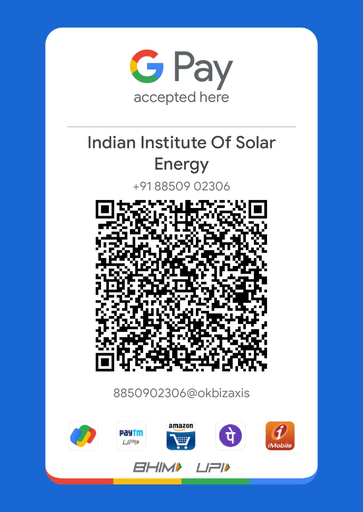
You can pay using Gpay too. Just scan the QR code below.