India's 500 GW Renewable Energy Target: Career Opportunities for Engineers
India's commitment to establish 500 gigawatts (GW) of non-fossil-fuel electricity capacity by 2030 represents one of the largest engineering and infrastructure mobilizations in modern industrial history. Crossing 50% non-fossil power capacity in June 2025—five years ahead of schedule—has turned national climate ambition into a massive, multi-decade hiring surge across solar PV design, battery energy storage systems (BESS), EV powertrains, and high-voltage grid integration. This comprehensive guide outlines the verified policy targets, technical competencies, career tracks, and training pathways available to engineers and technical professionals.
Educational Note: This analysis provides objective technical analysis and career guidance. Certification programs deliver practical skills and knowledge; IISE does not guarantee commercial placements or specific employment outcomes.
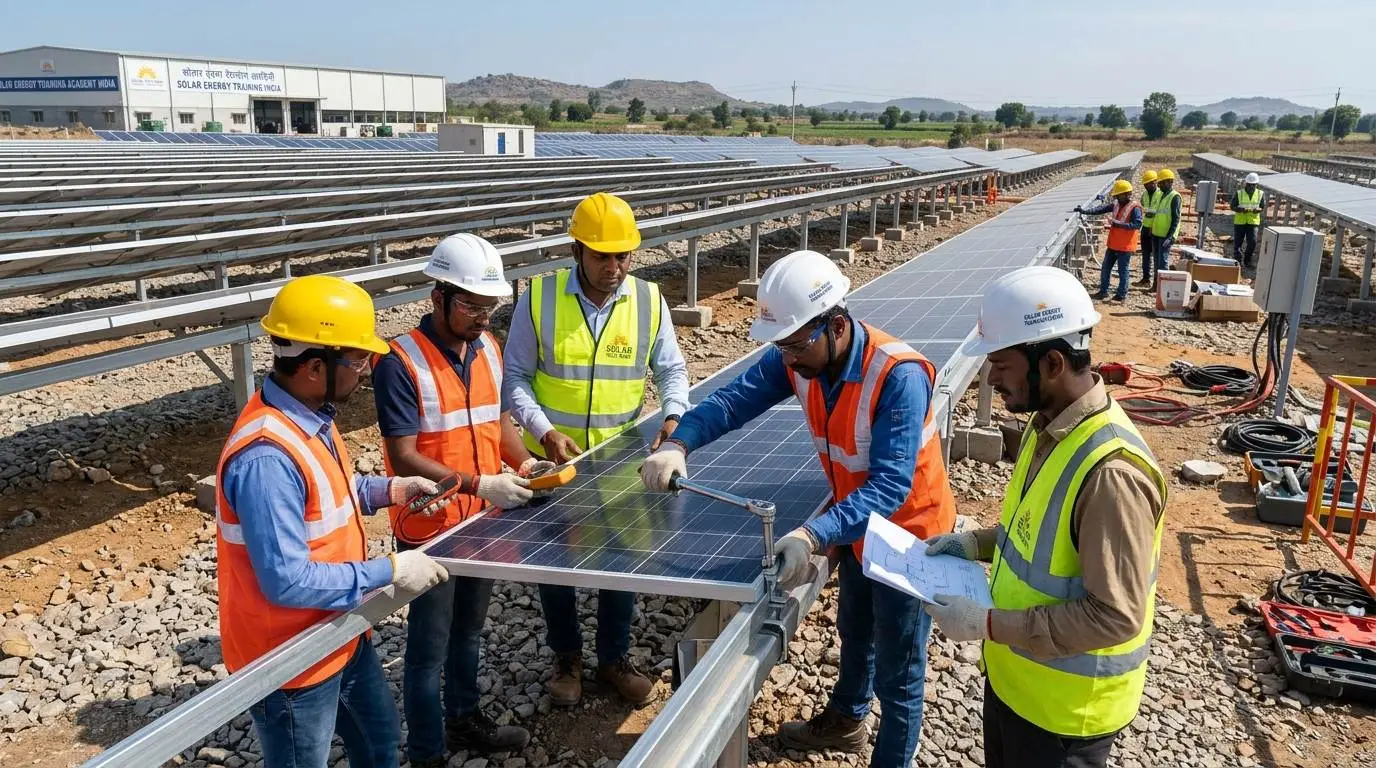
Executive Summary: The 500 GW Non-Fossil Build-Out and Engineering Demand
India's energy transition is entering its most capital-intensive and technologically demanding phase. At COP26 in Glasgow, India pledged to install 500 gigawatts (GW) of cumulative electricity capacity from non-fossil fuel sources by 2030. This milestone is part of India's five "Panchamrit" climate commitments formalized in its Nationally Determined Contributions (NDCs) under the Paris Agreement.
Crucially, official policy designates this as a non-fossil-fuel target, which encompasses renewable sources (solar PV, onshore wind, large hydro, small hydro, biomass, and waste-to-energy) alongside nuclear power. India reached an early landmark in June 2025 by crossing 50% of its total installed capacity from non-fossil sources—more than five years ahead of its Paris commitment.
As of December 31, 2025, official Ministry of Power and Central Electricity Authority (CEA) data reveals that India boasts 266.79 GW of non-fossil capacity, representing 51.93% of the total 513.73 GW national grid. To reach 500 GW by 2030, India must construct and commission an additional 233.21 GW of non-fossil generation over the next four years. This requires an average addition of roughly 46.6 GW annually—an unprecedented rate that is fundamentally transforming the Indian engineering job market.
Workforce modeling by the Council on Energy, Environment and Water (CEEW) and the Natural Resources Defense Council (NRDC) projects that the 500 GW target and associated clean energy initiatives will support over 4.4 million (44 lakh) full-time-equivalent jobs by 2030. Between FY23 and FY26 alone, the clean energy sector added an estimated 6.5 lakh jobs. More importantly for job seekers, 60% to 90% of these roles require skilled, certified engineers and technical specialists rather than untrained labor.
Deconstructing India's 500 GW renewable energy target: Policy Origins, Technology Mix, and Reality
To understand where the jobs are and how engineering specializations fit, one must first understand the architecture of the 500 GW target. When announced at COP26, India committed to reaching 500 GW of non-fossil electricity capacity by 2030. This policy framework is frequently conflated in mainstream commentary with "500 GW of solar" or "500 GW of renewable energy." In legal and technical reality, the distinction is significant:
Renewable Energy Sources (RES): Encompasses Solar PV, Wind Energy, Hydro Power (both large hydro and small hydro), Biomass Power / Bagasse Cogeneration, and Waste-to-Energy.
Non-Fossil Capacity: Includes all Renewable Energy Sources (RES) plus Nuclear Power (currently 8,780 MW installed with several thousand MW under active construction).
Therefore, while solar is the primary growth driver, achieving 500 GW requires coordinated deployment across all zero-carbon technologies.
The technology breakdown for achieving the 500 GW milestone by 2030 is strategically diversified across generation, storage, and grid stability assets:
Expected to contribute over 290–300 GW by 2030. Spans multi-gigawatt utility parks (e.g., Bhadla, Khavda), commercial & industrial (C&I) rooftop installations, and 10 million residential rooftops under the ₹75,021 Cr PM Surya Ghar: Muft Bijli Yojana.
Targeted to reach ~100 GW. Driven by modern 3 MW+ high-hub-height onshore turbines, wind-solar hybrid projects, repowering older sub-megawatt sites in Tamil Nadu/Gujarat, and emerging seabed bids for offshore wind.
Targeted to reach 60–70 GW. Large conventional hydro combined with off-river Pumped Storage Plants (PSPs) provides essential fast-ramping spinning reserve, inertia, and water battery storage to balance variable solar.
CEA forecasts demand for 47 GW / 236 GWh of BESS by 2032. Backed by the ₹3,760 Cr central Viability Gap Funding (VGF) scheme, standalone and co-located BESS systems stabilize the grid duck curve.
Targeted to expand from 8.78 GW to 15–20 GW by 2030 via indigenous 700 MWe Pressurized Heavy Water Reactors (PHWRs) and Russian VVER-1000 reactors, providing continuous clean baseload.
Providing firm, dispatchable distributed power through biomass briquetting, bagasse cogeneration in sugar belts, and municipal solid waste-to-energy facilities across urban centers.
Installed Capacity vs. Electricity Generated: A critical engineering distinction is that 1 GW of solar capacity does not produce the same annual electrical energy as 1 GW of thermal or nuclear power. Due to daytime solar availability, solar PV operates at a Capacity Utilization Factor (CUF) of roughly 20% to 25%, while onshore wind achieves 30% to 38%. Consequently, meeting India's surging electricity demand requires massive overbuilding of non-fossil capacity coupled with high-voltage Inter-State Transmission Systems (ISTS) and utility-scale energy storage.
From Policy Ambitions to Field Realities: The transition from government policy tenders to operational megawatts requires resolving land acquisition, right-of-way (ROW), DISCOM power purchase agreements (PPAs), Approved List of Models and Manufacturers (ALMM) domestic content mandates, and substation bay allocations. Each of these execution bottlenecks requires trained engineers who understand both technical design and regulatory compliance.
India's Current Verified Progress: Installed Capacity as on December 31, 2025
According to official data released by the Ministry of Power via Press Information Bureau (PIB Release PRID: 2223720, published February 5, 2026), India's power generation capacity crossed the historic 500 GW total milestone in September 2025 and stood at 513,730 MW (513.73 GW) as on December 31, 2025.
Of this national total, non-fossil fuel sources accounted for 266,788 MW (266.79 GW) or 51.93%, while conventional fossil fuels (coal, lignite, gas, and diesel) stood at 246,942 MW (48.07%). During the 2025 calendar year alone, India added an extraordinary 48,436.83 MW (48.44 GW) of renewable capacity, driven by 37,945 MW of solar and 6,348 MW of wind power.
| Generation Fuel Category | Installed Capacity (MW) | Capacity in Gigawatts (GW) | Share in Total Grid (%) |
|---|---|---|---|
| Coal | 219,610 MW | 219.61 GW | 42.75% |
| Lignite | 6,620 MW | 6.62 GW | 1.29% |
| Gas | 20,122 MW | 20.12 GW | 3.92% |
| Diesel | 589 MW | 0.59 GW | 0.11% |
| Total Fossil Fuel Sources | 246,942 MW | 246.94 GW | 48.07% |
| Solar Power | 135,810 MW | 135.81 GW | 26.44% |
| Wind Power | 54,511 MW | 54.51 GW | 10.61% |
| Hydro Power (Large Hydro + PSPs) | 50,915 MW | 50.92 GW | 9.91% |
| Biomass Power / Bagasse Cogeneration | 10,757 MW | 10.76 GW | 2.09% |
| Small Hydro (up to 25 MW) | 5,159 MW | 5.16 GW | 1.00% |
| Waste-to-Energy | 857 MW | 0.86 GW | 0.17% |
| Nuclear Power | 8,780 MW | 8.78 GW | 1.71% |
| Total Non-Fossil Fuel Sources (Dec 31, 2025) | 266,788 MW | 266.79 GW | 51.93% |
| Total National Installed Capacity | 513,730 MW | 513.73 GW | 100.00% |
Calculating the Remaining Runway: To reach 500,000 MW by December 2030, India must install an additional 233,212 MW (233.21 GW) over the remaining five years (2026 through 2030). Given that India demonstrated an addition of 48.44 GW in 2025 alone, the national target of adding ~46.6 GW annually is fully aligned with MNRE's declared tender trajectory of bidding 50 GW of renewable capacity per year through Renewable Energy Implementing Agencies (SECI, NTPC, NHPC, and SJVN).
Why the 500 GW Target Matters for Engineers: The Technical Lifecycle
A national build-out of 500 GW is not merely a financial or policy transaction; it is an immense engineering project spanning multiple technical disciplines. Deploying ~46.6 GW of non-fossil capacity every year between 2026 and 2030 requires deep technical expertise across every stage of the infrastructure lifecycle—from solar irradiance modeling to extra-high-voltage substation commissioning.
The modern clean-energy sector has moved far beyond simple panel assembly. High DC/AC ratios, bifacial TOPCon cell architectures, dynamic reactive power control (STATCOM), string inverter clipping, and containerized battery storage require rigorous engineering talent. Below are the nine core technical domains driving active engineering recruitment:
Project Development & Feasibility
Satellite Global Horizontal Irradiance (GHI) and Direct Normal Irradiance (DNI) assessment, topography, shadow contour analysis, land boundary GIS mapping, soil testing, and grid interconnection feasibility studies.
Engineering Design & Estimation
String configuration, DC/AC oversizing ratio (typically 1.25–1.40), inverter selection, civil structure wind load calculations (IS 875), Single Line Diagrams (SLD), and detailed Bill of Materials (BOM) creation.
Procurement & Balance of System (BoS)
ALMM compliance, bifacial module testing, single-axis tracker selection, DC solar cable sizing, combiner box architecture, string monitoring units, and high-efficiency transformer procurement.
Civil, Structural & Construction EPC
Ground piling, torque tube alignment, module mounting structure (MMS) assembly, underground cable trenching, road construction, drainage management, and HT switchyard equipment foundation erection.
Testing, Commissioning & Synchronization
Insulation resistance testing, open-circuit voltage (Voc) verification, short-circuit current (Isc) checks, transformer oil breakdown voltage (BDV) tests, relay coordination, and DISCOM grid synchronization.
Grid Integration & Transmission
High-voltage ISTS Pooling Substations (400 kV / 765 kV), transmission line sag-tension modeling, reactive power compensation (STATCOM / capacitor banks), and Low-Voltage Ride-Through (LVRT) compliance.
O&M, Diagnostics & Asset Management
Thermographic drone inspection for hot-spot detection, string I-V curve tracing, soiling ratio monitoring, robotic dry-cleaning scheduling, inverter IGBT fault diagnosis, and predictive failure analysis.
Energy Storage Systems (BESS)
Lithium Iron Phosphate (LFP) containerized battery storage, Battery Management System (BMS) cell balancing, thermal liquid cooling loops, fire suppression (NFPA 855), and peak shaving dispatch logic.
Power Electronics & SCADA Monitoring
Multi-MPPT algorithms, bidirectional inverter firmware, Modbus TCP/RTU telemetry, IEC 60870-5-104 substation protocols, cloud data loggers, and Performance Ratio (PR) analytics.
While workforce studies independently forecast millions of clean-energy jobs, individual career success depends entirely on demonstrable technical capability. Engineering degrees provide the foundational mathematics and physics, but employers specifically screen for practical software simulation proficiency (PVsyst), electrical code familiarity, and field installation experience.
Career Pathway Comparison: 8 Clean Energy Specializations in India
The renewable energy ecosystem is diverse. An electrical engineer may thrive in substation switchyard engineering or BMS firmware development, whereas a civil or mechanical engineer may gravitate toward solar structural design, tracker mechanics, or EPC site execution. The comparison table below evaluates eight prominent clean-energy pathways across responsibilities, essential skills, tools, and recommended IISE training programs:
| Career Pathway | Typical Job Titles | Core Responsibilities | Technical Skills & Tools | Entry vs. Senior Scope | Recommended IISE Course |
|---|---|---|---|---|---|
| Solar Energy Engineering Utility & Rooftop | Solar PV Design Engineer, Solar Project Engineer, Solar O&M Engineer | Plant layout design, string sizing, shadow simulation, equipment selection, field execution, and commissioning. | PVsyst, AutoCAD, Helioscope, SLDs, cable sizing, IEC 62446, IS 875 standards. | Entry: Drafting SLDs & site surveying. Senior: Multi-MW EPC delivery & grid interconnection. | PG Diploma in Solar Technology → |
| Wind Energy Engineering Onshore & Offshore | Wind Resource Engineer, Turbine Installation Engineer, Wind O&M Specialist | Wind mast anemometry, micrositing, turbine erection, yaw/pitch mechanism servicing, gearbox lubrication, and blade repair. | WAsP, WindPRO, SCADA telemetry, hydraulic systems, high-altitude safety (GWO). | Entry: Anemometry data analysis & field maintenance. Senior: Hybrid park design & repowering projects. | Renewable Energy Programs → |
| Battery Energy Storage (BESS) Grid & C&I Storage | BESS System Engineer, BMS Firmware Engineer, Energy Storage Specialist | Containerized battery pack sizing, thermal liquid cooling design, fire suppression (NFPA 855), cell balancing, and grid stabilization. | LFP cell chemistries, BMS architecture, C-rate sizing, CAN bus, Modbus TCP, MATLAB/Simulink. | Entry: Module assembly & testing. Senior: Grid-scale BESS dispatch & hybrid storage integration. | Battery Systems Courses → |
| Electric Vehicle Technology Powertrain & Charging | EV Powertrain Engineer, Motor Control Specialist, EV Charging (CPO) Engineer | Traction inverter design, motor control algorithms (FOC), EVSE charging station deployment (CCS2/Bharat DC), and CMS integration. | BLDC/PMSM motors, regenerative braking, OCPP 1.6J/2.0.1, AIS-156 safety compliance. | Entry: Charger installation & harness testing. Senior: High-voltage powertrain architecture. | PG Diploma in EV Technology → |
| Grid & Power Systems Transmission & Substation | Substation Design Engineer, Power Systems Analyst, Grid Compliance Engineer | 400kV/765kV substation bay layout, transmission line modeling, protection relay coordination, and harmonic mitigation. | ETAP, PSCAD, DigSILENT, switchgear protection, STATCOM, CEA Grid Code. | Entry: Protection relay testing. Senior: Regional load dispatch center (RLDC) compliance. | Solar Energy Engineering Hub → |
| Renewable Project Management Techno-Commercial EPC | Renewable Project Manager, EPC Contract Manager, Planning Engineer | Project schedule tracking, contractor management, vendor contracts, cash flow management, regulatory approvals, and client liaising. | Primavera P6, MS Project, FIDIC contracts, EPC budgeting, risk mitigation. | Entry: Site progress reporting. Senior: End-to-end P&L ownership of 100 MW+ packages. | PG Diploma in Solar Technology → |
| Energy Auditing & Efficiency Industrial Decarbonization | Certified Energy Auditor, Energy Manager, Industrial Efficiency Consultant | Thermal & electrical energy auditing, specific energy consumption (SEC) reduction, waste heat recovery, and BEE compliance. | BEE PAT Scheme, power analyzers, flue gas analyzers, ISO 50001 energy standards. | Entry: Walk-through energy audits. Senior: Corporate net-zero roadmaps & PAT trading. | Energy Auditing Courses → |
| Renewable Sales & Business Dev Commercial & B2B | Techno-Commercial Sales Manager, PPA Business Developer, Rooftop Sales Lead | C&I rooftop origination, corporate open access PPA structuring, financial model presentations (IRR, NPV), and tender bidding. | LCOE modeling, tariff benchmarking, CAPEX vs. OPEX/RESCO financing structures. | Entry: Residential rooftop client origination. Senior: Group captive multi-MW corporate transactions. | Diploma in Solar Technology → |
Solar Career Opportunities: Core Roles, Skills & Field Competencies
With solar energy projected to supply the vast majority of capacity additions under the 500 GW target, hiring demand is robust across both utility-scale solar parks and distributed rooftop solar. The rollout of the PM Surya Ghar: Muft Bijli Yojana has catalyzed thousands of decentralized engineering opportunities across municipal and rural districts.
Below is a breakdown of the specific day-to-day competencies employers screen for across nine essential solar engineering positions:
☀️ 1. Solar PV Design Engineer
Specializes in energy yield simulations, module string layout, near-shading 3D modeling, inter-row pitch optimization, and DC/AC loss budgeting.
🏠 2. Rooftop Solar Project Engineer
Manages residential and C&I rooftop designs, roof structural integrity checks, net metering application filings, DISCOM bi-directional meter synchronization, and subsidy compliance.
🛠️ 3. Solar EPC Site Engineer
Supervises on-site mechanical and civil execution, ramming/piling, module mounting structure (MMS) torque checks, DC cable string pulling, and combiner box termination.
⚡ 4. Testing & Commissioning Engineer
Executes pre-commissioning electrical testing, insulation resistance (Megger), string polarity checks, inverter anti-islanding tests, HT switchyard energization, and grid code safety compliance.
🔍 5. Solar O&M Asset Engineer
Ensures 25-year plant availability, schedules automated module washing, investigates string tripping, manages plant spare parts inventory, and performs preventive maintenance.
📈 6. Performance Diagnostics & SCADA Specialist
Monitors multi-site telemetry via central SCADA dashboards, calculates weather-corrected Performance Ratio (PR), models clipping losses, and identifies underperforming strings.
✅ 7. QA/QC & Electrical Safety Engineer
Enforces IEC 61215/61730 module reliability certifications, inspects earthing pits (< 1 ohm), lightning arrestor coverage (IS/IEC 62305), and workplace electrical safety compliance.
💵 8. Techno-Commercial Estimation Engineer
Prepares detailed cost estimates, capital expenditure (CAPEX) budgets, Bill of Quantities (BOQ), tender bid documentation, and Levelized Cost of Electricity (LCOE) models.
🌍 9. Solar Project Development Manager
Leads early-stage land acquisition, right-of-way (ROW) clearance, state transmission utility (STU) connectivity approvals, environmental clearances, and Power Purchase Agreement (PPA) negotiations.
The Clean Energy Convergence: Battery Storage (BESS) & EV Careers
India's rapid expansion toward 500 GW of variable solar and wind power creates a major grid challenge: how to balance generation peaks during sunny afternoons with evening load demand. This has accelerated the convergence of renewable generation with Battery Energy Storage Systems (BESS) and the electrification of transportation (EVs).
Supported by the Central Government's ₹3,760 Crore Viability Gap Funding (VGF) for 4,000 MWh of BESS, the ₹18,100 Crore Advanced Chemistry Cell (ACC) PLI scheme, and the Ministry of Heavy Industries' ₹10,900 Crore PM E-DRIVE Scheme, career demand in energy storage and electric mobility has grown dramatically.
🔋 Battery Storage (BESS) Career Specializations
🚗 Electric Vehicle (EV) Technology Specializations
Interconnection with Solar Energy: In C&I facilities and smart microgrids, solar PV and battery storage are increasingly engineered as a single unified system. Engineers who possess cross-disciplinary knowledge—understanding both solar DC bus generation and battery electrochemical storage—command distinct hiring advantages across top EPC developers and storage OEMs.
Renewable Energy Business Opportunities: Entrepreneurial Models
The 500 GW clean-energy transition is not solely creating corporate employment; it is driving an unprecedented surge in clean-energy entrepreneurship. The distributed nature of rooftop solar, localized EV charging, and O&M servicing favors agile local contractors and specialized engineering firms over massive conglomerates.
However, establishing a sustainable clean-energy enterprise requires rigorous technical competence, electrical licensing, working capital management, and compliance adherence. Below are eight viable business models for engineers and technical founders:
1. Residential Rooftop Solar EPC
Delivering turnkey 1 kW to 10 kW rooftop solar installations under the PM Surya Ghar scheme. Requires DISCOM empaneled vendor registration, national portal synchronization, and local customer origination.
2. Commercial & Industrial (C&I) Solar Solutions
Designing and constructing 50 kW to 2 MW rooftop and ground-mount installations for factories, warehouses, schools, and hospitals seeking to slash daytime grid tariff costs.
3. Solar Operations & Maintenance (O&M) Firm
Offering recurring Annual Maintenance Contracts (AMC) for commercial solar plants. Services include automated robotic panel cleaning, drone thermal imaging, grass cutting, and inverter servicing.
4. Solar Engineering Design Consultancy
Providing specialized freelance or firm-level engineering services to EPC contractors: 3D shadow analysis, Single Line Diagrams, structural wind-load stamping, and energy yield bankable reports.
5. EV Charging Station Operator (CPO)
Setting up public DC fast charging hubs and AC destination chargers at commercial plazas, highways, restaurants, and residential societies utilizing OCPP-compliant cloud software.
6. Commercial Battery Storage & Backup Solutions
Supplying behind-the-meter battery energy storage systems (BESS) for businesses to replace polluting diesel generators (DG sets) and achieve peak shaving against high time-of-day (ToD) tariffs.
7. Solar Agricultural Pumping (PM-KUSUM)
Implementing standalone and grid-connected solar water pump installations under PM-KUSUM Components B & C across agricultural districts and farmer producer organizations (FPOs).
8. Energy Auditing & Carbon Advisory
Conducting Bureau of Energy Efficiency (BEE) statutory energy audits for designated industrial consumers (DCs) and developing corporate ESG decarbonization roadmaps.
Launching a renewable business requires clear customer segmentation, cash flow discipline, and technical credibility. Winning commercial contracts and bank financing requires presenting compliant system designs, single-line diagrams, and verifiable equipment specifications. Structured training equips prospective founders with the technical standards and project methodologies needed to succeed.
The Technical Competency Matrix: What Clean Energy Employers Screen for in 2026
As the clean energy industry matures, hiring managers at leading EPC contractors (such as Tata Power Solar, Sterling and Wilson, Larsen & Toubro), independent power producers (ReNew, Adani Green, Avaada), and innovative storage startups have moved past generic qualifications. What differentiates a winning candidate is demonstrable competence across specific engineering domains:
| Technical Competency Area | Core Engineering Concepts & Standards | Associated Software & Tools | Practical Demonstration in Interviews |
|---|---|---|---|
| 1. Electrical Fundamentals & Codes | AC/DC circuit analysis, three-phase balanced systems, power factor correction, harmonics mitigation, IS 732, CEA safety regulations. | Calculation sheets, Mathcad, Excel sizing tools | Deriving fault current levels and explaining reactive power management at substation terminals. |
| 2. Solar PV System Design | Near-shading 3D modeling, inter-row pitch, string voltage matching, DC/AC oversizing ratio (1.25–1.40), temperature coefficient derating. | PVsyst, Helioscope, AutoCAD Electrical | Presenting a bankable PVsyst simulation report with a well-explained loss diagram (tree). |
| 3. Equipment & BoS Knowledge | N-type TOPCon vs. Heterojunction (HJT) module technology, bifacial albedo gain, central vs. string inverters, ALMM compliance rules. | Datasheet comparative analysis, BOM generators | Justifying inverter clipping selections and balancing capital expenditure against lifetime yield. |
| 4. Cable Sizing & Protection | DC solar XLPO cable ampacity, laying depth derating factors, voltage drop limitation (< 1.5% DC, < 2% AC), fuse and breaker ratings. | IEC 60287, IS 1554, Cable sizing calculators | Performing manual cable cross-section calculations accounting for thermal conductivity and grouping. |
| 5. Earthing & Lightning Protection | Chemical earthing design, touch and step potential, grid resistance (< 1 ohm), Type 1 and Type 2 Surge Protection Devices (SPD). | IS 3043, IEEE 80, IS/IEC 62305 | Drafting earthing layout drawings with dedicated inverter and structure earthing pits. |
| 6. Commissioning & Troubleshooting | Insulation resistance testing, open-circuit voltage (Voc) verification, anti-islanding protection, string I-V curve tracing, hot-spot thermography. | Fluke Megger, Seaward I-V Tracer, Thermal Imagers | Diagnosing diode failure, microcracks, or PID degradation from real thermographic and I-V traces. |
| 7. Yield & Performance Ratio (PR) | Weather-corrected Performance Ratio (PR), pyranometer calibration, soiling loss modeling, contractual availability guarantees. | SCADA dashboards, Meteocontrol, Solar-Log | Explaining the mathematical difference between raw PR and temperature-adjusted PR under high ambient heat. |
| 8. Battery Chemistry & BMS | LFP vs. NMC cell safety, C-rates, cell balancing topologies, State of Charge (SoC), thermal runaway mitigation, AIS-156 norms. | CANalyzer, BMS testing software, MATLAB | Interpreting cell voltage delta thresholds during high-rate charging and discharging cycles. |
| 9. Technical Documentation (SLD) | Drafting professional Single Line Diagrams (SLD), array layouts, general arrangement drawings (GA), detailed Bill of Materials (BOM). | AutoCAD, SolidWorks, DraftSight | Walking through a complete HT-connected SLD from module string to 33 kV vacuum circuit breaker (VCB). |
| 10. Techno-Commercial Estimation | CAPEX costing breakdown, Levelized Cost of Electricity (LCOE), tariff modeling, tender bidding, vendor negotiation. | Financial modeling in Excel, BOQ templates | Calculating the payback period, IRR, and NPV for a 100 kWp commercial rooftop installation. |
The Practical Project Advantage: Academic degrees prove theoretical understanding, but candidate portfolios demonstrating completed PVsyst yield designs, single-line diagrams, and hands-on laboratory testing consistently win competitive hiring decisions.
Actionable Career Roadmap: 5 Steps to Enter the Clean Energy Sector
Transitioning into renewable energy—whether you are a graduating engineering student, a professional pivoting from conventional thermal or automotive domains, or an aspiring contractor—requires a structured path. Here is the verified five-step progression:
Step 1: Self-Assessment & Stream Alignment
Align your foundational academic degree with industry tracks. Electrical and electronics engineers possess natural advantages in inverter electronics, grid integration, and BMS. Mechanical and civil engineers excel in structural mounting, wind loading, tracker mechanics, and EPC site execution.
Step 2: Acquire Rigorous Domain Technical Knowledge
Master industry-standard engineering tools and statutory codes. Study the National Electrical Code of India, IS/IEC 62446 commissioning standards, Central Electricity Authority (CEA) Technical Grid Standards, and solar design suites such as PVsyst, Helioscope, and AutoCAD Electrical.
Step 3: Complete Practical Hands-On & Laboratory Training
Theoretical knowledge must be paired with hands-on practice. Work directly with physical solar panels, string inverters, chemical earthing electrodes, solar cable crimping tools, multi-meters, Megger insulation testers, and BMS hardware in an accredited laboratory environment.
Step 4: Build a Verifiable Engineering Project Portfolio
Develop three to five comprehensive, interview-ready project portfolios: (1) A complete 50 kWp commercial rooftop PVsyst simulation with detailed 3D shading; (2) A 1 MWp ground-mounted solar electrical Single Line Diagram (SLD); and (3) A battery storage sizing model for peak-shaving.
Step 5: Pursue Targeted Industry Placement or Launch an Enterprise
Target specialized clean-energy recruitment channels across EPC contractors, developer IPPs, solar module manufacturers, and battery pack innovators. Alternatively, obtain DISCOM empanelment and vendor registration to launch your own rooftop EPC or consulting enterprise.
Tailored Advice by Learner Profile
Prioritize simulation software mastery (PVsyst) and single-line diagram drafting. Entry-level graduate engineer trainee (GET) roles screen heavily for software modeling capability and a willingness to supervise site commissioning.
Leverage your prior experience in thermal power, automotive manufacturing, or civil infrastructure. Bridge domain gaps by taking advanced diploma courses covering clean-energy codes, BESS integration, and tariff structures.
Focus on field-level installation, structure torque verification, cable termination, inverter servicing, and preventive maintenance. Specialized O&M and site supervisor roles offer steady career progression.
Master techno-commercial sizing, net metering regulations, PM Surya Ghar vendor guidelines, and electrical contractor licensing. Establish supplier ties with Tier-1 module and inverter distributors.
Regional Clean Energy Hubs: Where Project Activity and Hiring are Clustered
India's renewable energy deployment is shaped heavily by regional solar irradiance, wind resource corridors, state-level DISCOM regulations, and industrial manufacturing clusters. While multi-gigawatt utility-scale solar parks cluster in high-insolation desert regions, decentralized rooftop solar, EV charging infrastructure, and corporate engineering roles are distributed across the entire country.
India's utility solar epicenter. Home to the 2,245 MW Bhadla Solar Park, Fatehgarh complexes, and high-voltage 765 kV Green Energy Corridors. Driving high demand for utility EPC site engineers, substation engineers, and O&M asset managers.
Pioneering the world's largest 30 GW Khavda Renewable Energy Park in Kutch. Leads the nation in residential rooftop solar adoption, solar module manufacturing lines, and Dholera Special Investment Region clean-tech manufacturing.
India's onshore wind powerhouse (Muppandal corridor), emerging offshore wind testbeds off the Gulf of Mannar, and the automotive/EV manufacturing heartland centered around Chennai and Hosur.
Home to the 2,050 MW Pavagada Solar Park and the nation's premier clean-tech and EV software innovation hub in Bengaluru. Major hiring center for BMS software, IoT SCADA, and power system analysis.
The commercial solar capital. Leads in C&I factory rooftop installations, open access group captive projects, EV fleet adoption, and corporate headquarters of major renewable IPPs and EPC conglomerates (Mumbai/Pune).
Massive decentralized deployment under PM Surya Ghar across Uttar Pradesh (Ayodhya Solar City), Madhya Pradesh (Rewa Ultra Mega Solar), and emerging rooftop solar adoption across Delhi NCR, Punjab, and Haryana.
Engineers do not need to relocate to remote desert solar parks to build a rewarding clean energy career. Over 43% of new jobs are in distributed rooftop solar, commercial energy efficiency, and EV charging infrastructure—sectors actively hiring in virtually every Tier-1, Tier-2, and Tier-3 urban center across India.
Career Progression Framework & Indicative Compensation Benchmarks
Compensation in India's renewable energy sector is highly dynamic and correlated with technical competence, software proficiency, and operational delivery. Because actual salaries vary depending on employer scale (Tier-1 EPC vs. regional installer), project magnitude, and candidate certifications, the table below provides an indicative industry career progression framework:
| Career Level & Experience | Typical Designations | Core Operational Responsibilities | Indicative Annual CTC Range |
|---|---|---|---|
|
Entry-Level 0 – 2 Years | Graduate Engineer Trainee (GET), Junior Solar Design Engineer, Site Engineer, O&M Technician | Drafting Single Line Diagrams (SLDs), running basic PVsyst simulation reports, on-site supervision of cable stringing, conducting Megger insulation tests. | ₹3.0L – ₹4.8L PA |
|
Mid-Level Engineer 2 – 5 Years | Solar PV Design Engineer, Solar EPC Project Engineer, Commissioning Engineer, BMS Firmware Engineer | Autonomous plant layout optimization, inverter clipping loss minimization, DISCOM net metering approvals, high-voltage switchyard commissioning, BMS testing. | ₹5.0L – ₹8.5L PA |
|
Senior Specialist 5 – 9 Years | Senior EPC Project Manager, Lead Electrical Engineer, Head of O&M, BESS Storage Specialist | Full package delivery of 50 MW+ utility or C&I portfolios, vendor procurement negotiations, contractor management, substation bay synchronization, P&L oversight. | ₹9.0L – ₹16.0L PA |
|
Leadership / Director 10+ Years | VP – Engineering & Projects, Chief Technical Officer (CTO), Head of Utility Solar Development | Multi-gigawatt pipeline strategy, capital allocation, corporate PPA origination, regulatory tariff litigation, technology evaluation (e.g., Perovskite tandems, green hydrogen). | ₹18.0L – ₹35.0L+ PA |
Compensation figures reflect compiled industry hiring trends from clean-energy EPCs and developers. Salaries are never guaranteed and depend heavily on individual demonstration of skills. Candidates who master specialized tools such as PVsyst, AutoCAD Electrical, and Battery Energy Storage sizing consistently command salary premiums over candidates with only classroom-only degrees.
How IISE Training Supports Career Preparation
Founded to bridge the critical gap between academic university curricula and industrial field execution, the Indian Institute of Solar Energy (IISE), a unit of CERMS India Foundation, has trained over 3,000+ alumni over 15+ years of excellence. IISE programs combine rigorous theoretical foundations with hands-on laboratory simulation, equipment testing, and practical design methodologies.
Explore IISE's verified training pathways designed specifically for engineers, technicians, working professionals, and clean energy entrepreneurs:
PG Diploma in Solar Technology
- Target Learner: Engineering graduates (Electrical, Mechanical, Civil, Electronics) & working professionals.
- Curriculum: PVsyst simulation, AutoCAD Single Line Diagrams, string inverter selection, BoS sizing, IEC 62446 commissioning standards.
- Practical Exposure: Hands-on laboratory equipment testing, cable crimping, pyranometer calibration, field site visits.
- Mode & Delivery: Comprehensive classroom, blended learning, and intensive practical workshop modules.
Diploma in Solar Technology
- Target Learner: Polytechnic diploma engineers, ITI technicians, electricians, and site supervisors.
- Curriculum: Rooftop solar installation, module mounting structures, inverter connections, net metering, PM Surya Ghar compliance.
- Practical Exposure: Structure assembly, earth resistance testing, Megger testing, preventive maintenance procedures.
- Mode & Delivery: Industry-aligned technical diploma with practical lab drills.
B.Voc in Solar Technology
- Target Learner: Undergraduates seeking a formal, skill-oriented university degree.
- Curriculum: Multi-year vocational curriculum aligned with National Skills Qualifications Framework (NSQF) standards.
- Practical Exposure: Extensive industry internships, project engineering, power electronics, and solar resource analysis.
- Mode & Delivery: 3-Year Vocational Degree combining university academics with industry skills.
PG Diploma in EV Technology
- Target Learner: Automotive, mechanical, electrical, and embedded systems engineers entering electric mobility.
- Curriculum: EV powertrain architectures, BLDC/PMSM motor drives, traction inverters, regenerative braking, DC fast charging (CCS2).
- Practical Exposure: Motor control simulation, charging protocol testing (OCPP 1.6J/2.0.1), high-voltage safety.
- Mode & Delivery: Blended professional diploma for automotive & electronics engineers.
Battery Systems & Energy Storage
- Target Learner: Engineers seeking specialized competency in electrochemical storage, BESS, and microgrids.
- Curriculum: Lithium cell chemistries (LFP/NMC), Battery Management System (BMS) design, thermal runaway mitigation, AIS-156.
- Practical Exposure: Cell balancing algorithms, containerized BESS sizing, battery pack diagnostics.
- Mode & Delivery: Intensive specialized engineering certification.
Energy Auditing & Management
- Target Learner: Plant electrical/mechanical engineers, maintenance managers, and environmental auditors.
- Curriculum: Bureau of Energy Efficiency (BEE) audit standards, PAT Scheme compliance, waste heat recovery, industrial motor efficiency.
- Practical Exposure: Power quality analyzer testing, flue gas analysis, thermal imaging for insulation loss.
- Mode & Delivery: Specialized preparation for BEE Certified Energy Auditor examinations.
IISE courses are structured to build demonstrable technical competency and job-ready engineering skills. Admissions are open to eligible candidates based on academic prerequisites. IISE does not make claims of guaranteed employment; career advancement is determined by personal technical application and market performance.
Essential IISE Technical Knowledge Hubs & Directories
Expand your understanding of specialized clean-energy domains through IISE's dedicated curriculum directories and engineering resource centers:
Solar Energy Hub
Comprehensive solar engineering programs, utility park design tutorials, and rooftop EPC guidance.
Electric Vehicles Hub
Traction powertrain design, motor controllers, battery pack assembly, and EVSE charging networks.
Battery Systems Hub
BMS firmware development, cell balancing, safety compliance (AIS-156), and containerized BESS sizing.
Energy Auditing Hub
Industrial energy efficiency, BEE Certified Energy Auditor preparation, and decarbonization strategies.
Frequently Asked Questions: India's 500 GW Target & Clean Energy Careers
Fact-checked, objective answers to the most common questions regarding India’s 2030 non-fossil capacity target, career tracks, software skills, and professional certification.
Announced by Prime Minister Narendra Modi at COP26 in Glasgow, the target commits India to installing 500 gigawatts (GW) of cumulative electricity generation capacity from non-fossil-fuel sources by the year 2030. This target forms one of the five ‘Panchamrit’ climate pledges formalized in India’s Nationally Determined Contributions (NDCs) under the Paris Agreement.
No. The official policy terminology is ‘non-fossil-fuel capacity,’ which encompasses all Renewable Energy Sources (Solar PV, Onshore Wind, Large Hydro, Small Hydro, Biomass, and Waste-to-Energy) PLUS Nuclear Power (which currently contributes 8,780 MW and has multiple 700 MWe reactors under construction). While Solar PV is the single largest growth component, the target includes all zero-carbon sources.
As of December 31, 2025 (official Ministry of Power data in PIB Release PRID: 2223720), India possessed 266,788 MW (266.79 GW) of installed non-fossil capacity, representing 51.93% of the total 513.73 GW national grid. India crossed the landmark 50% non-fossil milestone in June 2025—over five years ahead of its Paris Agreement commitment. To reach 500 GW by 2030, an additional 233.21 GW must be installed over 2026–2030 (~46.6 GW annually).
The clean energy build-out recruits across multiple engineering disciplines: Electrical and Electronics Engineers lead in inverter technology, grid integration, BMS firmware, and substations; Mechanical Engineers excel in module mounting structures, wind turbine nacelles, tracker mechanics, and thermal management; Civil Engineers manage land surveying, piling foundations, and switchyard construction; and Computer/Data Engineers drive SCADA telemetry and AI-driven yield diagnostics.
Employers prioritize proficiency in PVsyst (the global standard for bankable energy yield simulations and shading analysis), AutoCAD Electrical (for Single Line Diagrams and general arrangement drawings), Helioscope (for rapid commercial rooftop modeling), Meteonorm (for solar irradiance datasets), and STAAD.Pro (for structural wind-load analysis under IS 875 standards).
Yes, BESS is one of the fastest-growing clean tech sectors. With the Central Electricity Authority (CEA) projecting demand for 47 GW / 236 GWh of battery storage by 2032 and the government providing ₹3,760 Crore in Viability Gap Funding (VGF), engineers skilled in battery pack sizing, BMS architecture, liquid thermal management, and containerized dispatch logic are in high demand.
The ₹75,021 Crore PM Surya Ghar scheme aims to install rooftop solar on 10 million (1 crore) households. Because residential rooftop solar requires local site surveying, roof structural checks, DISCOM net metering coordination, and physical installation, CEEW estimates that rooftop solar accounts for roughly 43% of all clean energy jobs, offering immense opportunity for local EPC entrepreneurs and installers.
Absolutely. While high-voltage system design and grid simulation generally require an engineering degree, over 60% of workforce demand is in field-level installation, structure assembly, inverter wiring, and operations & maintenance. Diploma holders and ITI electricians who acquire structured training (such as IISE’s Diploma in Solar Technology) progress rapidly into supervisory and site engineering positions.
A comprehensive solar EPC career requires mastery of four distinct areas: (1) System design and PVsyst simulation; (2) Balance of System (BoS) equipment selection and ALMM compliance; (3) Electrical safety codes, earthing pits, and surge protection; and (4) Testing, pre-commissioning Megger testing, and DISCOM synchronization under IS/IEC 62446 standards.
Yes. Common entrepreneurial paths include residential rooftop solar contracting, C&I solar engineering, solar O&M services, EV charging station operation, and energy auditing consultancy. Founders must obtain electrical contractor licensing, DISCOM vendor empanelment, and build strong supplier credit lines with module and inverter distributors.
No credible institute can guarantee employment. What structured training provides is verifiable technical competency: the ability to draft Single Line Diagrams, perform bankable PVsyst simulations, size battery banks, and troubleshoot inverters. These demonstrable project skills consistently set certified candidates apart from applicants holding only theoretical classroom degrees.
Learners can review detailed course curricula, eligibility criteria, and delivery schedules directly on IISE’s official portal at indianinstituteofsolarenergy.com/courses/, or consult an admissions advisor via WhatsApp at +91 88509 02306.
Turn India's 500 GW Transition Into Your Career Advantage
India's clean-energy transition is an active, multi-billion-dollar infrastructure build-out happening right now. Equip yourself with the verifiable simulation, design, and commissioning skills that top solar EPCs, battery innovators, and developer utilities are actively seeking.
Authoritative Sources & Official Government Publications
All policy targets, installed capacity statistics, and workforce projections cited in this guide have been verified against authoritative government notifications and credible research organizations:
-
1. Ministry of Power / Press Information Bureau (PIB Delhi)
"Non-Fossil Fuel Share In Total Installed Power Capacity: 500 GW non fossil capacity by 2030, Net Zero Emissions by 2070" (Published: 05 Feb 2026, 2:35 PM, PRID: 2223720).
https://www.pib.gov.in/PressReleasePage.aspx?PRID=2223720&lang=1®=3 -
2. Ministry of New and Renewable Energy (MNRE)
"Physical Progress Achievements & Annual Capacity Bidding Trajectory (50 GW/annum)."
https://mnre.gov.in/en/physical-progress/ -
3. Central Electricity Authority (CEA)
"Executive Summary of Power Sector & National Electricity Plan (NEP) Generation 2022–2032."
https://cea.nic.in/ - 4. Council on Energy, Environment and Water (CEEW) & NRDC "India's Expanding Clean Energy Workforce: Opportunities in Solar, Wind, and Energy Storage Systems (June 2026)."
-
5. Ministry of Finance, Government of India
"Union Budget 2026–27: Demand No. 71, Ministry of New and Renewable Energy (Gross ₹44,614.67 Cr, Net ₹32,914.67 Cr)."
https://www.indiabudget.gov.in/ -
6. Ministry of Heavy Industries (MHI)
"PM E-DRIVE Scheme Guidelines: ₹10,900 Crore Financial Outlay for Electric Mobility (Through March 31, 2028)."
https://heavyindustries.gov.in/
Related Technical Guides & Career Articles
Continue building your industry knowledge with these related technical analyses published by the IISE Expert Team:
Battery Management System (BMS): What It Is and How It Works
Solar Training: The First Step to a High-Growth Career in Solar Energy
Union Budget 2026: Renewable Energy, Solar, EV & Storage Highlights
Educational & Policy Disclaimer: The information provided in this guide is compiled strictly for educational, technical training, and career guidance purposes. National capacity targets, subsidy provisions (such as PM Surya Ghar), tariff waivers, and statutory regulations are subject to ongoing administrative notifications by the Ministry of New and Renewable Energy (MNRE), Ministry of Power (MoP), Central Electricity Authority (CEA), and state electricity regulatory commissions (SERCs). IISE provides skill-development education and practical laboratory training; completion of any training program does not constitute an explicit guarantee of corporate employment, specific compensation benchmarks, or commercial enterprise profits.