Union Budget 2026: Renewable Energy, Solar, EV and Battery Storage Highlights for Professionals
An authoritative, data-backed operational breakdown of India’s Union Budget 2026–27 provisions across solar PV deployment, battery energy storage systems (BESS), EV manufacturing, critical mineral duty waivers, and green hydrogen infrastructure. Specifically curated for solar EPC engineers, electrical designers, EV technicians, plant managers, and clean-energy entrepreneurs planning their professional roadmap.
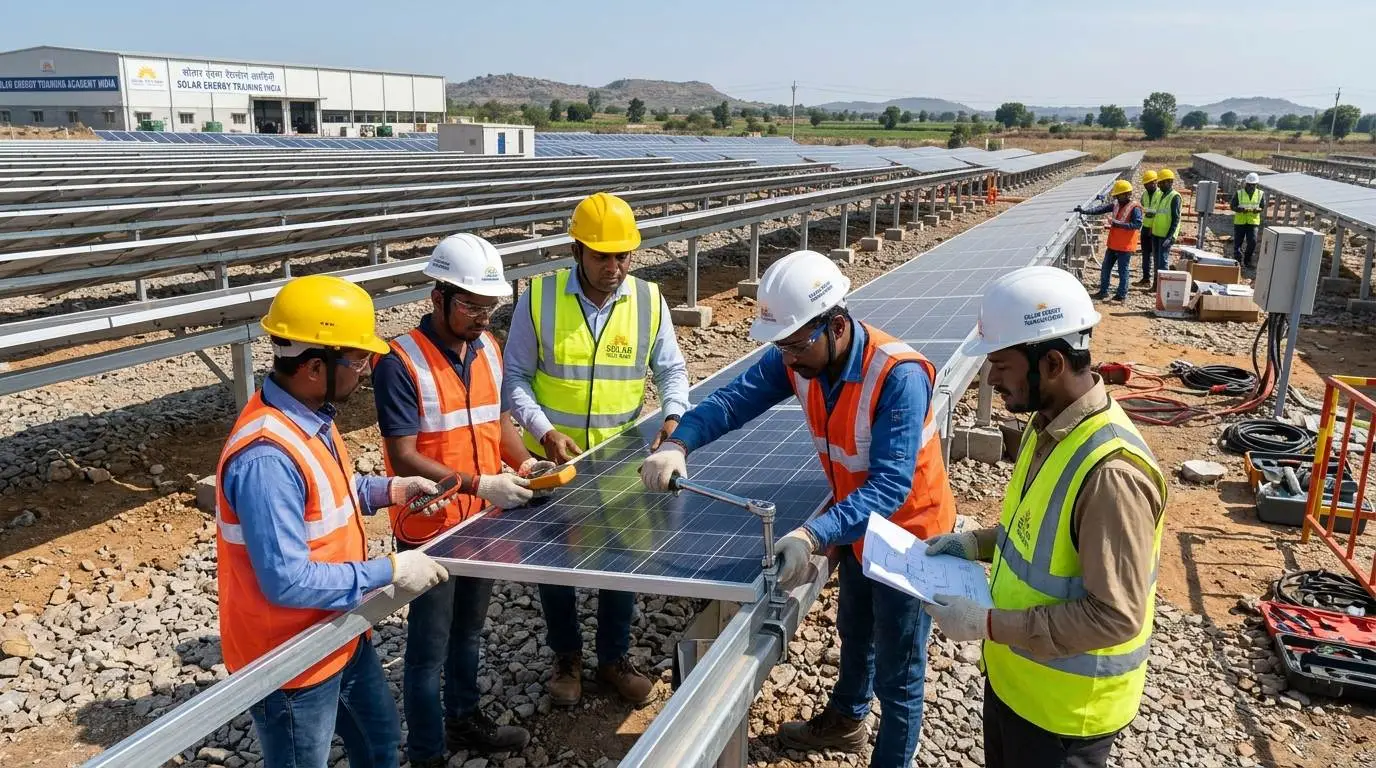
Practical Industry Impact: Budget 2026–27 earmarks historic direct allocations for residential rooftop solar, domestic storage battery manufacturing, and industrial decarbonization.
Union Budget 2026 at a Glance: Key Verified Measures
Below are the six official fiscal allocations and policy shifts from the Union Budget 2026–27 documents and relevant Ministry notifications that directly reshape the clean energy job market.
₹32,914.67 Cr
Net Budget Estimates for MNRE (BE 2026–27)
Gross total budget reaches ₹44,614.67 Cr (up from ₹26,549.38 Cr Net BE in 2025–26). This reflects aggressive capital outlays for rooftop solar subsidies, grid-scale tenders, and green hydrogen pilot infrastructure.
₹22,000+ Cr
PM Surya Ghar: Muft Bijli Yojana Outlay
Part of the ₹75,021 Cr national program targeting 1 crore households with up to 300 units free monthly solar power. Provides up to ₹78,000 direct subsidy per 3 kW residential rooftop installation, fueling massive demand for solar EPC installers.
₹3,760 Cr VGF
Viability Gap Funding for BESS (4,000+ MWh)
Provides up to 40% capital support for grid-connected Battery Energy Storage Systems. 85% of capacity is reserved for state DISCOMs, driving levelized storage costs down to ₹5.50–₹6.60/kWh and spurring utility-scale storage engineering roles.
₹10,900 Cr
PM E-DRIVE Scheme Operational (thru 2028)
Formal operational scheme replacing FAME II: allocates ₹4,391 Cr for 14,028 e-buses, ₹2,000 Cr for 72,300 public EV charging stations, and ₹2,767 Cr for e-2Ws/e-3Ws incentives, creating heavy demand for EV powertrain and charging technicians.
0% Duty
Exemption on 25 Critical Minerals & Capital Goods
Full Basic Customs Duty (BCD) waiver on Lithium, Cobalt, Nickel, Copper, Gallium, and mineral processing capital goods. Also waives BCD on sodium antimonate for solar glass, lowering raw material costs for cell and module plants.
₹19,744 Cr
National Green Hydrogen Mission (SIGHT Program)
Targeting 5 MMT annual green hydrogen capacity by 2030. Backed by financial incentives for domestic electrolyser manufacturing and pilot green ammonia/steel projects, opening high-end R&D and electrochemical engineering careers.
Table of Contents — Navigate This Technical Guide
What Union Budget 2026 Means for India's Clean-Energy Transition
India's nationally determined contribution (NDC) targets 500 GW of non-fossil electric capacity by 2030 and Net-Zero carbon emissions by 2070. The Union Budget 2026–27 decisively shifts government intervention from early-stage pilot encouragement to full-scale domestic industrialization, grid balancing, and consumer prosumerism.
▶ Accelerated Domestic Value Addition
By combining customs exemptions on 25 critical minerals with tariffs on non-ALMM (Approved List of Models and Manufacturers) imports, the budget makes domestic cell assembly and ingot/wafer manufacturing economically mandatory. Indian EPCs can no longer rely on unchecked component imports.
▶ Grid Firming & Interconnection Mandate
Solar power generation peaks at noon, creating steep duck curves for state DISCOMs. The Budget's dedicated funding for inter-state transmission system (ISTS) green energy corridors and BESS VGF addresses the transmission bottleneck head-on, ensuring round-the-clock (RTC) power stability.
▶ From Centralized Utilities to 1 Cr Prosumers
With over ₹22,000 Cr directed to rooftop solarization, the focus expands beyond multi-megawatt desert solar parks to millions of rooftops in Tier-1, Tier-2, and rural districts. This decentralization requires thousands of localized installation and maintenance contractors.
Institutional Perspective: While budgetary allocations establish the funding ceiling, actual project execution depends on timely release of operational guidelines by state nodal agencies (SNA) and state electricity regulatory commissions (SERCs). Clean energy professionals must understand both the central budget numbers and state-level net metering regulations.
Solar Energy & Renewable Energy: Verified Budget Provisions
The solar sector continues to receive the lion's share of MNRE funding. Below is the verified status of the flagship programs and regulatory mandates governing solar technology in FY 2026–27.
1. PM Surya Ghar: Muft Bijli Yojana — Residential Rooftop Solar Scaling
Official Document Provision: Sustained central budget allocation exceeding ₹22,000 Cr under Demand No. 71 for residential rooftop financial assistance, as part of the total ₹75,021 Cr scheme outlay launched to solarize 10 million households.
- Subsidy Slabs: Up to ₹30,000 for 1 kW systems, ₹60,000 for 2 kW systems, and a maximum of ₹78,000 for systems of 3 kW or higher capacity.
- Who Benefits: Residential homeowners, residential welfare associations (RWAs for common area lighting up to 500 kW at ₹18,000/kW), and empaneled local solar EPC installers.
- Practical Engineering Implication: Requires strict compliance with Domestic Content Requirement (DCR) modules and verified BIS standards. Creates immediate demand for site survey technicians, shadow analysis specialists, net metering coordination engineers, and DISCOM liaison officers.
2. Solar PV Manufacturing PLI & Customs Duty Realignment
Official Document Provision: Ongoing execution of the ₹24,000 Cr cumulative Production Linked Incentive (PLI) scheme for high-efficiency solar modules (Tranches I and II), coupled with customs duty exemptions on capital machinery and sodium antimonate for solar glass manufacturing.
- Status: Continuing scheme with reinforced fiscal protection. Non-ALMM imported modules remain subjected to 40% Basic Customs Duty, while cells face 25% BCD.
- Manufacturing Target: Over 48 GW of fully integrated solar module manufacturing capacity coming online across Gujarat, Rajasthan, Tamil Nadu, and Odisha.
- Engineering Skills Required: Silicon crystallization, wafer slicing quality control, TOPCon and HJT cell architecture, module lamination, and electroluminescence (EL) defect inspection.
3. Agricultural Solarization: PM-KUSUM Component Realignment
Official Document Provision: Budget allocation under MNRE Demand No. 71 supports feeder-level solarization (Component C) and solar agricultural pump sets (Component B) under the PM-KUSUM program.
- Practical Shift: Transition from standalone DC solar pumps to grid-connected feeder-level solar plants (typically 500 kW to 2 MW capacity) installed near 33/11 kV rural substations.
- Who Benefits: Rural EPC contractors, agricultural co-operatives, farmers selling surplus energy to DISCOMs, and distributed solar maintenance teams.
Battery Energy Storage Systems (BESS): Grid Firming & Industrial Applications
As variable renewable energy penetration surpasses 25% on state grids, energy storage transitions from an optional add-on to an essential grid stabilization mechanism. Here is how official policy supports BESS integration and where engineering opportunities reside.
Viability Gap Funding (VGF) Framework
Approved with a central budgetary support of ₹3,760 Cr providing up to 40% capital cost support for 4,000+ MWh of storage capacity through 2030–31.
DISCOM Mandate: At least 85% of total project capacity must be contracted to state distribution utilities for peak shaving and frequency regulation at a targeted LCoS of ₹5.50–₹6.60/kWh.
Commercial & Industrial (C&I) Storage
Rising Time-of-Day (ToD) electricity tariffs in Maharashtra, Gujarat, and Tamil Nadu are driving private industrial facilities to deploy 100 kWh to 2 MWh behind-the-meter BESS units.
Core Role: Storing daytime rooftop solar surplus to offset expensive evening peak grid tariffs (peak power surcharges often reaching 20–30% above base rates).
Battery Chemistry & BMS Engineering
Stationary storage relies heavily on Lithium Iron Phosphate (LFP) prismatic cells due to superior thermal stability and cycle life (4,000–6,000 cycles at 80% DoD) compared to NMC chemistries.
Specialization: Battery Management Systems (BMS) with CAN/Modbus protocols, active cell balancing, and containerized HVAC thermal run-away suppression.
🔋 Practical Educational Case: Sizing a 500 kWp Solar + 250 kWh BESS System
Note: This model represents an educational engineering calculation, not a guaranteed financial return or government quotation.
Solar Generation: 500 kWp rooftop solar generates ~2,000 kWh/day. Midday surplus: ~400 kWh fed to battery.
BESS Specification: 250 kWh / 125 kW C/2 LFP storage container with bidirectional hybrid inverter.
Dispatch Strategy: Battery discharges during evening peak slot (6 PM – 10 PM) when grid tariff carries a ₹2.50/kWh peak penalty.
Engineering Skill Tested: Inverter round-trip efficiency (RTE ~86%), Depth of Discharge (DoD) calibration, and state of charge (SoC) management.
Electric Vehicles & Battery Technology: Official Scheme Clarification
A critical distinction for industry professionals: While speculative media reports frequently refer to "FAME III," the official government scheme formally notified and operational under the Ministry of Heavy Industries (MHI) is the PM E-DRIVE Scheme.
PM E-DRIVE Scheme (₹10,900 Cr Outlay)
Notified by MHI and extended through March 31, 2028, providing stable policy continuity across four strategic segments:
- E-Buses: ₹4,391 Cr to procure and deploy 14,028 state transport electric buses.
- Public Charging (EVPCS): ₹2,000 Cr to establish 72,300 public EV charging stations.
- Demand Incentives: ₹2,767 Cr targeting 24.79 lakh e-2Ws and 3.16 lakh e-3Ws.
- Testing & Modernization: ₹780 Cr for testing agencies (ARAI, ICAT, GARC) to upgrade safety labs.
PLI for Advanced Chemistry Cell (ACC) Batteries
The ₹18,100 Cr ACC PLI program mandates 50 GWh indigenous cell production to reduce battery import dependence from East Asia.
- Value Addition Target: Minimum 60% domestic value addition within five years of commercial operation.
- Key Beneficiaries: Cell manufacturers (Ola Cell Gigafactory, Reliance New Energy, Amara Raja, Exide Energy).
- Engineering Demand: Cell chemistry testing, cathode slurry preparation, electrolyte filling, formation and aging technicians.
High-Growth Engineering Roles in the EV Ecosystem
With 72,300 public chargers being funded and OEM production scaling up, employers seek engineers capable of handling power electronics, DC fast-charging protocols (CCS-2, CHAdeMO, Bharat DC-001), EV drivetrain motor controllers, and high-voltage safety diagnostics.
National Green Hydrogen Mission & Clean Tech Horizons
The National Green Hydrogen Mission (allocated ₹19,744 Cr total outlay) establishes India as an emerging exporter and domestic consumer of green hydrogen and green ammonia. Here is what the latest budget provisions imply for specialized engineering.
SIGHT Programme Execution (SECI Tranches)
Under the Strategic Interventions for Green Hydrogen Transition (SIGHT), SECI conducts competitive bidding for:
- Component I: Electrolyser manufacturing facilities (1,500 MW/yr annual capacity support).
- Component II: Production of Green Hydrogen (450,000 tonnes/yr capacity allocation).
Electrolyser Technology Specializations
Engineers must understand the trade-offs between key electrolyser architectures:
- Alkaline Electrolysers: Lower capex, mature supply chain, suited for steady utility baseload.
- PEM (Proton Exchange Membrane): Fast dynamic response, ideal for direct coupling with variable solar PV and wind turbines.
Industrial Decarbonization Mandates
Pilot project notifications focus on hard-to-abate industrial clusters:
- Refineries & Petrochemicals (replacing grey hydrogen desulfurization).
- Fertilizer plants (green ammonia synthesis).
- Direct Reduced Iron (DRI) steelmaking substituting green hydrogen for coking coal.
Policy Comparison Table: Verified Budget Provisions vs Schemes
A verified side-by-side assessment of India's clean energy policies, distinguishing newly announced fiscal provisions from existing statutory programs.
| Policy / Tech Domain | Verified Provision & Allocation | Status | Engineering & Industry Implication | Official Source |
|---|---|---|---|---|
| Rooftop Solar PV (PM Surya Ghar) | ₹22,000+ Cr central allocation in FY 2026–27; up to ₹78,000 direct subsidy per home. | EXPANDED / ACTIVE | High demand for certified residential rooftop installers, DISCOM liaison officers, and PV designers. | MNRE Demand 71 |
| Solar PV Module PLI | ₹24,000 Cr cumulative outlay across Tranches I & II for integrated gigafactories. | CONTINUING | Factory engineering roles in wafer slicing, TOPCon/HJT cell line maintenance, and module quality assurance. | MNRE Orders |
| Battery Storage (BESS VGF) | ₹3,760 Cr central VGF covering up to 40% capital expenditure for 4,000+ MWh capacity. | NOTIFIED / ACTIVE | High-value engineering in BESS container integration, SCADA power conversion systems, and DISCOM scheduling. | Ministry of Power |
| Electric Vehicles (PM E-DRIVE) | ₹10,900 Cr total outlay through March 31, 2028; ₹2,000 Cr for 72,300 charging stations. | NOTIFIED / EXTENDED | Charge point operators (CPOs) expanding field electrical engineers; OEM hiring for electric bus drivetrains. | MHI Gazette |
| ACC Battery Cell PLI | ₹18,100 Cr outlay for 50 GWh indigenous cell production plants. | OPERATIONAL | Electro-chemical testing, battery pack assembly, automated wire-bonding, and thermal safety auditing. | MHI PLI Cell |
| Critical Minerals Customs Waiver | 100% Basic Customs Duty exemption on 25 critical minerals (Lithium, Cobalt, Nickel, etc.). | NOTIFIED FISCAL | Lowers raw material bill-of-materials for Indian cell makers; accelerates domestic refining plant projects. | Finance Bill 2026 |
| National Green Hydrogen Mission | ₹19,744 Cr total mission outlay; SIGHT financial incentives for electrolysers. | ACTIVE ROLLOUT | Electrolyser assembly, hydrogen compression and storage safety, green ammonia synthesis plant modeling. | MNRE Mission |
High-Demand Technical Career Tracks for Engineers & Technicians
Budget allocations translate directly into corporate capital expenditure and contractor recruitment. Below are nine established engineering tracks experiencing accelerated hiring across India.
1. Solar PV Design & System Engineer
Key Responsibilities: 3D shading analysis in SketchUp, yield simulation in PVsyst, DC/AC sizing, single-line diagrams (SLDs), and Bill of Quantities (BOQ) preparation.
Recommended Training: PG Diploma in Solar Technology.
2. Solar EPC Project Execution Engineer
Key Responsibilities: Site mobilization, structure alignment, module mounting, DC cable crimping, inverter commissioning, earthing grid testing, and statutory CEIG approvals.
Recommended Training: Diploma in Solar Technology.
3. Solar Operations & Maintenance (O&M) Specialist
Key Responsibilities: SCADA real-time monitoring, thermographic drone inspections for hotspot detection, IV-curve tracing, degradation tracking, and predictive inverter servicing.
Recommended Training: Practical Solar O&M Hands-on Workshop at IISE.
4. Battery Energy Storage System (BESS) Engineer
Key Responsibilities: BESS container layout, battery rack series/parallel matching, BMS communication configuration via Modbus/TCP, and integration with Power Conversion Systems (PCS).
Recommended Training: Battery Systems & Energy Storage Course.
5. EV Powertrain & Battery Diagnostics Technician
Key Responsibilities: High-voltage pack diagnostics, contactor inspection, cell balancing validation, motor controller CAN-bus signal logging, and AIS-156 safety testing.
Recommended Training: PG Diploma in EV Technology.
6. EV Charging Infrastructure (CPO) Engineer
Key Responsibilities: Grid load study, LT/HT panel design, DC fast-charger commissioning (60 kW to 240 kW), OCPP 1.6/2.0 protocol testing, and cloud billing integration.
Recommended Training: Diploma in Electric Vehicle Technology.
7. Certified Energy Auditor / Energy Manager
Key Responsibilities: Mandatory energy auditing for Designated Consumers under BEE PAT scheme, power factor correction, harmonic distortion audits, and waste heat recovery studies.
Recommended Training: Certified Energy Auditor Course.
8. Renewable Project Development & Permitting Manager
Key Responsibilities: Land acquisition, solar insolation feasibility reports, open-access PPA negotiation, ISTS connectivity applications, and tariff bidding modeling.
Recommended Training: B.Voc in Solar Technology.
9. Clean Energy Contractor & Entrepreneur
Key Responsibilities: Operating a regional rooftop solar EPC business, PM Surya Ghar vendor empanelment, distributor supply chains, customer financing, and team management.
Recommended Training: Solar for Business Entrepreneurs Certificate Program.
Technical Skills Matrix: Market Demand vs IISE Training Pathways
A structured overview mapping required industry competencies to practical laboratory experience and verified IISE program pathways.
| Clean Energy Sector | Core Technical Skills | Hands-On Practical Experience | Verified Training Pathway |
|---|---|---|---|
| Rooftop Solar PV | PVsyst yield analysis, string voltage calculations, shadow analysis, SLD drawing in AutoCAD. | Physical installation on rooftop test benches, MC4 crimping, inverter parameter setup, net-meter wiring. | Diploma in Solar Tech |
| Utility Solar & Microgrids | Substation interfacing, HT switchgear sizing, SCADA protocols, transformer loss calculations, CEIG norms. | Earth resistance megger testing, circuit breaker timing tests, thermographic camera auditing. | PG Diploma in Solar Tech |
| Battery Energy Storage (BESS) | LFP cell cycle analysis, thermal runaway mitigation, BMS communication protocols, C-rate sizing. | Battery rack assembling, cell voltage balancing rigs, inverter-BESS Modbus configuration. | Battery Systems Program |
| Electric Vehicle Powertrain | BLDC / PMSM motor controller tuning, regenerative braking logic, CAN-bus sniffing, DC-DC converter sizing. | EV chassis wiring, dynamometer testing, insulation resistance checking, AIS-156 safety tests. | PG Diploma in EV Tech |
| Commercial Energy Auditing | Power quality analysis, total harmonic distortion (THD), specific energy consumption (SEC) auditing, HVAC balancing. | Fluke power analyzer data logging, lux meter audits, thermal imaging of motor winding overhauls. | Energy Auditor Program |
How Students & Working Professionals Should Prepare for Budget 2026 Opportunities
Transitioning into high-growth clean energy roles requires more than theoretical degrees. Follow this seven-step technical preparation roadmap designed for engineering graduates, diploma holders, and pivoting professionals.
Master Policy & Tariff Regulations
Study state net metering policies, gross metering guidelines, ALMM mandate lists, and DISCOM interconnection procedures. Understand how policy drives commercial viability.
Strengthen Electrical Fundamentals
Deepen knowledge in AC/DC power flow, transformer impedance, earthing and bonding, short-circuit calculations, and surge protection device (SPD) coordination.
Acquire Industry Simulation Tools
Gain certified proficiency in software standard tools: PVsyst for generation modeling, SketchUp with Skelion for 3D layout, and AutoCAD for Single Line Diagrams.
Complete Hands-On Lab Work
Physical workshop experience is irreplaceable. Practice module mounting, cable crimping, inverter setup, and battery bank balancing in an accredited laboratory.
Master Statutory Safety Standards
Learn Central Electricity Authority (CEA) safety guidelines, Indian Standard IS 3043 (earthing), IS 732 (wiring), and automotive standard AIS-156 for EV battery safety.
Build a Technical Portfolio
Employers evaluate actual work samples. Compile a portfolio of complete PVsyst generation reports, AutoCAD electrical drawings, and battery diagnostic logs.
Obtain Industry Credentials
Secure a university-affiliated or government-recognized diploma from an established institution like IISE to validate your competencies with hiring partners.
Practical Educational Project Examples (Lab & Field)
These project modules represent actual educational coursework completed by students at IISE to build portfolio-grade engineering experience.
50 kWp Commercial Rooftop Solar PV System Design
Objective: Design a rooftop solar installation for a manufacturing plant in Pune, adhering to MSEDCL net-metering regulations.
- 3D shadow modeling of factory parapets and HVAC chimneys.
- String sizing for 545 Wp bifacial mono-PERC modules (18 modules/string).
- 50 kW three-phase grid-tied string inverter selection with 98.6% efficiency.
- Comprehensive generation loss diagram and PR (Performance Ratio) report: 81.2%.
Solar-Plus-BESS Sizing for Commercial Peak Shaving
Objective: Dimension a behind-the-meter battery storage system to curb 150 kVA peak demand surcharges during evening ToD windows.
- Load profile analysis across 15-minute interval smart meter logs.
- Sizing 200 kWh LFP battery bank operating at 0.5C discharge rate.
- Programming EMS (Energy Management System) control logic for peak shaving.
- Battery thermal management air-conditioning load calculation.
EV High-Voltage Battery Pack Diagnostic & Safety Audit
Objective: Perform physical teardown, diagnostics, and AIS-156 safety validation on a 72V 3.2 kWh electric two-wheeler battery pack.
- Individual cell voltage differential measurement (<15 mV threshold).
- BMS CAN-bus live communication tracing and fault-code clearing.
- Insulation resistance (megger) testing between high-voltage bus and chassis.
- Thermal runaway isolation barrier verification.
1 MWp Ground-Mount Solar EPC Planning & Interconnection
Objective: Formulate complete EPC project execution plan, civil foundation design, and 11 kV substation synchronization.
- Topographical survey and ramming foundation depth calculation.
- HT yard design: 1250 kVA step-up transformer and VCB switchgear.
- Earth pit design achieving <1.0 Ohm system resistance.
- CEIG inspection readiness checklist and pre-commissioning testing.
Implications for Clean Energy Businesses, EPCs & Startups
The Union Budget's fiscal measures open substantial commercial opportunities for regional entrepreneurs and established contractors. However, sustainable profitability requires rigorous operational planning rather than chasing subsidies alone.
1. Rooftop Solar EPC Franchises
The PM Surya Ghar scheme creates a turnkey market for local EPC firms empaneled with national portals (e.g., National Portal for Rooftop Solar). Key success factor: Maintaining rapid net-metering turnaround times and providing robust 5-year comprehensive maintenance contracts.
2. EV Charging Point Operator (CPO)
With ₹2,000 Cr allocated for EV charging infrastructure under PM E-DRIVE, setting up highway fast-charging hubs or fleet depot charging stations represents a viable annuity revenue model. Essential: Location traffic study and reliable high-tension (HT) power sanctions.
3. Specialized Solar O&M Contracting
India's installed solar capacity (>85 GW) creates a recurring servicing requirement. Independent Service Providers (ISPs) offering robotic dry-cleaning, drone thermography, and inverter board repair generate stable margins without high working capital requirements.
✓ Commercial Feasibility Checklist for Clean Energy Entrepreneurs
Recommended IISE Programs Aligned with Union Budget 2026
Turn national policy growth into practical career momentum. Explore our accredited, placement-backed academic degrees, diplomas, and engineering certificates.
PG Diploma in Solar Technology
Comprehensive program covering utility-scale solar EPC, microgrid engineering, PVsyst simulation, SCADA automation, and regulatory statutory compliances.
B.Voc in Solar Technology
3-year UGC-affiliated Bachelor of Vocation degree combining heavy industrial electrical engineering theory with multi-semester field EPC apprenticeships.
Diploma in Solar Technology
Fast-track professional diploma focusing on rooftop solar design, PM Surya Ghar execution, inverter wiring, and net metering liaisoning.
PG Diploma in EV Technology
Advanced powertrain engineering covering BLDC/PMSM controllers, BMS CAN communication, battery pack testing, and DC fast-charging standards.
Battery Systems & Storage
Specialized training in BESS dimensioning, LFP vs NMC cell chemistry, thermal management, inverter coupling, and grid ancillary service integration.
Certified Energy Auditor Course
Preparation for statutory industrial energy audits, BEE PAT compliance, power quality harmonic logging, and commercial HVAC optimization.
Expert Interpretation & Practical Limitations of Budget 2026
To make informed business and career decisions, professionals must clearly separate confirmed fiscal allocations from ground-level administrative implementation realities.
1. Budget Speech vs Operational Guidelines
A budget announcement in Parliament does not automatically activate field subsidies. The concerned ministry (MNRE, MHI, or MoP) must notify administrative guidelines, empanelment terms, and portal workflows before applications open.
2. State Electricity Regulatory Commissions (SERCs)
Electricity is a concurrent subject. Even with central subsidies, net metering limits (e.g., 10 kW vs 500 kW caps), banking settlement terms, and fixed demand charges are determined by individual state electricity regulatory bodies.
3. Domestic Content & ALMM Compliance
Government subsidies under PM Surya Ghar and PM-KUSUM require strictly ALMM-listed modules and DCR-compliant cells. Projects deploying non-compliant components risk forfeiture of central financial assistance.
Frequently Asked Questions (FAQs) — Union Budget 2026
Clear, fact-checked answers addressing reader questions regarding budget numbers, scheme timelines, and career options.
The most impactful measures include: (1) Total Net Budget Estimates for MNRE (Demand No. 71) increased to ₹32,914.67 crore (Gross ₹44,614.67 crore); (2) Dedicated allocation exceeding ₹22,000 crore for residential rooftop solar under the PM Surya Ghar Muft Bijli Yojana; (3) Full Basic Customs Duty (BCD) exemption on 25 critical minerals including Lithium, Cobalt, and Nickel; (4) Sustained support for the ₹3,760 crore BESS Viability Gap Funding scheme; and (5) Operational execution of the ₹10,900 crore PM E-DRIVE electric mobility scheme through March 2028.
Union Budget 2026 did not create a separate new residential subsidy scheme; instead, it backed the existing flagship PM Surya Ghar: Muft Bijli Yojana with substantial budgetary resources exceeding ₹22,000 crore. Under this program, residential homeowners receive direct financial assistance of up to ₹30,000 for 1 kW systems, ₹60,000 for 2 kW systems, and a maximum of ₹78,000 for systems of 3 kW or higher capacity.
While speculative industry discourse frequently refers to “FAME III,” the official government scheme formally notified and operational under the Ministry of Heavy Industries (MHI) is the PM E-DRIVE (PM Electric Drive Revolution in Innovative Vehicle Enhancement) scheme. It carries an approved financial outlay of ₹10,900 crore active through March 31, 2028, allocating ₹4,391 crore for electric buses, ₹2,000 crore for public EV charging stations, and ₹2,767 crore for e-2Ws/e-3Ws demand incentives.
The central government approved a dedicated Viability Gap Funding (VGF) scheme with budgetary support of ₹3,760 crore, covering up to 40% of the capital cost for developing 4,000+ MWh of BESS projects by 2030–31. The scheme mandates that at least 85% of capacity is contracted to state distribution utilities to shave peak load tariffs.
The Finance Bill exempted Basic Customs Duty (BCD) on 25 critical minerals including Lithium, Cobalt, Nickel, Copper, Gallium, and Rare Earth Elements. This lowers the raw material input cost for domestic battery gigafactories and advanced electronics, enhancing cost-competitiveness against imported battery packs.
With 1 crore households targeted under PM Surya Ghar and multi-gigawatt utility auctions by SECI and NTPC, EPC companies require engineers proficient in PVsyst 3D shading simulations, AutoCAD single-line diagrams, string inverter selection, HT switchgear protection, and DISCOM net-metering liaison.
Industry employers prioritize proficiency in PVsyst (generation simulation & loss diagrams), SketchUp with Skelion or Helioscope (3D rooftop layout and shading), AutoCAD Electrical (detailed single-line diagrams and layout drawings), and Excel/Python for PV financial and degradation modeling.
Graduates should acquire targeted domain qualifications covering EV powertrain dynamics, motor controller firmware and tuning, Battery Management Systems (BMS) with CAN-bus communication, high-voltage battery pack diagnostics, and AIS-156 safety testing. Programs like IISE’s PG Diploma in EV Technology provide this targeted bridge.
Yes. IISE offers UGC-recognized degree pathways such as the B.Voc (Bachelor of Vocation) in Solar Technology, along with university-affiliated Postgraduate Diplomas, Professional Diplomas, and specialized short-term technical certificates for working professionals and entrepreneurs.
Yes. IISE programs feature practical physical workshops involving rooftop solar test rigs, battery assembly and testing stations, EV chassis diagnostic simulators, and power analyzer tools. IISE partners with over 200 clean energy hiring partners across India for career placements.
The ₹19,744 crore mission stimulates manufacturing roles in electrolyser assembly lines (alkaline and PEM stacks), electrochemical engineering, process safety for high-pressure hydrogen storage, and systems engineering for green ammonia synthesis plants.
Authoritative documents should always be verified on the official Union Budget portal (indiabudget.gov.in), the Press Information Bureau (pib.gov.in), the Ministry of New and Renewable Energy (mnre.gov.in), the Ministry of Heavy Industries (heavyindustries.gov.in), and the Ministry of Power (powermin.gov.in).
Related IISE Industry Resources & Guides
Explore our comprehensive technical knowledge base, regulatory deep dives, and clean energy training directories.
Solar Energy Knowledge Hub
Comprehensive guides covering solar PV design, net metering guidelines across Indian states, inverter technologies, and EPC cost benchmarking.
Explore Solar Hub →Electric Vehicle Technology Portal
In-depth technical coverage of EV drivetrains, battery management systems (BMS), charging protocol architectures, and automotive safety standards.
Explore EV Portal →Battery & Storage Systems Guide
Detailed analysis of stationary energy storage, LFP battery chemistry, grid-scale BESS integration, and thermal runaway mitigation protocols.
Explore Battery Guide →Energy Auditing & Management
Technical resources on statutory energy audits, power quality testing, industrial harmonic mitigation, and Bureau of Energy Efficiency (BEE) compliances.
Explore Energy Auditing →
Indian Institute of Solar Energy (IISE) — Technical Policy Desk
Established with a mission to deliver industry-leading technical training, engineering education, and workforce development in India's clean energy sector. With over 15 years of institutional experience, IISE offers UGC-recognized degree pathways, postgraduate diplomas, and professional skill development programs.
Prepare for India's Renewable Energy & EV Opportunities
Understand the policy landscape, master practical design and testing software, and enroll in structured diploma or degree pathways aligned with your career goals. Speak directly with an IISE senior technical career advisor today.
Official Government Sources & Budget References
Every claim, budgetary figure, and scheme allocation on this page is corroborated by the following official Indian government publications:
- Union Budget of India (Demand No. 71 — MNRE): Notes on Demands for Grants 2026–27, Ministry of Finance.
- Press Information Bureau (PIB): Cabinet Decisions on PM Surya Ghar, BESS VGF Scheme, and Critical Mineral Tariff Rationalization.
- Ministry of New and Renewable Energy (MNRE): National Green Hydrogen Mission Guidelines & Solar PLI Scheme Notifications.
- Ministry of Heavy Industries (MHI): Gazette Notification for PM Electric Drive Revolution in Innovative Vehicle Enhancement (PM E-DRIVE) Scheme.
- Ministry of Power (MoP) / Central Electricity Authority (CEA): National Electricity Plan (Generation & Transmission) & BESS Guidelines.
EDITORIAL & LEGAL DISCLAIMER: This technical analysis is published by the Indian Institute of Solar Energy (IISE) strictly for educational, career-planning, and technical informational purposes. Budget proposals, statutory notifications, and existing government schemes are subject to formal administrative guidelines, eligibility conditions, and state electricity regulatory commission (SERC) amendments. Readers, project developers, and entrepreneurs should verify current operational notifications directly with the relevant ministry portals (indiabudget.gov.in, mnre.gov.in, heavyindustries.gov.in) before entering into commercial contracts, making capital investments, or submitting project proposals. IISE does not provide financial or legal advice.