Electric Vehicle Courses in India: Build Your EV Technology Skills
Master high-voltage powertrain integration, Lithium-ion battery pack engineering, BMS firmware, traction motor control, and charging infrastructure. Hands-on practical lab sessions in Mumbai & Pune backed by flexible blended learning.
Engineering Core Competencies Covered
15+ Years of Leadership in Clean Technology & Engineering
Indian Institute of Solar Energy (IISE) is India's leading training institution dedicated to renewable energy, energy storage, and electric mobility. We combine academic rigor with genuine industrial hardware labs.
Pioneering Heritage
Over 15 years delivering specialized clean-energy training programs across India with nationwide recognition.
Dedicated EV Labs
Operational battery assembly lines, cell cyclers, motor dynamometers, and charging test rigs in Mumbai & Pune.
Regulatory Alignment
Curriculum meticulously aligned with AIS-038 Rev 2, AIS-156 Amendment 3, Bureau of Energy Efficiency, and MoHI guidelines.
Corporate Placement
Active career support, technical resume coaching, and referral linkages with EV OEMs, fleet aggregators, and Tier-1 suppliers.
Find Your Ideal Electric Vehicle Program
Select your current background to view the recommended qualification track, curriculum depth, and expected career outcome.
PG Diploma in EV Technology
Comprehensive 1-year postgraduate training covering full-stack vehicle engineering, BMS firmware, inverters, thermal modeling, and capstone R&D.
- Duration: 1 Year (Blended Hybrid)
- Eligibility: B.E. / B.Tech in Engineering
- Outcome: Powertrain & BMS Engineer Roles
Diploma in EV Technology
Rigorous 1-year (510 hours) technical diploma focused on battery assembly, wiring harnesses, motor testing, charging setups, and workshop troubleshooting.
- Duration: 1 Year (2 Semesters, 34 Credits)
- Eligibility: Polytechnic Diploma, ITI, 10+2 Science
- Outcome: EV Assembly & Test Technician
Fundamentals of EV Technology
Fast-track 1-month foundational orientation exploring EV vehicle topology, battery fundamentals, charging models, and clean-mobility business setup.
- Duration: 1 Month / Self-Paced
- Eligibility: Open to All (10+2, Students, Business)
- Outcome: Technical Sales & EV Entrepreneurship
Compare Verified Electric Vehicle Programs
Review authentic course curriculums, verified program fees, eligibility criteria, and direct enrolment pathways. All programs include official IISE certification.
PG Diploma in Electric Vehicle Technology
End-to-end electric powertrain engineering designed for engineering graduates and automotive professionals. Covers deep electrochemistry to vehicle CAN communications.
Diploma in Electric Vehicle Technology
Applied hands-on program tailored for polytechnic diploma holders, ITI technicians, and 10+2 science graduates. Focuses on physical assembly, diagnostics, and testing.
Fundamentals of Electric Vehicle Technology
Self-paced foundational course built for beginners, sales engineers, fresh school leavers, and clean-tech entrepreneurs looking to understand the EV landscape.
EV Software & Embedded Systems Course
Specialized programming and control firmware track for CS, IT, and Electronics engineers building AUTOSAR stacks, BMS state estimation, and motor control algorithms.
Why Study Electric Vehicle Technology in India?
India's electric mobility revolution is driven by central government capital allocation, stringent localized manufacturing mandates, and exponential adoption in commercial and consumer transit.
Government Policy Framework
The PM Electric Drive Revolution in Innovative Vehicle Enhancement (PM E-DRIVE) scheme and Auto Component PLI enforce high Domestic Value Addition (DVA). Engineers who understand indigenous component testing and AIS compliance are in high demand.
Commercial Fleet Electrification
State Transport Undertakings (STUs) including Mumbai BEST, Delhi DTC, and Bengaluru BMTC are deploying thousands of electric buses, spurring immediate demand for depot charging infrastructure engineers and high-voltage fleet service managers.
Battery Cell & Pack Manufacturing
Gigafactory announcements and localized pack assembly plants require engineers who can implement rigorous AIS-156 safety standards, thermal runaway mitigation barriers, and intelligent CAN bus telemetry.
Who Should Enrol in IISE's EV Programs?
Our curriculum tracks are structured to match your exact academic foundation and professional transition goals.
Mechanical & Automobile Engineers
Transition from internal combustion engines to EV chassis packaging, battery enclosure thermal management, drivetrain gear reduction, and vehicle dynamics.
Recommended: PG DiplomaElectrical & Electronics Engineers
Specialize in power conversion stages, bidirectional DC-DC converters, motor traction inverters, BMS firmware logic, and CAN bus vehicle telemetry.
Recommended: PG Diploma / SoftwarePolytechnic & ITI Technicians
Master physical battery pack assembly, spot welding, wire harness routing, multimeters, scan tool diagnostics, and high-voltage workshop safety.
Recommended: 1-Year DiplomaClean-Tech Entrepreneurs
Gain the commercial and technical mastery needed to set up EV battery retrofit workshops, fast-charging hubs, electric fleet operations, or service stations.
Recommended: Fundamentals / Diploma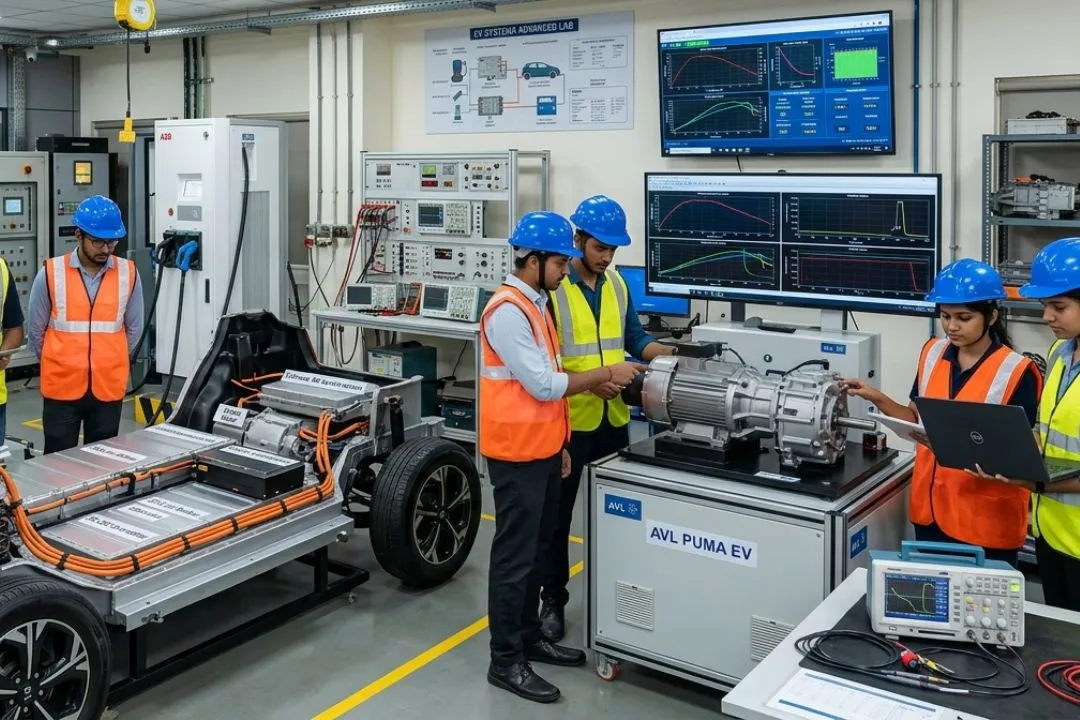
16-Module Curriculum: From Cell Electrochemistry to Vehicle Telemetry
Review the official engineering module syllabus covering the complete technical stack of electric mobility. Click any module to explore key topics.
Hands-On Laboratory Experience in Mumbai & Pune
Engineering mastery requires touching real automotive hardware. Our dedicated workshops allow students to construct, test, and troubleshoot genuine high-voltage systems.
Battery Assembly & Spot Welding
Hands-on construction of multi-cell packs using pneumatic spot welders, nickel strip matrix layouts, cell holders, busbars, and high-temperature Kapton insulation barriers.
Cell Testing & Impedance Analysis
Operation of multi-channel battery cyclers, internal resistance (AC milliohm) testing, thermal imaging during charge-discharge cycles, and automated capacity grading.
BMS Wiring & Logic Configuration
Wiring balance leads, configuring over-voltage, under-voltage, over-temperature, and short-circuit protection thresholds via PC GUI software and UART/CAN adapters.
Motor Dyno & Inverter Tuning
Tuning PMSM and BLDC motor controllers on dynamometers; observing phase current waveforms on digital oscilloscopes, and adjusting throttle map curves.
EV Charging Station Bench
Wiring AC Type 2 and DC fast charging stations; testing pilot control CP/PP state transitions, residual current device (RCD) tripping, and energy meter calibration.
High-Voltage Workshop Safety
Mandatory safety drills utilizing Class 0 1000V rated dielectric gloves, insulated torque tools, rescue hooks, and Lockout-Tagout (LOTO) protocols for vehicle servicing.
A Hybrid Model Designed for Professionals & Students
Advance your skills without putting your career or college education on hold. Our blended architecture combines online theory with intensive on-campus practical contact.
Weekend Live Virtual Lectures
Interactive live weekend evening sessions conducted by senior automotive powertrain specialists. Ask questions in real time, solve mathematical sizing problems, and analyze case studies.
24/7 Digital LMS Access
Comprehensive MasterStudy LMS portal with HD lecture recordings, circuit schematics, MATLAB script templates, regulatory PDFs, and module self-assessment quizzes accessible from any device.
On-Campus Practical Bootcamps
Intensive practical contact sessions held at IISE centers in Mumbai and Pune. Work directly with spot welders, battery packs, inverters, dynamometers, and diagnostics scan tools under faculty supervision.
Electric Vehicle Salary Bands & Job Profiles in India
Data-driven overview of career paths, hiring demand, and realistic compensation ranges based on current automotive cluster recruitment in Pune, Bengaluru, Chennai, and Delhi-NCR.
| Job Profile & Title | Experience Level | Indicative Annual Salary (INR) | Core Required Competencies |
|---|---|---|---|
| EV Service Associate / Technician | 0 – 2 Years | ₹2.4 Lakh – ₹4.2 Lakh | High-voltage safety, multimeter proficiency, OBD-II scanner operation, mechanical module assembly |
| Junior EV Battery Test Engineer | 0 – 3 Years | ₹3.8 Lakh – ₹6.5 Lakh | Battery cycler testing, AIS-156 test protocols, capacity grading, CAD pack modeling, basic CAN logging |
| EV Powertrain & Motor Drive Engineer | 2 – 5 Years | ₹6.0 Lakh – ₹10.5 Lakh | PMSM motor dyno tuning, Field-Oriented Control (FOC), inverter gate driver design, transmission sizing |
| Mid-Level BMS Firmware Engineer | 3 – 6 Years | ₹7.0 Lakh – ₹14.0 Lakh | Embedded C, MATLAB/Simulink SOC/SOH estimation, CAN protocol stacks, ISO 26262 functional safety |
| Senior Battery Pack Lead / Chief Architect | 6 – 10+ Years | ₹15.0 Lakh – ₹28.0+ Lakh | End-to-end pack architecture, liquid cooling thermal optimization, AIS-038 Rev 2 homologation, supplier auditing |
Key Determinants Influencing EV Salary Growth
Engineers possessing verifiable hardware lab experience, high-voltage safety credentials (LOTO), and expertise in battery testing standards (AIS-156) consistently command higher starting compensation. IISE's practical curriculum directly prepares graduates to demonstrate these competencies during technical hiring evaluations.
Why Choose Indian Institute of Solar Energy?
Five demonstrable advantages that make IISE India's most credible practical institution for electric vehicle and clean technology training.
Component-Level Depth
We move past superficial automotive concepts. Our students analyze cell electrochemistry, calculate thermal dissipation matrices, configure MOSFET gate drives, and analyze CAN ID frames.
Physical Hardware Labs
Real hardware beats simulation-only training. Our Mumbai and Pune facilities feature live battery spot welders, high-precision cell cyclers, motor dyno benches, and AC/DC chargers.
Solar-EV Convergence
As India's pioneer solar training institution, IISE uniquely bridges the gap between solar photovoltaic generation, stationary battery storage (BESS), and electric vehicle charging hubs.
Mumbai & Pune Centers
Strategically located in Maharashtra's automotive industrial corridor—surrounded by leading EV OEMs, Tier-1 component manufacturers, and clean-tech startup clusters.
Practicing Automotive Faculty
Instructors are practicing powertrain engineers, battery system designers, and automotive consultants with real-world product homologation and field experience.
10,000+ Alumni Network
Join a robust, active alumni network spanning renewable energy EPCs, automotive suppliers, EV startups, and government energy undertakings across India.
Step-by-Step Admissions Journey
A transparent, merit-based, four-phase application process designed for prospective Indian and international technical applicants.
Submit Application
Fill out the official online enquiry form with your educational credentials, current branch/specialization, and desired EV course track.
Profile Assessment
An academic technical counselor reviews your background, evaluates course eligibility, and confirms which track aligns best with your goals.
Seat Confirmation
Confirm your enrollment via the official payment gateway or choose an installment plan. Seats are capped at 30 per batch to ensure dedicated lab access.
LMS Onboarding
Receive digital LMS access, study guides, and schedule dates for weekend live virtual lectures and Mumbai/Pune practical laboratory bootcamps.
Course Fees & Flexible Installment Schedules
Honest, verified tuition fees with zero hidden charges. Installment options and corporate sponsorship paths available.
| Program Title | Duration & Format | Total Verified Fee | Installment Structure | Official Enrolment Action |
|---|---|---|---|---|
| PG Diploma in Electric Vehicle Technology | 1 Year (16 Modules, Blended Hybrid) | ₹160,000 | ₹60,000 admission confirmation + 2 installments of ₹50,000 | Enrol Now → |
| Diploma in Electric Vehicle Technology | 1 Year (2 Semesters, 510 Hours, 34 Credits) | ₹79,999 | ₹35,000 admission confirmation + 2 installments of ₹22,500 | Enrol Now → |
| Fundamentals of Electric Vehicle Technology | 1 Month / Self-Paced (6 Modules) | ₹9,999 (₹14,999) | Single one-time payment with instant LMS access | Enrol Now → |
| EV Software & Embedded Systems Specialist | 3–6 Months Specialized Technical Track | Contact Admissions | Custom individual and corporate sponsorship options | Check Eligibility → |
Support for UPI, Net Banking, all major Credit/Debit Cards, and Razorpay-secured checkout.
Companies upskilling engineering teams can request GST invoices and custom batch schedules.
Have questions about EMI options? Chat directly on WhatsApp →
Capstone Engineering Projects & Learner Outcomes
IISE students do not just study theory—they build, test, and document real automotive engineering projects that validate their competence to employers.
48V 100Ah LFP Pack with Thermal Runaway Barrier
Designed and assembled a 16S2P prismatic battery pack for an electric 3-wheeler. Implemented passive cell balancing BMS, thermal aerogel barriers, and validated AIS-156 Amendment 3 compliance.
Student: Mechanical & Thermal BatchField-Oriented Control (FOC) for 5kW PMSM Traction Motor
Developed Space Vector PWM switching algorithms on an STM32 microcontroller. Configured Clarke/Park transforms, PI current loops, and demonstrated 92% efficiency on the laboratory dynamometer.
Student: Electrical & Electronics BatchSolar-Coupled 60kW DC Fast Charging Hub Design
Engineered a complete charging hub model combining a 30 kWp rooftop solar PV array, a 100 kWh stationary lithium buffer, and dual CCS2 DC chargers with smart peak-shaving control.
Student: Clean-Tech Entrepreneurship BatchExplore Related Clean Technology Programs
Broaden your engineering capabilities across energy storage, solar photovoltaics, and industrial energy auditing.
Battery & Storage Courses
Specialized deep dive into stationary battery energy storage systems (BESS), grid storage, and cell recycling.
View Storage Courses →Diploma in Solar Energy
Comprehensive 1-year training covering grid-connected and off-grid solar PV system sizing, installation, and O&M.
View Solar Diploma →Solar Engineer Certificate
Intensive design course on PVsyst, AutoCAD, system modeling, net metering regulations, and project tendering.
View Certificate →Certified Energy Auditor
Prepare for Bureau of Energy Efficiency (BEE) national certification for industrial electrical and thermal auditing.
View Auditor Course →Frequently Asked Questions About EV Courses in India
Verified answers regarding admissions eligibility, course duration, hands-on lab sessions, fees, and placement support.
Accelerate Your Career in India's Electric Vehicle Revolution
Join India's most credible practical institution for electric vehicle and battery engineering. Limited seats per batch to ensure dedicated laboratory access and direct faculty mentorship.
Request Course Syllabus & Admissions Counseling
Have specific questions about eligibility, upcoming batch dates, or installment options? Share your details to connect with a senior technical advisor.
Submit Admissions Enquiry
Connected to official admissions workflow (Gravity Forms ID: 24).
Automotive EV Technical Standards & Glossary
A reference guide to the automotive regulations, safety standards, and engineering frameworks taught across IISE's EV programs.
| Regulatory Standard | Governing Body / Origin | Technical Domain & Scope | Curriculum Module Coverage |
|---|---|---|---|
| AIS-038 (Rev 2) | Automotive Research Association of India (ARAI) | Specific safety requirements for electric powertrains in M and N category vehicles (passenger cars & commercial buses). | Module 02, Module 12 |
| AIS-156 (Amend 3) | Ministry of Road Transport and Highways (MoRTH) | Safety and thermal runaway propagation requirements for L-category vehicles (electric 2-wheelers & 3-wheelers). | Module 03, Module 04, Module 12 |
| IEC 61851 / SAE J1772 | International Electrotechnical Commission | Conductive electric vehicle charging systems, control pilot signaling, and electrical protection protocols. | Module 07 |
| ISO 26262 | International Organization for Standardization | Road vehicles functional safety lifecycle, hazard analysis and risk assessment (HARA), Automotive Safety Integrity Levels (ASIL A to D). | Module 04, Software Track |
| UN R100 (ECE-R100) | United Nations Economic Commission for Europe | Global approval provisions for electric power train safety and Rechargeable Energy Storage Systems (REESS). | Module 12, Module 13 |
Electric Vehicle Course in India – Hands-On EV Technology Training
Step into one of the fastest-growing industries with our Electric Vehicle Course in India, designed to equip you with job-ready, industry-relevant EV skills. Learn directly from experts, gain hands-on practical exposure, and unlock career opportunities in the rapidly expanding EV ecosystem.
Bridge the gap between academic learning and professional career advancement with our specialized EV technology course in India. Master battery management, motors, and smart charging.
India's Booming EV Market at a Glance
Course Overview
We don’t just teach theory; we build industry-ready professionals through our EV course with job assistance in India. Electric Vehicles (EVs) are transforming the global transportation landscape. With strong government support, increasing fuel costs, and a shift toward sustainability, the EV industry is witnessing exponential growth.
This course provides comprehensive training in EV systems, battery technology, and charging infrastructure, ensuring you are ready to work in real-world EV applications.
Why Choose an EV Career?
- Rapid growth in EV adoption across India
- High demand for skilled EV professionals
- Government initiatives like FAME accelerating opportunities
- Strong career potential in manufacturing, service, and entrepreneurship
EV Diploma Course Curriculum


Choose Your Career Path
Tailored programs designed by industry veterans at the electric vehicle training institute India for every career stage.
PG Diploma in EV Technology
Comprehensive masterclass covering design, testing, and system integration for senior engineering roles.
- ✓ Advance BMS Design
- ✓ Thermal Management
- ✓ Vehicle Simulation
Diploma in EV Technology
Practical focused curriculum for graduates looking to pivot into the green mobility sector quickly.
- ✓ Motor Control Logic
- ✓ Charger Infrastructure
- ✓ Testing Frameworks
EV Certifications
Rapid upskilling for working professionals focusing on specific domains like EV battery management training.
- ✓ Battery Basics
- ✓ Safety Protocols
- ✓ Regulatory Compliance
Master Core EV Technologies
Comprehensive curriculum covering the entire EV ecosystem. This program emphasizes hands-on learning, ensuring real-world competence.
You will work on:
Advanced Hands-on EV Labs- Electric Vehicle Workshop Sessions
Experience real-world engineering at our state-of-the-art facility. Work with professional testing tools and actual EV components.

EV Engineer Salary & Career Scope in India
Future-Proof Your Career
The industry is seeking specialists. Here’s where you could be. After completing this course, you can pursue roles such as:
- EV Engineer
- Battery Engineer
- Charging Infrastructure Specialist
- EV Technician
- EV Business Entrepreneur
EV Design Engineer
Battery Specialist
Charging Tech
Project Manager
Why Indian Institute of Solar Energy?
We don’t just teach theory; we build industry-ready professionals through our EV course with job assistance in India.
- Industry-aligned EV curriculum
- Strong focus on practical training
- Experienced trainers from EV sector
- Hybrid learning flexibility
- Career-oriented approach
UGC Recognized Certification
Global validity for your professional credentials.
Hybrid Learning Model
Online theory combined with weekend practical labs.
100% Placement Support
Mock interviews and resume building with HR experts.
Invest in Your Future Today
EV Courses in Mumbai & Pune
Starting from ₹4,500/month with zero-cost EMI options. Secure your seat with a token amount of ₹5,000.
Frequently Asked Questions
Who is eligible for the EV technology course India?
Engineers (Electrical, Mechanical, Electronics), Final year students, and professionals looking to transition to the EV sector are eligible. We also have specialized tracks for entrepreneurs.
Do you provide placement assistance?
Yes, our dedicated placement cell works with leading EV manufacturers like Tata Motors, Ola Electric, and Mahindra Electric to ensure our students get prioritized for interviews.
What practical experience will I gain?
You will work on live BMS units, assemble battery packs, program motor controllers, and use industrial simulation software like MATLAB and Ansys for EV design.
What is the career scope in EV industry?
The EV industry offers high-growth careers in engineering, battery technology, charging infrastructure, and entrepreneurship.
What salary can I expect after this course?
Freshers can earn ₹3–6 LPA, with higher growth as experience increases.
Total: 34 Courses View all