TECHNICAL EDUCATION & CAREER BLUEPRINT • ISO 9001:2015 CERTIFIED
Mastering EV Technology with India’s Best Courses: Complete Engineering, Career & Training Guide
Electric vehicle (EV) technology represents the most profound paradigm shift in automotive and power engineering in over a century. Driven by India’s net-zero 2070 decarbonization commitment, the national mandate for 30% electric vehicle adoption by 2030, and the multi-thousand-crore PM E-DRIVE Scheme, the domestic mobility ecosystem is rapidly transitioning away from internal combustion architectures toward high-voltage electromobility.
This authoritative technical guide provides a rigorous blueprint for engineering students, mechanical and electrical graduates, practicing technicians, and technical entrepreneurs seeking to master EV powertrain design, high-voltage battery storage, Battery Management Systems (BMS), motor control algorithms, and charging infrastructure. Learn how structured technical training at the Indian Institute of Solar Energy (IISE) provides the laboratory-tested competencies demanded by leading OEMs and tier-1 clean-tech employers.
- Institutional Standing: Technical education unit of the Centre for Energy Research and Training, ISO 9001:2015 certified.
- Practical Mastery: Real-world battery pack teardown, cell balancing, motor dyno testing, and high-voltage isolation in Mumbai with hybrid pan-India digital delivery.
- Regulatory Compliance: Deep curriculum coverage of Automotive Industry Standards AIS-156 (Amendment 3), AIS-038 Rev 2, and BIS charging standards.
- Clean Energy Synergy: Integrated cross-domain training linking Solar Photovoltaics (PV), Battery Energy Storage Systems (BESS), and Electric Mobility.
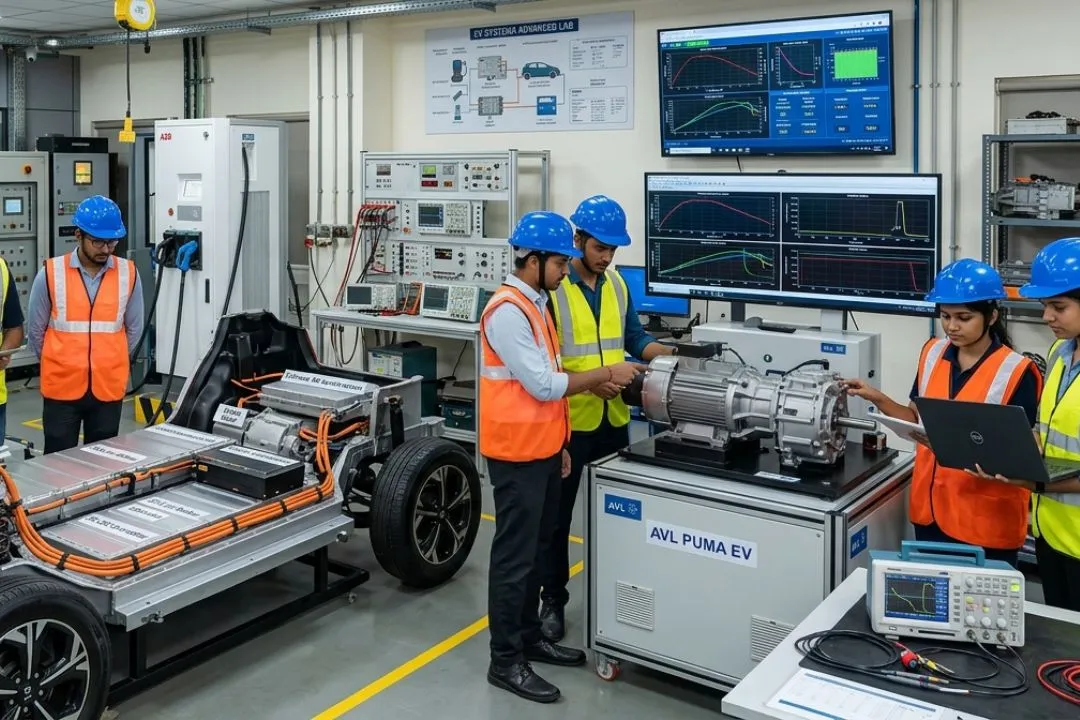
1. Introduction to Electric Vehicle Technology: Working Principles & Architectures
Electric Vehicle (EV) technology encompasses the multi-disciplinary engineering principles governing the conversion of electrochemical energy stored in rechargeable battery packs into mechanical tractive effort via solid-state power electronics and electromagnetic traction motors. Unlike legacy vehicles powered by fossil fuel combustion, an electric vehicle relies on a closed-loop electromechanical powertrain that coordinates high-voltage direct current (DC) distribution, multi-phase sinusoidal alternating current (AC) motor drives, active thermal management, and intelligent vehicle supervisory control.
Fundamental Differences: Electric Vehicles (EV) vs. Internal Combustion Engines (ICE)
To understand the engineering paradigm of electromobility, engineers must evaluate how EV powertrains fundamentally diverge from internal combustion engines:
| Technical Parameter | Internal Combustion Engine (ICEV) | Battery Electric Vehicle (BEV) |
|---|---|---|
| Energy Conversion Efficiency | 20% – 30% (Severe thermodynamic Carnot heat losses through exhaust and radiator) | 85% – 92% (High-efficiency electrochemical-to-electromagnetic conversion) |
| Moving Mechanical Components | Over 2,000 moving parts (pistons, valves, camshafts, crankshaft, clutch, multi-speed transmission) | Approx. 20 moving parts (motor rotor, bearings, single-speed reduction gear, differential) |
| Torque-Speed Characteristic | Peak torque delivered only within narrow mid-range RPM band; requires complex multi-ratio transmission | Instant maximum torque from 0 RPM; smooth continuous acceleration with single-speed reduction |
| Braking Energy Recovery | 100% of kinetic energy dissipated as waste friction heat through brake rotors and pads | Regenerative braking reverses motor into generator, recapturing up to 20%–30% of deceleration energy |
| Direct Tailpipe Emissions | High emissions of CO₂, NOx, particulate matter (PM2.5/PM10), and unburnt hydrocarbons | Zero tailpipe emissions; lifecycle decarbonization scales directly with renewable grid clean power |
Taxonomy of Modern Electrified Vehicles
Electrified mobility spans four distinct vehicular architectures depending on the degree of electrical hybridization:
- Battery Electric Vehicles (BEVs): Fully electric vehicles powered exclusively by high-voltage chemical energy storage (e.g. 400V or 800V lithium-ion battery packs) with no internal combustion engine. Examples in India include the Tata Nexon EV, MG Windsor, and Mahindra XUV400.
- Hybrid Electric Vehicles (HEVs): Combine a conventional internal combustion engine with a small auxiliary electric motor and low-capacity battery pack (typically 1–2 kWh). The battery is recharged exclusively through regenerative braking and engine charging—no external plug-in charging exists. Examples include the Toyota Urban Cruiser Hyryder and Maruti Suzuki Grand Vitara Strong Hybrid.
- Plug-in Hybrid Electric Vehicles (PHEVs): Feature a larger traction battery pack (typically 10–25 kWh) that can be recharged directly from the electric grid via an external charging port, providing 40–80 km of pure electric driving range before seamlessly engaging an auxiliary internal combustion engine for extended highway travel.
- Fuel Cell Electric Vehicles (FCEVs): Utilize compressed hydrogen stored in high-pressure tanks (typically 700 bar) combined with atmospheric oxygen across a Proton Exchange Membrane (PEM) fuel cell stack to generate electricity on demand, exhausting only pure water vapor.
Why EV Engineering Knowledge is Urgent for India: India imports over 85% of its crude oil requirements, creating severe macroeconomic vulnerability and balance-of-trade exposure. Concurrently, rapid vehicular density in major metropolitan centers has driven severe urban air quality degradation. Developing domestic engineering capability in EV powertrains, battery thermal safety, and charging infrastructure directly enables national economic sovereignty, urban decarbonization, and alignment with India’s massive 500 GW renewable electricity targets.
2. Why Learn EV Technology? The Multidisciplinary Engineering Imperative
The transition from internal combustion powertrains to electrified traction systems is not merely a component substitution; it represents a comprehensive architectural reimagining of automotive engineering. Traditional mechanical combustion systems are being replaced by high-voltage electrical distribution, multi-phase power electronics, electrochemical energy storage, and sophisticated real-time digital control software.
Mastering EV technology equips engineers with cross-disciplinary competencies that bridge mechanical design, electrical power systems, embedded controls, and chemical safety. Across India’s expanding manufacturing hub—spanning Pune, Bengaluru, Chennai, the Delhi-NCR cluster, and Gujarat—OEMs and Tier-1 suppliers are experiencing an acute shortage of engineers who possess both theoretical system modeling depth and practical laboratory diagnostic skills.
Mechanical & Automobile Engineers
Piston thermodynamics and exhaust systems are giving way to advanced battery pack structural design, vibration analysis (NVH), computational fluid dynamics (CFD) for liquid cold plates, lightweight chassis materials, crashworthiness modeling, and single-speed reduction transmission packaging.
Electrical & Power Engineers
Opportunity to master high-voltage DC distribution, traction inverters utilizing cutting-edge Silicon Carbide (SiC) MOSFETs, Permanent Magnet Synchronous Motor (PMSM) electromagnetic flux design, Space Vector PWM, bidirectional charging converters, and grid-tied charging infrastructure.
Electronics & Embedded Engineers
High demand for Battery Management System (BMS) firmware development, Analog Front End (AFE) cell monitoring, CAN bus/LIN vehicle telematics, Kalman filter State-of-Charge (SOC) estimation, motor Field-Oriented Control (FOC), and ISO 26262 automotive functional safety compliance.
Realistic Career Outlook: EV engineering roles demand rigorous technical fundamentals rather than superficial familiarity. While employment opportunities and compensation depend on individual academic background, demonstrated project portfolio, and hiring market dynamics, engineers who master hardware-level testing, BMS diagnostics, and power electronics position themselves at the forefront of the automotive transformation.
3. Overview of the EV Industry in India: Ecosystem, Manufacturing & Policy Landscape
India’s electric vehicle transition possesses distinctive market characteristics compared to Western and European markets. Rather than luxury passenger cars, India’s volumetric electrification is anchored in low-voltage light electric vehicles—specifically electric two-wheelers (E2W) and electric three-wheelers (E3W)—before rapidly scaling into public electric bus fleets and commercial freight logistics.
1. Market Segments & Adoption Vectors
- Electric Two-Wheelers (E2W): High-volume consumer and commercial delivery segment. Operating primarily on 48V to 72V lithium-ion (LFP and NMC) architectures with portable or fixed packs, this segment is driven by lower total cost of ownership (TCO) and daily operating cost reductions exceeding 75% compared to petrol scooters.
- Electric Three-Wheelers (E3W): Leading urban passenger and cargo electrification. E-rickshaws and L5 commercial three-wheelers serve last-mile urban logistics for major e-commerce platforms, offering immediate operational parity and rapid investment payback.
- Passenger Electric Cars (E4W): Transitioning from early adoption to mainstream fleet and private ownership. Operating on 300V to 400V high-voltage architectures with liquid-cooled battery packs ranging from 20 kWh to 70+ kWh, delivering 250 km to 500 km certified single-charge ranges.
- Commercial Electric Buses & Trucks: State Transport Undertakings (STUs) are rapidly deploying heavy electric buses through centralized aggregation tenders managed by Convergence Energy Services Limited (CESL), while intra-city delivery fleets transition to light electric commercial vehicles (e-LCVs).
2. Domestic Battery Manufacturing & The ACC PLI Framework
A critical vulnerability of India’s early EV deployment was reliance on imported lithium-ion cells. To establish domestic energy sovereignty, the Ministry of Heavy Industries initiated the ₹18,100 Crore Production Linked Incentive (PLI) scheme for Advanced Chemistry Cell (ACC) Battery Storage, catalyzing 50 GWh of localized cell manufacturing capacity. Concurrently, hundreds of Indian battery pack assemblers have established automated laser-welding and end-of-line testing facilities across the nation.
3. Public Charging Infrastructure & Standard Protocols
India’s charging ecosystem has converged around standardized international and domestic norms:
- Combined Charging System 2 (CCS2): The statutory national standard for DC fast charging across 4-wheeler passenger vehicles and heavy commercial buses, supporting power levels from 30 kW up to 240+ kW.
- Type 2 AC Connectors: Standard for single-phase (3.3 kW) and three-phase (7.4 kW to 22 kW) AC destination charging in residential, commercial, and workplace complexes.
- Open Charge Point Protocol (OCPP 1.6J / 2.0.1): The universal open communication protocol linking physical charging stations to centralized Charge Point Operator (CPO) billing, authentication, and load management cloud servers.
4. Statutory Policy & Safety Standards Framework
India’s regulatory framework enforces stringent technical standards and fiscal incentives:
- PM E-DRIVE Scheme: The flagship financial incentive scheme notified by the Ministry of Heavy Industries (MHI) to succeed FAME-II, allocating dedicated subsidies for electric two-wheelers, three-wheelers, electric ambulances, public bus fleets, and extensive public charging networks.
- Automotive Industry Standards (AIS-156 & AIS-038 Rev 2): Rigorous safety standards mandated by the Ministry of Road Transport and Highways (MoRTH). Enforces thermal propagation delay, active audio-visual runaway warnings, cell-level micro-spacing, IPX7 immersion ingress protection, and onboard BMS historical data logging.
- Favorable GST Structure: Uniform 5% GST levied on electric vehicles and EV charging equipment, compared to 28% plus cess on conventional internal combustion engine vehicles.
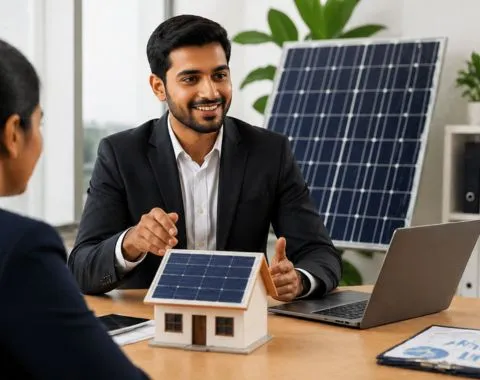
4. How an Electric Vehicle Works: Complete Energy, Power & Control Flow
Operating an electric vehicle involves a synchronized sequence of electrochemical, electromagnetic, and digital control processes. Unlike the mechanical linkages of an internal combustion engine, energy and operational commands flow across high-voltage direct current (DC) buses, low-voltage control networks (CAN/LIN), and three-phase sinusoidal alternating current (AC) cables.
The engineering workflow below illustrates how energy originates in the traction battery and converts into mechanical propulsion at the road surface:
Step 1: Electrochemical Storage (Traction Battery)
The high-voltage battery pack (typically 48V–72V in 2W/3W, 350V–400V in passenger EVs, and 800V in ultra-fast charging platforms) stores direct current (DC) energy across thousands of interconnected lithium-ion cells configured in series-parallel strings.
Step 2: Safety Isolation & Pre-Charge Cycle
Upon vehicle startup, the Battery Management System (BMS) initiates a pre-charge circuit through a current-limiting resistor to charge the inverter’s DC-link capacitors slowly, eliminating catastrophic inrush currents before main contactors close.
Step 3: Supervisory Telemetry (BMS)
The BMS continuously monitors cell voltages (±1 mV), multi-point temperatures (NTC sensors), and total pack current via Hall-effect shunts, calculating real-time State-of-Charge (SOC) and verifying High-Voltage Interlock Loop (HVIL) continuity.
Step 4: High-Voltage Distribution (PDU)
The Power Distribution Unit routes fused high-voltage DC electricity to three destinations: the primary traction inverter, the high-voltage air-conditioning compressor, and the positive temperature coefficient (PTC) cabin heater.
Step 5: Power Conversion (Bi-directional Inverter)
The traction inverter uses high-speed Silicon IGBT or Silicon Carbide (SiC) MOSFET switches to convert the battery’s DC voltage into 3-phase variable-voltage, variable-frequency AC via Space Vector Pulse Width Modulation (SVPWM).
Step 6: Electromechanical Conversion (Traction Motor)
The 3-phase AC excites stator windings in a Permanent Magnet Synchronous Motor (PMSM) or Induction Motor, generating a rotating magnetic field that exerts magnetic torque on the rotor, producing instant rotation from 0 RPM.
Step 7: Mechanical Torque Multiplication (Gearbox & Differential)
Because electric motors spin up to 12,000–18,000 RPM, a compact single-speed reduction gearbox (ratio ~8:1 to 10:1) steps down rotor speed to wheel speed while multiplying torque, and the differential splits power to the drive axles.
Step 8: Auxiliary Low-Voltage Conversion (DC-DC Converter)
A solid-state, galvanically isolated DC-DC buck converter steps down 400V/800V DC to 12V/24V DC, continuously charging the auxiliary 12V battery and powering lights, infotainment, electric power steering (EPS), and safety ECUs.
Step 9: Kinetic Energy Recapture (Regenerative Braking)
During coasting or braking, vehicle kinetic momentum back-drives the motor rotor, turning the motor into an electrical generator. The inverter rectifies this AC back into DC to recharge the battery pack while providing deceleration.
Step 10: Active Thermal Regulation (TMS)
Dual liquid cooling loops with dedicated water-glycol coolant, a refrigeration chiller, and a PTC heater circulate fluid through battery cold plates and motor water jackets to maintain cell temperatures within the ideal 20°C–35°C window.
5. Core Technical Modules: The 15 Pillars of EV Engineering
A professional electric vehicle engineering curriculum must span both foundational mechanical design and advanced embedded power electronics. Below are the 15 fundamental technical domains that define rigorous EV technology education:
Module 1: EV Architecture & System Integration
Topologies (front-wheel drive, rear-wheel drive, dual-motor AWD), packaging considerations, high-voltage vs low-voltage partitioning, weight distribution, center-of-gravity optimization, and chassis structural integration.
Module 2: Lithium-ion Battery Chemistries
Deep dive into Lithium Iron Phosphate (LFP – LiFePO₄), Nickel Manganese Cobalt (NMC – LiNiMnCoO₂), and Lithium Titanate (LTO). Gravimetric/volumetric energy densities (Wh/kg, Wh/L), cycle life (1,500–4,000+ cycles), and thermal runaway thresholds.
Module 3: Battery Pack Design & Cell Packaging
Cylindrical (18650, 21700, 46800), prismatic, and pouch cell packaging. Series-parallel string mathematics (e.g. 96S2P), busbar sizing, laser and ultrasonic spot welding, Cell-to-Pack (CTP) structural architectures, and IP67/IP69K sealing.
Module 4: Battery Management Systems (BMS)
Analog Front End (AFE) ICs, millivolt-accuracy voltage sensing, shunt/Hall current sensing, passive bleeding vs active inductive balancing, Coulomb counting, Extended Kalman Filter (EKF) SOC/SOH estimation, and HVIL fault loops.
Module 5: Electric Traction Motors
Operating physics of Permanent Magnet Synchronous Motors (PMSM), Interior PMSM (IPM), AC Induction Motors (IM), and Switched Reluctance Motors (SRM). Torque-speed curves, constant-torque vs constant-power zones, and field weakening.
Module 6: Power Electronics & Traction Inverters
3-phase H-bridge inverter design, Silicon IGBTs vs Silicon Carbide (SiC) MOSFETs, switching losses, gate driver isolation, dead-time insertion, and bidirectional DC-DC buck/boost converter topologies.
Module 7: Motor Controllers & Advanced Control
Field-Oriented Control (FOC), Space Vector PWM (SVPWM), Clarke and Park mathematical transformations, resolver and optical encoder feedback, closed-loop speed/torque regulation, and torque vectoring.
Module 8: AC & DC EV Charging Technologies
Level 1 single-phase AC charging (3.3 kW), Level 2 three-phase AC charging (7.4 kW to 22 kW with On-Board Charger), and Level 3 DC Fast Charging (30 kW to 240+ kW direct off-board pack charging).
Module 9: Charging Connectors & Communication Protocols
Combined Charging System 2 (CCS2: AC pins + DC high-current pins), Type 2 Mennekes, GB/T, CHAdeMO. Control Pilot (CP) PWM duty cycle signaling (IEC 61851), digital Power Line Communication (PLC – ISO 15118), and OCPP 1.6J/2.0.1.
Module 10: Thermal Management Systems (TMS)
Liquid cold plates, 50/50 water-glycol coolant circulation, refrigeration chillers, positive temperature coefficient (PTC) heaters, thermal runaway propagation barriers (aerogels, mica sheets), and AIS-156 pressure relief venting.
Module 11: EV Diagnostics & CAN Bus Telemetry
Controller Area Network (CAN 2.0B / CAN FD), Unified Diagnostic Services (UDS over ISO 14229), Diagnostic Trouble Codes (DTCs), insulation resistance monitoring, High-Voltage Interlock Loop (HVIL) fault finding, and bus sniffers.
Module 12: Regenerative Braking & Energy Efficiency
Kinetic energy recapture mechanics, brake pedal stroke sensor blending with hydraulic ABS/ESP, motor back-EMF, deceleration rate curves, and State-of-Charge (SOC) threshold cutoffs at full battery charge.
Module 13: High-Voltage Electrical Safety & Isolation
NFPA 70E, UN ECE R100, AIS-038 Rev 2 safety regulations. Manual Service Disconnect (MSD) de-energization, zero-energy capacitor discharge verification (<50V DC), Class 0 1000V insulated tools, PPE, and Lock-Out Tag-Out (LOTO).
Module 14: Battery Recycling & Second-Life Applications
Hydrometallurgical and pyrometallurgical recovery of Lithium, Cobalt, and Nickel; Battery Waste Management Rules 2022 (Extended Producer Responsibility – EPR); repurposing degraded automotive packs (>70% SOH) for stationary solar energy storage (BESS).
Module 15: EV Testing, Performance Modeling & Homologation
Tractive effort modeling (aerodynamic drag, rolling resistance, gradient resistance), acceleration power requirements, chassis dynamometer testing, and Indian Driving Cycle (IDC) range validation.
CRITICAL HIGH-VOLTAGE SAFETY NOTICE
Modern electric vehicle traction systems operate between 48V and 800V Direct Current (DC), presenting severe hazards of fatal electric shock, high-energy arc flash, and chemical fire. Reading theoretical guides or online courses ALONE DOES NOT qualify an individual to service, open, or diagnose high-voltage battery packs or inverters. All high-voltage physical operations must be conducted under qualified engineering supervision following strict Lock-Out Tag-Out (LOTO) protocols, using Class 0 (1000V rated) insulated tools and certified personal protective equipment (PPE).
6. Practical Skills & Learning Outcomes: From Engineering Theory to Lab Mastery
Theoretical understanding of electromagnetism and battery chemistry is only the first step. True engineering competence requires hands-on diagnostic capability, laboratory testing experience, and schematic interpretation.
Through structured technical training at an accredited facility like IISE, learners master the following eight core practical competencies:
- High-Voltage Isolation & Zero-Energy Verification: Executing formal Lock-Out Tag-Out (LOTO), safely removing the Manual Service Disconnect (MSD), and measuring DC bus residual voltage using CAT III/IV 1000V digital multimeters to verify capacitor discharge below 50V DC.
- Lithium Cell Characterization & Sorting: Performing high-precision open-circuit voltage (OCV) measurements and 1 kHz AC internal resistance (AC-IR) testing using specialized battery milliohm meters to ensure cell uniformity before pack assembly.
- Battery Module Assembly & Spot Welding: Operating pneumatic micro-spot welders to connect nickel/copper busbars to cylindrical 21700/18650 cells, verifying weld penetration, and conducting mechanical peel tests.
- BMS Harnessing, Calibration & Balancing: Wiring voltage sensing taps, connecting NTC thermal probes, configuring over-voltage/under-voltage protection cutoffs, and testing passive bleeding balancing currents.
- Motor Controller Tuning & FOC Parameterization: Interfacing controller software to set throttle response curves, configure maximum phase currents, calibrate resolver angle offset, and adjust regenerative braking torque ramp rates.
- CAN Bus Frame Sniffing & DBC Decoding: Connecting USB-to-CAN hardware analyzers (PCAN/CANable), capturing raw hexadecimal traffic on high-speed vehicle buses, and decoding real-time telemetry (cell voltages, pack temperature, and motor RPM).
- EVSE Pilot Signal Oscilloscope Analysis: Connecting digital storage oscilloscopes to charging test benches to measure Control Pilot (CP) 1 kHz PWM square-wave duty cycle (verifying current capacity) and Proximity Pilot (PP) resistance states.
- Automotive High-Voltage Schematic Interpretation: Reading engineering wiring harness diagrams, understanding relay logic, fuse ratings, contactor interlocks, and tracing low-voltage sensor networks.
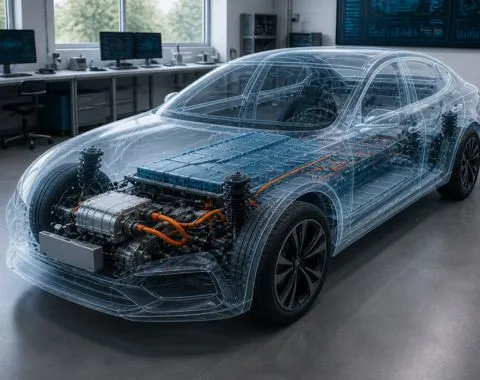
7. EV Technology Course Options: Verified IISE Programs & Pathways
Selecting an appropriate training pathway depends on your educational background, current engineering experience, and immediate professional objectives. Below are the verified Electric Vehicle and Clean Energy Technology courses offered by the Indian Institute of Solar Energy (IISE), featuring comprehensive engineering curricula, practical lab immersion, and recognized certification:
PG Diploma in Electric Vehicle Technology
Postgraduate / Advanced Engineering Diploma
Eligibility: B.E. / B.Tech / Diploma in Mechanical, Electrical, Automobile, Electronics or Allied Engineering Branches
Delivery Mode: Hybrid (Advanced Online Technical Lectures + Practical Laboratory Workshops in Mumbai)
Core Focus: Comprehensive powertrain sizing, battery pack structural modeling, BMS firmware engineering, motor Field-Oriented Control (FOC), power electronics design, and AIS-156/AIS-038 homologation compliance.
Diploma in Electric Vehicle Technology
Technical Engineering Diploma
Eligibility: Diploma Engineers, ITI Technicians, Automotive Mechanics, and Technical Supervisors
Delivery Mode: Classroom Instruction + Intensive Practical Hands-on Workshop
Core Focus: Practical vehicle component layout, high-voltage wiring harness assembly, traction motor testing, battery pack assembly, workshop diagnostics, and preventative maintenance workflows.
Fundamentals of Electric Vehicle Technology
Foundational Technical Certification
Eligibility: Engineering Freshers, Science Graduates, Technicians, and Non-Automotive Professionals
Delivery Mode: Flexible Self-Paced Online Certificate Program
Core Focus: Introduction to EV powertrain architecture, lithium-ion battery chemistries, electric traction motors, AC/DC charging systems, and essential high-voltage workshop safety guidelines.
Advance Electric Vehicle Design Engineering
Advanced Specialized Design Certificate
Eligibility: Mechanical, Electrical, and Automobile Design Engineers & Simulation Analysts
Delivery Mode: Hybrid Engineering Masterclass (Simulation & Laboratory Design)
Core Focus: Advanced tractive force calculations, MATLAB/Simulink powertrain simulation, battery thermal management CFD, inverter switching topology, and vehicle dynamics modeling.
EV Battery Technology Course Online
Modular Professional Certification
Eligibility: Battery Technicians, Pack Assemblers, Solar BESS Engineers, and EV Service Leads
Delivery Mode: Comprehensive Online Modular Program
Core Focus: Lithium cell chemistry selection (LFP vs NMC), pack series-parallel sizing, BMS architecture selection, AIS-156 safety testing standards, thermal runaway mitigation, and quality assurance.
Mobility Li-ion Battery Training
Practical Hands-on Laboratory Workshop
Eligibility: Battery Pack Manufacturers, Assembly Technicians, and Clean-Tech Entrepreneurs
Delivery Mode: Immersive Practical Workshop at IISE Mumbai Training Facility
Core Focus: Hands-on cell sorting by OCV/AC-IR, pneumatic resistance spot welding of nickel busbars, BMS harness wiring, end-of-line pack load testing, and second-life battery repurposing.
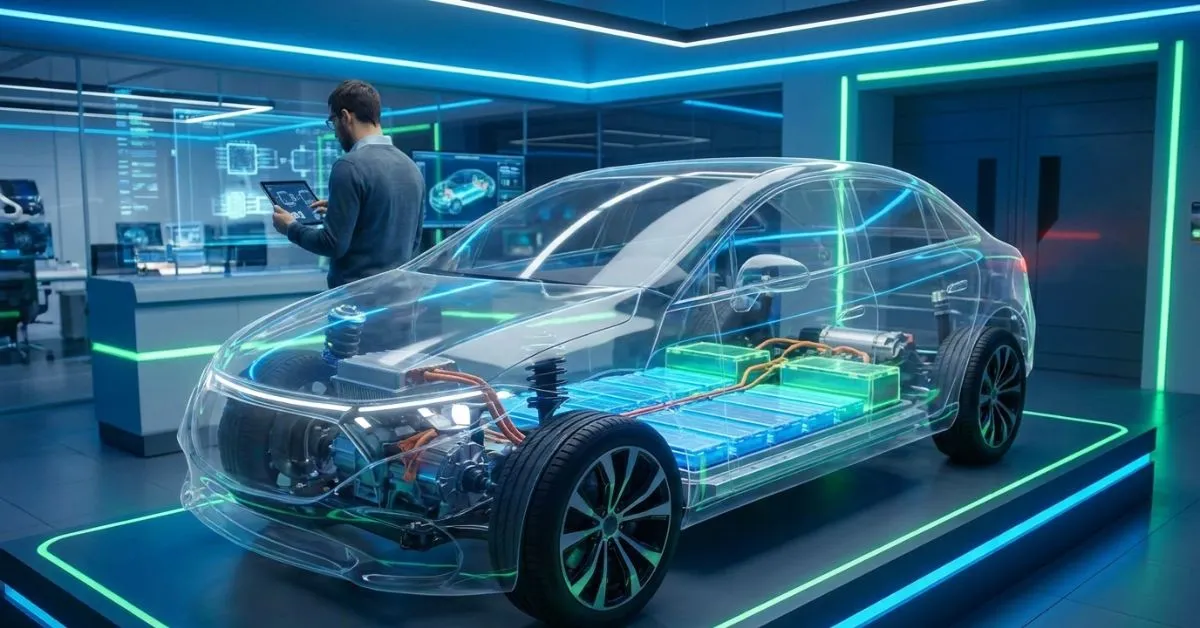
8. Course Curriculum & Learning Roadmap: The 7-Stage Engineering Progression
Mastering electric vehicle technology requires a logical progression from foundational circuit laws to complex vehicle integration and homologation testing. Below is the recommended 7-stage technical learning roadmap:
Stage 1: Electrical & Mechanical Foundations
DC/AC electrical circuit analysis, Kirchhoff’s laws, electromagnetism, semiconductor physics (diodes, MOSFETs, IGBTs), basic thermodynamics, and automotive chassis mechanics.
Stage 2: EV Powertrain Architecture & Topologies
Vehicle taxonomy (BEV, HEV, PHEV), powertrain component layout, tractive effort equations, high-voltage vs low-voltage partitioning, and weight balance optimization.
Stage 3: Advanced Battery Systems & BMS Engineering
Lithium-ion electrochemical chemistries (LFP vs NMC), cell form factors, series-parallel pack design, BMS Analog Front End (AFE) architecture, and SOC/SOH estimation algorithms.
Stage 4: Electric Traction Motors & Power Electronics
PMSM, BLDC, and AC induction motor operating principles, 3-phase inverter switching, Field-Oriented Control (FOC), Space Vector PWM (SVPWM), and bidirectional DC-DC converters.
Stage 5: Charging Infrastructure & Smart Grid Integration
AC Level 1/2 and DC Fast Charging systems, CCS2 connector standards, Control Pilot (CP) signaling, OCPP 1.6J/2.0.1 protocols, Vehicle-to-Grid (V2G), and solar-EV charging plazas.
Stage 6: High-Voltage Safety, Diagnostics & Telemetry
Safety isolation testing, Lock-Out Tag-Out (LOTO), PPE standards, OBD-II diagnostic protocols over CAN bus, reading Diagnostic Trouble Codes (DTCs), and resolving HVIL faults.
Stage 7: System Integration, Performance Testing & Capstone
End-to-end tractive resistance modeling, vehicle range simulation across Indian Driving Cycles (IDC), chassis dynamometer testing, AIS-156 homologation compliance, and an applied design project.
9. Who Should Learn EV Technology? Tailored Learning Pathways by Background
Because electric mobility is inherently multidisciplinary, engineers and technical professionals enter the field from diverse specializations. Below is how different professional backgrounds transition into EV engineering:
Mechanical Engineers
Transition from internal combustion engines to battery pack enclosure structural design, vibration analysis (NVH), computational fluid dynamics (CFD) for liquid cooling plates, transmission reduction gearing, and crashworthiness.
Electrical & Electronics Engineers (EEE/ECE)
Leverage circuit fundamentals into high-voltage DC distribution, traction inverters (SiC MOSFETs), motor Field-Oriented Control (FOC), BMS Analog Front Ends, and DC fast charging power electronics.
Automobile Engineers
Modernize traditional chassis, suspension, steering, and braking expertise with electrified powertrain sizing, regenerative braking dynamics, CAN bus telematics, and AIS homologation.
Diploma & ITI Technicians
Upskill into high-demand technical roles: battery pack assembly technician, high-voltage vehicle service mechanic, charging station maintenance technician, and quality inspection lead.
Fresh Engineering Graduates
Bridge academic curriculum gaps with hands-on, job-ready electric vehicle technical competencies to stand out in OEM, Tier-1, and clean-tech startup recruitment.
Automotive Technicians & Garage Owners
Future-proof independent workshops to safely service, diagnose, and repair high-voltage electric two-wheelers, three-wheelers, and passenger cars without electric shock hazards.
EV Fleet Operations & Maintenance Leads
Learn diagnostic protocols, remote telematics interpretation, battery State-of-Health (SOH) tracking, and preventative maintenance for commercial delivery fleets and electric buses.
Mid-Career Engineers Seeking Transition
Engineers from legacy ICE engine, exhaust, fuel-injection, and emissions domains pivoting into sustainable powertrain development, battery systems, and testing.
Clean-Tech Entrepreneurs & Founders
Gain engineering depth to evaluate battery pack manufacturing, EV retrofitting, solar-powered charging plazas, and micro-mobility fleet operations with technical confidence.
10. EV Career Opportunities & Technical Job Profiles in India
India’s electric vehicle sector is generating specialized technical roles across OEM research centers, Tier-1 component manufacturers, battery pack assembly facilities, and national charging infrastructure networks. Unlike generalized automotive roles, EV positions require specific competencies in power electronics, battery chemistry, digital control protocols, and high-voltage safety.
Below are 11 principal technical job profiles currently shaping the Indian e-mobility landscape:
1. EV Powertrain Integration Engineer
Responsible for system-level sizing, motor-inverter matching, high-voltage wiring architecture, and tractive performance simulation. Foundational skills: MATLAB/Simulink, vehicle dynamics, electrical schematics.
2. Battery Pack Design & Thermal Engineer
Focuses on mechanical packaging of cells, structural enclosure stiffness, cold plate fluid dynamics (CFD), vibration isolation, and AIS-156 compliance. Foundational skills: CAD (SolidWorks/CATIA), ANSYS Fluent, thermal modeling.
3. BMS Hardware & Firmware Engineer
Designs Analog Front End (AFE) circuits, writes embedded C/C++ firmware, develops Coulomb counting and Kalman filter SOC/SOH algorithms, and implements CAN communication. Foundational skills: Embedded C, TI/ADI AFEs, CAN bus protocols.
4. Power Electronics & Motor Drives Engineer
Designs 3-phase traction inverters, gate driver circuits, and DC-DC converters; calibrates Field-Oriented Control (FOC) and Space Vector PWM algorithms. Foundational skills: Power electronics, PCB design, DSPs, switching loss modeling.
5. EV Testing, Calibration & Validation Engineer
Conducts chassis dynamometer testing, motor efficiency mapping, thermal climatic chamber trials, and regulatory homologation tests. Foundational skills: DAQ systems, CANalyzer/PCAN, AIS-038 Rev 2 testing procedures.
6. High-Voltage EV Diagnostic Technician
Performs vehicle-level troubleshooting, reads OBD-II Diagnostic Trouble Codes (DTCs), traces HVIL faults, and safely replaces contactors and battery modules. Foundational skills: CAT III/IV multimeters, LOTO protocols, automotive wiring.
7. EV Charging Infrastructure (CPO) Engineer
Manages site feasibility, grid substation interconnection, DC fast charger (CCS2) commissioning, and OCPP backend integration. Foundational skills: Electrical distribution, IS 17017 standards, OCPP networking.
8. Battery Quality & Cell Testing Technician
Executes cell incoming inspection, measuring open-circuit voltage (OCV), AC internal resistance (AC-IR), and running charge-discharge degradation cycles. Foundational skills: Battery cyclers, impedance meters, quality control.
9. EV Fleet Operations & Telematics Specialist
Monitors remote IoT telematics feeds, schedules depot charging, tracks battery state of health, and optimizes fleet vehicle uptime. Foundational skills: Telematics software, data analysis, battery life cycle management.
10. EV Technical Sales & Applications Engineer
Translates technical powertrain and charging specifications for B2B fleet clients, commercial logistics operators, and institutional buyers. Foundational skills: Technical communication, TCO modeling, proposal engineering.
11. Vehicle Homologation & Compliance Specialist
Navigates national regulatory approval processes with testing agencies (ARAI, ICAT) under Central Motor Vehicles Rules (CMVR) and AIS standards. Foundational skills: Automotive regulatory documentation, testing standards.
Industry Remuneration Drivers: Compensation across India’s e-mobility sector varies significantly based on an individual’s academic foundation, verified laboratory competencies, domain specialization (e.g., BMS embedded firmware and power electronics design command substantial market premiums over generic technician roles), geographic cluster (Bengaluru, Pune, Chennai, Delhi-NCR), and hiring employer scale (Tier-1 OEM vs. high-growth startup).
11. How to Choose the Right EV Course: 12-Point Technical Evaluation Checklist
With the surge in commercial interest in electric mobility, hundreds of generic online crash courses have emerged. However, engineering recruitment demands practical laboratory capability and rigorous system design. Use this 12-point checklist to objectively evaluate any EV training program in India:
1. Syllabus Depth & Engineering Rigor
Verify whether the course teaches mathematical modeling, circuit analysis, and physical equations, or merely displays superficial slide presentations.
2. Genuine Physical Laboratory Access
Ensure the program provides access to physical battery pack assembly benches, cell testing instruments, and motor test dynamometers rather than purely pre-recorded videos.
3. Battery Pack & BMS Focus
Confirm that the curriculum covers hands-on cell sorting by OCV/AC-IR, spot welding nickel strips, BMS wiring, and active/passive balancing configuration.
4. High-Voltage Electrical Safety Training
The program must incorporate formal Lock-Out Tag-Out (LOTO) protocols, NFPA 70E, and AIS safety standards using certified 1000V Class 0 insulated tools.
5. Industry-Standard Software Exposure
Look for practical training on standard engineering tools such as MATLAB/Simulink, CAN bus analyzers, CFD software, and diagnostic scanning interfaces.
6. Practicing Faculty & Industry Mentors
Instructors should be active clean-technology engineering practitioners with field experience in automotive R&D, battery manufacturing, or renewable energy.
7. Physical Diagnostic Hardware Exposure
Ensure students learn how to connect OBD-II scanners, decode CAN bus hexadecimal messages, and measure high-voltage insulation resistance (>500 Ω/V).
8. Flexible Hybrid Delivery Modes
Working professionals and outstation students benefit from structured hybrid models combining remote engineering masterclasses with concentrated physical lab bootcamps.
9. Honest Institutional Claims
Reputable technical institutes focus on verifiable skill acquisition and rigorous engineering outcomes rather than deceptive ‘100% placement guarantees.’
10. Verified Institutional Accreditation
Confirm institutional credentials, such as ISO 9001:2015 quality management certification, established operational history, and registered training centers.
11. Clean Energy Integration Scope
Electromobility is intrinsically linked to renewable power; institutes covering Solar PV, Battery Storage (BESS), and EV charging provide superior systemic perspective.
12. Fee Transparency & Curriculum Value
Course fees, practical laboratory inclusions, examination procedures, and certification credentials should be fully transparent before enrolment.
12. Why Consider IISE? India’s Dedicated Clean Technology Technical Institute
The Indian Institute of Solar Energy (IISE) is a premier technical training institution dedicated to bridging the critical clean-energy skills deficit across India. Operating as a specialized educational unit of the Centre for Energy Research and Training, IISE has established a distinguished reputation for engineering excellence in renewable energy and electric mobility.
Verified Institutional Strengths & Infrastructure
- ISO 9001:2015 Certified Quality Management: IISE adheres to certified international quality protocols governing curriculum design, pedagogical delivery, laboratory safety, and candidate assessment.
- Comprehensive Clean-Tech Nexus: Unlike standalone automotive coaching centers, IISE specializes across the unified triumvirate of modern clean tech: Solar Photovoltaics (PV), Battery Energy Storage Systems (BESS), and Electric Vehicle (EV) Powertrains. This provides learners with a holistic systems perspective on grid integration and clean mobility.
- Dedicated Mumbai Laboratory Facilities: Practical training is conducted in dedicated engineering laboratories in Mumbai, equipped with lithium-ion cell testers, spot welding machinery, battery pack assembly stations, and motor test benches.
- Flexible Hybrid Learning Architecture: Combining rigorous, interactive digital engineering lectures with focused hands-on practical lab modules, enabling working professionals and students from all Indian states to participate without career interruption.
- Ethical, Evidence-Based Pedagogy: IISE emphasizes rigorous engineering principles, hands-on diagnostics, and transparent student mentorship rather than commercial gimmicks or fabricated placement guarantees.
- Verified Institutional Contact Channels: Students have direct access to admissions counselors and academic faculty via our Mumbai offices, telephone helpline (+91 98192 25503 / +91-80 62258 666), and official email (info@iise.ac / info@iiseindia.org).
Learn more about our organizational vision, technical faculty, and training methodology on our official Why Train With Us and Our Mission pages.

13. Technical Specialization Matrix: EV Powertrain vs. Battery vs. Charging vs. Diagnostics
Because electromobility encompasses mechanical, electrochemical, electrical, and firmware disciplines, engineers frequently choose to specialize in distinct subsystems. The matrix below outlines the typical technical focus, prerequisite backgrounds, industry tools, and career pathways across the five major specializations:
| Specialization Domain | Core Technical Focus | Essential Software & Hardware Tools | Ideal Academic Background | Target Industry Roles |
|---|---|---|---|---|
| EV Powertrain & Systems Engineering | Vehicle dynamics, tractive effort sizing, motor-gearbox matching, high-voltage distribution, and energy consumption modeling. | MATLAB/Simulink, AVL CRUISE, Ricardo IGNITE, chassis dynamometers. | Mechanical, Automobile, Mechatronics Engineering. | EV Powertrain Architect, Vehicle Integration Engineer, Systems Modeler. |
| Battery Technology & BMS Development | Lithium cell electrochemical modeling, series-parallel packaging, thermal runaway mitigation, AFE hardware, and SOC/SOH algorithms. | Battery cyclers, spot welders, ANSYS Fluent, Embedded C, TI/ADI AFE GUI. | Chemical, Materials, Electrical, Electronics Engineering. | Battery Pack Design Engineer, BMS Firmware Developer, Cell Quality Lead. |
| EV Charging Infrastructure & CPO Engineering | Grid transformer interconnection, DC fast charger (CCS2) topology, OCPP protocol integration, billing gateways, and solar-EV integration. | OCPP simulators, power quality analyzers, digital storage oscilloscopes. | Electrical, Power Systems, Renewable Energy Engineering. | Charging Network Project Manager, CPO Operations Engineer, EVSE Design Lead. |
| Power Electronics & Motor Drives | Traction inverter design, SiC MOSFET switching, Field-Oriented Control (FOC), Space Vector PWM, and isolated DC-DC converters. | Altium Designer, PLECS, Texas Instruments DSPs, motor dyno benches. | Electrical & Electronics Engineering (EEE), Instrumentation. | Inverter Hardware Engineer, Motor Calibration Specialist, Firmware Engineer. |
| EV Field Diagnostics & Fleet Servicing | Vehicle-level fault tracing, OBD-II DTC analysis, insulation resistance monitoring, contactor replacement, and high-voltage safety isolation. | CAT III/IV multimeters, CAN bus analyzers (PCAN), insulation testers. | Diploma Mechanical/Electrical, Automobile, ITI Motor Mechanic. | EV Master Diagnostic Technician, High-Voltage Workshop Lead, Fleet Service Lead. |
14. Applied Engineering Scenarios: Real-World Calculations & Systems Analysis
Educational Note: The following five scenarios represent illustrative technical engineering exercises designed to demonstrate applied mathematical calculations and component interactions in modern electric vehicle systems.
Scenario 1: Estimating Battery State of Charge (SOC) via Coulomb Counting & OCV Relaxation
Mathematical Principle: Coulomb counting integrates current over time: SOC(t) = SOC(t₀) - [1 / Q_rated] × ∫ I(τ) dτ
Engineering Problem: A 400V battery pack with a rated capacity of 60 Ah is discharging at a steady current of 30 A for 45 minutes (0.75 hours). Assuming initial SOC was 100%, calculate the consumed capacity and current SOC.
Step-by-Step Calculation:
1. Consumed Charge: Q_discharged = 30 A × 0.75 h = 22.5 Ah.
2. Remaining Capacity: 60 Ah - 22.5 Ah = 37.5 Ah.
3. Calculated SOC: (37.5 Ah / 60 Ah) × 100% = 62.5%.
4. Sensor Drift Correction: Because current sensor errors accumulate over extended driving, the BMS utilizes open-circuit voltage (OCV) look-up tables during vehicle rest periods (>2 hours relaxation) to recalibrate the baseline SOC.
Scenario 2: Traction Inverter Electrical Frequency & Motor Synchronous Speed
Mathematical Principle: The synchronous mechanical speed (N_s in RPM) of a motor depends on inverter fundamental frequency (f) and pole pair count (P): N_s = (120 × f) / P
Engineering Problem: An electric vehicle uses an 8-pole Permanent Magnet Synchronous Motor (PMSM). When cruising at 3,600 RPM, what fundamental electrical frequency must the traction inverter generate via Space Vector PWM?
Step-by-Step Calculation:
1. Rearranging formula: f = (N_s × P) / 120.
2. Substituting parameters: f = (3,600 × 8) / 120 = 240 Hz.
3. PWM Switching Context: The inverter’s micro-controller switches its IGBT/SiC power modules at a much higher carrier frequency (typically 10 kHz to 16 kHz) to synthesize this smooth 240 Hz sinusoidal current while minimizing audible switching noise and harmonic motor losses.
Scenario 3: Kinetic Energy Recapture during Regenerative Deceleration
Mathematical Principle: The kinetic energy change during vehicle deceleration is: ΔE_k = 0.5 × m × (v₁² - v₂²) × η_regen
Engineering Problem: A 1,600 kg passenger EV decelerates from 90 km/h (25 m/s) to 18 km/h (5 m/s). Assuming an electromechanical regeneration roundtrip efficiency (η_regen) of 72%, calculate the electrical energy returned to the battery pack.
Step-by-Step Calculation:
1. Total Kinetic Energy Change: 0.5 × 1,600 × (25² - 5²) = 800 × (625 - 25) = 480,000 Joules (480 kJ).
2. Recaptured Electrical Energy: 480 kJ × 0.72 = 345.6 kJ.
3. Converted to kWh: 345.6 kJ / 3,600 = 0.096 kWh.
4. Engineering Note: In stop-and-go urban driving, recurring 0.05–0.1 kWh recaptures accumulate to extend overall vehicle driving range by 15% to 25%.
Scenario 4: Battery Heat Generation & Liquid Coolant Flow Sizing
Mathematical Principle: Internal resistive heating is calculated by Joule’s Law: P_heat = I² × R_internal. Required coolant flow rate is: ṁ = P_heat / (c_p × ΔT)
Engineering Problem: A 400V 60 kWh pack undergoes 120 A DC fast charging. Total internal resistance is 60 mΩ (0.060 Ω). Calculate heat generation and required flow rate of 50/50 water-glycol (specific heat capacity c_p = 3.5 kJ/kg·K) to restrict coolant temperature rise (ΔT) to 4°C.
Step-by-Step Calculation:
1. Joule Heat Generated: P_heat = 120² × 0.060 = 14,400 × 0.060 = 864 Watts (0.864 kW).
2. Required Coolant Mass Flow: ṁ = 0.864 kW / (3.5 kJ/kg·K × 4 K) = 0.864 / 14 = 0.0617 kg/s.
3. Volumetric Flow Rate: 0.0617 kg/s × 60 s ≈ 3.7 kg/min ≈ 3.5 Liters/min.
4. Thermal Safety: Maintaining uniform coolant flow across all modules prevents localized cell temperature disparities from exceeding 3°C, eliminating premature pack aging.
Scenario 5: Vehicle Tractive Resistance & Highway Range Calculation
Mathematical Principle: Total tractive force required to cruise on a flat road: F_total = F_rolling + F_aero = (C_rr × m × g) + (0.5 × ρ × C_d × A × v²)
Engineering Problem: A 1,500 kg EV cruises at 100 km/h (27.78 m/s). Rolling resistance coefficient C_rr = 0.012, air density ρ = 1.2 kg/m³, drag coefficient C_d = 0.28, frontal area A = 2.2 m². Powertrain efficiency is 88%. Calculate wheel power and energy consumption per 100 km.
Step-by-Step Calculation:
1. Rolling Resistance: F_rolling = 0.012 × 1,500 × 9.81 = 176.6 N.
2. Aerodynamic Drag: F_aero = 0.5 × 1.2 × 0.28 × 2.2 × (27.78)² = 0.3696 × 771.7 = 285.2 N.
3. Total Tractive Force: 176.6 N + 285.2 N = 461.8 N.
4. Wheel Power: P_wheel = F_total × v = 461.8 N × 27.78 m/s = 12,829 Watts = 12.83 kW.
5. Battery Power (88% efficiency): 12.83 kW / 0.88 = 14.58 kW.
6. Energy Consumption: Cruising 100 km takes exactly 1 hour, consuming 14.58 kWh per 100 km. A 60 kWh pack would deliver approx. (60 / 14.58) × 100 ≈ 411 km highway range.
15. Frequently Asked Questions: Expert Guidance on EV Training & Careers
Find authoritative answers to the most common questions asked by students, engineering graduates, technicians, and working professionals considering electric vehicle education in India:
Electric vehicle technology encompasses the multidisciplinary engineering principles governing the storage of electrical energy in electrochemical battery packs and its conversion into mechanical tractive motion through high-efficiency power electronics and electromagnetic traction motors, integrated with intelligent vehicle supervisory software and thermal management.
For engineering freshers, technicians, and individuals with no prior automotive background, a foundational program such as IISE’s ‘Fundamentals of Electric Vehicle Technology’ is ideal. It introduces EV powertrain architecture, lithium-ion battery basics, motor principles, charging modes, and essential high-voltage workshop safety guidelines.
Yes, absolutely. Mechanical engineers play a vital role in EV design, transitioning their skills into structural battery enclosure design, crashworthiness, vibration analysis (NVH), computational fluid dynamics (CFD) for liquid cooling plates, motor water jacket design, and single-speed reduction transmission packaging.
Yes. Electrical and Electronics Engineering (EEE) graduates are ideally suited for electric mobility, commanding high demand in traction inverter design (utilizing SiC MOSFETs), motor Field-Oriented Control (FOC), high-voltage DC distribution, Battery Management System (BMS) hardware, and high-power DC fast charging infrastructure.
Eligibility depends on the specific course level: Foundational certificates welcome freshers, science graduates, and enthusiasts; technical diplomas are tailored for ITI technicians, polytechnic diploma holders, and automotive mechanics; advanced postgraduate diplomas (such as IISE’s PG Diploma in EV Technology) typically require a degree or diploma in Mechanical, Electrical, Automobile, Electronics, or allied engineering branches.
An EV certificate is typically a short-term, focused program (spanning 2 to 6 weeks) covering specific modular topics such as battery assembly or EV charging fundamentals. A diploma is a comprehensive, multi-month curriculum covering end-to-end powertrain design, in-depth mathematical modeling, laboratory testing, and formal engineering capstone projects.
Foundational technical literacy can be established in 4 to 8 weeks. Comprehensive professional competence—encompassing powertrain modeling, BMS firmware, practical spot welding, and motor controller parameterization—typically requires 3 to 6 months of structured study and hands-on laboratory immersion.
A rigorous curriculum covers 7 core pillars: 1) Electrical and mechanical circuit foundations, 2) EV vehicle architecture and tractive effort modeling, 3) Lithium battery chemistries and BMS algorithms, 4) Traction motors (PMSM/IM) and inverters, 5) AC and DC fast charging infrastructure (CCS2/OCPP), 6) High-voltage safety (LOTO) and CAN bus diagnostics, and 7) AIS-156/AIS-038 homologation testing.
Yes, battery technology is the single most critical, technologically intensive, and cost-dominant subsystem in an electric vehicle, representing 30% to 40% of the vehicle bill-of-materials. Mastering cell chemistries (LFP vs NMC), pack packaging, spot welding, and BMS protection is central to EV engineering.
A Battery Management System is the electronic intelligence that protects and manages a high-voltage battery pack. It continuously measures individual cell voltages down to millivolts, tracks cell temperatures, monitors current, executes active or passive cell balancing, calculates real-time State-of-Charge (SOC) and State-of-Health (SOH), and opens safety contactors in the event of an over-voltage, under-voltage, over-current, or short-circuit fault.
AC charging supplies alternating current from the electric grid to the vehicle’s On-Board Charger (OBC), which rectifies AC to DC to charge the battery (typically limited to 3.3 kW to 22 kW). DC Fast Charging utilizes an off-board high-power converter (30 kW to 240+ kW) that converts grid AC to DC externally and feeds high-voltage DC directly into the battery pack via dedicated contactors, bypassing the on-board charger.
Graduates can pursue technical roles across OEMs, Tier-1 suppliers, battery assemblers, and charging operators, including: EV Powertrain Integration Engineer, Battery Pack Design Engineer, BMS Firmware Developer, Power Electronics Inverter Engineer, Testing & Validation Engineer, High-Voltage Diagnostic Technician, and Charging Network (CPO) Project Engineer.
Practical hands-on training is essential. Electric vehicles operate on lethal direct current voltages (up to 800V DC). Hands-on laboratory training is required to safely master Lock-Out Tag-Out (LOTO) isolation, precision battery spot welding, BMS tap harnessing, oscilloscope EVSE pilot signal analysis, and CAN bus troubleshooting.
Evaluate programs using objective criteria: verify syllabus depth (real engineering physics vs marketing slides), confirm physical laboratory access (cell testing, spot welding, motor dyno), verify faculty clean-tech industry experience, check high-voltage safety coverage, and prioritize established institutions with verified quality credentials (e.g., ISO 9001:2015) rather than unverified placement promises.
You can explore course curricula directly on the official IISE website (https://indianinstituteofsolarenergy.com), speak with an academic counselor on our admissions helpline at +91 98192 25503 or landline +91-80 62258 666, or email your academic resume to info@iise.ac or info@iiseindia.org.
16. Related IISE Learning Resources & Course Catalog
Expand your clean-technology expertise by exploring IISE’s verified technical training offerings across electric vehicles, battery energy storage systems (BESS), and solar photovoltaics:
PG Diploma in Electric Vehicle Technology →
Comprehensive advanced engineering diploma covering powertrain sizing, BMS algorithms, and motor control.
Diploma in Electric Vehicle Technology →
Practical technical diploma focusing on hands-on vehicle wiring, motor testing, and battery assembly.
Fundamentals of Electric Vehicle Technology →
Accelerated online certification introducing basic EV architecture, batteries, and charging systems.
Advance Electric Vehicle Design Engineering →
Specialized curriculum covering MATLAB powertrain simulation, CFD thermal management, and power electronics.
EV Battery Technology Course Online →
Modular professional program covering lithium chemistries, pack safety, BMS selection, and AIS-156 compliance.
Mobility Li-ion Battery Training →
Hands-on laboratory workshop covering cell sorting, precision spot welding, and pack testing in Mumbai.
Fundamentals of Battery Storage →
Foundational course exploring electrochemical storage technologies for solar PV and stationary microgrids.
Battery Energy Storage & Micro-Grids in India →
Advanced engineering program on grid-scale BESS, peak shaving, and renewable energy integration.
Ready to Master EV Technology and Lead India’s Clean Mobility Transition?
Take the decisive step toward an engineering career in electric powertrain design, high-voltage battery systems, and charging infrastructure. Enrol in IISE’s industry-aligned technical training programs featuring hands-on laboratory immersion in Mumbai and flexible hybrid learning across India.
Admissions Helpline: +91 98192 25503 | Landline: +91-80 62258 666
Official Email: info@iise.ac | info@iiseindia.org | Location: Mumbai, Maharashtra
17. Related Technical Guides & Recommended Reading
Deepen your engineering knowledge with these authoritative, technically verified guides from the IISE Research Team:
How Does an Electric Vehicle Work? Complete Technical Guide India
Understand how electric vehicles convert stored electrical energy into motion through battery packs, BMS, inverters, electric motors, regenerative braking, and intelligent vehicle controls.
FAME III EV Incentives & PM E-DRIVE Scheme Explained (2026–28)
An operational engineering breakdown of Ministry of Heavy Industries subsidies for electric 2W, 3W, public e-buses, and charging plazas under the PM E-DRIVE framework.
EV Powertrain Explained: Motor, Battery, Controller & Inverter
A component-by-component engineering guide to electric vehicle powertrains, comparing permanent magnet motors, silicon carbide inverters, and battery pack architectures.
Battery Safety Standards in India: IS16270, IS16046 & AIS-156 Explained
A definitive technical walkthrough of statutory compliance under AIS-156 Amendment 3, thermal runaway propagation tests, and Bureau of Indian Standards (BIS) mandates.