Engineering Field Guide 18 min read IEC 62446 & MNRE Compliant

Solar Power Plant Maintenance: Complete Checklist, Tips & O&M Schedule

A practical, India-focused engineering guide to inspecting, cleaning, monitoring, testing, and maintaining photovoltaic assets for higher energy yield, 99%+ availability, and long-term electrical safety.

Published: 29 May 2023
Substantially Updated: October 2026
Technical Review: IISE Solar O&M Engineering Faculty
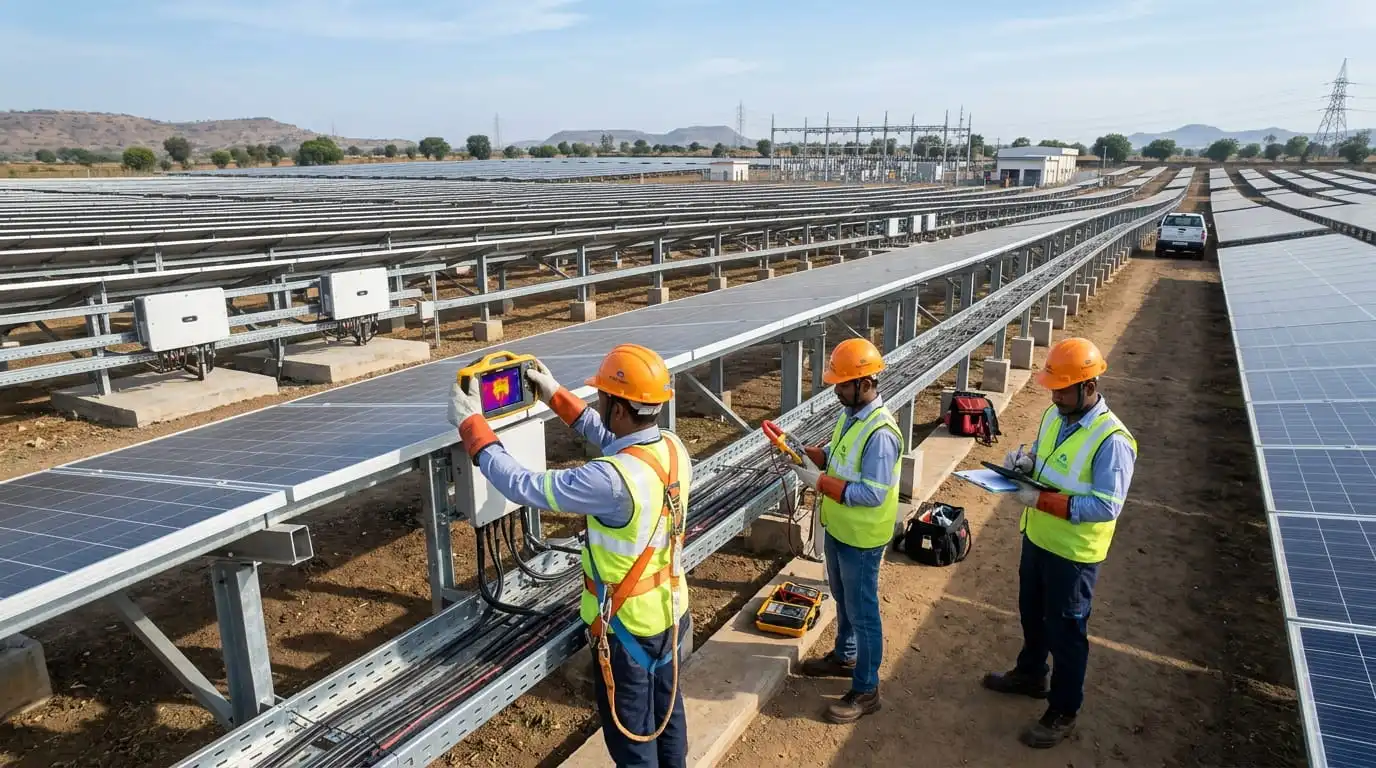
Certified solar O&M engineers conducting string testing and infrared thermography, Solar Power Plant Maintenance on a solar power plant in India
Field Operation: Certified solar technicians conducting string balance and thermal diagnostics under clear sky conditions. Photo: IISE Field Engineering Archive
Key Engineering Takeaways
  • 1
    Soiling Can Degrade Generation by 15–30%: In high-dust Indian corridors (such as Rajasthan, Gujarat, and industrial NCR), uncleaned solar modules lose up to 1% generation per day during dry months. Regular scheduled cleaning with soft demineralized water (TDS < 200 ppm) is mandatory.
  • 2
    Preventive Outweighs Corrective Maintenance: Over 70% of unexpected plant shutdowns originate from preventable balance-of-system (BOS) issues—including loose DC connections, dirty inverter filters, and blown string fuses—detectable through routine checks.
  • 3
    Thermal Imaging Identifies Invisible Faults: Infrared (IR) thermography per IEC 62446-3 detects sub-surface cell hotspots, defective bypass diodes, and high-resistance terminations long before catastrophic component failure occurs.
  • 4
    Safety Protocols are Legally Non-Negotiable: Solar arrays produce live DC voltages up to 1000V or 1500V whenever exposed to daylight. Strict Lockout/Tagout (LOTO), arc-flash PPE, and CEA-mandated earthing tests must precede all internal servicing.
  • 5
    Inverters Represent the Greatest Downtime Risk: Although modules represent the largest capital expense, inverters account for approximately 60–70% of unscheduled plant downtime. Heat dissipation and cooling fan health are paramount.
  • 6
    Maintenance Must Adapt to Regional Microclimates: Maintenance schedules cannot be static; they must be tailored specifically to pre-monsoon, post-monsoon, and peak summer weather cycles across different Indian climatic zones.
  • 7
    Detailed Documentation Protects Warranties: Equipment manufacturers routinely reject warranty claims for failed modules or inverters if owners fail to provide verifiable periodic inspection and maintenance logs.

What Is Solar Power Plant Maintenance?

Solar photovoltaic maintenance encompasses the organized combination of technical, electrical, civil, and administrative actions executed throughout the operational lifecycle of a solar power plant to maintain or restore it to a state where it performs its required generation function safely and efficiently.

Solar Maintenance vs. Solar O&M: Understanding the Distinction

While the terms are often used interchangeably in casual discussion, industry professionals maintain a clear technical distinction between Operations and Maintenance:

  • Operations (O): The continuous, real-time monitoring and management of the power generation facility. Operations includes SCADA supervision, generation forecasting, dispatch coordination with state load dispatch centres (SLDCs) or local DISCOMs, energy accounting, performance ratio calculations, security surveillance, and emergency shutdown triggering. For a deeper strategic perspective, explore our comprehensive guide on Solar O&M: How to Maintain a Solar Power Plant in India.
  • Maintenance (M): The hands-on physical, mechanical, and electrical interventions performed on physical assets. Maintenance includes module washing, bolt re-torquing, vegetation trimming, filter replacements, calibration of pyranometers, insulation resistance testing, and component repairs.

The Four Pillars of Solar Maintenance

  • Preventive Maintenance (PM): Pre-planned, time-scheduled inspections and servicing performed at predetermined intervals (daily, monthly, quarterly, annually) regardless of whether faults have occurred. Its goal is to minimize degradation, mitigate component wear, and prevent unplanned outages.
  • Corrective Maintenance (CM): Reactive repairs executed immediately after a fault, alarm, or mechanical breakdown is detected. Examples include replacing blown DC string fuses, clearing grid trip faults, or repairing storm-damaged module clamps.
  • Predictive Maintenance (PdM): Advanced maintenance triggered by pattern recognition, statistical trends, and diagnostic analytics derived from SCADA monitoring. Rather than inspecting randomly, technicians are dispatched based on data indications—such as identifying a string whose current has drifted 8% below adjacent strings under identical plane-of-array (POA) irradiance.
  • Condition-Based Maintenance (CBM): Maintenance initiated when specific monitored parameters exceed pre-set engineering thresholds (e.g., inverter internal heatsink temperature crossing 75°C, triggering an automatic cooling circuit overhaul).
Why Solar Power Plant Maintenance Is Important

A solar power plant is an infrastructure investment designed to operate for 25 years or longer. Inadequate maintenance converts a projected 14–18% equity internal rate of return (IRR) into an underperforming, high-liability asset.

  • Maximizing Energy Yield and Performance Ratio (PR): Every kilowatt-hour lost to soiling, clipping, or string outage is irrecoverable revenue. By maintaining clean optical surfaces, unshaded module arrays, and low electrical contact resistance, preventive maintenance directly elevates the plant's Performance Ratio.
  • Ensuring Equipment Reliability and Plant Availability: Grid-connected solar plants are expected to deliver uptime availability exceeding 98.5% to 99%. Unscheduled downtimes caused by preventable failures (such as undetected moisture ingress into a String Combiner Box or inverter cooling fan seizure) severely depress annual generation metrics.
  • Protecting 25-Year Asset Lifespan: While silicon PV cells have exceptional operational durability, balance-of-system components—encapsulant EVA, backsheet polymers, junction box potting resins, electrolytic capacitors in inverters, and galvanized steel structural coatings—are vulnerable to environmental aging. Proactive maintenance halts corrosion, stops micro-arcing before fire develops, and ensures the plant reaches its full 25-year operational life.
  • Mitigating Catastrophic Fire and Electrical Safety Hazards: Photovoltaic arrays generate lethal direct current (DC). Unlike alternating current (AC), DC arcs do not exhibit natural zero-crossing points, making DC arc faults self-sustaining and capable of generating temperatures exceeding 3,000°C. Regular thermal scans, torque verification on electrical lugs, and insulation resistance checks are vital to prevent catastrophic array fires.
  • Preserving OEM Warranties: Tier-1 module and inverter manufacturers provide extensive product (10–12 years) and linear performance (25–30 years) warranties. However, these warranties contain strict maintenance clauses. Warranty claims for burnt bypass diodes, delaminated backsheets, or failed IGBTs will be outright rejected if the plant operator cannot present certified periodic maintenance records proving compliance with OEM operating manuals.

The 10 Essential Solar Power Plant Maintenance Tips

Originally published as an introductory checklist, these core maintenance principles have been completely upgraded into rigorous, actionable engineering field protocols.

Tip 1: Conduct Comprehensive Visual and Mechanical Inspections

Mechanical & Civil Integrity
What to Inspect Front glass for chips or cracks; encapsulant for browning or snail trails; backsheet for delamination; mounting structures for deflection or rust; clamp bolt tightness; cable trays for sagging.
Why It Matters Cyclic wind vibration can loosen clamp bolts, leading to module dislodgement during severe storms. Physical glass fractures allow moisture ingress, destroying solar cell grid lines through electrochemical corrosion.
Recommended Frequency Monthly for rooftop and C&I plants; bi-weekly or rolling walk-throughs for utility-scale facilities; mandatory immediate walk-through after high-wind storms or severe rainfall.
Tools & Methods Visual inspection checklists, calibrated torque wrenches (sample checking 5–10% of clamp bolts per MW), inspection mirrors, and GPS-tagged digital cameras.
Warning Signs White snail trails across cell surfaces; brown busbar discoloration; loose clamp bolts easily turned by hand; sagging cable conduits touching sharp steel edges.
Corrective Action Re-torque loose fasteners to OEM specification (typically 12–15 N·m for M8 stainless steel bolts on aluminium clamps); tag cracked modules for electrical isolation and warranty replacement.

Professional Boundary: Visual scans can be conducted by trained site technicians; structural re-engineering or replacing damaged load-bearing purlins requires a certified structural engineer.

Tip 2: Implement Scientific Solar Panel Cleaning and Soiling Management

Optical & Yield Optimization
What to Inspect Uniformity and depth of surface dust, cementitious industrial deposits, bird droppings (fouling), biological moss growth along lower frames, and mineral scale (hard-water staining) from prior improper washings.
Why It Matters Dust accumulation attenuates incident solar radiation, directly reducing current output. Concentrated localized soiling (such as dried bird droppings) creates localized reverse-bias conditions where shaded cells act as electrical resistors, dissipating energy as heat and generating dangerous hotspots.
Recommended Frequency Every 10–15 days in high-soiling, dry, or industrial regions; every 20–30 days in moderate suburban areas; seasonal adjustments prior to dry winter/summer months.
Tools & Methods Demineralized or soft water (TDS < 200 ppm, pH 6.5–7.5), soft non-abrasive microfiber brushes or rotating semi-automated nylon brush assemblies, low-pressure water feeds (< 30–35 PSI / < 2.5 bar), or waterless robotic dry-cleaning systems for desert terrains.
Warning Signs Visible dust film wiping off onto a white glove; persistent dark crusts on module bottom frames; string current drops of >5% compared to adjacent cleaned arrays.
Corrective Action Wash modules during early morning (before 08:30 AM) or late afternoon (after 05:30 PM) when cell temperatures are low. Never clean modules during peak sunshine to avoid thermal shock glass breakage. Soak stubborn bird deposits before gently wiping with soft microfiber cloths.

Professional Boundary: Ground-mounted array cleaning can be carried out by trained cleaning crews wearing basic PPE; elevated rooftop cleaning requires fall-arrest lifelines, roof-walkway permits, and working-at-height certifications.

Tip 3: Continuously Monitor String-Level and SCADA Performance Data

Supervision & Analytics
What to Inspect Real-time generation curves, daily Specific Yield (kWh/kWp), daily/monthly Performance Ratio (PR), inverter efficiency, string current balance across multiple MPPTs, DC bus voltage stability, and weather station metrics (POA Irradiance, module temperature, ambient temperature, wind speed).
Why It Matters An electrical fault on a single string in a 100 kW commercial plant may only decrease overall plant output by 4–6%—an underperformance easily masked by day-to-day weather fluctuations unless string-level current data is benchmarked against pyranometer readings.
Recommended Frequency Real-time automated alert monitoring (continuous); daily morning generation log checks; weekly performance ratio trend audits; comprehensive monthly generation reconciliation.
Tools & Methods Cloud-based SCADA dashboards (e.g., Solar-Log, meteocontrol, OEM platforms like Huawei FusionSolar, Sungrow iSolarCloud, SMA Sunny Portal), calibrated Class-A pyranometers, and PT100/PT1000 temperature sensors.
Warning Signs Mid-day generation curves showing unexpected plateaus (inverter clipping or thermal derating); single string current dropping to 0 A (blown fuse or disconnected MC4); PR dropping below 75% under clear skies.
Corrective Action Cross-reference inverter alarm codes; conduct string open-circuit voltage ($V_{oc}$) and operating current ($I_{mp}$) testing on underperforming channels; check temperature sensors for calibration drift.

Professional Boundary: Plant operators monitor dashboards and record anomalies; diagnosing internal SCADA communication bus failures (Modbus RTU RS485 or TCP/IP) requires a qualified solar O&M engineer.

Tip 4: Prioritize High-Voltage Electrical Safety, LOTO, and Arc-Flash Protocols

HSE & Life Safety
What to Inspect Condition of personal protective equipment (PPE), presence and legibility of high-voltage hazard warning labels, physical integrity of Lockout/Tagout (LOTO) padlocks and hasps, condition of rubber insulating floor mats in inverter rooms, and availability of insulated rescue hooks.
Why It Matters Solar strings cannot be switched off at the module level when illuminated by daylight; open-circuit voltages easily reach 600V to 1500V DC. Touching live DC conductors can result in fatal electric shock or trigger explosive arc flashes capable of causing severe third-degree burns.
Recommended Frequency Verified before every single maintenance shift; formal PPE and safety equipment audit conducted monthly; safety induction refreshed quarterly.
Tools & Methods Calibrated digital multimeter rated CAT III 1000V / CAT IV 600V with finger-guarded test probes, Class 0 or Class 1 electrical insulating gloves (inspected and air-tested before use), arc-flash face shields, safety shoes with composite toes and dielectric soles, and standardized LOTO kit.
Warning Signs Faded or missing 'DANGER - 1000V DC' signage; cracked insulation on test multimeter leads; worn electrical gloves; corroded padlock points on DC isolators.
Corrective Action Immediately halt work if safety equipment is compromised. Enforce strict de-energization procedures: switch off the AC circuit breaker first, open the DC load break switch second, verify zero voltage with an approved multimeter, apply LOTO padlocks, and discharge residual capacitive energy before opening enclosures.

Professional Boundary: Unqualified individuals must NEVER open energised electrical enclosures or test DC voltages. All internal enclosure work must strictly be performed by licensed electrical personnel certified in solar PV systems.

Tip 5: Maintain Digital Maintenance Logs and Warranty Records

Compliance & Asset Protection
What to Inspect Maintenance management systems, physical on-site logbooks, module flash test reports from commissioning, inverter warranty certificates, calibration certificates of testing instruments, cleaning cycle logs, and equipment breakdown history.
Why It Matters In the event of an insurance claim (following a lightning strike or storm damage) or a manufacturer warranty claim, underwriters and OEMs require timestamped evidence of regular preventive maintenance. Without logs, claims are routinely denied.
Recommended Frequency Updated daily following any site activity; comprehensive audit of documentation conducted quarterly; cloud backups performed weekly.
Tools & Methods Digital Computerized Maintenance Management Software (CMMS), mobile inspection forms with photograph uploads, barcode/QR asset tracking tags on all inverters and combiner boxes.
Warning Signs Blank periods in physical logbooks; missing calibration dates on insulation testers; undocumented component replacements; inability to locate original commissioning baseline reports.
Corrective Action Standardize digital record templates for every maintenance task. Assign specific technician sign-offs for cleaning dates, water TDS readings, torque checks, and electrical test values ($V_{oc}, I_{sc}, R_{iso}$).

Professional Boundary: Plant supervisors and site managers maintain and audit record completeness; technical review of logs for warranty claims is handled by the lead solar engineer.

Tip 6: Ensure Inverter Ventilation, Filter Cleanliness, and Thermal Management

Power Electronics & Heatsinks
What to Inspect Inverter internal and external cooling fan operation, air intake and exhaust filter mesh cleanliness, heatsink fins for dust/insect blockage, ambient temperature inside inverter rooms/shelters, door rubber gaskets for dust sealing, and internal moisture indicators.
Why It Matters Solar inverters operate with high power densities, converting vast amounts of DC energy to AC. High internal temperatures accelerate the drying of electrolytic capacitors, degrade IGBT semiconductor switches, and trigger automatic thermal power derating—reducing inverter output during peak noon hours when generation should be highest.
Recommended Frequency Monthly inspection and cleaning of air filters; quarterly verification of cooling fan RPM and bearing noise; annual deep cleaning of heatsinks.
Tools & Methods Industrial anti-static vacuum cleaners, dry low-pressure compressed air canisters, soft cleaning brushes, infrared non-contact thermometers, and handheld anemometers.
Warning Signs Excessive cooling fan vibration or grinding noise; dust clogs visible on external filter grilles; inverter displaying 'Over-temperature Derating' or 'Fan Fault' warning alarms; ambient room temperature exceeding 45°C.
Corrective Action Power down the inverter following strict shutdown sequence. Remove filter screens, wash with clean water and dry thoroughly (or vacuum clean); clear dust between heatsink fins using soft brushes; replace failing fans with OEM-approved parts immediately.

Professional Boundary: Exterior filter mesh cleaning may be done by trained technicians; opening the inverter chassis to replace internal fan assemblies or clean internal PCBA components must be done by OEM-certified solar technicians.

Tip 7: Regularly Test and Replace Balance-of-System (BOS) Components

Protection & Switchgear
What to Inspect String fuses and fuse holders for scorching or heat embrittlement; DC surge protection devices (SPDs) for triggered flag indicators (red vs. green); contact resistance of DC disconnect switches; AC circuit breakers and contactors for contact pitting; and terminal blocks for thermal discoloration.
Why It Matters BOS components constitute only a small fraction of capital cost but represent frequent points of failure. A degraded SPD will fail to clamp lightning voltage spikes, leading to total inverter destruction during electrical storms.
Recommended Frequency Quarterly visual check of SPD status flags; semi-annual verification of fuse ratings and contact resistance; annual trip-testing of AC breakers and earth fault relays.
Tools & Methods Milliohm meter / micro-ohmmeter, calibrated digital multimeter, spare fuse stock (correct gPV fast-acting DC rated fuses, e.g., 1000V/1500V, 15A/20A/25A), and spare modular SPD cartridges.
Warning Signs SPD flag displaying red or yellow instead of green; blackened fuse cartridges; loose fuse clips failing to maintain spring tension; burnt plastic smell inside combiner boxes.
Corrective Action Replace triggered SPD cartridges immediately with units matching exact nominal discharge current ($I_n$) and maximum continuous operating voltage ($U_c$). Replace blown fuses only after investigating and resolving the underlying string short-circuit or reverse-current condition. Never bypass a fuse with copper wire.

Professional Boundary: Replacing plug-in SPD modules and fuses under de-energized conditions may be performed by qualified solar technicians; breaker testing and primary injection testing require licensed electrical engineers.

Tip 8: Engage Certified Professionals for Major High-Voltage and Structural Repairs

Statutory & HV Operations
What to Inspect Contractor qualifications, safety certifications, valid electrical contractor licenses (Grade A/B as per Indian state licensing boards), insurance coverage, and calibration certificates of contractor testing equipment.
Why It Matters Attempting complex internal repairs on central inverters, high-voltage HT switchgear, vacuum circuit breakers (VCBs), or oil-immersed transformers without specialized training carries extreme risks of electrocution, arc flash explosions, voided manufacturer warranties, and legal liability under Indian electrical regulations.
Recommended Frequency As needed for corrective interventions; mandatory engagement for annual technical audits and five-year statutory inspections.
Tools & Methods Authorized service partner agreements, formal Service Level Agreements (SLAs), standardized Work Permits, and Electrical Safety Audits conforming to IS 5216 and CEA safety guidelines.
Warning Signs Unqualified local electricians attempting to modify inverter control boards; bypassing safety interlocks to clear recurrent inverter trip alarms; using uncalibrated testing meters.
Corrective Action Maintain standing Annual Maintenance Contracts (AMCs) or service agreements with certified solar O&M providers or OEM service centres. Ensure all external personnel complete site safety inductions before stepping into transformer yards or inverter stations.

Professional Boundary: Routine observation and basic preventive cleaning remain in-house; all medium/high-voltage switching, transformer oil testing (BDV test), and internal inverter PCB replacements must be executed by authorized professionals.

Tip 9: Maintain Alignment with Updated Firmware, BIS Standards, and OEM Guidelines

Grid Compliance & Cybersecurity
What to Inspect Inverter firmware revision numbers, SCADA gateway software patches, revised technical circulars from the Ministry of New and Renewable Energy (MNRE), updated Bureau of Indian Standards (BIS) codes (IS 16221, IS 16270), and State Electricity Regulatory Commission (SERC) grid connectivity compliance updates.
Why It Matters Modern solar plants are cyber-physical systems. Outdated inverter firmware can cause erroneous grid-code tripping during minor grid voltage fluctuations (fault ride-through failures), cybersecurity vulnerabilities in remote monitoring dongles, and suboptimal Maximum Power Point Tracking (MPPT) algorithm performance.
Recommended Frequency Semi-annual review of OEM firmware release notes; immediate updates upon critical security or stability patches; annual review of regulatory compliance standards.
Tools & Methods OEM firmware update portals, secure USB transfer drives or over-the-air (OTA) SCADA updates, manufacturer application engineering bulletins, and MNRE/CEA gazette notifications.
Warning Signs Recurring nuisance trips with codes indicating 'Grid Frequency Out of Range' or 'Grid Voltage Fluctuation' that modern firmware revisions have resolved; inability of SCADA to communicate with newly added data logger units.
Corrective Action Schedule firmware updates during night-time hours when inverters are in standby mode to prevent generation loss or interrupted flashing processes. Always back up existing configuration parameters before flashing new firmware.

Professional Boundary: Executed by lead O&M engineers or authorized OEM field service engineers.

Tip 10: Shift from Reactive Fixes to Predictive and Condition-Based Maintenance

PdM & Anomaly Detection
What to Inspect Long-term degradation trends in Performance Ratio (PR), historical hotspot progression on thermal databases, insulation resistance degradation over rainy vs. dry seasons, and inverter thermal signature trends under equivalent irradiance.
Why It Matters Fixing equipment only when it breaks (reactive maintenance) guarantees maximum downtime and emergency repair premiums. Predictive maintenance detects the earliest signature of deterioration, allowing repairs to be scheduled during non-generation evening hours or planned grid outages.
Recommended Frequency Monthly predictive data analytics review; bi-annual thermographic trend mapping; continuous condition-based automated threshold alerts.
Tools & Methods Predictive O&M software with machine learning anomaly detection, aerial drone thermography, automated I-V curve tracer analytics, and vibration sensors on tracker drive systems.
Warning Signs Gradual decline in insulation resistance from $50\,M\Omega$ down to $2\,M\Omega$ over several months; thermal imaging showing a module junction box temperature rising $15^\circ\text{C}$ hotter than surrounding boxes.
Corrective Action Schedule preemptive replacement of failing bypass diodes, re-tighten suspect cable terminations during evening shifts, and replace aged DC cable runs before complete ground faults trigger plant-wide tripping.

Professional Boundary: Led by experienced solar technical asset managers and performance analytics engineers.

Complete Solar Power Plant Maintenance Checklist

This comprehensive engineering checklist covers mechanical, electrical, optical, civil, and monitoring components across all solar plant domains.

ComponentMaintenance TaskFrequencyWhat to InspectTool / MethodWho Should Perform It
PV ModulesOptical & Structural InspectionMonthlyGlass breakage, delamination, snail trails, frame distortion, yellowingVisual check, magnifying glassQualified Solar Technician
PV ModulesSoiling & Dust RemovalWeekly to FortnightlyDust thickness, bird droppings, cementitious crust, sootSoft microfiber brush, DM water (<200 ppm)Trained Cleaning Crew
PV ModulesThermal Hotspot AuditSemi-AnnuallyCell hotspots, localized thermal gradients, bypass diode heatingHandheld IR camera / Aerial drone per IEC 62446-3Certified Thermographer / Engineer
Module Mounting StructureMechanical Integrity & TorqueQuarterlyBolt looseness, structural deflection, corrosion, zinc flakingCalibrated torque wrench (12–15 N·m), coating gaugeMechanical Technician
DC Cables & ConduitsInsulation & Routing AuditQuarterlyUV embrittlement, conduit sagging, sharp edge rubbing, rodent bitesVisual inspection, cable tie replenishmentQualified Solar Technician
MC4 ConnectorsContact & Thermal CheckSemi-AnnuallyMating tightness, water ingress, heat deformation, discolourationThermal imaging, pull-check inspectionQualified Solar Technician
String Combiner Boxes (SCB)Interior & Seal CheckMonthlyGasket degradation, dust/water ingress, internal moisture, silica gelVisual check, seal replacementQualified Solar Technician
DC String FusesFuse Health & Clip TensionQuarterlyOverheating discolouration, fuse rating consistency, spring clip gripMultimeter (resistance mode), visual checkQualified Solar Technician
Surge Protection Devices (SPD)Status Flag VerificationMonthlyFlag indicator colour (green = healthy, red = triggered/blown)Visual inspection, modular replacementQualified Solar Technician
DC Isolators / SwitchesContact & Operation TestHalf-YearlyHandle mechanical action, contact pitting, terminal tightnessManual operation under NO-LOAD, torque checkLicensed Electrical Engineer
Solar Inverters (String/Central)Ventilation & Air FiltersMonthlyFilter dust clogging, heatsink blockage, exhaust airflow volumeIndustrial vacuum cleaner, compressed dry airQualified Solar Technician
Inverter Cooling FansFan Bearing & RPM CheckQuarterlyAbnormal noise, vibration, bearing seizure, failure alarmsVisual check, acoustic check, RPM telemetryQualified Solar Technician
Inverter Electrical TerminalsThermal & Torque AuditHalf-YearlyAC/DC terminal lug tightness, heat discoloration, cable creepCalibrated torque wrench, thermal imagingLicensed Electrical Engineer
Inverter FirmwareRevision & Patch VerificationSemi-AnnuallyCurrent firmware version vs. OEM recommended stable buildLaptop, OEM service software, USB toolO&M Engineer
AC Distribution Board (ACDB)Breaker & Busbar InspectionQuarterlyBreaker terminal heat, busbar insulation, phase balanceThermal scan, calibrated multimeter, torque checkLicensed Electrical Engineer
Earthing & Grounding GridEarth Resistance MeasurementPre-Monsoon & Post-MonsoonSoil resistance, pit corrosion, copper tape integrity, water level4-pole Earth Resistance Tester (Fall of Potential)Licensed Electrical Engineer
Lightning Protection (ESE/Franklin)Air Terminal & Down-conductorHalf-YearlyMechanical anchoring, strike counter reading, bonding continuityVisual check, strike counter log, bonding testerQualified Solar Technician
Transformers (Inverter Duty)Oil & Thermal InspectionMonthlyOil level, silica gel breather colour (blue/pink), oil leaksVisual check, temperature gauge readingsSubstation Technician
TransformersOil Dielectric Breakdown (BDV)AnnuallyDielectric breakdown voltage, moisture content, dissolved gasesOil sampling kit, laboratory BDV test setCertified High-Voltage Agency
HT Switchgear & VCBContact & Insulation CheckAnnuallyMechanism lubrication, vacuum bottle integrity, breaker timingInsulation tester (2.5kV/5kV), timing test setCertified High-Voltage Engineer
SCADA & SensorsSensor Cleaning & CalibrationMonthlyPyranometer dome cleanliness, ambient & module temp probesSoft optical lens cloth, distilled waterQualified Solar Technician
Weather Station (WMS)Pyranometer CalibrationAnnually / BienniallySensor calibration drift against reference standardCalibrated secondary standard pyranometerSpecialist Instrumentation Tech
Drainage & Civil WorksStorm Water Channel ClearancePre-Monsoon & Post-RainSilt build-up, debris clogging, soil erosion around footingsManual clearance, shovel, civil inspectionSite Maintenance Worker
Vegetation ManagementGrass & Weed TrimmingMonthly (Rainy Season)Grass overgrowing bottom module rows, climbing vinesMechanical brush cutter, string trimmerSite Maintenance Worker
Site Boundary & SecurityPerimeter Fence & CCTV CheckWeeklyFence integrity, animal burrowing, gate locks, camera blindspotsPhysical perimeter walk, security monitor checkSecurity / Site Supervisor
Fire Safety EquipmentExtinguisher & Sand Bucket AuditMonthlyPressure gauge in green zone, nozzle blockage, sand drynessVisual inspection, weight check, refilling logSafety Officer / Technician

Solar Power Plant Maintenance Schedule: Frequency & Seasonal Framework

Maintenance frequencies must be adapted to plant capacity, mounting type, regional atmospheric conditions, and OEM specifications. The following calendar provides a structured operational framework:

1. Routine Time-Based Frequencies

  • Daily: Review central SCADA or inverter cloud monitoring dashboards by 09:30 AM to verify all inverters have synchronized with the grid. Track daily Specific Yield ($Y_f$ in kWh/kWp). Review and clear low-priority communication alerts; escalate critical fault alarms immediately.
  • Weekly: Conduct an exterior walkthrough of inverter rooms and string combiner boxes. Ensure all enclosure latches are securely fastened. Check perimeter fencing and inspect main drainage outlets for surface debris.
  • Monthly: Execute scheduled solar module washing cycles according to regional soiling schedules. Vacuum air intake filter grilles on all inverters. Visually inspect array rows for module glass damage or bird fouling. Inspect string combiner box door gaskets and silica gel saturation. Clean pyranometer glass domes and check fire extinguisher pressure gauges.
  • Quarterly: Sample-torque 5–10% of module mounting structure clamp bolts, rail splices, and foundation connections using a calibrated torque wrench. Inspect DC cable trays and conduits for sagging or UV damage. Check DC string fuse holders for thermal discoloration. Perform infrared thermographic scanning of inverter AC/DC terminals and main AC distribution breakers.
  • Half-Yearly (Semi-Annual): Conduct full-array infrared thermography per IEC 62446-3 to identify cell-level hotspots and defective bypass diodes. Test mechanical operation of DC load-break disconnect switches and emergency stops under no-load conditions. Inspect civil foundation pillars for settlement or concrete cracking.
  • Annual: Perform comprehensive I-V curve tracing on 10–20% of array strings to evaluate series resistance and degradation rates against factory flash data. Complete full earth resistance testing of all earth pits using the 4-pole Fall of Potential method. Conduct dielectric breakdown voltage (BDV) testing on inverter-duty transformer oil. Execute insulation resistance (Megger) testing on all DC string cables and AC feeders. Calibrate protection relays on high-voltage switchgear.

2. Event-Triggered and Seasonal Frequencies

  • Before Monsoon Season (May – June): Inspect and lubricate enclosure door gaskets on inverters and combiner boxes; apply silicone grease to critical IP65/IP67 seals. Thoroughly desilt all storm-water drainage trenches and culverts. Audit lightning protection air terminals and down-conductors. Measure earth pit resistance before rains artificially lower soil resistivity to verify safety compliance under dry conditions.
  • After Monsoon Season (September – October): Perform deep module washing to remove baked-on mud splatters and organic grime. Clearcut rapid weed growth overgrowing bottom module rows. Inspect galvanized structures for oxidation and apply cold-galvanizing zinc spray (>90% zinc). Open combiner boxes to evacuate trapped condensation and replace saturated silica gel bags.
  • Before Peak Summer (February – March): Deep-clean inverter heatsink cooling fins using compressed air; wash and dry all air filters; verify cooling fan bearings to prevent thermal derating when ambient temperatures exceed 45°C. Conduct torque audits on high-current DC and AC busbars vulnerable to thermal expansion loosening.
  • During High-Soiling Periods (Dry Winter/Harvest Seasons): Increase cleaning frequency from bi-weekly to 10-day intervals to mitigate exponential soiling losses.
  • After Severe Storms or High Winds (>70 km/h): Conduct an immediate emergency walk-through to check for dislodged modules, twisted tracker torque tubes, damaged cable trays, or debris blown onto the array. Verify that tracker systems successfully entered automatic wind-stow mode.

India-Specific Solar Plant Maintenance Considerations

Operating solar assets in the Indian subcontinent presents unique operational challenges due to extreme heat, heavy monsoon deluges, airborne particulate pollution, and regional soil chemistry.

Region / StatePrimary Environmental ChallengesAdapted Maintenance Protocol
Rajasthan & Gujarat (Arid / Desert)Fine silica dust, severe sandstorms, extreme water scarcity, summer ambient heat exceeding 48°CDeploy waterless robotic dry-cleaning systems; construct well-ventilated shaded canopies over outdoor string inverters.
Coastal Belts (GJ, MH, Goa, KA, KL, TN, AP, OD)High maritime salinity, constant humidity >85%, accelerated galvanic corrosion, cyclonic coastal wind gustsSpecify C5-M marine corrosion-rated structures (IS 4759); use EPDM rubber isolation pads; inspect clamp torque and earthing tapes quarterly.
Indo-Gangetic Plain (Delhi-NCR, UP, Punjab, Haryana)Heavy winter smog (PM2.5/PM10), agricultural stubble-burning soot, cementitious grime formationIntensify cleaning cycles to 7–10 days during smog season; use demineralized water with approved biodegradable surfactants.
Deccan Plateau & South (Karnataka, Telangana, Maharashtra)Sticky red soil adhesion, intense monsoon downpours, aggressive post-monsoon weed proliferation, severe lightning strikesAggressive post-monsoon vegetation clearing with mechanical brush-cutters; semi-annual earth pit testing; pre-monsoon seal audits.

Solar Panel Cleaning and Soiling Management

Module cleaning is the single most frequent, labour-intensive, and yield-critical operational task in a solar power plant. Understanding the physics of soiling and employing proper cleaning chemistry is critical to prevent scratching the front glass and causing permanent transmittance loss.

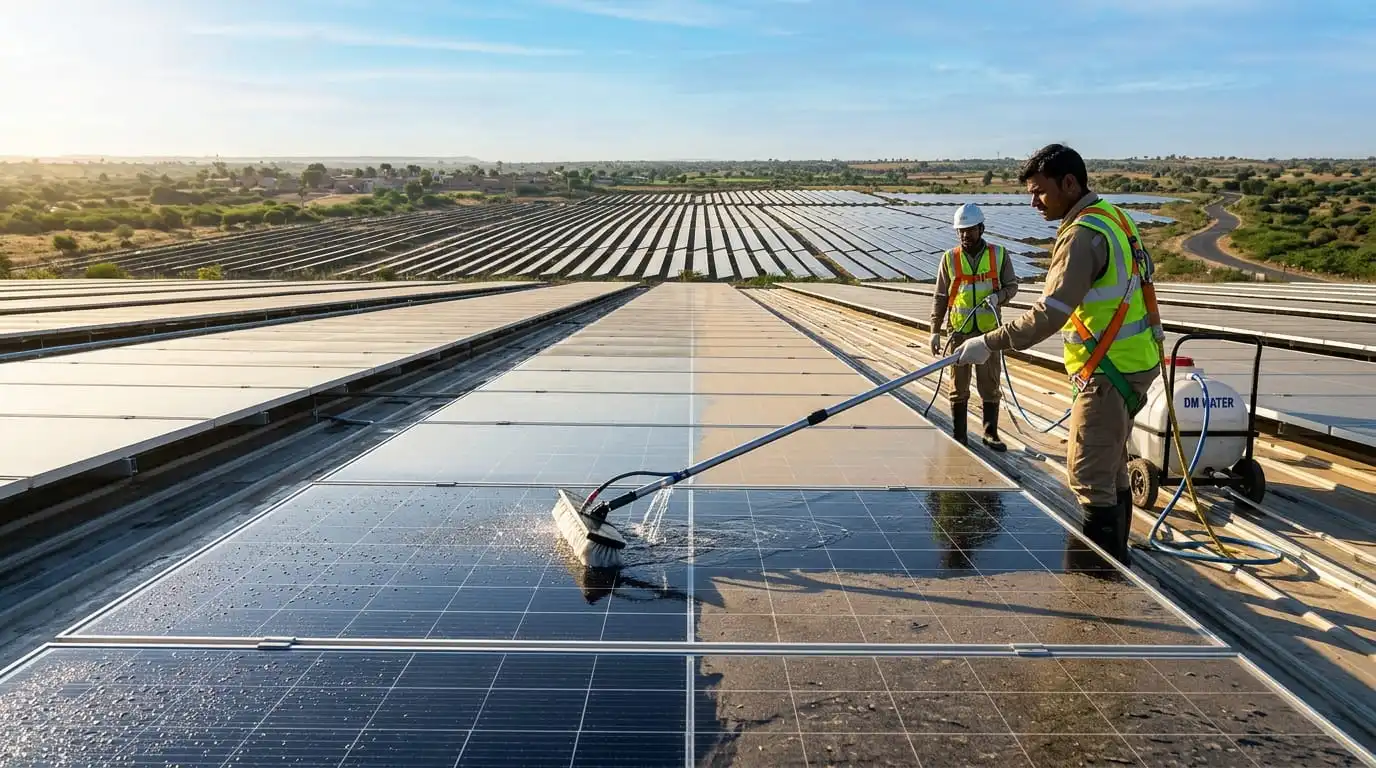
Solar technicians performing module cleaning on commercial solar panels in India using demineralized water and soft rotating brushes
Early Morning Cleaning: Technicians utilizing on-site demineralized water (<200 ppm TDS) and non-abrasive soft brushes before module glass heats up. Photo: IISE O&M Practical Training

Water Quality Standards for Solar Cleaning

Never use untreated borehole or municipal tap water without testing. Water utilized for module washing must satisfy the following chemical criteria:

ParameterRecommended SpecificationHazard If Exceeded
Total Dissolved Solids (TDS)< 200 ppm (Ideal: < 75 ppm)Chalky mineral deposits, white scaling, permanent light attenuation
pH Level6.5 – 7.5 (Neutral)Acidic (<6.0) or alkaline (>8.0) water etches anti-reflective coating
Electrical Conductivity< 300 µS/cmIncreases leakage current risks during washing operations
Total Hardness (CaCO3)< 20 ppmAccelerated calcification and scale formation
Chloride Content< 50 ppmCorrosive pitting of module aluminium frames and seals
CLEANING DO'S
  • Wash During Cool Hours: Clean exclusively between 05:30 AM and 08:30 AM, or between 05:30 PM and 08:00 PM. Module glass temperatures must not differ from wash water by more than 10°C.
  • Use Demineralized Water: Install an on-site reverse osmosis (RO) or demineralization (DM) filtration plant if borehole water TDS exceeds 200 ppm.
  • Soak Stubborn Spots: Pre-soak stubborn bird droppings with clean water for 2–3 minutes before gently wiping with soft microfiber cloths.
  • Use Non-Conductive Poles: Use non-conductive fiberglass telescopic poles when cleaning near live electrical arrays.
CLEANING DON'TS
  • NEVER Walk or Step on Panels: Stepping on modules causes microscopic silicon cell micro-cracks that subsequently degrade into burnt hotspots and dead cells.
  • NEVER Clean Hot Panels at Noon: Spraying cold water onto glass heated to 60–70°C creates severe thermal tensile stress, instantly fracturing tempered glass.
  • NEVER Use High Pressure: Water pressures exceeding 35 PSI (2.5 bar) compromise the silicone sealant between glass and aluminium frames.
  • NEVER Use Harsh Chemicals: Bleach, caustic soda, or hydrochloric acid chemically strip the microscopic anti-reflective nanocoating.
  • NEVER Use Wire Brushes: Abrasive scrubbing pads cause permanent micro-scratches that diffuse incoming solar radiation.

How to Monitor Solar Plant Performance

Monitoring a solar plant involves far more than simply checking whether total kilowatt-hours increased on a mobile app. Effective technical asset management requires understanding the mathematical relationships between raw energy generation, solar resource availability, and normalized efficiency benchmarks.

Key Performance Indicators (KPIs) Defined

  • Specific Yield ($Y_f$): Measures the total energy produced per kilowatt-peak of installed DC solar capacity over a defined period: $Y_f = E_{AC} / P_{DC,STC}$ (expressed in $\text{kWh/kWp/day}$). In India, daily specific yield typically ranges between 3.8 and 5.5 kWh/kWp/day.
  • Performance Ratio (PR): Defined under international standard IEC 61724-1, Performance Ratio is the ratio of actual AC energy generated to the theoretical energy the plant should have produced based on the Plane of Array (POA) irradiance:

    $$PR = \frac{Y_f}{Y_r} = \frac{E_{AC} / P_{DC,STC}}{H_{POA} / G_{STC}}$$
    Where $H_{POA}$ is measured irradiation in $\text{kWh/m}^2$, and $G_{STC}$ is $1.0\,\text{kW/m}^2$.
  • Plant Availability ($A_{plant}$) vs. Inverter Availability ($A_{inv}$): Plant availability measures the percentage of daylight hours the plant was capable of exporting power; inverter availability measures individual equipment uptime, isolating internal failures from DISCOM grid outages.
💡
Operational Engineering Rule: Energy Output (kWh) fluctuates directly with sunshine and season. Performance Ratio (PR %) normalizes for weather. A sharp drop in PR always indicates an internal technical fault (soiling, shading, inverter clipping, or string failure) regardless of whether the day was sunny or overcast.

Example Calculation: Diagnosing an Abnormal Performance Gap

Consider a 100 kWp rooftop solar plant in Ahmedabad on a clear day in March:

  • Measured Plane of Array Irradiance ($H_{POA}$): $6.2\,\text{kWh/m}^2$
  • Expected Theoretical Generation at 100% PR: $100\,\text{kWp} \times 6.2\,\text{h} = 620\,\text{kWh}$
  • Actual Monitored AC Generation ($E_{AC}$): $434\,\text{kWh}$
  • Calculated PR: $434 / 620 = 70.0\%$

Diagnostic Triage: A well-maintained rooftop installation should achieve a PR between 78% and 82% under clear sky conditions. A PR of 70.0% indicates an immediate 8–12% performance loss. The operator immediately cross-checks string currents in SCADA: if String #4 is generating 0 Amps while Strings #1–3 are generating 8.5 Amps, technicians are dispatched to replace a blown DC string fuse.

Solar Inverter Maintenance

While PV modules represent the largest capital asset, inverters represent the technical heart of the solar plant and account for approximately 60% to 70% of unscheduled maintenance events. Operating under continuous high power throughput, switching transistors (IGBTs or SiC MOSFETs) generate substantial thermal dissipation that must be actively managed.

1. Inverter Alarms and Fault Code Triage

  • Isolation Fault / Low Insulation Resistance ($R_{iso}$ Low): Indicates that the DC side insulation resistance to ground has fallen below safety thresholds (typically < 1 MΩ for 1000V systems or < 0.1 MΩ in wet weather). Prevalent on humid monsoon mornings due to damaged cable jackets or moisture in DC connectors.
  • Grid Voltage / Frequency Out of Range: Indicates that local utility grid parameters have drifted beyond permissible standards (e.g., CEA regulations requiring grid disconnection when voltage exceeds ±10% of nominal).
  • DC Overvoltage: Occurs on cold winter mornings when module open-circuit voltage ($V_{oc}$) exceeds the inverter's maximum DC input rating due to negative temperature coefficients.
  • Over-temperature / Derating Warning: Indicates internal heatsink temperatures have crossed thermal thresholds, triggering automatic power throttling.

2. Cooling Fans and Air Filter Maintenance

  • Filter Servicing: Washable foam or wire-mesh filters must be removed, vacuumed, washed with clean water, thoroughly dried, and reinstalled monthly. Never operate an inverter with wet filters or without filters fitted.
  • Fan Testing: Test fan functionality via the inverter service software test routine. Check for bearing noise, blade wobble, and mechanical resistance. Replace fans showing bearing friction before summer heat arrives.
  • Heatsink Fin Cleaning: Clear dead leaves, spiderwebs, dust nests, and debris from heatsink fins using non-metallic brushes and dry compressed air.
⚠️
HIGH VOLTAGE HAZARD & CAPACITOR DISCHARGE PROTOCOL: Solar inverters contain internal high-voltage DC link capacitors that store lethal electrical energy long after both the AC grid and DC array have been isolated.

Mandatory Procedure: Open the AC circuit breaker first, then open the DC load-break disconnect switch. Wait a minimum of 5 to 15 minutes (as specified in the OEM service manual) for internal bleed resistors to discharge capacitors. Always verify zero voltage across all terminals using a CAT III 1000V rated multimeter before touching internal components.

Electrical Maintenance and Solar Plant Safety

Working on solar PV power plants entails severe high-voltage DC hazards, medium/high-voltage AC hazards, arc flash risks, and working-at-height liabilities. Electrical maintenance must be executed strictly within the regulatory framework of the Central Electricity Authority (Measures relating to Safety and Electric Supply) Regulations and IS 5216 (Safety Procedures and Practices in Electrical Work).

The DC Hazard: Why Solar Direct Current Demands Specialized Caution

Unlike an AC motor or generator that can be de-energized by hitting an emergency stop, a solar PV array continues generating voltage as long as daylight strikes the cells. Furthermore, direct current does not have a natural periodic zero-voltage crossing point (unlike 50 Hz AC which passes through zero voltage 100 times per second). Consequently, once a DC arc initiates—due to a loose connector or an isolator opened under load—it sustains an intense, plasma-heated arc exceeding 3,000°C that will not extinguish until the physical gap is massive or fuel is consumed.

⚡
CRITICAL SAFETY RULE: Never disconnect an MC4 connector or open an unrated DC disconnect switch while current is flowing through the string. Always turn off the inverter or open the downstream DC circuit breaker first to drop current to 0 Amperes before disconnecting string conductors.

Earthing and Lightning Protection Maintenance

A solar power plant requires three independent, equipotentially bonded earthing systems:

  • Equipment Frame Earthing: Bonds all aluminium module frames, steel mounting structures, and metal cable trays.
  • System Earthing: Neutral grounding for inverters and transformers.
  • Lightning Protection Earthing: Dedicated low-impedance down-conductors connected to chemical earthing pits for Franklin rods or Early Streamer Emission (ESE) lightning masts.

Testing Protocol: Measure individual earth pit resistance every six months (pre-monsoon and post-monsoon) using a calibrated 4-pole digital earth tester via the Fall of Potential method. In accordance with IS 3043 (Code of Practice for Earthing) and CEA safety regulations, earth pit resistance should not exceed $1.0,Omega$ to $5.0,Omega$ for equipment grounding and < 5.0 Ω for lightning arrestors.

Advanced Solar Plant Inspection Techniques

Beyond routine visual checks, comprehensive solar plant maintenance relies on specialized diagnostic instruments that detect invisible sub-surface defects, micro-fractures, and high-resistance electrical faults before they escalate into catastrophic failures.

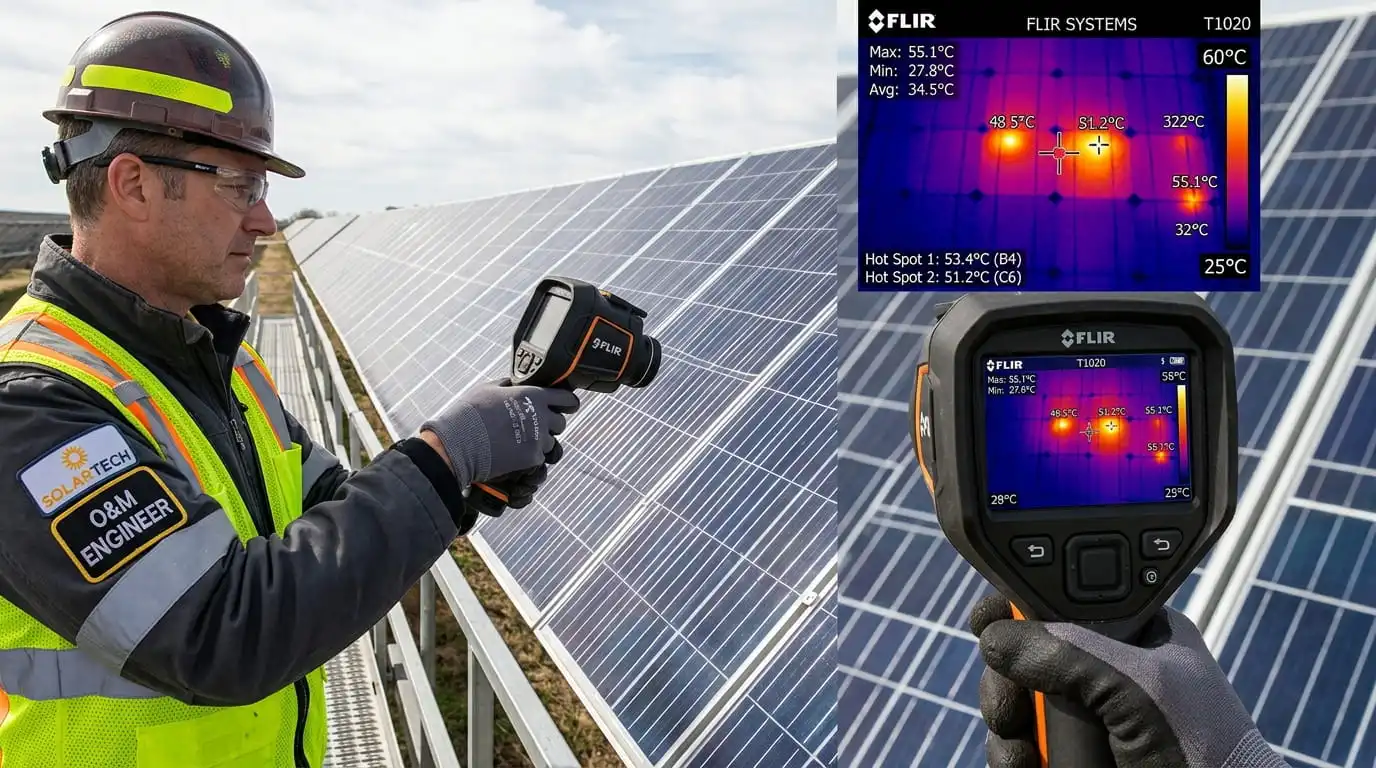
Infrared thermography scan displaying false-color thermal hotspots on solar PV cells compared to normal operating temperatures
Radiometric Thermography: IR inspection revealing localized cell hotspots ($Delta T > 25^circ ext{C}$) caused by internal cell shunts invisible to visual inspection. Photo: IISE Advanced Diagnostic Laboratory

1. Infrared (IR) Thermography (IEC 62446-3)

Thermal imaging detects infrared radiation emitted by objects, displaying surface temperature differentials invisible to human eyes. Tests must be conducted under steady irradiance exceeding $700, ext{W/m}^2$ with low wind speed (<4 m/s).

  • Single Hotspot ($Delta T = 10^circ ext{C} - 40^circ ext{C}$): Indicates a cracked silicon cell, internal localized short, or persistent bird fouling.
  • Patchwork / Checkerboard Pattern: Indicates severe cell mismatch or Potential-Induced Degradation (PID).
  • Entire Module Hot: Indicates an open-circuit string or disconnected module passing no current.
  • Hot Junction Box ($Delta T > 20^circ ext{C}$): Indicates a shorted bypass diode dissipating continuous string current as heat.

2. I-V Curve Tracing (Current-Voltage Analysis)

An I-V curve tracer sweeps string load from open-circuit to short-circuit in milliseconds while measuring simultaneous irradiance and module temperature. The resulting curve is converted to Standard Test Conditions (STC) using IEC 60891 equations and compared against the factory flash curve. Deviations reveal series resistance degradation, shunt current leakage, or bypass diode failure.

3. Insulation Resistance (Megger) Testing

Insulation resistance testing validates the dielectric integrity of DC string cables and combiner box busbars to ground. In accordance with IEC 62446-1, test voltage (1000V or 1500V DC) is applied between shorted string conductors and the earth busbar. The minimum acceptable insulation resistance must be at least $1.0, ext{M}Omega$. Readings below $1.0, ext{M}Omega$ mandate locating and repairing damaged cable jackets before energization.

Common Solar Plant Problems and Troubleshooting

A systematic diagnostic troubleshooting matrix for solar plant technicians, site supervisors, and asset managers.

Observed ProblemProbable Root CausesSymptomsFirst Diagnostic StepProfessional Corrective Action
Inverter Trips on "Low Isolation" ($R_{iso}$)Damaged DC cable sheath; moisture in MC4 connector; backsheet ruptureInverter fails to synchronize at dawn; clears as array warmsDisconnect strings individually; measure $R_{iso}$ of each string to groundLocate faulty string; replace damaged cable segment; re-crimp bad MC4 connectors
Single String Generates 0 AmpsBlown DC string fuse; loose MC4 connector; broken DC isolator contactString current = 0 A in SCADA; remaining strings normalCheck fuse continuity with multimeter; check $V_{oc}$ at combiner boxReplace blown fuse with identical gPV fast-acting fuse; re-seat MC4 connector
Plant Generates 15–25% Below BaselineHeavy uniform soiling; grid curtailment; inverter thermal deratingPR drops below 70%; daily yield suppressed under clear skiesCompare POA irradiance against generation; inspect module surfaceSchedule complete module washing cycle; clean inverter air filters and heatsink
Inverter Over-Temperature AlarmClogged air filters; failed internal cooling fans; blocked exhaust ventInverter alarm code triggered; power output clips mid-dayCheck external filter mesh for dust; verify exhaust fan spinningVacuum/wash air filters; replace failing fan assemblies; clear exhaust clearance
Severe Localized Module HotspotMicrocracked cell; localized bird droppings; bypass diode failureThermal imaging reveals $Delta T > 20^circ ext{C}$ over single cellClean module surface; re-scan with thermal camera under >700 W/m²If hotspot persists after cleaning, isolate module and file OEM warranty claim
Inverter Grid Voltage Out of RangeDISCOM grid voltage exceeds statutory limit (+10%); undersized AC cableInverter trips during peak noon generation; restarts repeatedlyMeasure AC grid voltage at inverter terminals and main LT panelIf grid is high, request DISCOM tap-changer adjustment; verify AC cable drop <1.5%
SCADA Communication FailureBroken RS485 communication wire; loose termination; IP conflictMonitoring portal shows "Offline" but inverters are generatingCheck RS485 polarity (A/B); verify gateway power and internet linkRe-terminate communication cables; ensure termination resistor ($120,Omega$) is set
Corroded / Discoloured MC4 ConnectorImproper crimping; mismatched connector brands; water ingressConnector body shows yellowing/charring; thermal scan hotThermal imaging of string connections during peak irradianceCut out damaged connector; re-crimp matching brand connectors with proper tool
Tracker System Fails to TrackActuator motor failure; damaged inclinometer sensor; anemometer errorTracker array stuck at morning tilt angle; mechanical shudderCheck tracker controller display for motor stall or sensor alarmManually jog tracker to test motor; calibrate inclinometer; replace faulty wind sensor
Potential-Induced Degradation (PID)High negative voltage to ground in humid conditions; sodium ion migrationSevere power loss (>20%) on negative string end modulesConduct EL imaging; inspect string voltage distributionInstall anti-PID mitigation box that applies positive voltage offset at night

Rooftop vs. C&I vs. Utility-Scale Solar Maintenance

Maintenance strategies must be tailored to the operational scale, mounting geography, and electrical architecture of the solar asset.

ParameterResidential Rooftop (<20 kWp)Commercial & Industrial (100 kWp – 2 MWp)Utility-Scale Ground-Mounted (>10 MWp)
Inspection MethodManual visual walkManual visual + Handheld IR thermographyDrone radiometric IR + String SCADA analytics
Cleaning ApproachManual hose & soft mop (Monthly)Semi-automated brush (10–15 day cycles)Waterless robotic cleaners / Tractor booms
Safety CriticalityWorking at height; ladder securityFactory HSE rules; sheet-metal roof safetyHV substation safety; arc flash; switchyard rules
Vegetation / CivilMinimal (gutter leaf clearing)Roof membrane integrity; drain clearanceHeavy weed clearing; trench & road maintenance
Manpower DeploymentOn-demand periodic visitScheduled monthly technician visitsFull-time on-site 24/7 O&M engineering team
AMC StructureBasic preventive package (1–2 visits/yr)Comprehensive SLA (Monthly PM + 24h CM)Performance-linked availability & PR contract

Preventive vs. Corrective vs. Predictive Maintenance

A balanced maintenance program optimizes capital allocation across all three maintenance philosophies to achieve the lowest Levelized Cost of Electricity (LCOE).

StrategyTrigger MechanismOperational ImpactFinancial Trade-Off
Preventive (Scheduled)Fixed calendar schedule (Monthly, Quarterly, Annual)Minimizes sudden breakdowns; halts steady degradationFixed predictable operating cost; prevents expensive component failures
Corrective (Reactive)Failure or alarm notificationCauses unplanned downtime; lost export generationHighest cost per event; emergency premiums; lost revenue during downtime
Predictive (Condition-Based)Condition or data anomaly trend (SCADA, IR scan)Intervenes before failure; scheduled during off-hoursLowest lifecycle cost; requires investment in smart monitoring tools

Field Cost Comparison: In a real-world scenario, a reactive repair on a 50 kW commercial inverter with blown cooling fans costs upwards of ₹1,50,000 in lost daytime generation plus emergency repair charges. In contrast, predictive monitoring detects fan RPM degradation three weeks in advance, enabling a scheduled ₹8,000 fan replacement during evening off-hours with zero generation loss.

Solar O&M Tools and Equipment

Professional solar plant maintenance requires precision instrumentation rated specifically for high-voltage DC photovoltaic applications.

InstrumentMeasurement RangePrimary Solar ApplicationQualified User Level
Solar Multimeter & Clamp MeterCAT III 1000V / CAT IV 600V DCDC String $V_{oc}$, Operating Current ($I_{mp}$)Qualified Solar Technician
Insulation Tester (Megger)500V / 1000V / 1500V DC testDC cable sheath dielectric healthLicensed Electrical Engineer
4-Pole Earth Resistance Tester0.01 Ω to 2000 ΩEarth pit & grid impedance checksLicensed Electrical Engineer
I-V Curve Tracer & Irradiance SensorUp to 1500V DC / 30A DC capacityString IV curve, $P_{max}$, fill factorCertified Solar O&M Engineer
Radiometric IR Thermal Camera-20°C to +650°CHotspot detection, terminal loose scansCertified Thermographer / Engineer
Optical Pyranometer (Secondary Std)Class A / Class B (0–2000 W/m²)Solar plane-of-array reference irradianceO&M Instrumentation Specialist
Calibrated Torque Wrench5–25 N·m / 20–100 N·mStructural clamp and busbar torque checksMechanical / Solar Technician
Water TDS / pH Digital Meter0–9999 ppm / 0–14 pHCleaning water quality validationSolar Cleaning Supervisor

Solar Plant Maintenance Documentation

Comprehensive documentation provides the operational audit trail required to maintain manufacturer warranties, satisfy insurance underwriting covenants, facilitate refinancing audits, and ensure asset value preservation.

  1. Daily Operational Log: Tracks daily solar radiation ($H_{POA}$), gross export generation ($E_{AC}$), daily specific yield, calculated PR, grid outage hours, and weather events.
  2. Preventive Maintenance Service Worksheets: Detailed checklists signed by certified technicians documenting completed torque verifications, filter washings, string open-circuit voltage ($V_{oc}$) measurements, and visual inspection findings.
  3. Cleaning and Water Quality Logs: Date and timestamp of every module washing cycle, recording wash water source, measured TDS (ppm) and pH, method used, and before/after PR change.
  4. Corrective Breakdown and Incident Reports: Formal root-cause analysis (RCA) documentation of any inverter tripping, component failure, blown fuse, or cable damage, detailing the identified cause, parts replaced, downtime duration, and preventative action taken.
  5. Periodic Calibration and Audit Certificates: Third-party calibration reports for all testing multimeters, insulation testers, torque wrenches, and pyranometers, alongside semi-annual radiometric thermal inspection reports.

Solar Power Plant Maintenance Cost Considerations

Solar maintenance expenditure should not be viewed as a discretionary overhead, but as an essential capital protection investment. Real-world O&M costs vary based on system topology, site accessibility, soiling velocity, and contract scope.

📊
Indicative Industry Cost Benchmarks (Indian Market Context):

• Utility-Scale Solar (MW scale): Typically ranges between ₹1,20,000 and ₹2,20,000 per MW per year for comprehensive O&M (excluding major non-warranty equipment overhauls).
• Commercial & Industrial Rooftop (100 kW – 1 MW): Typically ranges between ₹300 and ₹600 per kW per year.
• Residential Rooftop (<20 kW): Typically ranges between ₹800 and ₹1,500 per kW per year for periodic scheduled cleaning and technical inspection packages.

Solar O&M / AMC: What Should an AMC Include?

Entering into an Annual Maintenance Contract (AMC) is the standard method for C&I asset owners and industrial developers to ensure consistent uptime without maintaining a large in-house technical workforce.

The Solar O&M AMC Contract Checklist

  • Guaranteed Plant Availability SLA: Minimum 98.5% to 99.0% daytime availability with defined penalty clauses.
  • Defined Breakdown Response Times: Emergency on-site arrival within 4 to 8 hours for critical faults; 24 hours for minor alerts.
  • Minimum Scheduled Cleaning Cycles: Guaranteed number of cleaning cycles per year (typically 20–24 cycles) with certified soft water (TDS < 200 ppm).
  • Comprehensive vs. Non-Comprehensive Scope: Clear definition of whether replacement fuses, surge arresters, and inverter cooling fans are included in contract price.
  • Semi-Annual Technical Audits: Mandatory inclusion of pre-monsoon and post-monsoon thermal imaging scans and earth pit resistance testing.
  • Performance Ratio (PR) Commitment Clauses: Penalty-bonus mechanisms linked to guaranteed annual PR benchmarks.
  • Dedicated Safety Compliance: Contractor provides verified technician insurance, arc-flash PPE, and strict LOTO adherence.
  • Digital SCADA Monitoring & Reporting: Provision of monthly generation reports, PR degradation trends, and automated fault alert routing.
  • Exclusions Clearly Defined: Clear contractual boundaries regarding force majeure, utility grid outages, and external physical damage.
  • Warranty Claim Coordination: Contractor manages OEM RMA processes on behalf of the plant owner for failed modules or inverters.

12 Common Solar Maintenance Mistakes to Avoid

  1. Cleaning Modules Only When They "Look Dirty": By the time dust is visible from the ground, the array has already suffered an 8–15% generation loss. Adhere to a strict calendar schedule based on monitored PR rather than visual intuition.
  2. Ignoring Intermittent Inverter Fault Codes: Dismissing occasional "Grid Overvoltage" or "Low Isolation" alerts because the inverter restarts itself. Intermittent faults are early indicators of cable insulation breakdown or localized heating.
  3. Relying Exclusively on Smartphone Monitoring Apps: Monitoring portals display delayed, averaged data. They cannot alert you to localized cell micro-cracks, loose bolts, degraded surge arresters, or insect infestations inside combiner boxes.
  4. Washing Modules in the Heat of the Day: Spraying cold water onto panels heated to 60°C causes severe thermal shock that fractures tempered glass, immediately voiding the module's warranty.
  5. Using Hard Borehole Water for Cleaning: High-TDS water leaves behind calcium and magnesium carbonate scale that permanently clouds the anti-reflective coating, causing irreversible transmittance loss.
  6. Neglecting Structural Fastener Torque Checks: Assuming tightened bolts remain tight indefinitely. Wind vibrations, thermal cycling, and seismic micro-shifts loosen clamps, leading to module dislodgement during severe windstorms.
  7. Skipping Earth Resistance Testing: Assuming an earthing pit installed five years ago still functions. Soil desiccation, corrosion, and disconnected copper tapes can elevate resistance beyond 50 Ohms, leaving the plant unprotected against lightning strikes.
  8. Neglecting Vegetation Management: Allowing weeds and fast-growing vines to cast shadows over lower module rows. Bottom-row shading activates bypass diodes, dropping string generation by one-third or triggering cell hotspots.
  9. Permitting Unqualified Personnel to Perform Electrical Repairs: Allowing general facility maintenance staff to troubleshoot 1000V DC combiner boxes or inverter terminals, risking fatal electric shock or arc-flash explosions.
  10. Bypassing Blown Fuses with Copper Wire: When a string fuse blows, wrapping copper wire around the cartridge rather than diagnosing the underlying string short-circuit. This bypass creates catastrophic fire hazards when reverse currents flow.
  11. Failing to Document Maintenance Activities: Conducting repairs without logging dates, parts, and measurements, leaving the asset owner unable to substantiate linear performance warranty claims with Tier-1 manufacturers.
  12. Intervening Only After Massive Generation Losses Occur: Waiting for a 30% drop in generation before scheduling a site visit, allowing minor preventable issues to develop into costly permanent hardware failures.

When Should You Hire a Solar Professional?

Understanding safety and operational boundaries is critical for plant owners, facility managers, and non-electrical personnel.

Operational TierAuthorized PersonnelPermitted Maintenance ActivitiesAbsolute Safety Boundary
Tier 1: Basic Site MonitoringPlant Owner / Facility ManagerDaily app checking, reporting error codes, checking fence security, scheduling cleaningNEVER open electrical boxes or touch cables
Tier 2: Routine Preventive CareQualified Solar TechnicianModule washing (with safety harness), external filter vacuuming, mechanical torque checks, fuse replacement under de-energized stateNEVER perform energized high-voltage testing
Tier 3: Electrical Testing & RepairLicensed Electrical EngineerInternal inverter servicing, breaker torque checks, 1000V Megger insulation testing, 4-pole earth pit resistance testingRequires valid electrical contractor license
Tier 4: Specialist Technical AuditsCertified Engineering Testing AgencyAerial drone radiometric thermography per IEC 62446-3, full-array I-V curve tracing, transformer oil BDV/DGA testingRequires calibrated secondary standard instruments
🚨
CRITICAL SAFETY BOUNDARY: If a task involves opening an energised enclosure, testing circuits above 50 Volts, operating high-voltage disconnect switches, or working on roof edges without permanent railings, DO NOT ATTEMPT IT WITHOUT CERTIFIED PERSONNEL. Contact a qualified solar engineer or licensed electrical contractor immediately.

Quick Solar Power Plant Maintenance Checklist

Use this interactive field checklist for routine maintenance walkthroughs. Check items off during inspection—your selections are automatically saved on this device. You can also print a clean copy for physical logbooks.

Digital Field Inspection Sheet
Conforms to IEC 62446 Routine Preventive Inspection Protocol

Frequently Asked Questions (FAQs)

Authoritative answers to the most frequent technical, operational, and commercial questions regarding solar power plant maintenance in India.

A solar power plant requires daily remote performance monitoring via SCADA, monthly visual inspections and filter cleaning, quarterly mechanical torque and fuse checks, and comprehensive semi-annual and annual technical audits that include thermal imaging, earth resistance testing, and I-V curve tracing.
In India, solar modules should generally be cleaned every 10 to 15 days in dry, dusty, agricultural, or industrial regions (such as Rajasthan, Gujarat, and industrial NCR). In cleaner suburban areas, cleaning every 20 to 30 days may suffice. Cleaning cycles should accelerate before dry summer months and reduce during the active monsoon season.
Operations (O) involves continuous real-time remote surveillance, SCADA monitoring, generation forecasting, performance ratio tracking, and grid dispatch coordination. Maintenance (M) refers to the hands-on physical, mechanical, and electrical servicing—such as module cleaning, torque checking, filter replacement, and component repair.
Preventive maintenance includes scheduled module cleaning, checking structural bolt torque, vacuuming inverter air filters, inspecting string combiner box seals, testing surge protection devices, verifying cable insulation resistance, measuring earth pit resistance, and clearing vegetation around arrays.
For utility-scale solar parks, comprehensive O&M costs typically range between ₹1.2 lakh and ₹2.2 lakh per megawatt (MW) annually. For commercial and industrial (C&I) rooftop plants, costs generally range between ₹300 and ₹600 per kilowatt (kW) per year. Small residential rooftop maintenance packages typically range between ₹800 and ₹1,500 per kW per year.
Yes. In dusty and industrial environments across India, accumulated dust and soiling can reduce generation by 15% to 30%. Routine cleaning with demineralized water restores module optical transmittance, immediately recovering lost generation.
Cleaning water must have a Total Dissolved Solids (TDS) level below 200 ppm (ideally below 75 ppm), electrical conductivity below 300 µS/cm, and a neutral pH between 6.5 and 7.5. Using hard groundwater leaves behind calcium carbonate scale that causes permanent glass clouding.
Performance Ratio (PR) is defined under IEC 61724-1 as the ratio of actual AC energy produced to the theoretical energy the plant should have generated based on measured Plane of Array (POA) solar irradiance. It is calculated as PR = (E_AC / P_DC,STC) / (H_POA / G_STC), normalizing for weather variations to assess true system health.
Solar inverters require monthly cleaning or washing of intake air filter grilles, quarterly checks of internal cooling fan operation and heatsink fin clearance, semi-annual thermal scans and torque verification of electrical terminals, and periodic firmware updates to ensure grid-code compliance.
The most frequent solar plant faults include inverter isolation errors (R_iso low) caused by morning moisture, blown DC string fuses, burnt MC4 connectors due to improper crimping, module hotspots caused by bird droppings or micro-cracks, and grid overvoltage trips caused by utility network fluctuations.
Pre-monsoon maintenance involves inspecting and lubricating enclosure door gaskets on inverters and combiner boxes, clearing site drainage trenches and culverts to prevent localized flooding, testing earth pit resistance under dry conditions, and verifying the structural anchoring of lightning protection masts.
Infrared (IR) thermography per IEC 62446-3 detects sub-surface cell micro-cracks, malfunctioning bypass diodes, high-resistance electrical connections, and localized hotspots that are invisible to the naked eye, allowing corrective intervention before components suffer burn-through or cause fires.
Yes. For commercial, industrial, and utility-scale installations, an AMC ensures guaranteed uptime availability (typically >98.5%), fast breakdown response times, regular professional cleaning, and certified electrical testing that protects equipment warranties and maximizes return on investment.
In accordance with Central Electricity Authority (CEA) safety regulations and state electrical licensing rules, all internal electrical testing, switching, isolation, and repair on circuits exceeding 50V DC or 230V AC must be performed exclusively by qualified, licensed electrical personnel utilizing certified arc-rated safety equipment.
Preventive maintenance follows a fixed calendar schedule (e.g., cleaning filters every 30 days regardless of condition). Predictive maintenance utilizes data analytics, SCADA trends, and diagnostic tools (like thermal drone scans or I-V curve traces) to detect anomalies and perform maintenance only when parameters indicate impending failure.

Advance Your Solar O&M Career with IISE

Maintaining multi-megawatt solar plants and distributed commercial rooftop arrays requires certified engineering expertise. The Indian Institute of Solar Energy (IISE) is India's premier technical institute dedicated to renewable energy workforce development, delivering hands-on training on live solar power plants, digital testing instruments, and advanced SCADA systems.

Admissions Open 2026–2027

Speak with an IISE Academic & Technical Advisor

Have questions about solar O&M career paths, batch timings, or practical training facility visits? Contact our engineering admissions team today.