How Does Net Zero for Indian Industries Work? A Practical Guide for 2026
A comprehensive engineering roadmap for Indian manufacturers to measure baseline greenhouse gas emissions, slash commercial energy costs, deploy rooftop and captive solar, integrate battery storage, and build an auditable transition plan under BEE's Carbon Credit Trading Scheme (CCTS) and SEBI BRSR Core.
- 1 What Net Zero Actually Means
- 2 Scope 1, Scope 2, and Scope 3 Matrix
- 3 Why Net Zero Matters (CCTS, CBAM, BRSR)
- 4 The Four Decarbonisation Levers
- 5 5-Phase Industrial Action Plan
- 6 Industrial Solar Savings Calculator
- 7 India's Net Zero Roadmap: 2025–2070
- 8 Sector Strategies (Cement, Steel, Auto...)
- 9 Decarbonisation Careers & Skills
- 10 IISE Technical Training Programs
- 11 Frequently Asked Questions (FAQ)
- 12 Related Articles & Resources
1. What Does Net Zero Actually Mean? (And How It Differs From Carbon Neutrality)
In modern industrial boardrooms, "net zero" and "carbon neutral" are often mistakenly used as interchangeable synonyms. From an engineering and greenhouse-gas accounting perspective, however, they represent fundamentally different thresholds of rigor, investment, and operational accountability.
To understand how net zero works for an Indian manufacturing plant, one must distinguish between six precise terms established by the Intergovernmental Panel on Climate Change (IPCC) and the Greenhouse Gas (GHG) Protocol Corporate Standard:
Carbon Neutrality
- Focus: Balancing measured emissions by purchasing external carbon credits (offsets).
- Operational Abatement: Voluntary; a factory can achieve carbon neutrality without reducing internal fuel or power use by even 1%.
- Offset Nature: Frequently relies on avoided emissions credits (e.g., funding a forest conservation project elsewhere).
- Regulatory Scrutiny: Increasingly viewed as greenwashing under EU CBAM, FTC Green Guides, and SEBI BRSR guidelines if internal cuts are bypassed.
Net-Zero Emissions
- Focus: Permanent physical reduction of internal operations by at least 80% to 90% across Scope 1, 2, and 3.
- Operational Abatement: Mandatory structural transformation—onsite solar, process electrification, energy efficiency, and clean logistics.
- Offset Nature: Only permanent certified removals (direct air capture, biochar, mineralization) permitted, and strictly for genuine residual emissions.
- Regulatory Alignment: Fully aligned with India's Carbon Credit Trading Scheme (CCTS), ISO 14064, and the Science Based Targets initiative (SBTi).
Gross Greenhouse-Gas Emissions represent the total uncapped volume of carbon dioxide ($CO_2$), methane ($CH_4$), nitrous oxide ($N_2O$), and fluorinated gases released by the industrial facility in a fiscal year. Emissions Reduction refers to the actual megawatt-hours and kilolitres of fuel eliminated from the production cycle. Residual Emissions are the final unavoidable emissions (typically 5% to 15%) in sectors like cement kilns or chemical reduction where complete zero-carbon substitution is currently technically or economically unfeasible.
A credible net zero claim must follow this exact sequential hierarchy. Skipping steps 2, 3, or 4 to jump straight to credits invalidates statutory compliance filings.
For technical engineering teams looking to master this entire measurement and solar integration process, IISE's comprehensive solar courses in India outline every professional competency from entry-level design to advanced energy management.
2. Scope 1, Scope 2, and Scope 3 Emissions: The Industrial Accounting Framework
Any credible industrial decarbonisation strategy begins with greenhouse-gas inventory accounting under the GHG Protocol Corporate Standard and ISO 14064-1. Emissions are categorized into three discrete scopes based on operational control and ownership of the emitting source.
| Emissions Scope | What It Covers | Industrial Example | Potential Reduction Measures | Relevant Data to Collect |
|---|---|---|---|---|
| Scope 1 Direct Emissions | Direct greenhouse-gas emissions from sources owned or controlled by the company (fuel combustion, chemical reactions, company fleet). | Diesel burned in captive backup gensets (DG sets), coal/furnace oil in industrial boilers, thermic fluid heaters, and forklift diesel. |
• Transition boilers to biomass briquettes or green electricity. • Electrify material handling and yard trucks. • Install waste heat recovery systems on kiln/furnace exhausts. • Conduct leak detection for refrigerant gases (HFCs). | Fuel purchase registers (litres of diesel, tonnes of coal, SCM of natural gas), boiler operating logs, refrigerant recharging receipts. |
| Scope 2 Indirect Energy | Indirect emissions associated with the generation of purchased electricity, steam, heating, or cooling consumed by the industrial plant. | Grid power drawn from state DISCOM (MSEDCL, TANGEDCO, UGVCL, BESCOM) to run factory motors, compressors, chillers, and CNC machines. |
• Install captive rooftop and ground-mount solar arrays. • Contract Green Energy Open Access (interstate/intrastate). • Deploy Battery Energy Storage Systems (BESS) for solar time-shifting. • Procure Renewable Energy Certificates (I-RECs / REC India). | Monthly DISCOM HT electricity bills, 15-minute Time-of-Day (ToD) smart meter logs, CEA national grid emission factor (0.727 kg CO₂e/kWh). |
| Scope 3 Value Chain | All other indirect emissions across the upstream and downstream value chain—including supplier extraction, freight, and product end-of-life. | Emissions embedded in purchased steel or polymer resin raw materials, long-haul diesel transport by 3PL logistics, and outbound customer delivery. |
• Mandate Tier-1 supplier ESG disclosures and renewable targets. • Modal shift from road freight to electric rail corridors. • Circular product design using recycled scrap feedstocks. • Optimize route planning and lightweight packaging. | Tier-1 vendor emissions certifications, freight consignment manifests (tonnes × km), raw material bills of lading, corporate air travel records. |
Under both SEBI's BRSR and ISO 14064, industrial entities must select either the Operational Control approach (accounting for 100% of emissions from operations where the company directs operating policies) or the Equity Share approach (accounting based on financial ownership percentage). Furthermore, when reporting Scope 2 emissions, companies must disclose using the Location-based method (applying the official Central Electricity Authority baseline grid factor) alongside the Market-based method (factoring in specific green tariffs, open access PPAs, and verified solar self-consumption).
3. Why Net Zero for Indian Industries Matters: The Six Structural Drivers
Indian manufacturing leaders are no longer exploring decarbonisation out of altruism. The urgency is driven by hard financial arithmetic, statutory compliance mandates, export penalties, and shifting capital markets. Below are the six primary commercial drivers compelling Indian industrial facilities to accelerate their transition in 2026.
4. The Four Principal Levers of Industrial Decarbonisation
When engineering teams translate high-level corporate net-zero pledges into shop-floor reality, practical execution converges on four fundamental technological levers. These four areas form the core curriculum of modern renewable engineering education and represent the fastest avenues for cutting operating expenses.
☀️ Lever A: Rooftop & Captive Solar Power
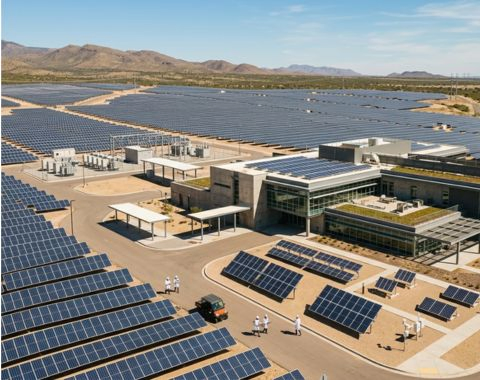
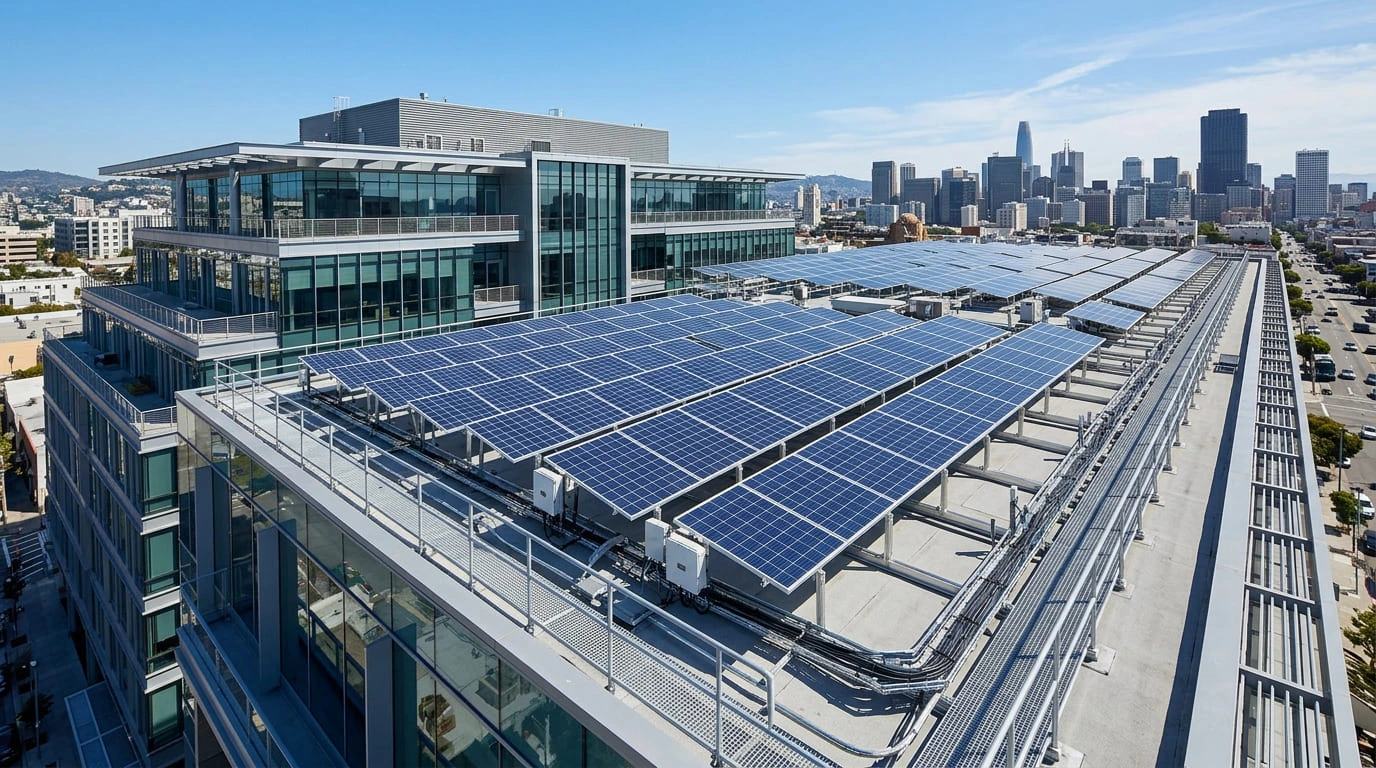
Fastest Scope 2 ReductionFor most manufacturing plants, factory shed rooftops and adjacent unused land represent dormant energy assets. Generating solar power behind the meter displaces dirty coal-fired grid electricity unit-for-unit. Under India's Green Energy Open Access Rules 2022, any commercial consumer with a sanctioned contract demand of 100 kW or higher can also wheel renewable electricity from offsite solar farms with streamlined approvals.
🔋 Lever B: Battery Energy Storage Systems (BESS) & Load Management
Intermittency & Peak ShavingSolar generation naturally peaks between 11:00 AM and 2:00 PM, whereas industrial plants often face punitive maximum demand charges and elevated Time-of-Day (ToD) tariffs during evening hours (6:00 PM to 10:00 PM). Integrating Containerized Lithium Iron Phosphate (LFP) BESS enables factories to soak up excess midday solar generation and discharge it during evening peak-rate periods.
🚚 Lever C: Industrial Electrification & EV Logistics Fleets
Direct Scope 1 AbatementEvery litre of diesel burned inside a factory yard or delivery vehicle directly inflates Scope 1 greenhouse-gas numbers. Converting material handling equipment, yard tuggers, staff transport, and captive delivery vehicles to electric vehicles (EVs) powered by rooftop solar eliminates liquid hydrocarbon emissions completely.
📋 Lever D: Investment-Grade Energy Audits & Deep Efficiency
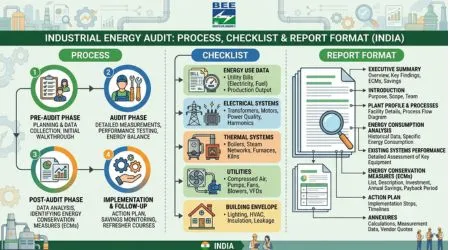
Lowest Cost AbatementThe cleanest, cheapest unit of electricity is the one you never consume. A formal investment-grade energy audit conducted by a BEE-Certified Energy Auditor identifies high-return efficiency retrofits that frequently pay for themselves in under 12 to 18 months, reducing energy intensity prior to solar sizing.
While solar and energy audits address 60%–80% of light and medium manufacturing emissions, heavy industries face thermodynamic boundaries. In cement, 60% of emissions stem from the chemical calcination of limestone ($CaCO_3 ightarrow CaO + CO_2$), which cannot be solved by electricity alone. In primary steelmaking, carbon is required as a chemical reducing agent in blast furnaces.
For these hard-to-abate sectors, India's National Green Hydrogen Mission (targeting 5 million metric tonnes per annum by 2030) provides the next frontier: replacing coking coal with green hydrogen in Direct Reduced Iron (DRI) shafts, and capturing kiln carbon through Carbon Capture, Utilisation, and Storage (CCUS). Learn more in our technical analysis of green hydrogen in India for engineers.
5. The 5-Phase Industrial Decarbonisation Action Plan
Moving an industrial enterprise from a fragmented corporate target to an auditable, cost-saving operational reality requires a structured implementation framework. Below is the five-phase roadmap utilized by certified energy engineers and ESG directors across Indian industrial estates.
Define organizational boundaries under operational control protocols. Quantify historical greenhouse gas emissions across a representative 36-month baseline period.
- Map all physical fuel storage (diesel tanks, furnace oil, LPG, natural gas meters).
- Collate 3 years of DISCOM HT billing statements and contract maximum demand histories.
- Identify major thermal and electrical consumer loads across the production lines.
- Establish a baseline year for statutory CCTS and SEBI BRSR filings.
Carry out technical engineering audits to unearth operational waste and evaluate onsite clean generation potential.
- Commission a comprehensive BEE-certified investment-grade electrical and thermal energy audit.
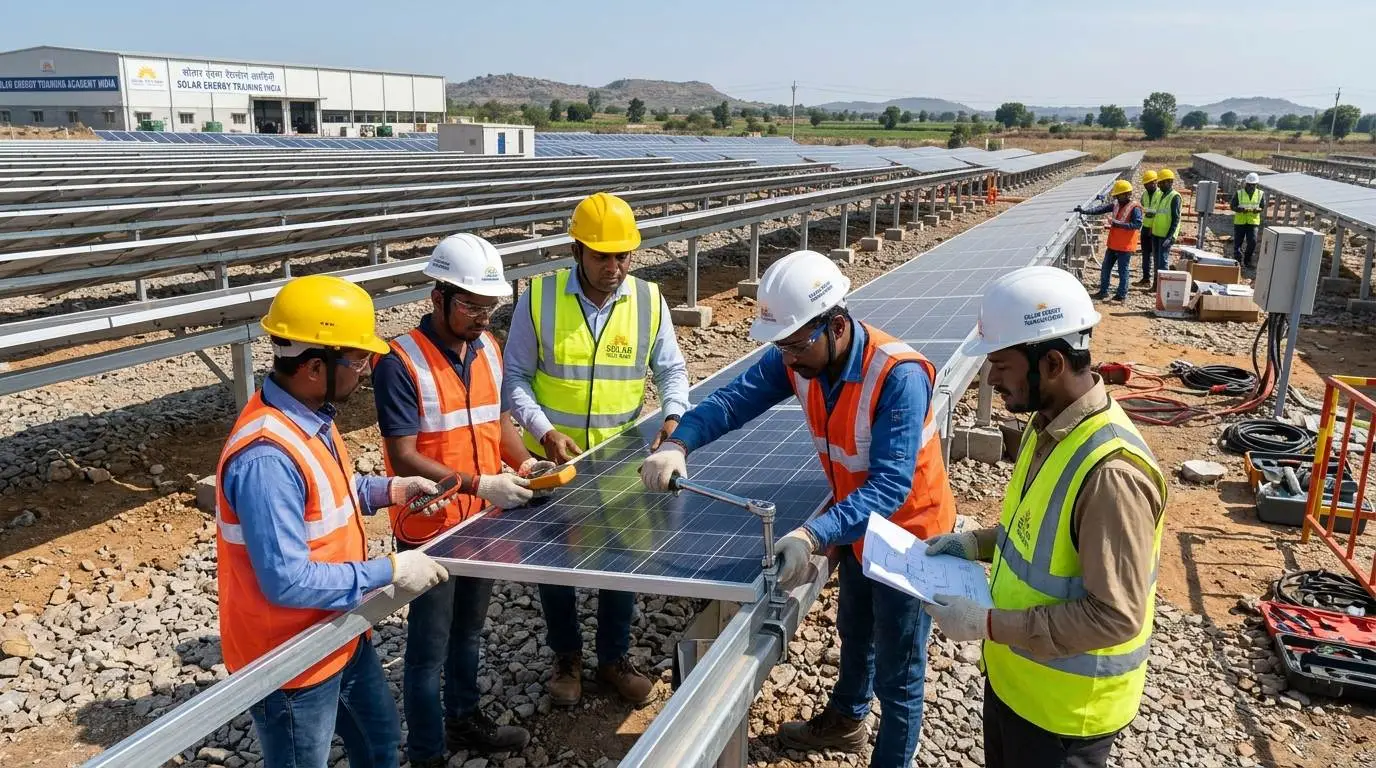
- Execute a rooftop drone LIDAR survey and ground feasibility study for captive solar array sizing.
- Simulate battery storage (BESS) peak-shaving economics using 15-minute load curves.
- Evaluate fleet electrification feasibility for internal forklifts, yard tugs, and delivery vans.
Construct a Marginal Abatement Cost Curve (MACC) to rank decarbonisation projects by cost per tonne of CO₂ avoided.
- Calculate CapEx requirements, simple payback periods, Net Present Value (NPV), and Internal Rate of Return (IRR).
- Assess financing models: CAPEX (direct plant ownership with 40% depreciation) vs. OPEX / RESCO (zero upfront cost PPA).
- Apply for green loan concessional financing through SIDBI, IREDA, or commercial green facilities.
- Finalise turnkey EPC contractor tenders with guaranteed performance ratios (PR ≥ 78%).
Execute physical construction, electrical grid interconnection, and automated digital telemetry monitoring.
- Erect rooftop solar structures, lay DC cabling, install inverters, and secure CEIG statutory electrical safety approvals.
- Deploy IoT sub-meters across main feeders to continuously capture equipment-level Specific Energy Consumption.
- Commission energy-efficient motor retrofits, VFD drives, and compressed-air leak detection systems.
- Integrate solar generation telemetry into central plant SCADA and energy management systems (EMS).
Ensure statutory compliance, trade surplus carbon credits, and systematically drive down residual emissions.
- Submit audited CCTS compliance filings to the Bureau of Energy Efficiency to monetise surplus Carbon Credit Certificates (CCCs).
- Publish independently assured SEBI BRSR Core disclosures for investors and institutional lenders.
- Address remaining residual emissions via high-permanence Indian carbon removals.
- Recalibrate 5-year rolling decarbonisation targets to ensure trajectory towards true net zero.
6. Industrial Solar Savings & Carbon Calculator
Estimate the indicative solar capacity, annual clean kilowatt-hours, annual electricity bill savings, simple payback period, and avoided greenhouse-gas emissions for your industrial facility. Adjust the default Indian industry assumptions below to match your operational parameters.
7. India's Net Zero Roadmap: 2025 to 2070 Milestones
India's climate trajectory is anchored by its Nationally Determined Contributions (NDCs) under the Paris Agreement and the national net-zero target announced at COP26 Glasgow. Understanding these statutory timeline horizons enables corporate leaders to plan capital allocation strategically.
• BRSR Core: Third-party assurance mandatory for top 1,000 listed entities.
• Green Open Access: 100 kW open access rules adopted across state electricity regulatory commissions (SERCs).
• GDP Emissions Intensity: 45% reduction in carbon intensity per unit of GDP from 2005 levels.
• Green Hydrogen: 5 Million Metric Tonnes (MMT) annual production under National Mission.
• Electrified Logistics: Complete electrification of freight rail networks and commercial short-haul trucking.
• Grid Flexibility: Massive deployment of pumped storage hydro (PHES) and grid-scale BESS for 24/7 clean power.
• Complete Structural Abatement: Phased retirement of unabated thermal assets.
• Permanent Removals: Deployment of industrial Carbon Capture, Utilisation & Storage (CCUS) across residual heavy industry.
For engineers eager to understand how the 500 GW national target is unlocking high-growth engineering roles, read our in-depth report on India's 500 GW renewable target and career opportunities.
8. Decarbonisation Strategies Across Key Indian Industrial Sectors
Every industrial vertical possesses distinct thermodynamic characteristics, power-to-heat ratios, and supply chain dynamics. A one-size-fits-all decarbonisation checklist fails in practice. Below are the tailored decarbonisation pathways for seven major manufacturing sectors in India.
1. Cement & Building Materials
2. Iron & Steel Industry
3. Textiles & Garment Processing
4. Food Processing & Cold Storage
5. Automotive & Component Manufacturing
6. Chemicals & Fertilisers
7. Warehousing, Distribution & Supply Chain Logistics
9. Careers in Industrial Decarbonisation: Technical Roles Shaping the Transition
India's industrial net-zero transition is not creating desk-bound policy jobs—it is creating an unprecedented surge in demand for hands-on, certified engineers who can design photovoltaic systems, conduct statutory energy audits, commission battery energy storage, and deploy EV charging infrastructure.
The 6-Step Technical Decarbonisation Skills Progression
How aspiring renewable energy engineers progress from foundational electrical concepts to leading comprehensive plant-wide decarbonisation initiatives:
Interested in exploring the specific roles and career trajectories in related clean-tech sectors? Read our detailed guides on how to become a BEE certified energy auditor and battery technology engineer career opportunities in India.
Build the Technical Skills Behind India's Energy Transition
The Post Graduate Diploma in Solar Technology at the Indian Institute of Solar Energy (IISE) is an intensive, one-year UGC-affiliated program designed to equip engineers, project managers, and technical entrepreneurs with end-to-end expertise in commercial solar PV design, captive plant engineering, and project commissioning.
Complete Curriculum: 10 Core Modules + 1 Capstone Project
Explore our specialized sister programs: BEE Energy Auditor Course • Battery Storage Training • EV Technology Training
11. Frequently Asked Questions (FAQ) on Industrial Net Zero
Find clear, authoritative answers to the most common questions regarding industrial carbon accounting, statutory Indian energy regulations, solar integration, and technical clean-energy career paths.
12. Explore Related Technical Guides & Research
Expand your understanding of India's clean-energy policies, certified engineering careers, and advanced decarbonisation technologies with these verified IISE research articles:
Ready to Develop Practical Renewable-Energy Engineering Skills?
Explore IISE programs designed to help engineers, plant managers, and technical entrepreneurs understand solar PV technology, industrial energy storage, EV charging systems, and the technical foundations of India's net-zero transition.

Published by IISE Technical & Editorial Advisory Team
The Indian Institute of Solar Energy (IISE) was established to provide industry-leading technical training, design engineering education, and practical certifications in solar photovoltaic technology, battery storage, and energy management in India. Our mission is to empower engineers, industrial enterprises, and clean-tech entrepreneurs to execute high-quality renewable energy projects.