Energy Audit Report Format: What to Include & How to Write It
A section-by-section breakdown of what a certifiable energy audit report must contain — built for auditors-in-training preparing for the field, the client meeting, or the BEE certification exam.

An energy auditor meticulously reviewing data charts and compliance report drafts before final submission.
Energy Auditing Courses
Explore the full range of energy auditing certification programs at IISE.
Explore Energy Auditing Courses →📋 In This Guide
A brilliant energy audit is only as useful as the report that documents it. Two auditors can walk the same facility, collect the same readings, and identify the same savings opportunities — and still produce reports that get completely different receptions. One gets signed off, funded, and acted on. The other gets sent back with questions, or worse, ignored. The difference is almost always format: whether the report is structured the way clients, regulators, and examiners expect an energy audit report to be structured.
This guide walks through the exact sections a professional, certifiable energy audit report needs in India — from the cover page to the appendices — and how to write each one so it holds up whether you're submitting it to a client, an employer, or the Bureau of Energy Efficiency (BEE) as part of your certification.
What Is an Energy Audit Report?
An energy audit report is the formal document that translates a facility's energy audit — the site visits, metering, utility bill analysis, and equipment inspection — into findings a client, regulator, or examiner can actually act on. It's not a data dump. It's a structured argument: here's what you're spending, here's where it's going, here's what to change, and here's what changing it will cost and save you.
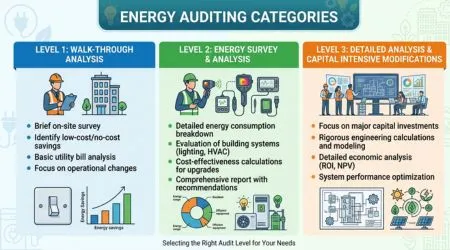
The depth and format expected varies by audit level:
- Preliminary / Walk-Through Audit Report — a shorter document based on a site walk-through and utility bill review. Identifies obvious savings opportunities without detailed metering.
- Detailed / General Audit Report — includes on-site metering, load profiling, and a full energy balance. This is the level most BEE-certified auditors are expected to deliver professionally.
- Investment-Grade Audit Report — the most rigorous level, with engineering-grade cost estimates and financial analysis suitable for capital budgeting or green financing applications.
The 12-section structure below applies most directly to a Detailed Audit Report — the level you'll be trained and examined on in a Certified Energy Auditor Course — but every section has a lighter equivalent in a Preliminary report and a heavier one in an Investment-Grade report.
The 12 Sections Every Energy Audit Report Must Have
Use this as your report skeleton. Every section below should exist in some form — even a Preliminary Audit report should touch on most of them, just in less depth.
| # | Section | What It Covers |
|---|---|---|
| 1 | Cover Page & Document Control | Facility name, audit dates, auditor credentials, version, confidentiality |
| 2 | Executive Summary | Plain-language overview of findings, top measures, total savings potential |
| 3 | Introduction & Objectives | Why the audit was commissioned, scope, audit level, standards referenced |
| 4 | Facility Description | Connected load, contract demand, operating hours, major equipment |
| 5 | Audit Methodology & Scope | Data collection method, instruments used, monitoring duration, exclusions |
| 6 | Energy Consumption Baseline | 12-month bill trend, load profile, specific energy consumption (SEC) |
| 7 | Observations & Findings | Energy balance / loss breakdown, inefficiencies tied to specific equipment |
| 8 | Energy Conservation Measures (ECMs) | Each measure's technical basis, implementation approach, expected savings |
| 9 | Financial Analysis | Investment cost, annual savings, payback period, ROI |
| 10 | Implementation Roadmap | Phased timeline, ownership, monitoring & verification plan |
| 11 | Compliance & Regulatory References | Energy Conservation Act, BEE guidelines, ECBC, ISO 50001 alignment |
| 12 | Conclusion, Recommendations & Appendices | Prioritized recommendations, raw data, nameplate data, photographs |
Cover Page & Document Control
The first page a reader sees. Keep it clean and complete: facility/client name, site address, audit start and end dates, auditor name and BEE certification number (if applicable), report version number, and a confidentiality classification if the client requires one.
- Facility name and address
- Audit period (start – end date)
- Auditor / firm name and credentials
- Report version and issue date
- Confidentiality statement
Executive Summary
This is the only section some decision-makers will read in full, so it has to stand alone. Summarize the audit scope, the top 3–5 findings, the highest-impact ECMs, and the total potential savings — in plain language, with no jargon and no equations. Save the technical depth for the sections that follow.
Introduction & Audit Objectives
State why the audit was commissioned (regulatory requirement, cost reduction, ESG reporting, pre-financing due diligence), what is in scope and out of scope, which audit level this report represents (Preliminary / Detailed / Investment-Grade), and which standards or codes the audit follows.
Facility / Plant Description
Give the reader a mental picture of the facility before you start reporting numbers. Include connected load, contract demand, production capacity or occupancy, operating hours and shift pattern, and a list of the major energy-consuming equipment (HVAC, motors, boilers, lighting, process equipment).
Audit Methodology & Scope
Document how the data was actually collected — walk-through inspection, portable metering, permanent sub-metering review, utility bill analysis — along with the instruments used, the duration of any monitoring period, and any limitations or exclusions. This section protects you: it defines exactly what your findings are and are not based on.
Energy Consumption Baseline
Establish the "before" picture with data, not adjectives. Present the 12-month utility bill trend, the load/demand profile, the specific energy consumption (SEC) benchmark, and a cost breakdown by fuel or utility type.
Observations & Findings
This is where you show your work. Break down where energy is actually being consumed and lost — an energy balance by equipment or process area — and list every inefficiency you observed, each one tied to a specific location or piece of equipment, not stated as a general impression.
Energy Conservation Measures (ECMs)
For each recommended measure, describe the technical basis, the implementation approach, and the expected savings in kWh, kW, and rupees. Group measures into three tiers so the client can prioritize: low-cost/no-cost, medium-investment, and capital-intensive.
Financial Analysis
Every ECM needs a number attached to justify it. At minimum, show implementation cost, expected annual savings, and simple payback period. For larger capital measures, add ROI or IRR so the analysis holds up in a capital budgeting conversation.
Implementation Roadmap / Action Plan
Turn the ECM list into a plan. Phase measures into immediate (0–3 months), short-term (3–12 months), and medium-term (1–3 years) buckets, assign responsible parties where known, and describe how savings will be measured and verified after each measure is implemented.
Compliance & Regulatory References
Cite the frameworks your recommendations align with — the Energy Conservation Act 2001 (as amended), BEE’s Perform, Achieve and Trade (PAT) scheme where applicable, ECBC/Eco-Niwas Samhita for buildings, and ISO 50001 if the facility has or is pursuing an energy management system. This section is what separates a professional report from a generic energy-saving checklist.
Conclusion, Recommendations & Appendices
Close with a prioritized recommendation list and a clear conclusion statement. Then back everything with appendices: raw data sheets, equipment nameplate data, site photographs, calculation worksheets, and calibration certificates for any metering instruments used.
How to Write Each Section — Practical Tips
Getting the sections right is half the job. Writing them so they actually get read and acted on is the other half.
- Shift tone by section. The Executive Summary should be readable by someone with zero technical background. The ECM and Findings sections can — and should — get technical. Save the deepest detail for the appendices.
- Show data, not impressions. Replace "energy consumption seems high" with the actual SEC figure and the benchmark you're comparing it to.
- Use tables and charts over paragraphs wherever you're presenting more than three numbers at once.
- Keep units consistent throughout the report — don't mix kWh and kW, or switch between rupees and lakhs mid-document.
- Cite standards by name, not just "as per norms." A reviewer should be able to verify every regulatory claim you make.
- Tailor every ECM to the facility. A copy-pasted list of generic energy-saving tips is the fastest way to lose credibility with a client or an examiner.
Common Mistakes That Get Reports Rejected or Marked Down
Watch out for these — they're the most common reasons a report gets sent back:
- Missing baseline data — recommending measures without first establishing the "before" energy consumption picture.
- Vague or absent ROI — an ECM with no payback period or savings estimate reads as a guess, not an audit finding.
- No compliance references — recommendations that don't tie back to any standard or regulation.
- Inconsistent units — switching between kWh, kW, and kVA without clarifying which is which.
- Generic, non-tailored recommendations — the same ECM list appearing in every report regardless of facility type.
- No supporting appendix — numbers in the body with no raw data, nameplate readings, or calculation sheets to back them up.
Report Format for the BEE National Certification Exam
If you're preparing for the Bureau of Energy Efficiency's National Certification Examination (NCE), report-writing skill isn't a side topic — it's directly examined. The NCE is structured across four papers:
| Paper | Focus Area | Relevance to Report Writing |
|---|---|---|
| Paper 1 | General Aspects of Energy Management & Energy Audit | Covers audit types, scope definition, and regulatory framework — feeds Sections 3 & 11 |
| Paper 2 | Energy Efficiency in Thermal Utilities | Boilers, furnaces, insulation, waste heat recovery — feeds Section 8 (ECMs) |
| Paper 3 | Energy Efficiency in Electrical Utilities | Motors, HVAC, lighting, battery & storage systems — feeds Section 8 (ECMs) |
| Paper 4 | Energy Performance Assessment (practical, open-book) | Directly tests report structure, calculations, and ECM justification |
Passing Papers 1–3 qualifies you as a Certified Energy Manager; passing all four qualifies you as a Certified Energy Auditor.
Paper 4 is where the 12-section structure above stops being theoretical — it's essentially asking you to produce a mini version of exactly this report, under exam conditions. Auditors who practice the full structure ahead of time consistently perform better here than those who only study the technical content in isolation. For a full walkthrough of the certification path itself, see How to Become a BEE Certified Energy Auditor in India.
Interactive Checklist: Is Your Report Complete?
Tick off each section as you confirm it's in your draft. This mirrors the exact 12-section structure above — if you can check every box, your report is structurally exam-ready and client-ready.
Your report structure is exam-ready. The next step is learning how to fill each section with audit-grade analysis and defensible numbers.
Enroll in the Certified Energy Auditor Course →Illustrative Report Snapshot
Here's what a well-formatted ECM table (Section 8 + 9 combined) looks like in practice. The figures below are illustrative only — built to demonstrate format, not to represent any real facility or client.
| Measure | Investment | Annual Savings | Payback |
|---|---|---|---|
| LED lighting retrofit | [VERIFY / illustrative] | [VERIFY / illustrative] | [VERIFY / illustrative] |
| VFD installation on pump motors | [VERIFY / illustrative] | [VERIFY / illustrative] | [VERIFY / illustrative] |
| Insulation upgrade on steam lines | [VERIFY / illustrative] | [VERIFY / illustrative] | [VERIFY / illustrative] |
Illustrative example for format only. Replace with real audit-derived figures for actual client deliverables.
Career Path: Becoming a Certified Energy Auditor
Knowing the report format is one part of the job. Being able to fill each section with defensible, audit-grade analysis — and pass the BEE certification that lets you sign off on reports professionally — is the rest of it.
Certified Energy Auditor Course
A structured path from audit fundamentals to BEE-exam-ready report writing, covering all four NCE papers with hands-on report-building practice.
Frequently Asked Questions
Related Reading