✓ Comprehensive 2026 Evaluation ⏱ 16 Min Read 📅 Updated for 2026 Cohorts ⚖ Institutional Transparency Disclosure

Indian Institute of Solar Energy Review 2026: Is IISE Worth It?

An Evidence-Based Educational Evaluation of IISE Courses, Practical Training, Fees, Affiliations, and Solar Career Outcomes in India

ℹ First-Party Review & Transparency Statement

Editorial Disclosure: This review is published directly by the Indian Institute of Solar Energy (IISE) in conjunction with the CERMS India Foundation. Rather than hosting biased marketing copy or fabricated third-party star ratings, this document is compiled as an authoritative, evidence-based program prospectus. It openly details verified course curricula, hands-on Personal Contact Programmes (PCP), faculty backgrounds, fee considerations, and institutional limitations to help prospective students and working professionals decide if IISE fits their specific educational goals and career stage.

As India accelerates toward its ambitious national target of 500 GW of non-fossil power capacity by 2030 and rolls out massive decentralized energy initiatives like the PM Surya Ghar Muft Bijli Yojana, the renewable energy sector faces a profound technical skill shortage. Thousands of engineering graduates, polytechnic diploma holders, electrical contractors, and mid-career professionals are evaluating whether specialized solar education can help them enter or advance in this booming market.

Among the specialized training institutions operating in India, the Indian Institute of Solar Energy (IISE) has emerged as a prominent technical institute offering hybrid diplomas, fast-track vocational certificates, and practical installation workshops. But with multiple educational alternatives available—from short online courses to university-led programs—prospective learners frequently ask: Is the Indian Institute of Solar Energy worth the time and financial investment? How effective is its hybrid delivery? Does it provide genuine hands-on plant experience, and what qualifications are awarded?

Quick Verdict: Is IISE the Right Choice for Your Solar Career? - Indian Institute of Solar Energy review

✓ Recommended For

  • Working Engineers: Professionals needing a structured, weekend-compatible hybrid schedule without leaving their current employment.
  • Aspiring Solar EPC Founders: Entrepreneurs looking for end-to-end commercial insight, tendering blueprints, vendor selection, and subsidy compliance.
  • Electrical & Mechanical Diploma Holders: Technical personnel seeking hands-on competency in PVsyst, Helioscope, array sizing, and on-site testing.
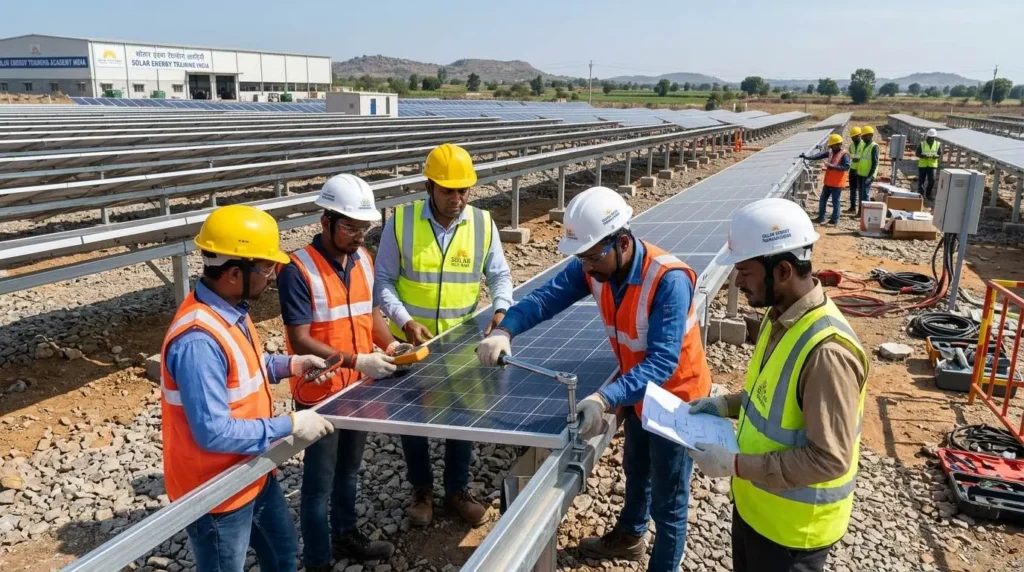
  • Rooftop Installers: Technicians wanting intensive floor training on an active 80kW live training plant near Mumbai.

⚠ When to Consider Alternatives

  • Statutory Master's Degree Seekers: If your objective is a conventional AICTE/UGC M.Tech or PhD requiring gate scores for academic research or university lectureships.
  • Pure Distance Learners Without Travel: If you cannot commit to traveling to Maharashtra for the mandatory 5-day on-site Personal Contact Programmes (PCP).
  • Unrealistic Job Seekers: Anyone expecting an unconditional "100% placement guarantee" with guaranteed executive starting salaries without verifiable interview performance.

Summary Verdict: The Indian Institute of Solar Energy offers one of India's most practically grounded training frameworks for vocational and applied solar engineering. Its distinct strength lies in bridging the gap between theoretical classroom formulas and actual site execution—combining software simulation with physical balance-of-system commissioning. Prospective learners must, however, align their qualification needs: while its B.Voc program is affiliated with UGC-recognized academic partners, its Post Graduate Diplomas are autonomous professional qualifications designed for industry competence rather than statutory university credit transfer.

About the Indian Institute of Solar Energy (IISE)

Founded to address the critical human resource deficit in India’s clean energy transition, the Indian Institute of Solar Energy (IISE) operates as a specialized technical training and educational institute in renewable energy engineering, energy management, and allied green technologies. The institute conducts its educational and professional training initiatives in collaboration with the CERMS India Foundation (Center for Energy Research and Management Studies), an established non-profit foundation focused on clean-tech research and vocational upskilling.

Unlike general academic colleges that treat solar power as a single elective within an electrical engineering syllabus, IISE’s entire curriculum and operational infrastructure are dedicated strictly to the renewable energy ecosystem. Its instructional portfolio spans five core technical verticals:

☀️
Solar PV Engineering

Rooftop, ground-mounted, off-grid, and utility-scale PV system design, sizing, and O&M.

⚡
Electric Vehicle Tech

EV powertrain architecture, charging infrastructure, motor drives, and embedded controls.

🔋
Battery Storage (BESS)

Lithium-ion cell chemistry, battery management systems (BMS), microgrids, and grid storage.

📊
Energy Auditing

BEE certification prep, industrial energy efficiency, thermal analysis, and carbon accounting.

Headquartered in Mumbai, Maharashtra, IISE provides instructional delivery through a hybrid learning ecosystem. Theoretical modules, software simulations (PVsyst, Helioscope, SketchUp Solar), and techno-commercial case studies are delivered through scheduled live virtual masterclasses and an interactive learning management system (LMS). Physical hands-on commissioning, wiring, electrical safety, inverter testing, and plant operations take place during concentrated Personal Contact Programmes (PCP) conducted at installed, grid-connected solar power facilities.

Learn more about the institute’s mission, governance, and institutional background on the official IISE About Us Page.

Who Should Consider IISE Training Programmes?

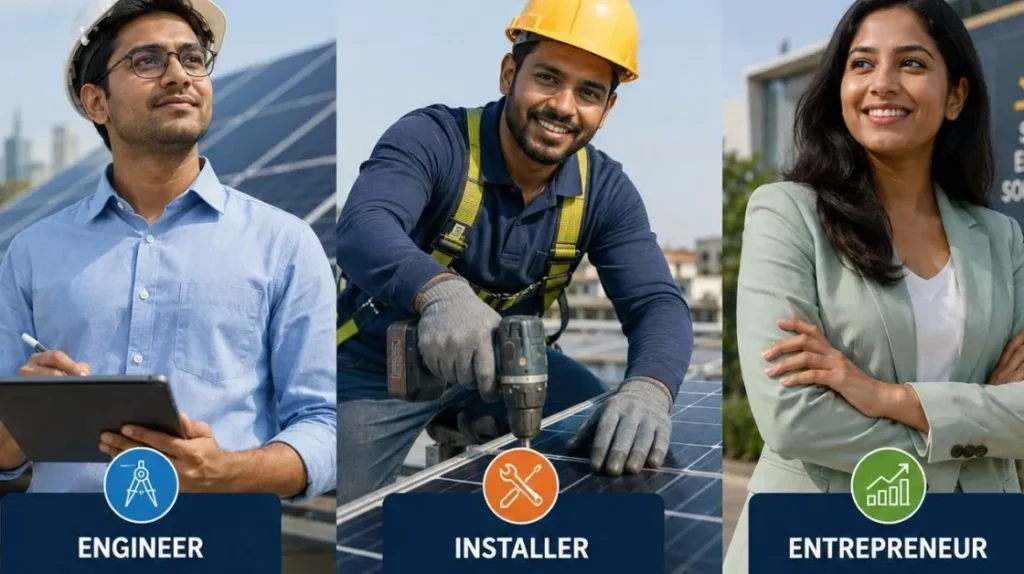
Solar energy is an interdisciplinary field requiring distinct skill sets at different career levels. IISE programs are not “one-size-fits-all” lectures; they are structured to meet the operational demands of five defined learner groups:

1. Engineering Graduates (Electrical, Mechanical, Civil, Electronics)

Recommended: PG Diploma in Solar Technology

The Challenge: Conventional university engineering curricula focus on generalized theory with minimal exposure to industrial PV sizing software, dynamic loss calculations, ALMM compliance, or DISCOM net-metering regulations.

How IISE Helps: Engineers gain rigorous mastery in simulation tools (PVsyst, Helioscope), single-line diagram (SLD) preparation, cable sizing, DC/AC distribution architecture, and utility interconnection standards, enabling direct transition into Solar Design Engineer and Project Engineer roles.

2. Polytechnic Diploma Holders & ITI Technicians

Recommended: Advance Diploma in Solar Tech / Solar Practical Workshop

The Challenge: Field electricians and technicians often perform manual installations without understanding string calculations, I-V curve diagnostics, inverter fault codes, or preventive maintenance SOPs.

How IISE Helps: Hands-on training on IISE's 80kW live training plant covers structural mounting, DC cabling, earthing resistance measurement, lightning arrestor installation, and safety protocols, advancing technicians into Site Supervisor and O&M Specialist positions.

3. Solar Entrepreneurs & EPC Contractors

Recommended: Solar Entrepreneurship Development / Solar Business Management

The Challenge: Launching a rooftop solar EPC firm requires commercial fluency: financial modeling, Levelized Cost of Energy (LCOE), bankability proposals, National Portal subsidy navigation, vendor procurement, and subcontractor quality management.

How IISE Helps: Teaches commercial proposal generation, tender evaluation, MSME credit schemes, and DISCOM liaisoning, empowering founders to quote competitively while safeguarding business gross margins.

4. Working Professionals Transitioning from Oil, Gas & Manufacturing

Recommended: Hybrid PG Diploma in Solar Technology

The Challenge: Mid-career professionals in thermal power, automotive manufacturing, or petrochemicals want to pivot into ESG and renewables without quitting their full-time jobs.

How IISE Helps: The modular weekend schedule combined with concentrated 5-day on-site PCP modules enables professionals to re-skill at senior project management and energy consultancy levels while maintaining their active careers.

5. 10+2 Graduates Seeking a Formal Vocational Degree

Recommended: B.Voc in Solar Technology (3-Year Degree Track)

The Challenge: Higher secondary students looking for an alternative to conventional B.Sc degrees that guarantees technical employability rather than pure academic memorization.

How IISE Helps: Offered in partnership with UGC-recognized academic institutions under the National Skills Qualifications Framework (NSQF), featuring 180 total credits and 200 hours of mandatory on-the-job training (OJT) every semester with multi-exit points (Certificate, Diploma, Full B.Voc Degree).

Courses & Programmes Offered at IISE: Complete 2026 Comparison

To assist prospective applicants in comparing training durations, eligibility criteria, delivery models, and practical components, the table below provides a verified overview of currently active solar training programs at the Indian Institute of Solar Energy:

Program NameDurationFormatEligibilityPractical ComponentCredential AwardedOfficial Link
PG Diploma in Solar Technology1 Year (2 Semesters)HybridB.E. / B.Tech / M.Sc / Equivalent Degree4x 5-Day PCP modules on live solar power plant near MumbaiAutonomous Post Graduate DiplomaView Syllabus →
Advance Diploma in Solar Technology1 Year (1,200 Hrs)Hybrid10+2 / Polytechnic Diploma / ITI / GraduatesComponent testing, small-scale PV kits, on-site O&M labAutonomous Advance DiplomaView Syllabus →
B.Voc in Solar Technology3 Years (6 Semesters)Hybrid10+2 Pass (Science / Maths preferred; others eligible)200 Hrs on-the-job training (OJT) per semester with solar EPCsUGC-Aligned B.Voc Degree (via Partner University)View Syllabus →
Solar Practical Workshop2 WeeksOn-Site LabOpen to all (Engineers, Technicians, Entrepreneurs)90% practical floor time on 80kW live training plantHands-on Technical Workshop CertificateView Syllabus →
Solar Engineer Certificate Course3 MonthsOnline + LabScience / Diploma / Engineering StudentsSoftware simulation projects & system sizing labsProfessional CertificateView Syllabus →
Solar Entrepreneurship Development1 to 3 MonthsHybrid / OnlineAspiring Business Owners, Contractors, ConsultantsReal-world proposal pitching, vendor costing, PM Surya Ghar setupsExecutive Management CertificateView Syllabus →

Important Admissions Advisory: Cohort intakes occur throughout the academic year. Official tuition fees, early-enrollment benefits, and EMI payment options vary by batch size and delivery track. To prevent reliance on outdated promotional fees, applicants must request the official, current fee structure directly through the IISE Official Course Inquiry Form.

Curriculum Architecture & Technical Competencies Covered

A major differentiator of the Indian Institute of Solar Energy is its industry-aligned syllabus. Rather than treating solar energy as high-level environmental theory, the curriculum is mapped directly to the daily technical workflows of engineering, procurement, and construction (EPC) firms, utility plant developers, and operations teams. Below is an overview of the core technical competencies imparted across IISE’s flagship diploma and engineering tracks:

01

Solar Photovoltaic Physics & Solar Geometry

Solar radiation principles, direct vs. diffuse irradiance, global horizontal irradiance (GHI), plane of array (POA), sun-path diagrams, solar azimuth and zenith angle modeling, and solar resource assessment datasets (Meteonorm, NASA, SolarGIS).

02

PV Module Technologies & ALMM Compliance

Comparative evaluation of Monocrystalline PERC, n-type TOPCon, and Heterojunction (HJT) cells. Understanding bifacial rear-gain factors, temperature coefficients, light-induced degradation (LID), PID resistance, and MNRE's Approved List of Models and Manufacturers (ALMM) regulations.

03

Inverters & Balance of System (BoS)

String inverters vs central inverters vs microinverters. Multi-MPPT window matching, DC-to-AC overloading ratios (DC capacity factor), transformer selection, DC combiner boxes (AJB/SCB), surge protection devices (Type I & II SPD), and DC isolation switches.

04

Software Simulation & Yield Modeling

Intensive hands-on simulation using PVsyst and Helioscope. Setting up 3D shading scenes, calculating near and far horizon shade losses, soiling curves, IAM losses, generating Performance Ratio (PR) yield reports, and exportable single-line electrical diagrams.

05

Electrical Earthing & Lightning Protection

Designing maintenance-free chemical earthing systems as per IS 3043. Lightning protection zones according to IEC 62305, step and touch potential analysis, dedicated inverter grounding, structure bonding, and ground fault protection schemes.

06

Testing, Commissioning & Quality Inspection

Pre-commissioning checklist execution, string open-circuit voltage (Voc) and short-circuit current (Isc) verification, insulation resistance testing (Megger), I-V curve tracing, infrared thermography for hotspot detection, and DISCOM synchronization protocols.

07

Battery Storage (BESS) & Microgrids

Lithium iron phosphate (LFP) vs NMC battery chemistries, cell degradation curves, battery management system (BMS) communication architectures, hybrid inverters, DC-coupled vs AC-coupled storage, peak shaving, and islanded microgrid controls.

08

Solar Economics, Tendering & EPC Management

Techno-commercial proposal formulation, Levelized Cost of Electricity (LCOE), Net Present Value (NPV), Internal Rate of Return (IRR), preparation of bills of quantities (BOQ), vendor selection criteria, and navigating the National Portal for PM Surya Ghar subsidy claims.

💡 Academic vs. Practical Competence Note

Prospective learners must recognize the distinction between theoretical familiarity and demonstrated practical competence. While software simulation can be mastered through dedicated home practice on a PC, physical site competency—such as handling high-voltage DC arrays, crimping MC4 connectors under torque specifications, and diagnosing phase imbalances—requires active participation during the mandatory on-site plant sessions.

Learning Format: Virtual Classes & Live Plant Training

To cater to working engineers, consultants, and technicians who cannot take a year-long sabbatical from their careers, the Indian Institute of Solar Energy operates a structured hybrid delivery architecture. This model bifurcates theoretical learning and field training into complementary phases:

💻

Phase 1: Live Interactive Online Masterclasses

  • Scheduled Sessions: Weekly live virtual lectures conducted on weekends and evenings to accommodate working professionals.
  • LMS Cloud Access: 24/7 access to high-definition session recordings, engineering calculation workbooks, and module lecture notes.
  • Software Lab Mentoring: Guided screen-share tutorials where students build real rooftop and ground-mount PVsyst yield models under instructor supervision.
  • Continuous Assessments: Modular quizzes, design assignment submissions, and peer case-study reviews.
⚡

Phase 2: On-Site Personal Contact Programmes (PCP)

  • Immersive Field Modules: Intensive 5-day on-site modules (two modules per semester for the PG Diploma) held near Mumbai, Maharashtra.
  • 80kW Live Training Plant: Students work directly on an operational, grid-connected solar power plant rather than miniature toy demonstration kits.
  • Physical Installation & Wiring: Hands-on mounting structure assembly, module clamping, string wiring, and DC distribution box terminations.
  • Commissioning & Testing: Calibrated multimeter testing, I-V curve tracer operation, clamp-on meter verification, and insulation resistance measurements.

❓ 5 Practical Questions Prospective Students Must Clarify Before Enrolling:

  1. Travel Feasibility: Can my professional schedule accommodate 5 consecutive days of on-site travel to Maharashtra during the designated PCP window?
  2. Hardware Requirements: Does my personal laptop meet the system requirements for PVsyst and AutoCAD Solar simulation?
  3. Attendance Strictness: What percentage of live online attendance is required before being permitted to appear for final assessments?
  4. Batch Flexibility: If an urgent work commitment prevents attendance during a scheduled PCP module, can the practical session be completed with the subsequent cohort without penalty?
  5. Lodging & Local Logistics: Does IISE provide subsidized local hostel/hotel arrangements during the practical workshop days, or must trainees arrange their own accommodations?

Faculty Leadership, Technical Mentors & Industry Experts

The credibility of any professional engineering program rests fundamentally upon the caliber of its instructional team. A key strength of the Indian Institute of Solar Energy is that its courses are taught not by generic academic lecturers, but by practicing clean energy consultants, corporate project directors, and PhD researchers actively working in the solar and EV industries:

DM

Dr. D S Malwad

Solar Expert & Consultant

PhD in Solar Energy. Author of 12+ peer-reviewed research papers in reputed international clean-tech journals. Holds 3 patents in solar product development and specialized PV applications.

SM

Dr. Srinivas M

Associate Professor & Power Electronics

Specialist in inverter power conditioning and grid electronics. Life member of the Indian Physics Association and member of the Editorial Board of the International Journal of Luminescence Applications.

RU

Rajesh Unnikrishnan

Project Director & EV Specialist

IIT Mumbai NCPRE-certified solar trainer. Electrical engineer with an MBA from Bradford University (UK) and over 20 years of leadership experience across India's power and energy infrastructure sectors.

YK

Yogendra Kainthola

Project Head – Solar EPC & Storage

Founder of Battery Life 2 and co-founder of Revive Battery EU and Zyrone Energy Pvt Ltd. Patent holder for an industrial battery regeneration machine, mentoring students in storage commercialization.

AT

Dr. Arpan Tewary

Professor – Solar Energy Research

PhD from the Rajiv Gandhi Institute of Petroleum Technology. Specialist in advanced materials and salt-resistant active electrodes for seawater splitting and electrochemical hydrogen generation.

RA

Rakesh Ambekar

Manager – Solar EPC & Liaison

Over a decade of direct liaisoning experience with state DISCOMs across Maharashtra and Gujarat, guiding trainees through open access, net metering approvals, and electrical inspectorate clearances.

Fees, Return on Investment & Cost Transparency

Evaluating the cost of professional training requires assessing both the direct tuition and the incidental expenses involved in completing practical modules. To maintain complete transparency, below is a realistic breakdown of the investment considerations associated with IISE courses:

Program CategoryIndicative Fee RangeWhat Is IncludedOut-of-Pocket Items to Plan ForPayment Terms
Short Hands-On Workshops (2-Week / Intensive)₹10,000 – ₹20,000*Full access to live plant practical floor, tools, PPE, course handouts, certificateLocal travel and lodging near Mumbai training centerOne-time enrollment fee
Professional Software Certifications (PVsyst / Design)₹8,000 – ₹18,000*Live virtual masterclasses, software exercises, project reviews, certificatePersonal laptop / PC with minimum 8GB RAMOne-time or 2-part split
Advance Diploma in Solar Technology (1-Year)₹35,000 – ₹55,000*Full 1200-hour syllabus, LMS access, lab practicals, placement supportTravel to practical lab sessionsSemester-wise or 0% interest EMI
Post Graduate Diploma in Solar Technology (1-Year)₹50,000 – ₹75,000*Comprehensive 10 modules, 4x 5-day on-site PCPs on 80kW plant, Capstone mentorshipTravel & boarding for 4x PCP trips to MaharashtraFlexible EMI installments via partner NBFCs
B.Voc in Solar Technology (3-Year Degree Track)University Regulated*180 academic credits, 200h OJT/semester, partner university exam feesSemester exam fees & textbook materialsSemester-wise institutional billing

⚠ *Important Fee Schedule Verification Notice

Do not pay based on third-party estimates: Fees listed above represent indicative standard rates and are subject to cohort size, applicable GST, promotional early-bird scholarships, and partner university revision. Prospective learners must request a formally stamped, itemized fee quote with refund policies before making any payment via the Official IISE Inquiry Desk.

Evaluating Return on Investment (ROI): For working engineers and entrepreneurs, ROI in solar education is realized through immediate technical applicability. An aspiring rooftop EPC contractor who learns to properly size string arrays, optimize inverter clipping, and navigate PM Surya Ghar vendor empanelement can recover the entire course tuition from the gross margin of their very first 5kW to 10kW residential installation. Similarly, design engineers proficient in PVsyst can compete directly for specialized EPC design roles that pay 20% to 40% higher starting packages than general maintenance technician jobs.

Certificates, Affiliations & Recognition: What You Must Know

One of the most critical aspects of choosing a technical training institute is understanding the legal nature and recognition status of the qualification awarded upon graduation. To uphold academic integrity and prevent common misconceptions, prospective applicants must understand the following structural distinctions:

1. Autonomous Professional Diplomas & Certificates (IISE / CERMS)

Nature of the Credential: The PG Diploma in Solar Technology, Advance Diploma in Solar Technology, and Solar Practical Workshop Certificate are autonomous professional qualifications awarded directly by the Indian Institute of Solar Energy in association with CERMS India Foundation.

Regulatory Clarity: These are industry-oriented vocational certifications designed for private-sector EPC employment, consulting, and entrepreneurship. They are not statutory university master's degrees (such as an M.Tech or M.Sc approved by AICTE/UGC) and cannot be utilized for pursuing PhD programs or qualifying for government academic lecturing (UGC NET/GATE).

2. B.Voc in Solar Technology (UGC-Aligned Partner University Degree)

Nature of the Credential: The 3-year Bachelor of Vocation (B.Voc) is delivered under the National Skills Qualifications Framework (NSQF) guidelines established by the University Grants Commission (UGC), in formal collaboration with recognized academic partner institutions.

Regulatory Clarity: Unlike autonomous diplomas, the B.Voc is a formal undergraduate university degree that carries statutory validity for competitive public examinations, civil services eligibility, and higher academic postgraduate admissions.

📋 Prospective Student Credential Verification Checklist:

  • ✓ If your goal is private industry employment: Leading solar EPCs, developers (e.g. Adani, Tata Power Solar, ReNew), and module makers prioritize verified software competence (PVsyst), site safety protocols, and actual plant exposure over whether a diploma is AICTE-accredited.
  • ✓ If your goal is starting an EPC business: Clients and DISCOM authorities require MSME registration, electrical contractor licensing (based on your ITI/Diploma/B.E.), and technical bankability knowledge—attributes directly covered in IISE training.
  • ✓ If your goal is government PSU recruitment: PSU engineer recruitment notifications (e.g. NTPC, SECI, BHEL) typically specify a statutory 4-year B.E./B.Tech degree via GATE scores. An autonomous diploma enhances your technical interview performance but cannot substitute for the baseline engineering degree requirement.

Career Opportunities & Realistic Solar Industry Pathways

India’s clean energy transition is not merely an environmental target; it is one of the country’s most powerful economic and employment engines. The government’s target of 500 GW of non-fossil capacity by 2030, coupled with the ₹75,000-crore PM Surya Ghar Muft Bijli Yojana aiming to solarize 10 million households, has generated an urgent requirement for technically trained professionals. Below are the key roles accessible to graduates of specialized solar training:

1. Solar PV Design Engineer

Core Responsibilities: Creating 3D solar array layouts, shadow profiling using Helioscope/SketchUp, calculating near/far horizon shading, running PVsyst simulation reports, and drafting detailed electrical Single Line Diagrams (SLD).

Prerequisites: Engineering degree / diploma + verified PVsyst & AutoCAD proficiency.

2. Solar Project & Site Execution Engineer

Core Responsibilities: Managing on-site rooftop or ground-mount construction, coordinating civil piling and module mounting structure (MMS) erection, string cabling, DC combiner box integration, and contractor quality supervision.

Prerequisites: Electrical / Mechanical / Civil background + structural and BoS knowledge.

3. Quality, Testing & Commissioning Engineer

Core Responsibilities: Pre-commissioning audits, string open-circuit voltage (Voc) verification, insulation resistance (Megger) checks, I-V curve tracing, infrared thermography for hotspot detection, and DISCOM synchronization.

Prerequisites: Electrical testing expertise + hands-on test instrument handling.

4. Operations & Maintenance (O&M) Engineer

Core Responsibilities: Monitoring plant performance via SCADA, analyzing daily generation data and PR curves, scheduling preventive soiling cleanings, diagnosing inverter fault codes, and managing annual maintenance contracts (AMC).

Prerequisites: SCADA familiarity + electrical troubleshooting diagnostic skills.

5. Rooftop Solar EPC Business Owner / Contractor

Core Responsibilities: Client acquisition across residential and C&I sectors, conducting shadow-free roof surveys, generating techno-commercial quotes, securing DISCOM net-metering sanctions, and procuring modules from ALMM-approved vendors.

Prerequisites: Techno-commercial proposal mastery + entrepreneurship training.

⚖ Transparent Placement & Salary Policy

No Unconditional Placement Guarantees: While IISE maintains an active career assistance desk connecting students to renewable energy EPC firms, developers, and inverter manufacturers, completing a course does not guarantee job placement or an automatic salary raise. Starting compensation in India's solar sector ranges widely—typically ₹2.8 LPA to ₹4.5 LPA for entry-level technician/junior design roles, and ₹6.0 LPA to ₹12.0+ LPA for experienced project and design leads—depending on prior engineering credentials, interview performance, and geographic location.

Balanced Evaluation: Key Advantages vs. Limitations of IISE

An objective, evidence-based review must evaluate both institutional strengths and potential trade-offs. Below is a structured two-column comparison based on verifiable program delivery characteristics:

✓ Notable Advantages of IISE

  • Dedicated Renewable Focus: Entire curriculum, faculty, and lab resources are dedicated exclusively to solar, storage, and EV systems—not generic electrical courses.
  • Weekend Hybrid Flexibility: Allows working engineers, technicians, and entrepreneurs to upskill without having to quit their current jobs.
  • 80kW Live Training Facility: On-site Personal Contact Programmes (PCP) take place on an active, grid-connected operating solar plant rather than desktop simulation alone.
  • Industry-Experienced Faculty: Instruction by corporate EPC project directors, patent-holding innovators, and PhD solar researchers (e.g. Dr. Malwad, Rajesh Unnikrishnan).
  • Entrepreneurial Blueprint: Specific emphasis on commercial feasibility, proposal drafting, tender costing, and PM Surya Ghar vendor empanelment.

⚠ Key Considerations & Limitations

  • Mandatory Travel for PCPs: Trainees living outside Maharashtra must budget for travel, lodging, and time off for the mandatory 5-day on-site modules near Mumbai.
  • Autonomous PG Diploma Status: The PG Diploma is an autonomous industry credential, not a statutory university M.Tech degree recognized for PhD or university lecturing.
  • Requires Self-Discipline: Online theory sessions and software projects require consistent personal time management alongside daily work.
  • No Guaranteed Placement: Career support is provided, but securing employment depends on individual merit, interview technical clarity, and market demand.
  • Hardware Needs: Mastery of PVsyst and AutoCAD Solar requires a personal PC/laptop meeting specific graphic and processor requirements.

IISE vs. Alternative Solar Training Pathways in India

To understand whether IISE is the appropriate training vehicle for your individual goals, consider how its hybrid vocational model compares against the four main alternative pathways available to Indian learners:

Evaluation FeatureIISE Hybrid ProgramsPre-Recorded MOOCs (Coursera/edX)Govt ITI / Suryamitra2-Year M.Tech (Renewable Energy)
Instruction FormatLive Online + On-Site Live Plant PCP100% Asynchronous Pre-recordedFull-time In-Person Practical FloorFull-Time Residential Campus
Design Software ProficiencyDeep Hands-on (PVsyst, Helioscope)Surface-level overview / QuizzesMinimal / Focus on wiring toolsAcademic MATLAB / Research code
Practical Site Experience80kW Grid-Tied Live Plant in MumbaiZero physical trainingPhysical workshop trade practiceInstitutional research lab benches
Working Professional FitHigh (Weekend schedule)High (Self-paced)Low (Fixed daily daytime trade hours)Very Low (Requires 2-year sabbatical)
Qualification TypeAutonomous Industry PG Diploma / NSQF B.VocOnline Certificate of CompletionNCVT / SCGJ Vocational CertificateStatutory AICTE/UGC Master's Degree
Primary Career TargetSolar PV Design Engineer, EPC Lead, FounderGeneral Conceptual UnderstandingSolar Wireman, Rooftop Installer TechnicianR&D Specialist, Academic Lecturer, Scientist

Student Trajectories, Alumni Experience & Evidence

To evaluate an educational institute reliably, prospective students should look past polished promotional slogans and examine the consistent qualitative patterns reported by past trainees and alumni working in the renewable energy industry.

Pattern 1: The Design Engineer Pivot

Electrical engineering graduates frequently report that mastering PVsyst simulation, loss tree analysis, and AutoCAD SLD generation gave them the precise technical portfolio needed to pass technical screening rounds at leading solar EPC developers, overcoming the typical "fresher with no experience" barrier.

Pattern 2: The Rooftop EPC Startup

Entrepreneurs who attended the Solar Entrepreneurship Program and Practical Workshop consistently cite the practical floor wiring and PM Surya Ghar National Portal navigation as key accelerators that allowed them to successfully quote and execute their first commercial 10kW to 50kW residential and industrial projects.

Pattern 3: Mid-Career Transitioning

Mid-career professionals in thermal power plants and conventional manufacturing highlight the weekend hybrid schedule and faculty accessibility (particularly direct mentorship on industrial battery storage and microgrids) as the vital link enabling them to transition into sustainable clean-tech consulting.

🔍 How to Independently Verify IISE Alumni & Student Outcomes:

We advise all prospective students to conduct independent due diligence: Search LinkedIn for alumni listing "Indian Institute of Solar Energy" in their education section. Review their current job titles at organizations like Adani, Tata Power Solar, Sterling and Wilson, and independent EPC firms. Reach out directly to 2–3 alumni to ask about their personal learning experience, the rigor of the PCP modules near Mumbai, and how the program helped their career progression.

How to Evaluate IISE Before Enrolling: 10-Point Due-Diligence Checklist

Investing in a professional development program requires careful validation. Before submitting an application or paying tuition fees, work through this practical 10-point checklist with an IISE admissions counsellor:

1
Confirm Exact Credential Title & Awarding Body Clarify whether you are enrolling in an autonomous industry diploma (IISE/CERMS) or a UGC-aligned university vocational degree (B.Voc) to ensure it matches your target employer's expectations.
2
Verify Minimum Eligibility Prerequisites Ensure your educational background (10+2, Polytechnic Diploma, B.E./B.Tech) satisfies the admission criteria for your selected program level.
3
Inspect Current Syllabus & Software Tools Request the latest module breakdown to confirm hands-on coverage of industry-standard tools like PVsyst, Helioscope, and AutoCAD Solar.
4
Confirm On-Site PCP Dates & Location Obtain the projected calendar dates for the 5-day practical sessions near Mumbai and plan necessary travel leave well in advance.
5
Check Personal Computer Hardware Specifications Verify that your personal PC/laptop meets the minimum requirements (Windows OS, Intel i5/i7 or equivalent, 8GB+ RAM) to smoothly execute PVsyst simulation runs.
6
Clarify Live Attendance vs. Recording Viewing Policy Ask how recorded video access is tracked for LMS attendance credit when job obligations prevent live weekend class participation.
7
Request an Official Itemized Fee Quotation Get full clarity on GST applicability, examination charges, study material fees, and installment dates before transferring any enrollment deposit.
8
Review Refund & Batch Deferral Policies in Writing Ensure you have written documentation of rules governing emergency cohort deferrals, medical leave, or fee refund eligibility windows.
9
Understand Career Assistance Scope Confirm what the placement desk provides: resume reviews, portfolio optimization, industry hiring alerts, and interview preparation workshops.
10
Engage with an Academic Counsellor Connect via telephonic consultation or WhatsApp with an IISE program advisor to discuss your individual career goals before committing.

Admission Process: Step-by-Step Application Walkthrough

Admissions for the 2026 academic and professional cohorts operate on a rolling intake schedule across diploma, certificate, and vocational degree tracks. Follow these five verified steps to complete your enrollment:

1

Step 1: Program Exploration & Online Inquiry

Review the available course tracks and submit your preliminary educational profile via the Official Course Inquiry Form. Indicate your technical background and specific training objective (career transition, software specialization, or EPC entrepreneurship).

2

Step 2: Academic & Career Counselling Call

An IISE academic advisor contacts you via telephone or WhatsApp (+91 88509 02306) to discuss your eligibility, recommend the optimal program track, outline upcoming batch dates, and clarify practical PCP schedules near Mumbai.

3

Step 3: Document Verification & Eligibility Check

Submit digital copies of your qualifying credentials (10+2 marksheet, Polytechnic Diploma, B.E./B.Tech degree certificate, and government photo ID) to verify eligibility prerequisites for the selected program level.

4

Step 4: Seat Confirmation & Flexible Fee Payment

Receive your formal admission offer and fee structure. Choose your preferred payment schedule: full advance payment with applicable early-enrollment benefits, semester installments, or flexible 0% interest EMI options through partner financial institutions.

5

Step 5: LMS Onboarding, Batch Orientation & Kick-Off

Obtain your unique credentials for the IISE Learning Management System (LMS), attend the virtual batch orientation with faculty, download required calculation workbooks, and commence your scheduled weekend live lectures.

Frequently Asked Questions (FAQ) About IISE

Direct, evidence-based answers to the most common questions prospective students, working engineers, and clean-tech entrepreneurs ask regarding IISE’s courses, learning format, fees, and career value:

Yes, IISE is well worth considering for working engineers, diploma technicians, and aspiring rooftop solar EPC entrepreneurs who require industry-aligned, practical solar training. Its distinct value lies in its hybrid delivery model—combining online PVsyst and Helioscope software simulation with mandatory 5-day on-site Personal Contact Programmes (PCP) conducted on an operational 80kW solar plant near Mumbai. However, learners requiring a statutory AICTE/UGC academic master’s degree for university lecturing or PhD admissions should explore conventional university programs instead.

IISE offers an extensive suite of renewable energy programs, including the 1-Year Post Graduate Diploma in Solar Technology, 1-Year Advance Diploma in Solar Technology, 3-Year B.Voc in Solar Technology (UGC-aligned degree track), 2-Week Solar Practical Workshop, Solar Engineer Certificate Course, Solar Entrepreneurship Development Program, and specialized software certification masterclasses in PVsyst and Helioscope.

The PG Diploma in Solar Technology is a 1-year intensive program divided into two semesters. It follows a hybrid delivery architecture: theoretical concepts, calculations, and software simulations are conducted via scheduled weekend live online sessions, while practical commissioning and testing are completed during four 5-day on-site Personal Contact Programmes (PCP)—two per semester—at an installed solar power facility near Mumbai.

IISE programs use a hybrid model. Theoretical masterclasses and design software tutorials are held live online with 24/7 access to LMS recordings for working professionals. However, on-site attendance is mandatory for the practical Personal Contact Programmes (PCPs) and the 2-week hands-on installation workshops to ensure trainees gain physical competency on live DC arrays, inverters, and switchgear.

Yes. Practical training is conducted on an operational, grid-connected 80kW solar power plant near Mumbai, Maharashtra. Trainees physically handle module mounting, string cabling, DC combiner box terminations, multimeter and I-V curve testing, insulation resistance checks (Megger), and inverter grid-synchronization procedures.

Fees vary by program: short practical workshops range from ₹10,000 to ₹20,000, specialized software masterclasses from ₹8,000 to ₹18,000, and comprehensive 1-year diplomas from ₹35,000 to ₹75,000. Flexible payment plans and 0% interest EMI options are available through partner financial institutions. Applicants should always obtain the current, itemized fee schedule directly through IISE’s official inquiry form.

Eligibility depends on the track: the PG Diploma requires a Bachelor’s degree in engineering (Electrical, Mechanical, Civil, Electronics) or an M.Sc in Physics/Renewable Energy; the Advance Diploma accepts 10+2, Polytechnic Diploma, or ITI qualified candidates; the B.Voc degree requires 10+2 completion (Science preferred); and the 2-Week Practical Workshop is open to all backgrounds.

Depending on your enrolled program, you receive an autonomous Post Graduate Diploma, Advance Diploma, or Professional Certificate awarded by the Indian Institute of Solar Energy in conjunction with CERMS India Foundation. For the 3-Year B.Voc program, graduates receive a formal vocational Bachelor’s degree conferred by an affiliated UGC-recognized university partner under NSQF guidelines.

No. IISE’s PG Diploma in Solar Technology is an autonomous, industry-focused professional credential designed for private-sector EPC employment and entrepreneurship. It is not an AICTE/UGC approved statutory university degree and cannot be used for government academic lecturing (UGC NET) or applying to doctoral (PhD) research programs.

No. IISE provides active career guidance, portfolio reviews, resume optimization, and direct job alerts from its hiring network of solar EPC developers and inverter manufacturers, but it does not make unconditional ‘100% job placement guarantees.’ Employment depends entirely on individual engineering competence, problem-solving ability, interview performance, and market demand.

Yes. IISE offers specialized non-engineering and entrepreneurship tracks such as the Solar Entrepreneurship Development Program and Solar Business Management. These courses focus on techno-commercial proposal drafting, Levelized Cost of Energy (LCOE), vendor procurement, financing, and navigating the National Portal for PM Surya Ghar rooftop solar subsidies.

You can connect directly with the IISE admissions and counselling team by submitting an application request on the official Course Inquiry Form at indianinstituteofsolarenergy.com/course-inquiry-form-2026-27/, by messaging via WhatsApp at +91 88509 02306, or by calling +91-80 62258 666.

Final Verdict: When is IISE the Right Educational Investment?

In an educational landscape often crowded with purely theoretical online courses or rigid multi-year academic degrees, the Indian Institute of Solar Energy fills a vital pragmatic niche in India’s clean energy ecosystem. Its primary strength is delivering applied technical competency: teaching prospective solar engineers and entrepreneurs how to accurately size PV arrays, model system losses in PVsyst, assemble balance-of-system hardware, verify electrical safety protocols, and execute commercial EPC contracts.

The program is particularly well-suited for working professionals and entrepreneurs who cannot afford to leave their full-time employment, but who recognize that decentralized solar, PM Surya Ghar, and battery energy storage represent immense commercial growth over the next decade. The combination of weekend virtual masterclasses with concentrated 5-day on-site plant modules provides a sensible, high-ROI upskilling framework.

Conversely, learners seeking statutory university master’s degrees for civil service exams, university teaching, or doctoral research should pursue AICTE-approved campus universities. When evaluated with clear, transparent expectations regarding its autonomous credentials and on-site PCP travel requirements, IISE stands as an authoritative, practically grounded gateway into India’s booming renewable energy sector.

Take the Next Step in Your Solar Energy Career

Whether you are an engineer looking to master PVsyst design, a technician seeking live plant certification, or an entrepreneur building a rooftop EPC venture—explore our 2026 course cohorts or consult with an academic advisor today.

Direct Admissions Line: +91 88509 02306  |  Landline: +91-80 62258 666  |  Mumbai, Maharashtra

Author, Reviewer & Editorial Transparency

✍ Prepared by: IISE Technical & Editorial Advisory Board

Compiled by the curriculum development team at the Indian Institute of Solar Energy in conjunction with CERMS India Foundation. The board regularly reviews industry engineering standards, ALMM list updates, and DISCOM net-metering regulations to ensure curriculum relevance.

🔍 Technical Review & Academic Verification

Technical claims, syllabus modules, test instrument protocols, and safety standards reviewed by Dr. D S Malwad (PhD Solar Energy) and Rajesh Unnikrishnan (NCPRE-Certified Trainer, Bradford MBA).


Institutional Integrity Policy: IISE does not engage third-party marketing agencies to manufacture fake student testimonials or generate manipulated review star ratings. This review is maintained as a transparent, authoritative program prospectus designed to help prospective learners evaluate syllabus content, learning formats, fees, and institutional limitations with complete factual accuracy.

References & Authoritative Source Notes

  1. Ministry of New and Renewable Energy (MNRE): National Solar Mission targets and 500 GW non-fossil capacity framework by 2030. mnre.gov.in
  2. PM Surya Ghar Muft Bijli Yojana: Operational guidelines and National Portal for Rooftop Solar vendor empanelement. pmsuryaghar.gov.in
  3. National Institute of Solar Energy (NISE) & Skill Council for Green Jobs (SCGJ): Technical competence frameworks and human resource standards for solar technicians and engineers. sscgj.in
  4. University Grants Commission (UGC): National Skills Qualifications Framework (NSQF) guidelines for Bachelor of Vocation (B.Voc) degree programmes. ugc.gov.in
  5. Central Electricity Authority (CEA): Technical Standards for Connectivity of the Distributed Generation Resources Regulations. cea.nic.in
  6. Indian Institute of Solar Energy & CERMS India Foundation: Official academic prospectus, syllabus repository, and training center facilities. indianinstituteofsolarenergy.com